
How Do You Find the Right Career for Your Skills?


· 10 min read
You find the right career for your skills by converting demonstrable abilities into a shortlist of roles that need them, then testing one direction with a small real project and an objective skills score. The catch is that the document most people use to pick a direction, the resume, barely tracks who actually thrives in a role: its correlation with real performance sits near r = 0.14, whereas measuring the work itself through structured skills assessments lifts that to 0.45-0.6+. So the shortcut is to get scored on ability up front. ZenHire's AI interview runs in roughly four minutes, hands back a verified skill score plus a spoken-English level graded on the A1-to-C2 CEFR scale, and since about 70% of employers now touch AI somewhere in hiring, walking in already proven beats hoping a recruiter decodes your titles.
How do you identify the right career for your skills?
You identify the right career for your skills by inventorying what you can actually do and matching it to the roles that demand it, not by scanning job boards for titles that sound impressive. The mechanism is simple: list your concrete, demonstrable abilities (the tasks you have completed, the tools you have used, the problems you have solved), then look for roles where those exact abilities are the core of the work, not a footnote.
A resume is a poor starting point because it is built around job titles and keywords, and those barely predict where you will succeed. When researchers check how well a plain resume scan forecasts on-the-job performance, the correlation lands around r = 0.14, barely better than guessing at your future field. Measuring the work instead changes the picture: structured and skills assessments reach 0.45-0.6+ predictive validity, which is why a skills-based job match surfaces roles a keyword filter would have hidden from you. Build the inventory once on a candidate profile and the matching runs on ability instead of phrasing.
For a concrete example, take a candidate who spent three years in a call center. The title reads "customer service representative," but the underlying skills are de-escalation under pressure, fast written communication, and pattern recognition across hundreds of cases a week. Those map cleanly onto roles in technical support, claims handling, onboarding, and customer success, none of which they would find by searching their old title. The edge case to watch: a hobby skill you have never used in paid work still counts, but it needs evidence before an employer can weigh it, so plan to demonstrate it rather than just assert it.
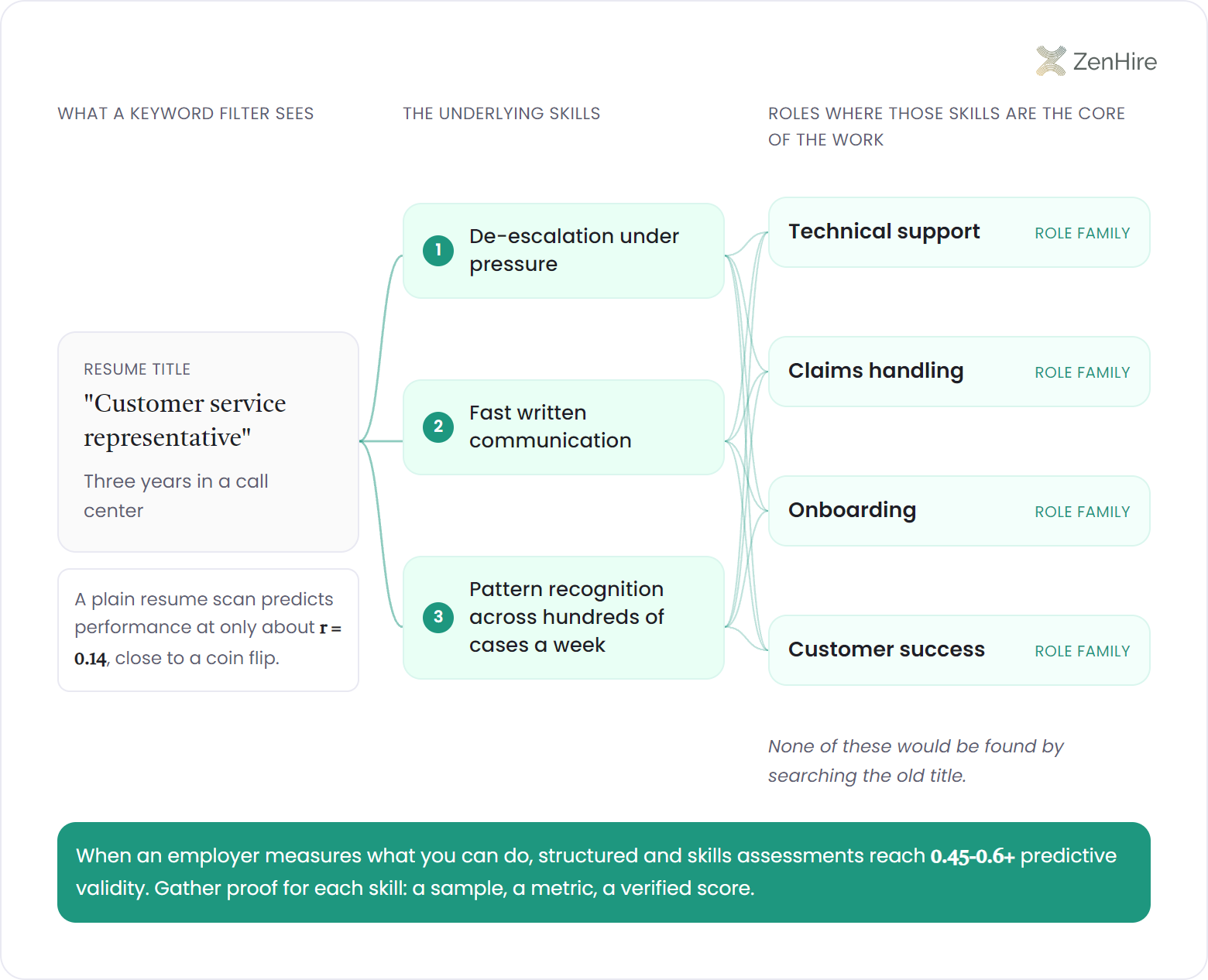
Method beats hope when you are choosing a direction. A resume forecasts performance at only about r = 0.14; measure the actual skills and that jumps to 0.45-0.6+. That gap is the whole reason skills-based screening helps a career-switcher: it rescues capable people a keyword filter would silently reject for carrying the wrong old job title.
- List demonstrable abilities: tasks done, tools used, problems solved, not duties on a JD
- Group them into clusters: communication, analysis, building, coordinating, persuading
- Match clusters to role families: find the verticals where your cluster is the core of the job
- Gather proof for each: a sample, a metric, a verified score an employer can trust
How do interests and skills point to the right career?
Interests and skills point to the right career when they overlap: your interests choose the direction and your verified skills prove you can carry it. Interest without skill is a daydream; skill without interest is a job you will leave. The right career sits where the two meet, and adding what the market pays for turns that overlap into a living. That overlap is the practical version of finding your ikigai career: the intersection of what you love, what you are good at, and what someone will pay you to do.
The mechanism is to treat interests as a filter, not the answer. Start with the directions that energize you, then ask, honestly, which of them you have the underlying skills for or could build quickly. A candidate who loves design but has never shipped anything is not ready for a senior design role, but the same interest plus strong communication and a fast-learning streak points cleanly at design-adjacent work like content, UX research, or free courses that close the gap in weeks. When you want to grow the soft skills that travel across all of these, improving soft skills compounds faster than chasing another credential.
A worked example: someone energized by helping people and strong at clear spoken explanation has an interest-skill overlap that points at teaching, support, training, and account roles. The edge case is the mismatch most people miss: when your strongest skill bores you. A talented spreadsheet analyst who dreads analysis should not optimize for the highest-paying analysis job; the durable move is to pair the marketable skill with a more energizing adjacent role (say, operations or enablement) so the skill funds the direction without becoming the whole day.
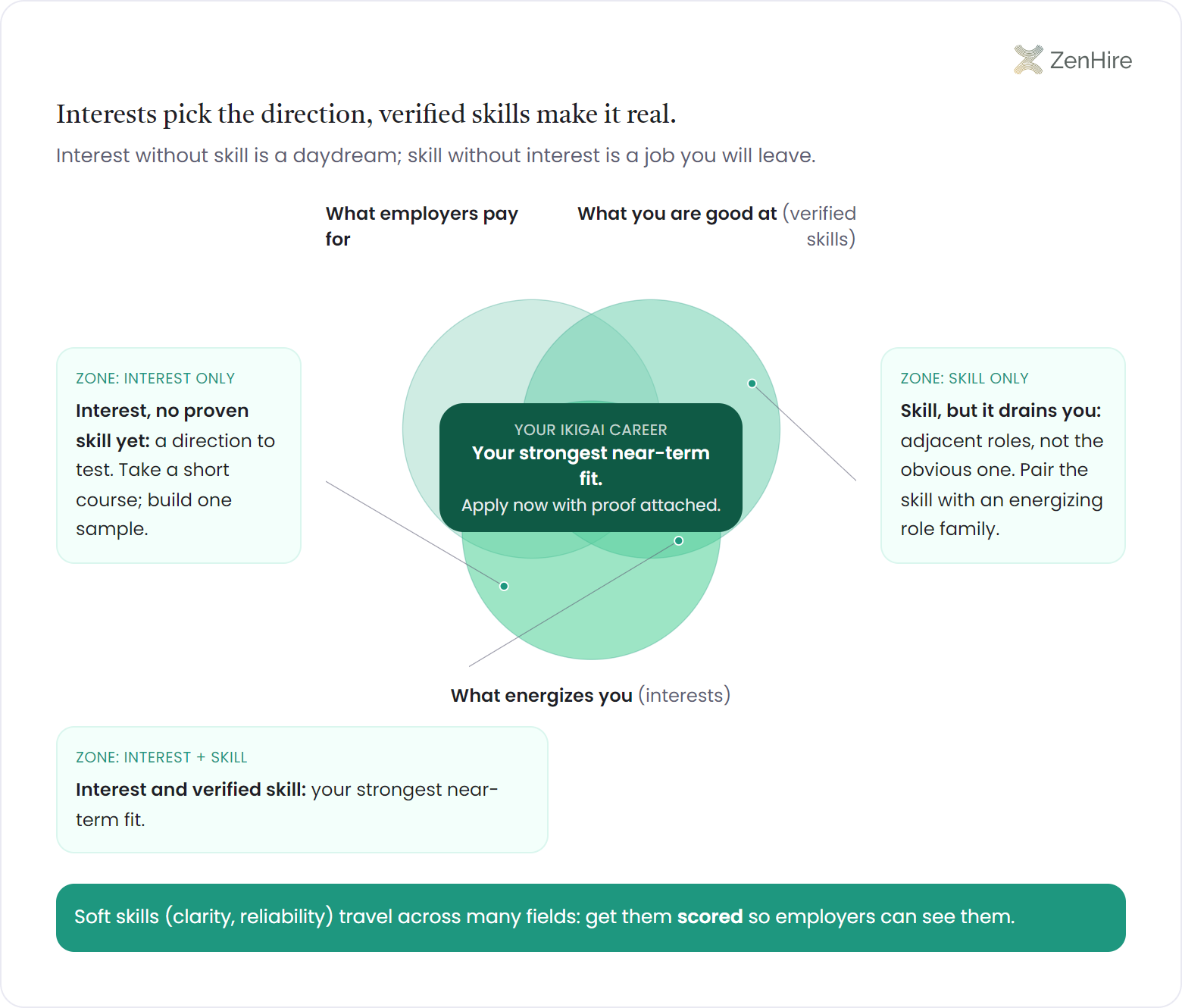
| What you bring | Where it points | Make it count |
|---|---|---|
| Interest, no proven skill yet | A direction to test | Take a short course; build one sample |
| Skill, but it drains you | Adjacent roles, not the obvious one | Pair the skill with an energizing role family |
| Interest and verified skill | Your strongest near-term fit | Apply now with proof attached |
| Soft skills (clarity, reliability) | Roles across many fields | Get them scored so employers can see them |
How do you test a career direction quickly?
You test a career direction quickly by running a small, real version of the work and getting your ability measured, instead of speculating for months. The fastest, cheapest test is a tight loop: do a scoped project that resembles the job, then put your skills in front of an objective evaluation so you learn whether the fit is real before you reorganize your life around it. Speed matters because the cost of a wrong guess is not just time; it is the momentum you lose restarting.
Concretely, the loop has three moves. First, build one small artifact in the direction you are testing: a sample, a volunteer task, a weekend project. Second, take a structured skills check so the result is comparable, not just self-assessed. ZenHire's AI interview fits into a coffee break, about four minutes of async questions, and returns a candidate skill score you can act on; if the direction you are testing involves speaking, the English proficiency assessment places you on the six-band CEFR ladder from A1 up to C2, and rates your accent for clarity alone, never docking you for sounding non-native. Third, read the signal and either lean in or pivot. With roughly 70% of employers now using AI somewhere in hiring, walking into applications already scored means you arrive proven instead of hoping a recruiter reads between the lines of a career change.
Take a candidate weighing a move into support roles: a weekend handling a friend's overflow tickets, plus a skills interview that takes about as long as making tea, tells them in days whether the work energizes them and whether their communication scores hold up, far faster than a six-month role change. The edge case: a low score on a first test is data, not a verdict. If the gap is a teachable skill, a short course closes it; you can also get matched with employers who hire for trajectory and will weight a fast-rising score over a perfect-on-paper resume.
Four minutes of async questions can settle a career question you have circled for months, and because bias-excluded, glass-box scoring keeps sensitive attributes out of the result, what you get back is a clean read on ability you can trust. With roughly 70% of employers now using AI in hiring, arriving already-scored puts you a step ahead of candidates still leaning on a resume alone.
- Build one small artifact in the direction you are testing, because a sample beats a claim
- Get an objective score: a skills check of roughly four minutes turns a career hunch into evidence
- Read the signal fast: lean in if it holds, pivot early if it does not
- Treat a low score as a map: it shows the exact gap a short course can close
When I was on the other side of a resume pile, I watched brilliant people get cut in seconds because a keyword did not line up with a title. That always felt backwards to me. So we built ZenHire to look at what you can actually do, your skills, your soft skills, the way you think under pressure, and to leave your name, age, and background out of the scoring entirely. If you are trying to find the right career, that is the fairer deal: a fast, glass-box read on your ability, where a strong candidate gets a real shot instead of being filtered out for how their last job was worded. You should be judged on what you can do next, not on the phrasing of what you did before.
Frequently asked questions
How do I find the right career if I do not have a degree?+
You find the right career without a degree by leading with proven skills instead of credentials. A resume, degree line and all, forecasts performance at only about r = 0.14, so skills-based screening, which reaches 0.45-0.6+, is exactly what gives a candidate without the usual paper a fair shot. Get your ability measured, attach the proof, and apply where the work matches what you can do.
What is the fastest way to test a career direction?+
The fastest way to test a direction is a small real project plus an objective skills check. Build one sample of the work, then take a structured assessment (ZenHire's is over in the length of a short coffee break, near four minutes) so you learn whether the fit and your scores hold up in days rather than guessing for months.
How do interests fit into choosing a career?+
Interests choose the direction; verified skills prove you can carry it. The right career sits where the two overlap, and adding what the market pays for turns that overlap into a living. Use interest as a filter, then check honestly which directions you have, or can quickly build, the skills for, and once a direction holds, focus on how to get hired faster in it.
Will an AI screen judge me fairly if I do not fit the usual profile?+
A bias-excluded, glass-box screen is built to judge you on ability, not pedigree. Sensitive attributes are kept out of the scoring, accent is rated for clarity only and never penalized, and every score is explainable. That is often a fairer deal than an informal human resume scan, which hides more bias than a transparent, audited one.
Does fit really matter that much for me, the candidate?+
Fit protects you as much as the employer. Roughly half of frontline turnover happens within the first 90 days, and a wrong-fit start costs you momentum and a restart. Testing a direction before you commit means you land somewhere the work actually suits you and you can grow.
Free for finding the right career
The 1-page career-fit worksheet
A simple worksheet to map your skills to role families, line up interests with verified ability, and pick one direction to test this month, with the exact signals employers actually weigh.