
What Should You Do After Losing Your Job?


· 10 min read
After losing your job, you should stabilize first, upskill second, and re-enter on proof: file for benefits the same week, map your runway, then convert the downtime into one verified skill employers can act on. Here is why the last step matters most: the resume that now carries a gap is also the weakest predictor of how you will actually perform, correlating with real job outcomes at just r = 0.14, whereas a verified skills assessment tracks performance three to four times more tightly, in the 0.45-0.6+ range. Around 70% of employers now use AI somewhere in hiring, and bias-excluded scoring keeps a career gap and sensitive attributes out of the result entirely.
What are the first steps after losing your job?
The first steps after losing your job are to stabilize your footing before you start searching: protect your income, map your runway, and secure your professional record. The instinct is to fire off applications the same afternoon, but a panicked search produces panicked applications. An hour spent steadying the basics buys you weeks of calmer, better-aimed effort, and it keeps a hard week from turning into a hard quarter.
Work through the practical list in order. File for any unemployment benefits or severance you are owed the same week, because most programs date your support from when you apply, not from when you lost the role. Map your runway honestly: how many months your savings cover, and where you can trim now rather than later. Save anything you will need from your old work email before access is cut, export your contacts, and request a reference or two while colleagues still remember the project clearly. Only then turn to the search itself, and aim it at roles that genuinely fit your strengths rather than everything that is open, since narrowing to what jobs fit my skills saves you from fifty filter rejections that teach you nothing.
A concrete example: a warehouse coordinator laid off in a site closure files for benefits on day two, lists six months of runway, and pulls three references before her login is disabled, then spends week one mapping which roles reuse her scheduling and inventory skills, not blasting the same resume everywhere. The edge case worth naming: if the loss came with a non-compete, a disputed final paycheck, or unclear severance terms, get those questions answered before you sign anything or start a competing role, because a rushed signature is far harder to undo than a slow one.
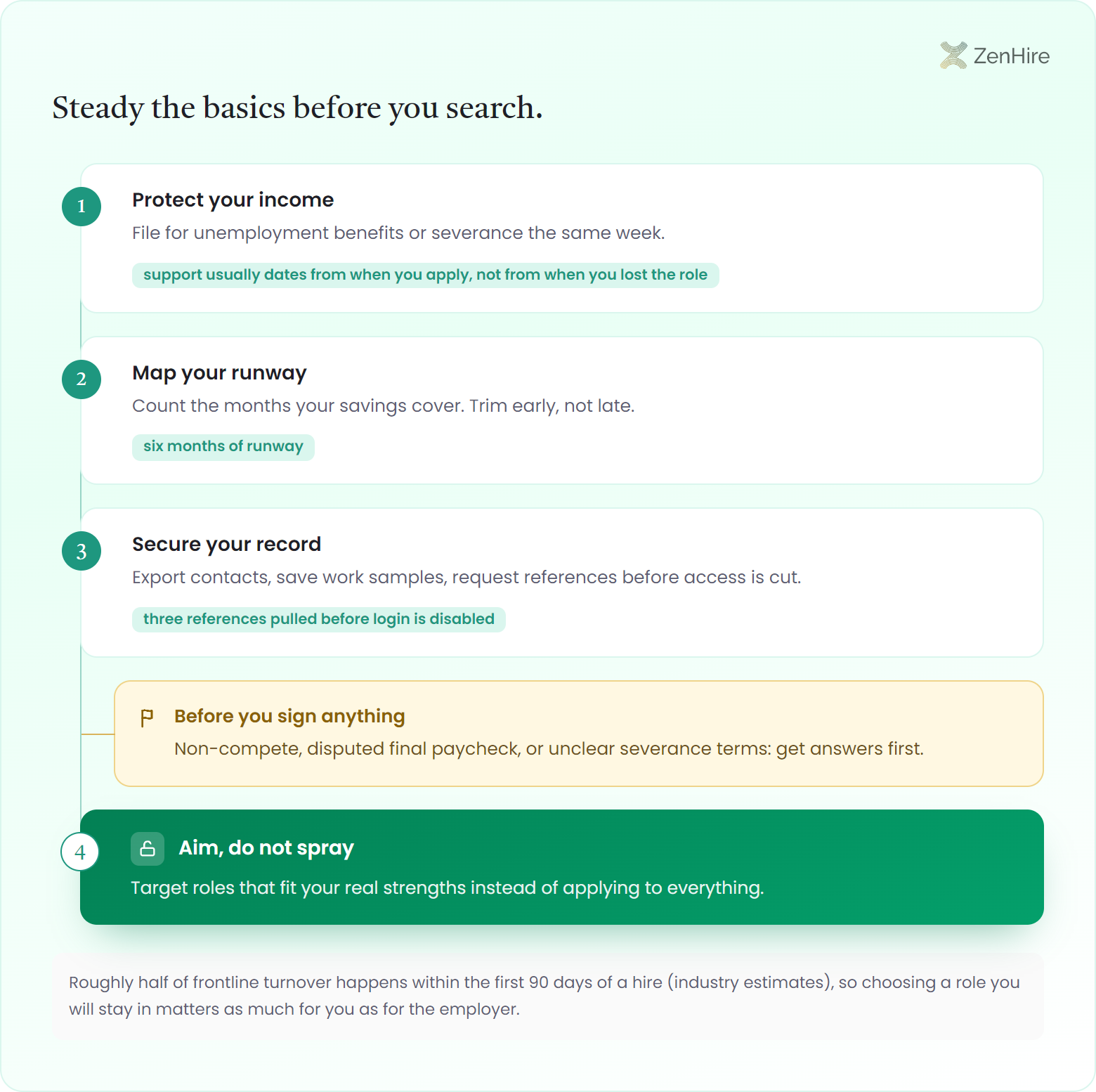
Roughly half of [frontline turnover](/turnover) happens within the first 90 days of a hire (industry estimates), which means fit matters as much for you as for the employer. Steadying the basics first lets you choose a role you will actually stay in, instead of grabbing the first offer and risking another short, costly stint.
- Protect your income: file for benefits or severance the same week, since support usually dates from when you apply
- Map your runway: count the months your savings cover and trim early, not late
- Secure your record: export contacts, save work samples, and request references before access is cut
- Aim, do not spray: target roles that fit your real strengths instead of applying to everything
How do you turn downtime after losing your job into upskilling?
You turn downtime after losing your job into upskilling by treating the gap as a focused build window: pick one or two skills that open the most doors, learn them cheaply, and finish with a result you can show. Unstructured time is the trap; a layoff can drift into months of low-grade application anxiety. The reframe is to spend the first weeks producing evidence instead of consuming worry, because evidence is what gets you back to work.
The mechanism is simple: employers cannot see effort, only proof, so the goal of any course is a verifiable outcome: a score, a certificate, a portfolio piece, a measured skill. Start from demand, not interest: look at the roles you actually want, list the skills they keep asking for, and learn those first. Many of the highest-leverage options cost nothing; our roundup of free courses to get a job is built exactly for this window. Pair the hard skill with the soft ones that every employer screens for, because communicating clearly under pressure is itself a teachable, measurable skill; see how to improve your soft skills. This matters more than it used to: around 70% of employers now use AI somewhere in hiring, and those systems reward demonstrated, structured skill over a polished narrative.
A concrete example: a retail supervisor uses a six-week gap to complete a free spreadsheet-and-inventory course and a short customer-communication module, then converts both into a measured result on a candidate skill score, so when she applies, the skill is already verified rather than merely claimed. The edge case: do not collect ten half-finished courses. One completed, verified skill outperforms a wall of started-but-abandoned certificates, because a hiring system can act on the finished one and has to discard the rest. If your time or money is tight, finish one thing well rather than dabbling in five.
| How you spend the downtime | What an employer can actually do with it |
|---|---|
| Worry and refresh job boards | Nothing. There is no signal to act on |
| Start ten courses, finish none | Little, since unfinished work is not verifiable |
| Finish one course with a verified result | Surface you for matching roles, since the skill is proven |
| Add a measured soft-skills result | Score the communication signal AI screens weight most |
How do you re-enter the market stronger after losing your job?
You re-enter the market stronger after losing your job by leading with proven skills instead of a gap-explaining narrative, building a verified profile that lets employers judge what you can do, not where you have been. The old playbook was to bury the gap in resume wording and hope a recruiter read past it. The stronger play is to make the gap irrelevant: when your skills are measured and verified, the dates matter far less than the demonstrated ability.
Here is why this works in your favor. The very document a layoff scars, your resume, is also the shakiest evidence of what you can do: screened on its own it lines up with actual on-the-job performance at only about r = 0.14, barely above a coin flip, which is exactly why keyword filtering punishes a career gap that has nothing to do with your ability. Run the same person through a structured, skills-based assessment and the signal tightens to roughly 0.45-0.6 or higher, so an employer can trust the score enough to act on it fast. A fair system shows its work and strips out what should not count: sensitive attributes never touch the score, and if the role needs spoken language, your clarity is graded on the CEFR band from A1 through C2 without a non-native accent costing you a point. Build your candidate profile around that verified evidence, then let it work for you by getting matched with employers whose open roles fit your proven strengths.
A concrete example: instead of applying cold to twenty companies and re-explaining the layoff in each cover letter, you record one verified assessment and a short async AI interview, roughly four minutes on your own schedule and no recruiter to read past the gap, and then employers with matching roles come to you, so the conversation opens on your skills rather than your last exit. The edge case worth knowing: re-entering stronger does not mean hiding the layoff. If it comes up, name it plainly and pivot to what you built during the gap; a verified new skill is a far better answer than a defensive one, and it turns the hardest interview question into your strongest moment.
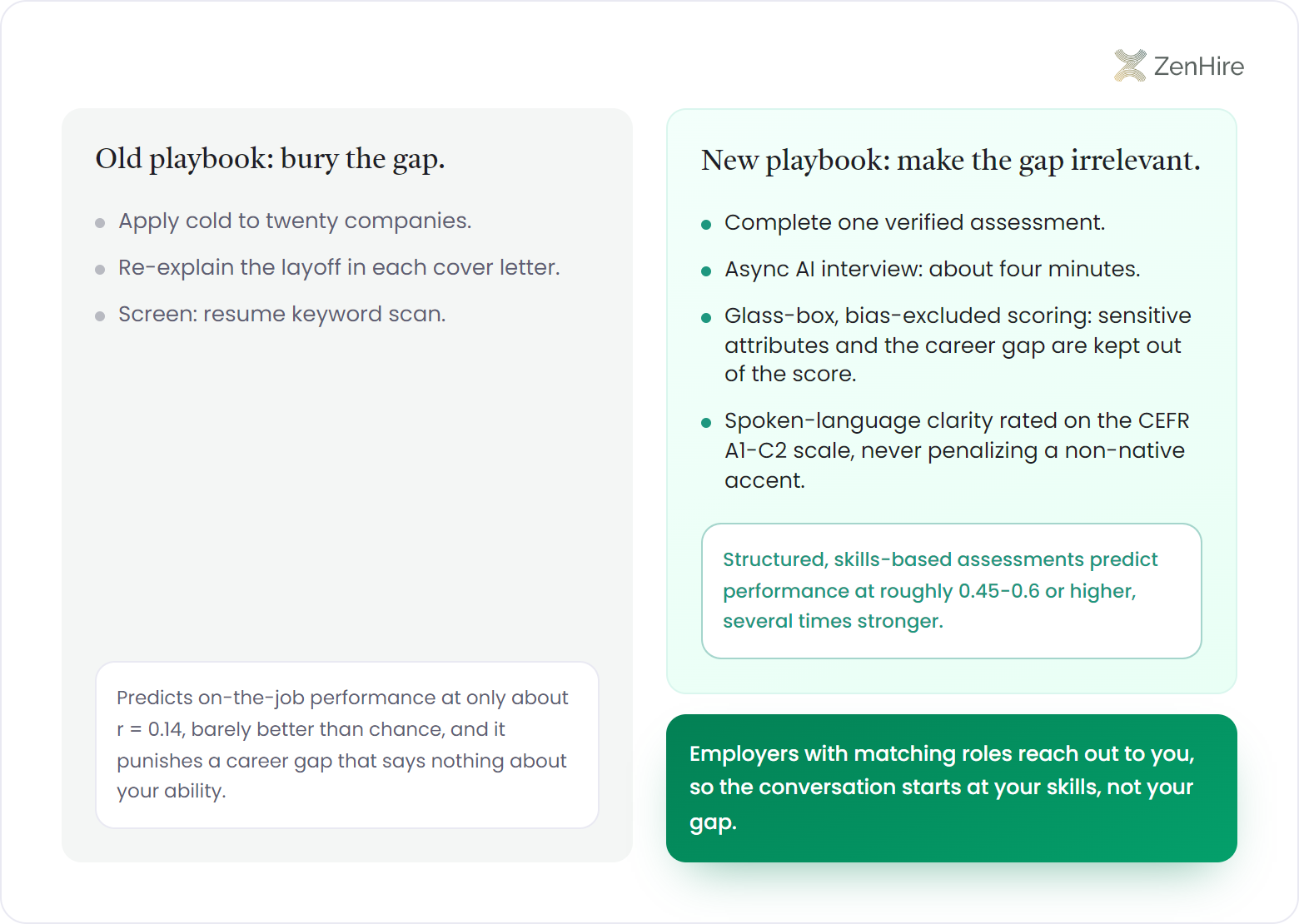
How you are measured beats how you word it. Screened alone, the resume now marked by your gap tracks real performance at about r = 0.14; a structured skills assessment of the same person tracks it at 0.45-0.6+, several times tighter. Because a bias-excluded, glass-box score never sees the dates or the sensitive details, you are judged on what you can do, not on the shape of the timeline you arrived with.
- Lead with proof: a verified skill outranks a polished gap explanation
- Let the match come to you: one verified profile gets surfaced for many fitting roles
- Know the screen is on your side: bias-excluded scoring keeps the gap out of the result
- Name the gap, then pivot: point to the new skill you built, not a defensive excuse
I have watched genuinely capable people lose a job for reasons that had nothing to do with them (a budget cut, a reorg, a site that closed) and then carry that gap into every interview like it was a verdict. It is not. What always felt backwards to me is that a resume scan punishes that gap hardest, when the gap says the least about whether you can do the work. So we built ZenHire to judge what you can actually do: your skills, how you communicate, your real ability, with the things that should never matter, such as where you are from, how your name sounds, or a stretch of time between jobs, kept out of the score entirely. If you used your downtime to get better, you deserve a fast, fair shot at proving it. That is the whole point.
Frequently asked questions
What is the very first thing to do after losing your job?+
The very first thing to do after losing your job is to protect your income before you start applying. File for any unemployment benefits or severance the same week, because support usually dates from when you apply, not from when you lost the role. Then map your runway and secure your contacts and references before access is cut, and a steady footing makes every later step calmer and better aimed.
How long should I wait before job searching after a layoff?+
You should steady the basics first, but you do not need a long pause before searching. Take the day or two needed to file for benefits, map your runway, and save your records, then begin aiming your search at roles that fit your real strengths. Spraying applications the same afternoon usually backfires; a focused start within the first week beats a frantic one on day one.
Will a gap on my resume from being laid off hurt my chances?+
A career gap hurts you most under an old-style resume scan, which is exactly the screen you can route around. Read on its own, a resume forecasts real performance at only about r = 0.14, so the scan punishes a gap that says almost nothing about your ability. A skills-based, bias-excluded evaluation keeps the gap out of the score and judges what you can actually do, giving you a fairer shot than keyword filtering.
How do I make the most of the downtime after losing my job?+
You make the most of the downtime by producing proof, not consuming worry. Pick one or two skills the roles you want keep asking for, learn them cheaply through free courses, and finish with a verifiable result: a score, certificate, or measured skill. One completed, verified skill outperforms ten half-finished courses, because a hiring system can act on the finished one.
How do I bounce back stronger after a layoff?+
You bounce back stronger by re-entering on proven skills instead of a gap-explaining narrative. Build a verified profile so employers judge what you can do, then let matching roles come to you. A structured assessment tracks performance in the 0.45-0.6+ range against just 0.14 for the resume that now shows your gap, so a verified score gets acted on quickly, and naming the gap and then pointing to a skill you built becomes your strongest answer, not your weakest.
Free for bouncing back after a layoff
Restart on proven skills: build your candidate profile
Create a verified profile that scores you on real skills and soft skills, not pedigree or a gap, then gets you surfaced to employers with roles that fit. Prove it once, get matched many times.