


Surface previously unexplored talent.
DOCX
JPG
Extract key data with 97% accuracy, regardless of format.


Apply intelligent cut-offs based on customizable criteria. Flag candidates for:

Job Hopping
Employment Gaps
Grammar / Spelling Errors
Customize hiring to your goals, prioritize job-specific skills, experience and education. Include only what matters to you.

AI resume screening software reads every CV for demonstrated competency, not keyword bingo, so the strong candidate who never wrote the exact phrase still ranks. CVDeepMatch extracts 97% of CV data and aligns 93%-plus with human screeners, then surfaces the people your filters would have buried.
It reads each resume for evidence of real work, then scores how that evidence maps to the role rather than counting term matches. A keyword filter rewards the candidate who pasted the right words; semantic matching rewards the candidate who actually did the job.
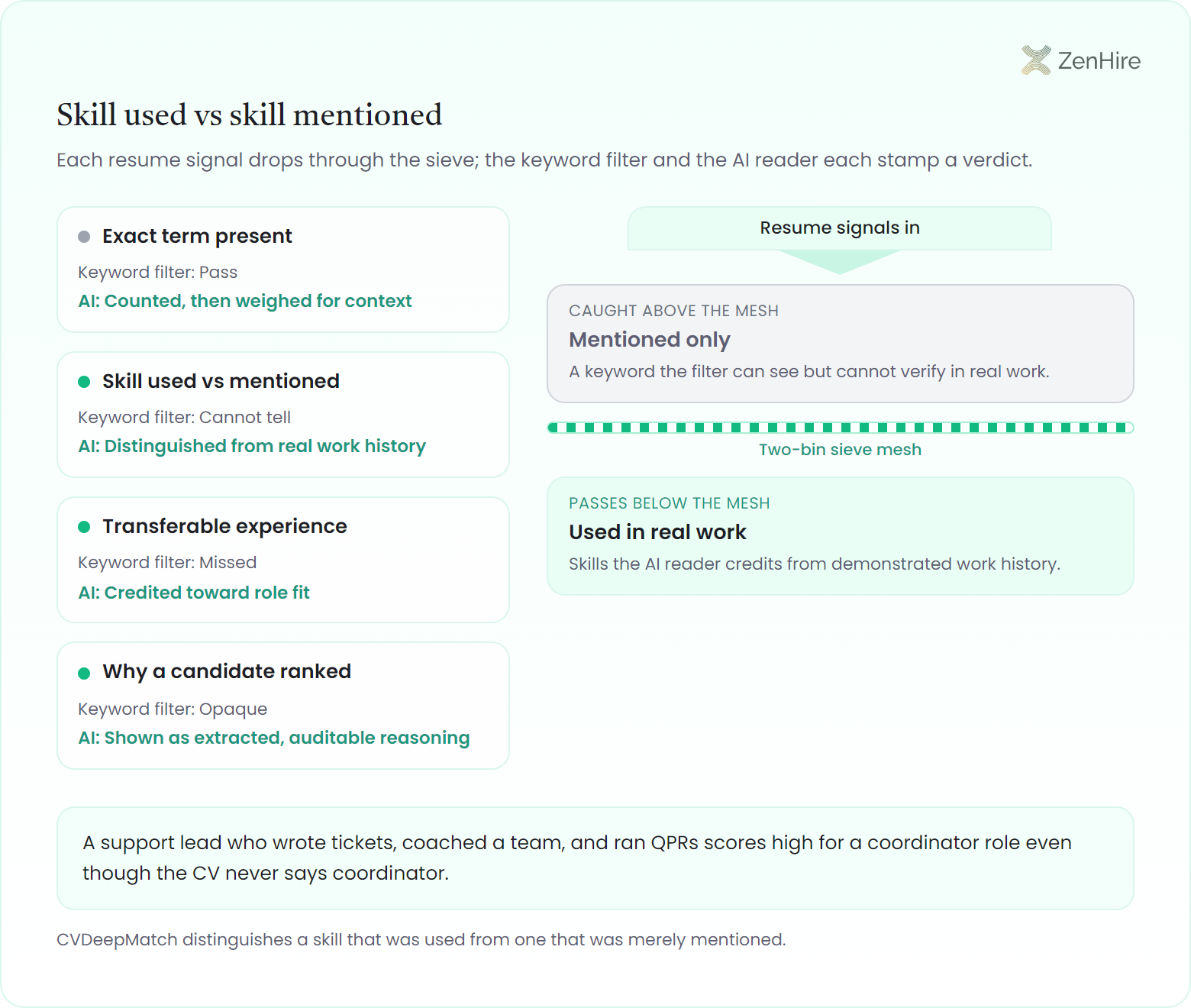
CVDeepMatch distinguishes a skill that was used from one that was merely mentioned, and it credits transferable experience a literal filter ignores. Concrete example: a support lead who wrote tickets, coached a team, and ran QPRs scores high for a coordinator role even though the CV never says coordinator. Edge case: a thin, sparsely worded resume gives the model little signal, so pair the score with an ai interview or assessment before you reject a borderline candidate.
Some argue that any automated scorer just rebrands keyword matching with extra steps. That breaks down on inspection: the match score is built from extracted experience, qualifications, and skill usage, each visible in the candidate profile, so you can see why a non-obvious applicant ranked above an obvious one rather than trusting a hidden term count. The same engine powers ZenHire candidate matching across every open role.
The problem starts before any AI: eyeballing a raw CV correlates with later job performance at roughly r = 0.14, barely better than a coin toss. When CVDeepMatch reads that same resume for demonstrated competency and you stack an interview and a work-sample assessment on top, the combined signal climbs past 0.6 more than four times the predictive weight of the keyword scan it replaces.
| Signal | Keyword filter | AI resume screening |
|---|---|---|
| Exact term present | Pass | Counted, then weighed for context |
| Skill used vs mentioned | Cannot tell | Distinguished from real work history |
| Transferable experience | Missed | Credited toward role fit |
| Why a candidate ranked | Opaque | Shown as extracted, auditable reasoning |
Yes, when the model scores demonstrated competency, excludes sensitive attributes by design, and logs every decision so a human can audit it. The risk in hiring is not the model; it is the undocumented gut call that hides bias no one can review.
CVDeepMatch uses a glass-box, explainable approach: each score traces back to extracted skills and experience, sensitive demographic factors are architecturally excluded, and the platform runs on a SOC 2 Type II and GDPR posture. Concrete example: two applicants with the same demonstrated skills land at the same score regardless of school name or address. Edge case: bias in your historical data can still enter through the job description and weightings, so review the criteria you set, not just the output the model returns. Teams that need this rigor for compliance lean on our ethical hiring approach end to end.
Skeptics point to public cases where AI hiring tools entrenched bias, and that caution is fair. The difference is transparency. An explainable scorecard with an audit log and excluded attributes can be inspected, corrected, and defended in a way an informal manual screen never can, which lowers exposure rather than raising it.
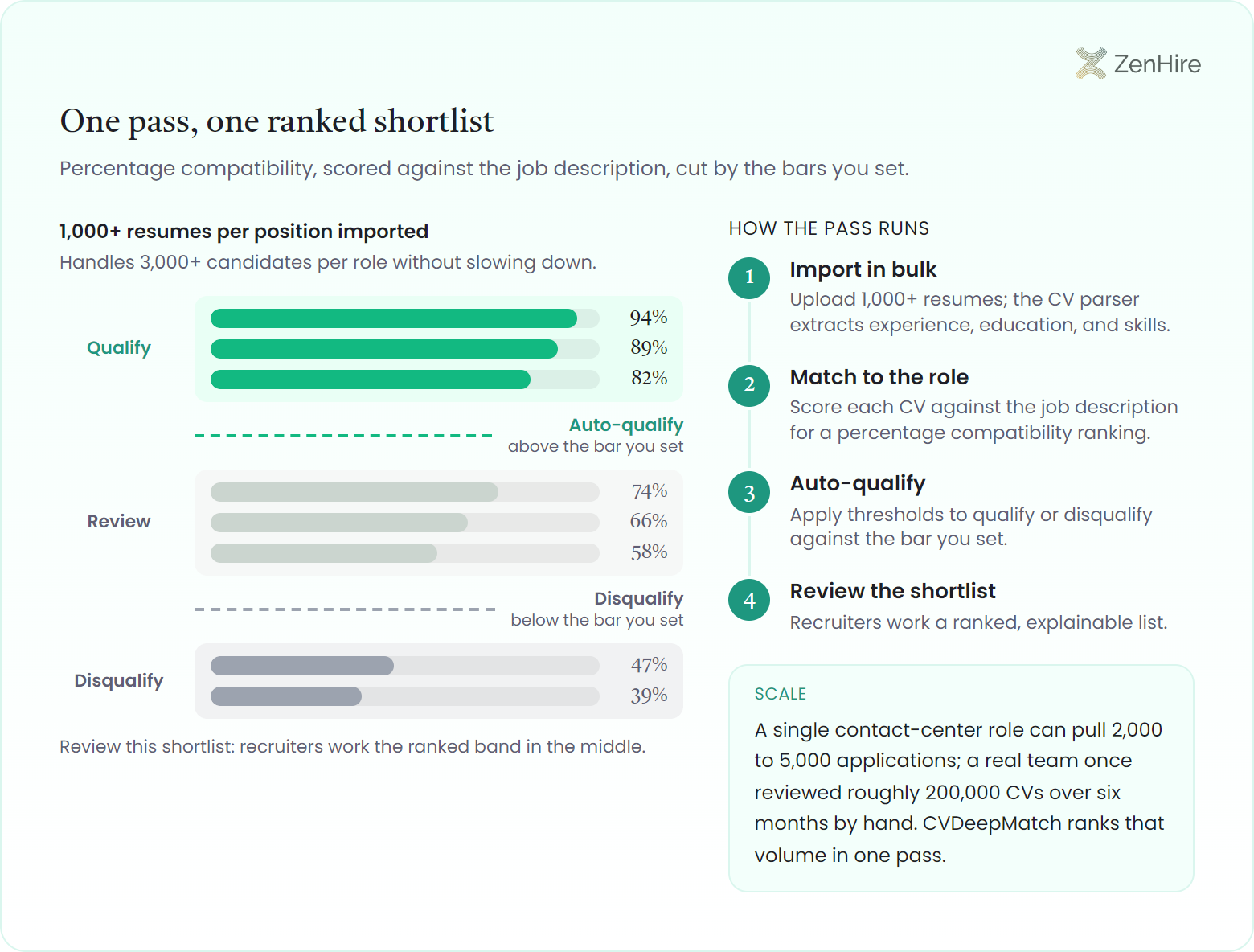
It ranks a bulk import of 1,000-plus resumes against a job description in a single pass, so a stack that took days of manual reading becomes a shortlist you act on the same session. The system parses, scores, and orders every applicant without a recruiter touching each one.
CVDeepMatch handles positions with 3,000-plus candidates without slowing down, auto-qualifies or disqualifies against thresholds you set, and pushes the ranked list straight into review. Concrete example: a high-volume role that pulls thousands of applications returns a scored, ordered list instead of an inbox no one can finish, the exact pattern behind bpo high-volume hiring campaigns. Edge case: screening speed does not fix a thin top of funnel; if too few qualified people apply, the tool ranks fast but you still need sourcing and referrals to fill the pipeline. To skip parsing entirely, the same extraction runs through the resume parsing api.
A single contact-center role can pull 2,000 to 5,000 applications, and a real team once reviewed roughly 200,000 CVs over six months by hand. CVDeepMatch ranks that volume in one pass, so a recruiter opens a scored shortlist instead of an inbox no one can finish.
1. Import in bulk
Upload 1,000-plus resumes per position; the CV parser extracts experience, education, and skills automatically.
2. Match to the role
CVDeepMatch scores each CV against the job description for a percentage compatibility ranking.
3. Auto-qualify
Apply thresholds to qualify or disqualify candidates against the bar you set.
4. Review the shortlist
Recruiters work a ranked, explainable list instead of reading every application by hand.
AI resume screening software is a tool that reads each CV, scores it against a job description, and ranks candidates by demonstrated fit. CVDeepMatch extracts 97% of CV data and produces a percentage match score from real skills and experience, not keyword counts.
CV matching software differs from keyword search by judging whether a skill was used in real work rather than merely present in the text. CVDeepMatch credits transferable experience and aligns 93%-plus with human screeners, so strong non-obvious candidates rank instead of being filtered out.
An automated CV screening tool reduces hiring bias when it scores demonstrated competency, excludes sensitive attributes, and logs every decision. CVDeepMatch uses an explainable, glass-box model on a SOC 2 Type II and GDPR posture, so each ranking is auditable rather than a hidden gut call.
AI resume screening handles bulk volume at once, ranking 1,000-plus imported resumes per position and supporting 3,000-plus candidates per role without slowing down. It turns a multi-day manual review into a same-session ranked shortlist with auto-qualify thresholds you control.
AI resume screening is built to surface good candidates with imperfect resumes by reading for transferable skills and demonstrated work, not exact phrasing. For a thin or sparsely written CV, pair the match score with an AI interview or skills assessment before making a final call.
Free for AI resume screening evaluation
A one-page reference for evaluating any CV-matching tool: what 97% extraction and 93%-plus human alignment actually measure, how used-vs-mentioned skill detection works, and the auto-qualify thresholds to set before you trust a shortlist.


Reimagine hiring with ZenHire: AI-powered, ethical, and built for a faster, fairer future.
Book a demo