
Call center hiring software screens thousands of agent applicants per role, scores spoken English on the CEFR scale (A1-C2) in about four minutes, and runs an AI interview on every candidate, so your team works a ranked shortlist instead of an inbox. It is purpose-built for high-volume hiring where a wide funnel breaks manual screening.
Volume and the voice. A single agent role can pull thousands of applications, and every hire has to prove spoken English under live-call pressure that a resume never shows. Office hiring optimizes for one good fit; high-volume agent recruitment optimizes for hundreds of fast, consistent, defensible decisions.
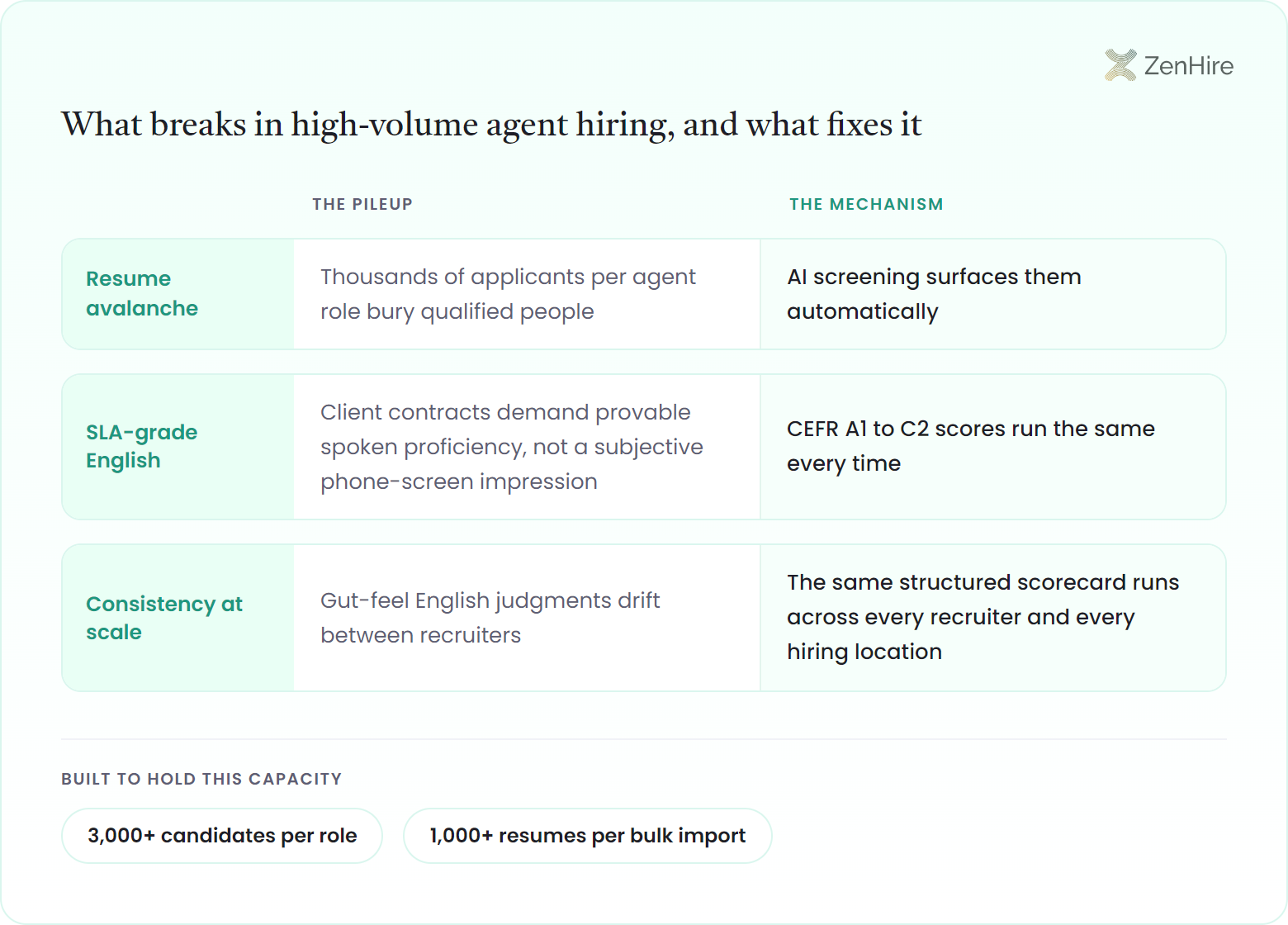
Some argue it is the same funnel, just bigger. It is not. At 3,000-plus applicants per role, manual phone screens stop scaling and gut-feel English judgments drift between recruiters, so quality and SLA proof collapse exactly when client launches depend on them. Call center hiring software fixes that by AI-interviewing every applicant and scoring English the same way every time, then ranking the pool automatically with ai cv matching for high-volume hiring doing the first-pass triage.
Concrete example: a campaign standing up 200 agents in 60 days gets a structured CEFR score and competency scorecard on each candidate, so recruiters review a shortlist, not a flood. The edge case worth flagging: for a tiny, senior, non-phone role the volume math reverses, and a manual process is fine; this engine earns its keep when the funnel is wide.
One de-identified team manually reviewed roughly 200,000 CVs over six months before automating the first pass. At 3,000+ candidates per role and 1,000+ resumes per bulk import, that is the scale where gut-feel screening quietly breaks.
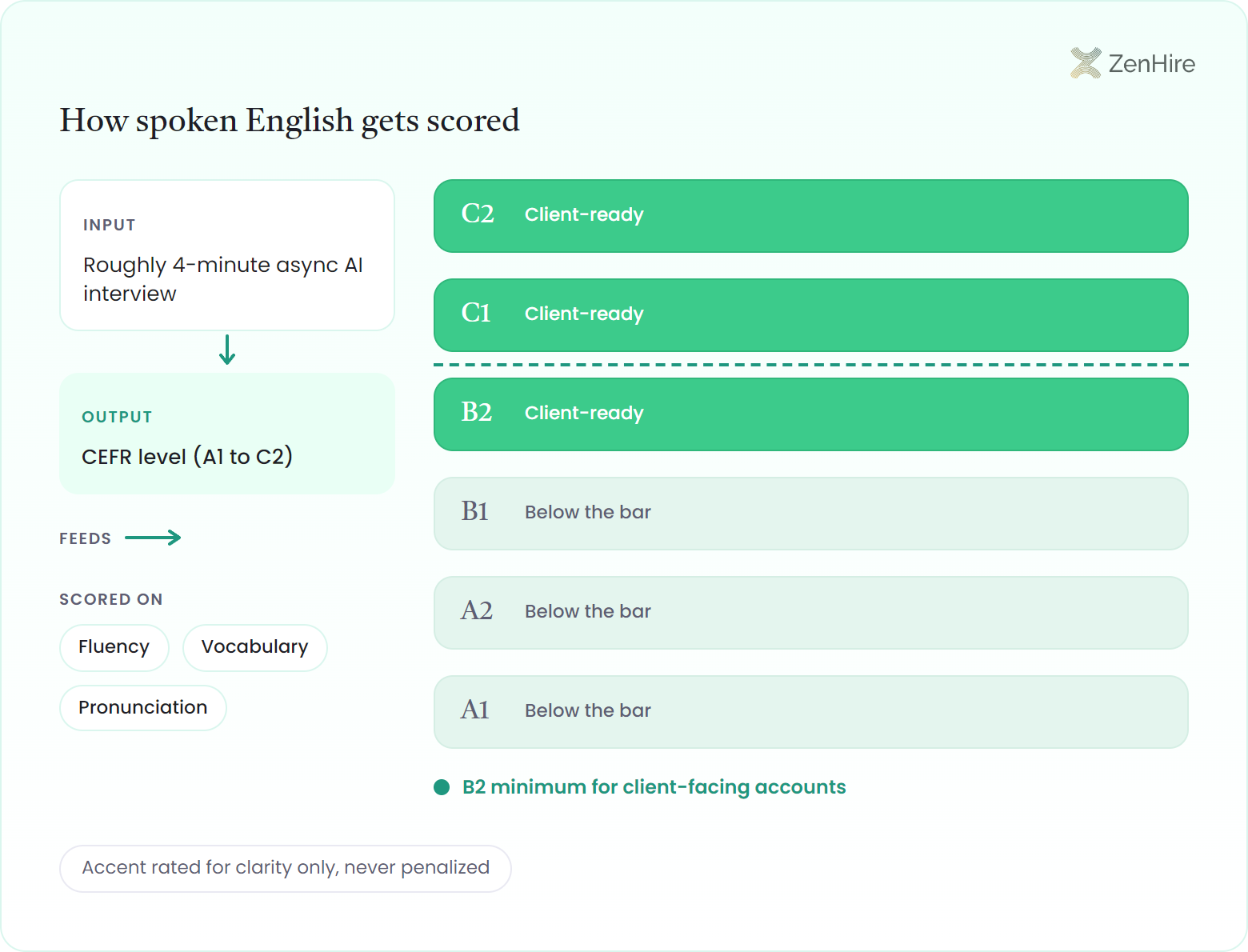
You let the AI assess spoken English on the CEFR scale from a short recording, then set a per-role bar. Each candidate completes a roughly four-minute interview; the system returns a CEFR level (A1 to C2) plus dimensional scores for fluency, vocabulary, and pronunciation, and you require, say, a B2 minimum for client-facing accounts. The same scoring runs through the cefr english scoring api if you want it embedded in your own flow.
The mechanism matters for fairness and defensibility. Scoring is glass-box and explainable, sensitive attributes are excluded from the model by design, and accent is rated only for clarity, never penalized for being non-native, the kind of bias-reducing screening a client audit expects. That gives you documentation you can show in a client vendor audit, not a recruiter's hunch. Published alignment with expert PhD linguists runs 90-96 percent, versus 68-75 percent for untrained reviewers.
One edge case: heavy background noise or a two-speaker line can muddy a raw recording, so the engine isolates candidate-only audio and diarizes speakers before scoring. For a noisy at-home applicant pool, that is the difference between a usable score and a thrown-out interview.
Across five PhD linguists as ground truth, language scoring aligned 90-96 percent with expert evaluations while untrained recruiters landed at just 68-75 percent. CV field extraction clears 97 percent accuracy on the same pipeline.
| Stage | Manual phone screen | Call center hiring software |
|---|---|---|
| English check | Subjective, recruiter-by-recruiter | CEFR A1-C2, scored the same every time |
| Time per candidate | 25-30 minutes live | ~4-minute async AI interview |
| Coverage | A sampled few | Every applicant in the pool |
| Documentation | Notes, if any | Explainable score for client audits |
Yes, by screening for fit before the offer rather than discovering it after. Contact-center attrition commonly runs 30-45 percent (third-party industry research), and replacing one frontline agent costs roughly 5,000 to 20,000 dollars, so every avoidable early exit is real money. Roughly half of frontline leavers walk inside the first 90 days, before training has paid back.
Some will say attrition is a coaching and pay problem no tool can touch. Partly true, but a large share of early churn is mis-hire churn: people placed on a resume scan who cannot carry a call or were never a fit for shift work. A resume tells you almost nothing about whether someone survives a live queue, and the numbers say so: paper screening tracks later performance at roughly 0.14, while a structured interview plus validated skills assessment lands the combined signal in the 0.45 to 0.6-plus band. An agent hiring platform that evaluates communication and competency up front, with a structured ai interview on every applicant, catches those mismatches before day one.
Concrete example: weighting a customer-service scorecard toward composure under pressure and clear communication filters out the candidates most likely to walk in week one. The edge case: attrition driven purely by compensation or scheduling sits outside hiring, so pair better screening with the operational fixes. The software narrows the controllable slice; it does not erase the whole number.
For a role that lives on the phone, the screen you trust matters: sorting agents on the resume alone predicts who performs at about r = 0.14, but pairing a structured interview with a validated skills assessment lifts the combined signal into the 0.45 to 0.6-plus range, several times sharper than paper.
1. Define fit
Build a weighted scorecard for the competencies that predict who stays on the phones.
2. Assess everyone
Run the AI interview and CEFR check on every applicant, not a sampled few.
3. Rank by fit
Auto-score and shortlist candidates against the bar, surfacing strong matches first.
4. Hire the stayers
Move qualified candidates forward in bulk and cut the mis-hires that churn early.
Call center hiring software is a platform that screens high-volume agent applicants automatically, running an AI interview and a CEFR English assessment on each one. It is built to handle 3,000+ candidates per role and bulk import of 1,000+ resumes without slowing down, so recruiters review a ranked shortlist.
BPO recruitment software adds an intelligence layer that a standard ATS lacks: it evaluates spoken English, communication, and competency instead of only tracking applicants through stages. It works alongside your existing ATS through the recruitment api and pushes a scored, ranked shortlist back to it.
An agent hiring platform proves English proficiency by scoring each candidate on the CEFR scale from a short recording, with explainable, audit-ready output. Published alignment with expert linguists runs 90-96 percent, so you get defensible documentation for client vendor audits rather than a subjective phone-screen note.
Call center hiring software stops cheating by running fraud checks on every interview: it detects multiple speakers, reading or AI-generated answers, and scripted responses, with scripted-response detection alignment around 91 percent. A human-review queue handles flagged edge cases so remote testing stays honest.
BPO recruitment software handles campaign hiring by assessing applicants 24/7 in roughly four minutes each and advancing them in bulk, so standing up hundreds of agents in 60-90 days becomes a ranked pipeline rather than a scheduling marathon. It speeds screening, so keep your sourcing channels feeding the top of the funnel.
Free for BPO agent screening
A practical playbook for high-volume agent hiring: how to set per-role CEFR bars, build a customer-service scorecard, run fraud checks on remote interviews, and ramp a 200-agent campaign without adding recruiters.


See how ZenHire AI-interviews every applicant and proves SLA-grade English in about four minutes.