
As remote hiring grows, so does candidate fraud. ZenHire quietly verifies identity and credentials, helping teams hire with confidence and clarity.
Book a demo
So should you.
Only real and qualified candidates make it through your hiring process with ZenHire’s AI-driven fraud detection suite
Prevents identity fraud and impersonation in hiring.

ID-to-Interview Matching: Compares live interview screenshots with uploaded IDs.
ID-to-Application Matching: Ensures applicants remain the same throughout the hiring process.
AI-Powered Face Verification: Takes live photos upon application and cross-references them at different hiring stages.
Deepfake & AI-Generated Face Defense: Flags synthetic face filters.


Ensures the right person is actually attending the interview.
Detects multiple voices speaking during interviews.
Uses face detection AI to identify more than one person in the video frame.
Catch ghostwriters, proxies, or multiple people coaching a candidate.
Ensures real skills and genuine responses from applicants.
Ensure candidates aren't using AI to answer for them.
Detects ChatGPT-generated responses in assessments and interviews.
Flags scripted, unnatural answers that mimic AI-generated patterns.
Detect candidates that read from another screen or a phone.
Speech analysis identifies scripted vs. spontaneous answers.


Stops candidates from searching for answers online.
Live screenshots during tests to detect phone use or external assistance.
Tracks tab switching, alt-tabbing, and time spent outside the test window.
Flags multiple logins from the same IP or device of professional cheaters.
Prevents organized cheating and professional test-stealing services.
Make cheating impossible by randomizing every test.
Randomized question order & adaptive question pools to prevent test stealing.


Continuously improves fraud prevention tactics.
Long-term commitment to stay ahead of the evolving cheating methods.
Regular ethical hacking challenges encourage experts to find vulnerabilities before fraudsters do.
Stops fraudulent applications in mass hiring environments.
Detect identical or near-identical resumes submitted under different names.
Identifies professional cheating services that generate fake candidate profiles.
Tracks IP & Device data to prevent test stealing & repeated test taking.

Ensure only legitimate candidates move forward.
Instantly filter out fraudulent applications.
AI-driven fraud detection ensures honest, equal opportunities.
Candidate verification software confirms the person you assess is the person you hire, catching duplicate CVs, AI-generated answers, and proxy interviews with 91% scripted-response detection. It runs automatically inside every assessment, so honest applicants never feel the check.
It cross-checks identity and submission signals on every applicant, then flags anything that does not line up for human review. Duplicate CVs, mismatched details, and identity-verification gaps surface automatically instead of slipping through a manual scan.
The mechanism stacks several passive signals rather than relying on one gate. The system fingerprints submissions to spot the same resume entered under different names, applies identity-verification options at the assessment stage, and monitors session and IP behavior for anomalies. One concrete example: a candidate who submits an identical CV under two emails to game ranking gets caught and merged into a single profile with full history. The system is engineered to do this across positions that draw 3,000+ candidates and bulk imports of 1,000+ resumes without slowing down, which is exactly where manual duplicate-spotting collapses in high-volume bpo hiring. This is why fraud checks matter most at scale: the same integrity engine underpins ZenHire's approach to high-volume hiring across thousands of applicants. The edge case worth naming is shared devices or households, where two legitimate applicants can trip an IP flag, so those land in a review queue rather than an automatic reject.
Duplicate submissions are not an edge case at scale: a single high-volume role can pull 2,000-5,000 applications, and ZenHire holds 97% CV-extraction accuracy while fingerprinting every one of them, so a resume re-entered under a second email is merged instead of double-counted in your ranking.
Yes. Multiple-speaker detection and speaker diarization separate every voice in a recording, so a second person feeding answers or standing in for the applicant is isolated and flagged rather than scored as the candidate.
Some argue that audio-only checks are easy to fool with a coached helper just off-camera or a synthetic voice. In practice the diarization runs on every interview and scores only the candidate's isolated audio, while reading detection separately catches the scripted, unnaturally fluent delivery that voice cloning and off-screen coaching produce. The same engine that powers ZenHire's ai interview software returns a fraud-signals result on the very recording it scores for language, so verification is not a separate vendor or step. That same recording also drives ZenHire's interview analysis, which reads communication and skills from the audio the fraud checks protect. A concrete example: in a two-way live interview, the system extracts candidate-only audio so a prompter's voice is excluded from the score and surfaced as a fraud signal. The honest limit is that verification flags risk and routes it to a human; the final call on an ambiguous case stays with your reviewer, not the algorithm.
ZenHire's scripted- and AI-response detection clears 91% accuracy on scripted answers, and the same engine reaches 90-96% alignment with five PhD linguists on language scoring versus 68-75% for untrained recruiters, so the fraud signal and the score behind it both hold up under scrutiny.
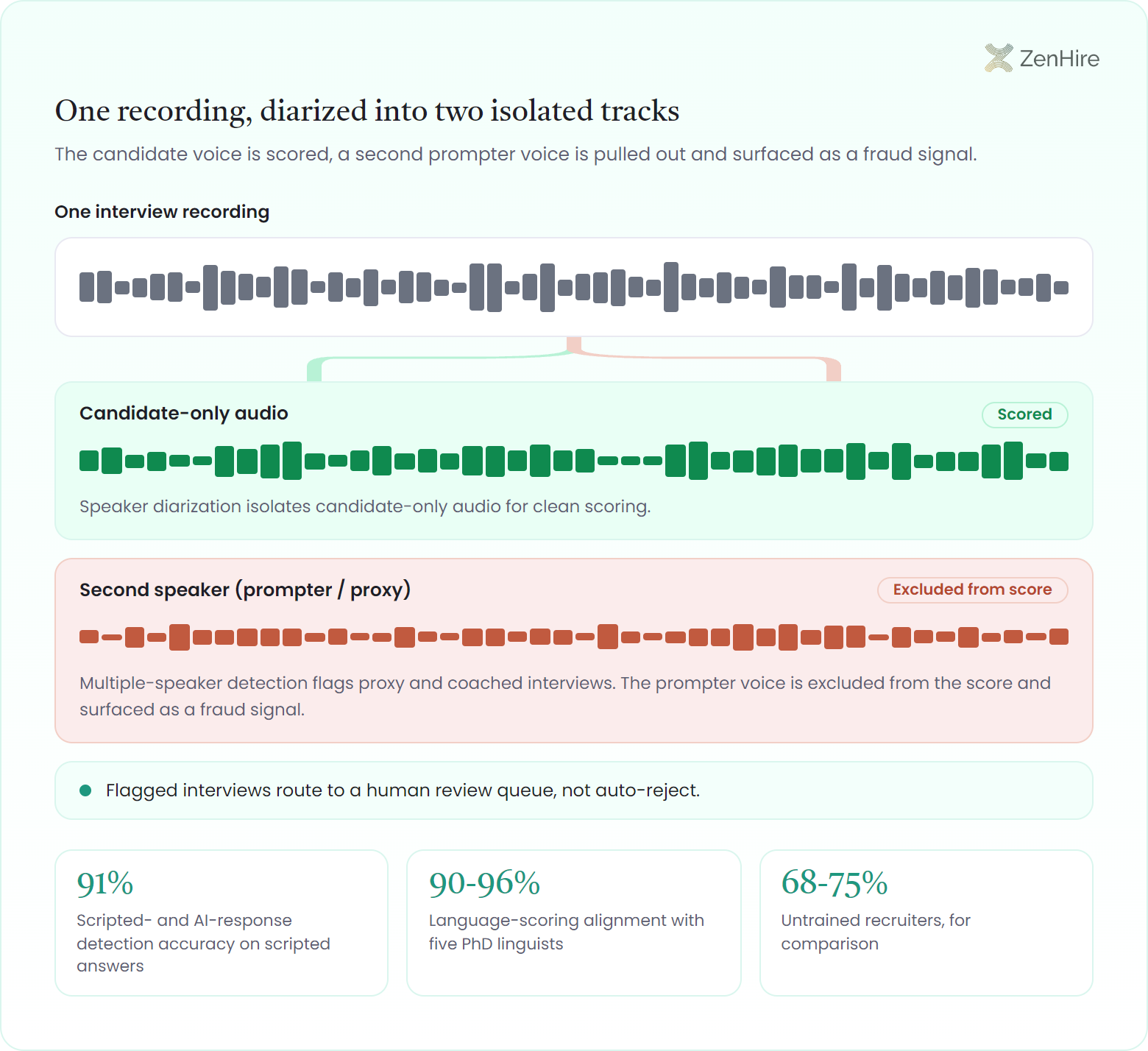
Because the checks are passive. Every integrity signal runs in the background of the assessment a candidate already takes, so an honest applicant completes the same short interview and never sees an extra step.
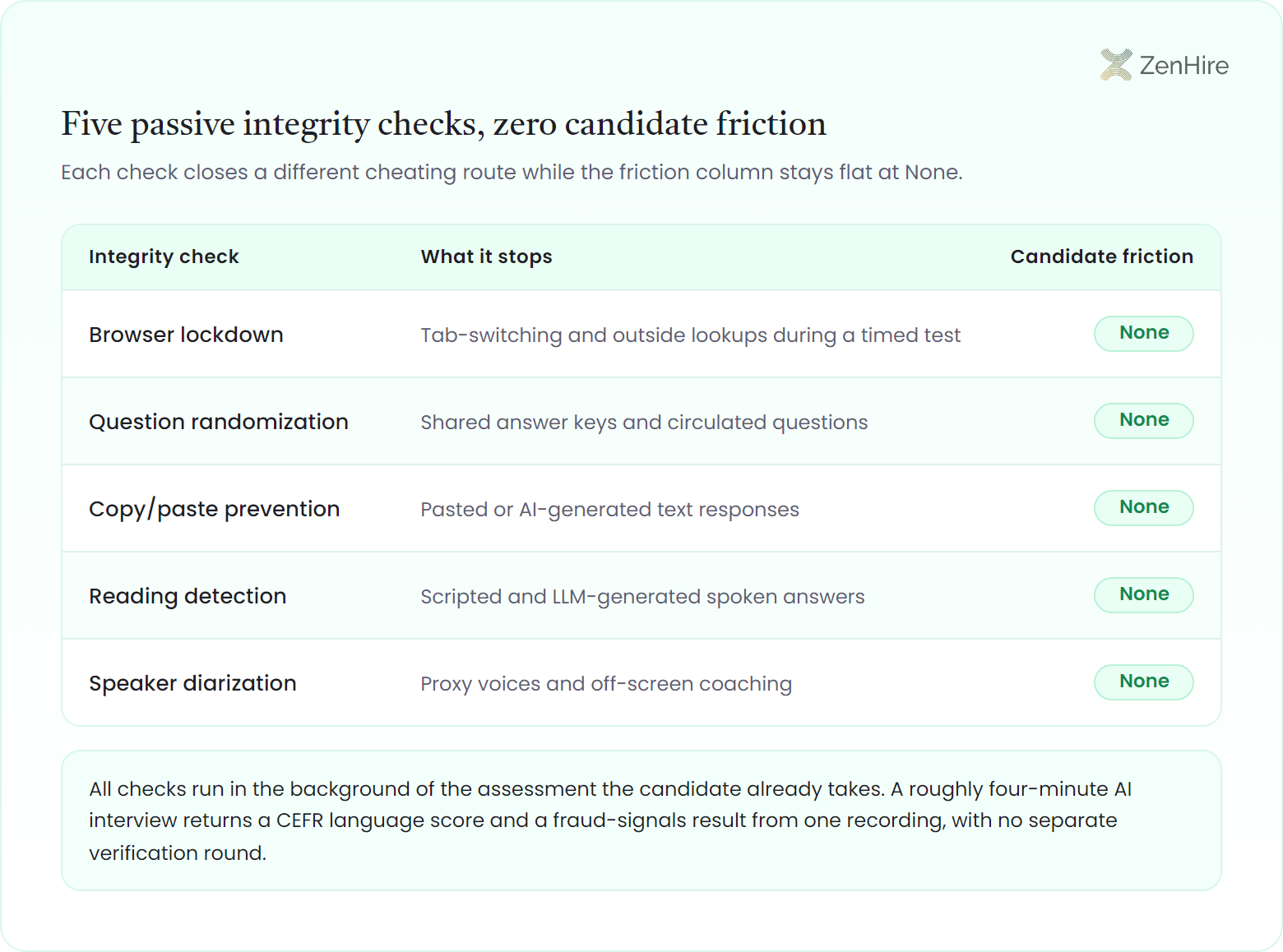
The mechanism is to attach verification to existing actions rather than bolting on new ones. Browser lockdown, question randomization, and copy/paste prevention operate during the timed test the candidate is already doing, and audio fraud checks run on the same recording used for scoring. A concrete example: a roughly four-minute AI interview returns a CEFR language score and a fraud-signals result from one recording, with no separate verification round. Because the fraud checks are built into ZenHire's speech intelligence api, the same JSON response carries the CEFR level and the fraud_signals object together. Keeping honest applicants moving through one short step is also what protects the candidate experience that fraud checks can otherwise degrade. The edge case is low-bandwidth or noisy environments, where audio-only assessment and candidate-only audio extraction keep the experience accessible instead of forcing a heavier, friction-adding video step.
| Integrity check | What it stops | Candidate friction |
|---|---|---|
| Browser lockdown | Tab-switching and outside lookups during a timed test | None |
| Question randomization | Shared answer keys and circulated questions | None |
| Copy/paste prevention | Pasted or AI-generated text responses | None |
| Reading detection | Scripted and LLM-generated spoken answers | None |
| Speaker diarization | Proxy voices and off-screen coaching | None |
Candidate verification software confirms that an applicant is who they claim and that their answers are genuinely theirs. It runs duplicate-CV, identity, multiple-speaker, and reading checks automatically on every application, flagging integrity risks for review before a recruiter invests time.
Hiring fraud detection software catches AI-generated answers through reading detection and copy/paste prevention. Reading detection identifies the scripted, unnaturally fluent delivery typical of LLM-generated responses and reaches 91% detection on scripted answers, while text checks block pasted content in written assessments. These are among the most common forms of recruitment fraud that remote hiring now has to guard against.
An interview anti-fraud tool detects proxy and deepfake interviews using multiple-speaker detection and speaker diarization. The system isolates each voice, scores only the candidate's audio, and flags a second speaker or synthetic delivery as a fraud signal routed to human review.
Candidate verification adds no friction for honest applicants because every check is passive. Browser lockdown, randomization, and audio fraud signals run inside the roughly four-minute assessment a candidate already takes, so genuine people complete one short interview with no extra verification step.
Candidate verification is fair and explainable by design. The integrity engine excludes sensitive attributes to reduce bias in hiring, uses a glass-box approach where every signal is auditable, and routes flags to a human reviewer, giving you defensible, GDPR and SOC 2 Type II aligned records rather than an opaque auto-reject.
Free for Candidate verification & anti-fraud
A one-page checklist for stress-testing remote-assessment integrity: the proxy, scripted-answer, and duplicate-CV checks to demand, the bias and explainability questions to ask any vendor, and what a defensible fraud signal should actually include.


Let’s talk. Book a demo and see ZenHire’s Fraud Detection AI in action!