


What Is Ethical AI Hiring?
Ethical AI hiring ensures fairness, transparency, and bias reduction in automated recruitment processes.
ZenHire Team
What is ethical AI in hiring?
Ethical AI hiring is the design and deployment of recruitment algorithms that evaluate candidates on job-relevant qualifications alone, with bias audits, explainable scoring, fraud detection, and human oversight built into every decision. Organizations with audited ethical AI practices report 30% higher candidate trust and 25% better workforce diversity than teams running unaudited systems. Regulators now enforce the standard: NYC Local Law 144 mandates bias audits, the Illinois AIVD Act requires consent for AI video interviews, and the EU AI Act classifies employment AI as high-risk.
Ethical AI hiring applies throughout the entire recruitment process, encompassing multiple dimensions:
- Bias prevention: Designing algorithms that don't perpetuate historical discrimination
- Transparency: Providing clear explanations of how AI influences hiring decisions
- Accountability: Establishing oversight mechanisms for algorithmic decision-making
- Privacy protection: Handling candidate data responsibly and securely
- Fraud prevention: Ensuring hiring integrity through verification systems
As AI becomes central to recruitment processes, organizations must balance efficiency gains with ethical obligations to candidates and society.
Why ethical AI hiring matters for organizations
Ethical AI hiring isn't just a moral imperative; it delivers tangible business benefits:
| Benefit Area | Impact |
|---|---|
| Legal compliance | Avoid discrimination lawsuits and regulatory penalties |
| Talent access | Reach qualified candidates who might be filtered by biased systems |
| Employer brand | Build reputation as a fair, inclusive employer |
| Team diversity | Create more innovative, high-performing teams |
| Hiring quality | Select candidates based on actual job fit, not proxy characteristics |
Organizations with strong ethical AI practices report 30% higher candidate trust and 25% improvement in workforce diversity compared to those using unaudited AI systems.
Key ethical challenges in AI recruitment
AI hiring systems face several ethical challenges that require careful attention:
- Training data bias: AI systems learn from historical data that may reflect past discrimination
- Proxy discrimination: Neutral-seeming factors that correlate with protected characteristics
- Opacity: Complex algorithms that make decisions difficult to explain or audit
- Candidate fraud: Deceptive practices that undermine hiring integrity, requiring robust fraud detection systems
- Privacy concerns: Extensive data collection that may intrude on candidate rights
- Automation bias: Over-reliance on AI recommendations without human judgment
Addressing these challenges requires intentional design choices, ongoing monitoring, and commitment to continuous improvement.
Building fair and unbiased AI hiring systems
Creating ethical AI hiring requires systematic approaches at every stage:
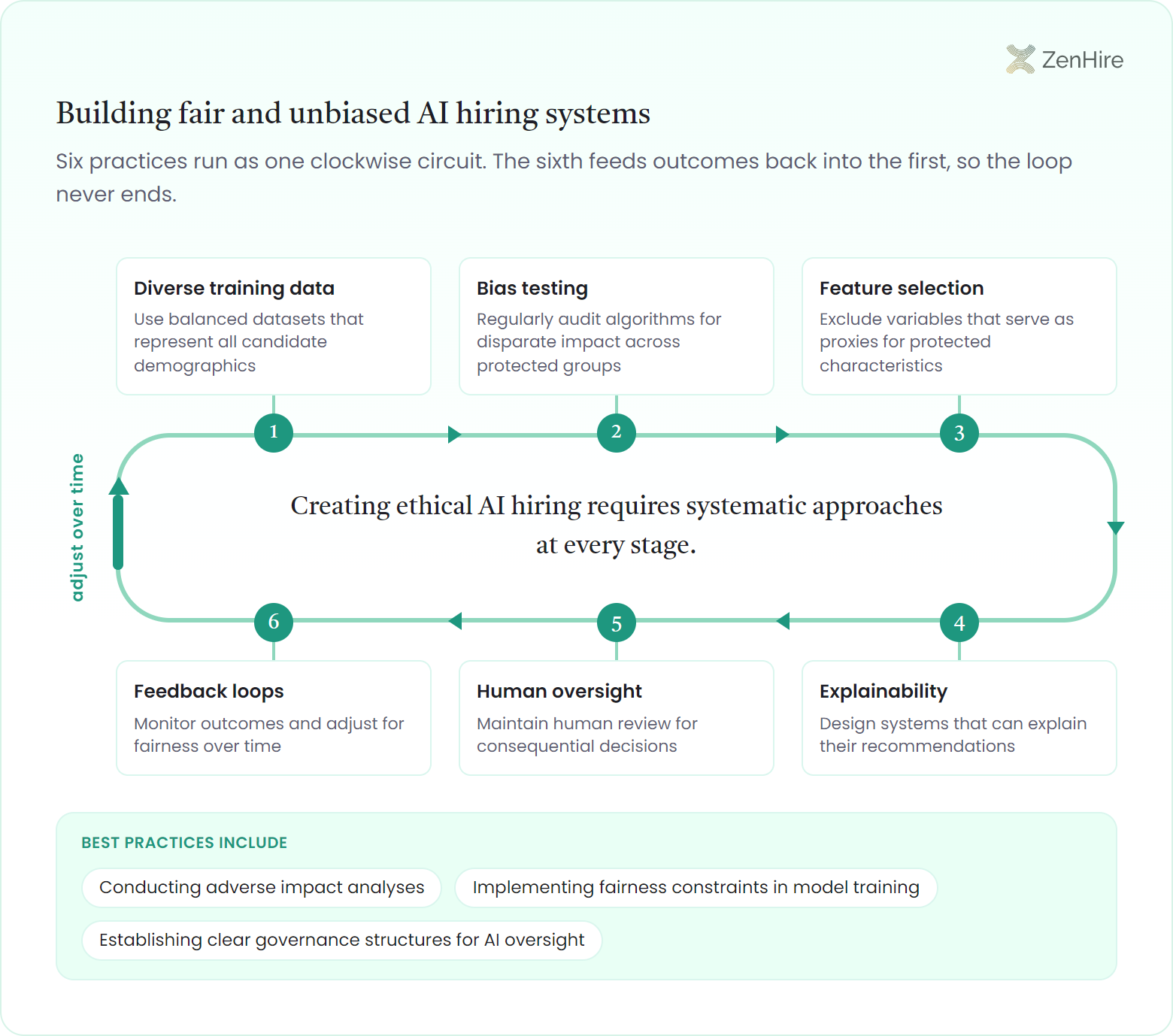
- Diverse training data: Use balanced datasets that represent all candidate demographics
- Bias testing: Regularly audit algorithms for disparate impact across protected groups
- Feature selection: Exclude variables that serve as proxies for protected characteristics
- Explainability: Design systems that can explain their recommendations
- Human oversight: Maintain human review for consequential decisions
- Feedback loops: Monitor outcomes and adjust for fairness over time
Best practices include conducting adverse impact analyses, implementing fairness constraints in model training, and establishing clear governance structures for AI oversight.
Fraud prevention and hiring integrity
Ethical AI hiring also includes protecting the hiring process from fraud and deception:
- Identity verification: Confirm candidate identities throughout the process
- Proxy interview detection: Identify when someone other than the applicant participates
- AI-generated content detection: Recognize machine-generated responses
- Credential verification: Validate educational and professional claims
Fraud prevention protects both employers from bad hires and honest candidates from unfair competition with deceptive applicants.
The regulatory landscape for AI hiring
Governments worldwide are implementing regulations governing AI in employment:
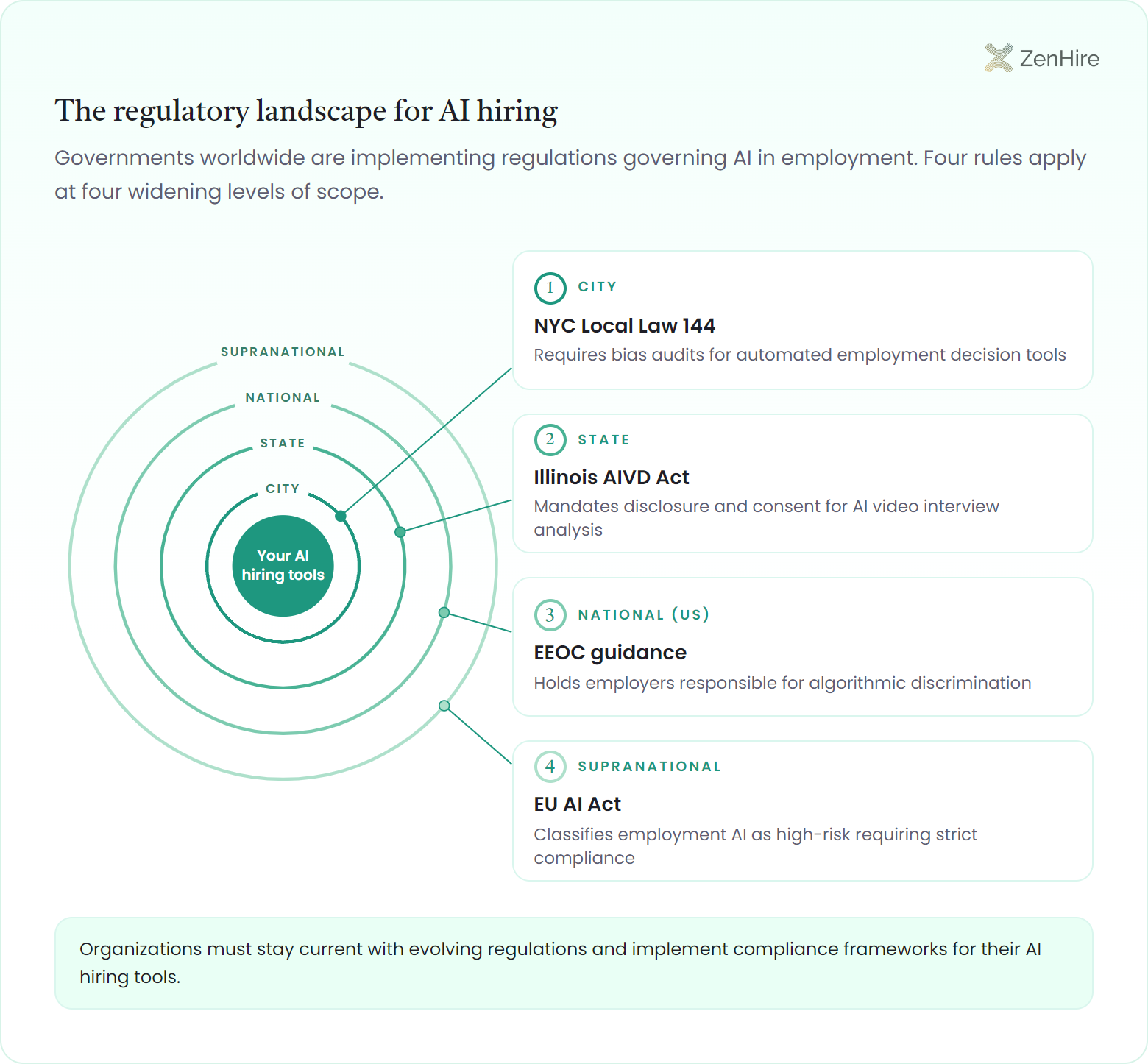
- NYC Local Law 144: Requires bias audits for automated employment decision tools
- Illinois AIVD Act: Mandates disclosure and consent for AI video interview analysis
- EU AI Act: Classifies employment AI as high-risk requiring strict compliance
- EEOC guidance: Holds employers responsible for algorithmic discrimination
Organizations must stay current with evolving regulations and implement compliance frameworks for their AI hiring tools.
How ZenHire ensures ethical AI hiring
ZenHire builds ethical principles into every aspect of our AI hiring platform:
- Continuous bias auditing: Regular analysis of outcomes across demographic groups
- Transparent scoring: Explainable AI that shows why candidates received specific ratings
- Fraud detection: Multi-layered systems to prevent deceptive practices
- Compliance support: Tools and documentation for regulatory requirements
- Human-in-the-loop: AI recommendations with human final decision authority
Explore our detailed guides on bias-free AI hiring and AI fraud detection to learn how ZenHire maintains hiring integrity while delivering exceptional candidate experiences.
Related Articles

AI Fraud Detection in Recruitment
AI Fraud Detection in Recruitment
How AI-powered fraud detection protects organizations from hiring fraud and identity deception.
Building Bias-Free AI Hiring Systems
Building Bias-Free AI Hiring Systems
Learn how to design and implement AI hiring systems that minimize unconscious bias.
