
Built for ATS platforms, AI interview tools, and BPOs who need CEFR language scoring without forcing candidates into a separate test. One API call: instant proficiency data from any conversation.

Question-agnostic CEFR scoring (A1-C2)
85-90% accuracy vs PhD linguists
4-minute assessments, not 30
Works with any audio or video input
{
  "cefr_level": "B2",
  "confidence": 0.92,
  "fluency_score": 78,
  "pronunciation_score": 82,
  "vocabulary_richness": 74,
  "accent_clarity": "high",
  "assessment_duration": "3m 42s"
}Send us any interview audio or video. Get back CEFR scores, detailed metrics, and fraud detection, all in under 4 minutes.
Send interview recordings via API. Works with one-way interviews, two-way calls, AI interviews, any format.
Our glass-box AI evaluates fluency, pronunciation, vocabulary, and accent: question-agnostic, bias-aware.
Receive structured JSON with CEFR level, detailed scores, explainable reasoning, and fraud flags.
POST /api/v1/assess
Content-Type: multipart/form-data

{
  "audio_url": "https://your-bucket/interview.mp3",
  "format": "one_way_interview",
  "language": "en",
  "include_transcript": true
}{
"assessment_id": "assess_7xK9mPq",
"cefr_level": "B2",
"cefr_confidence": 0.92,
"fluency": {
"score": 78,
"words_per_minute": 142,
"hesitation_ratio": 0.08
},
"pronunciation": {
"score": 82,
"accent_clarity": "high",
"intelligibility": 0.91
},
"vocabulary": {
"score": 74,
"diversity_index": 0.68,
"appropriateness": "professional"
},
"fraud_flags": {
"multiple_speakers": false,
"reading_detected": false,
"ai_generated": false
},
"processing_time_ms": 12400
}Words per minute, natural flow, micro-pauses, hesitation patterns
Clarity, intelligibility, accent characteristics, phoneme accuracy
Diversity index, context appropriateness, professional terminology
Multiple speakers, reading detection, AI-generated response flags
Validated against industry-leading assessments and PhD linguist evaluations. Trusted by Fortune 100 enterprises for call center hiring at scale.
Language assessment is a premium feature your clients will pay for
All-in-one beats fragmented solutions every time
Assessment data lives in your platform, so they can't easily leave
Skip 18+ months of R&D. Ship in weeks.
Candidates don't need a separate 30-min language session
The interview IS the assessment: zero change management
CEFR-aligned results they can show to their clients
Language screening in minutes, not days
The market splits into expensive standalone tests and raw speech engines. ZenHire is the only solution that combines interview context with language assessment, with no separate test required.
| Capability | ZenHire API | Traditional Assessments | Scenario-Based Tools | Speech Engines |
|---|---|---|---|---|
| Question-agnostic (works on any interview) | ✓ | - | - | ✓ |
| CEFR-level output | ✓ | ✓ | ✓ | Partial |
| Interview context awareness | ✓ | - | - | - |
| No separate test session needed | ✓ | - | - | ✓ |
| Fraud detection (AI, multiple speakers) | ✓ | - | Partial | - |
| White-label / embeddable | ✓ | - | Limited | ✓ |
| Glass-box explainable AI | ✓ | - | - | - |
| Assessment time | ~4 min | 22-30 min | 15-30 min | Real-time |
| Price per assessment | ~$1 | $15-68 | $10-60 | $0.01-0.03 |
They require candidates to take a separate 22-30 minute structured test. Costly ($15-68/test) and adds friction to your hiring flow.
ZenHire: Same quality, 68x cheaper, 7x faster, no extra session.
They have their own scenario-based questions. You can't use their assessment on YOUR interview content; candidates must do theirs separately.
ZenHire: Invisible assessment from any conversation you're already running.
Building speech AI takes 18+ months and $500K+ in specialized ML talent. Then you need bias auditing, GDPR compliance, and ongoing maintenance.
ZenHire: Production-ready API. Integrate in weeks, not years.
Whether you're a platform adding language capabilities or a BPO replacing expensive assessments, ZenHire adapts to your workflow.
20-500 employees • HR Tech companies
Your clients want assessment built-in, but they leave your platform for standalone tests. That's revenue walking out the door.
Embed CEFR scoring natively. Clients get language assessment inside YOUR ATS, with no extra vendor, no extra cost to them.
Higher ACV, better close rate, stickier clients. Assessment data lives in your platform.
Independently audited security controls for data protection, availability, and confidentiality.
Full European data protection compliance with right to explanation and data minimization.
Glass-box architecture meets transparency requirements. Fully auditable AI decisions.
Unlike black-box models, every ZenHire decision can be traced, audited, and explained.
In a blind study on 600+ candidates, ZenHire matched industry-leading assessments, in a fraction of the time.
Pay only for what you use. Select your plan.
1 credit = 1 minute of audio processing
Need more than 22K minutes? Contact us for custom enterprise pricing.
Language assessment software scores spoken English on the CEFR scale (A1 to C2) from a short recording in about four minutes, so you can prove that customer-facing hires can carry a call before they ever take one. It grades fluency, vocabulary, and pronunciation, and rates accent for clarity only.
It listens to a short spoken answer and returns a CEFR band from A1 to C2 in about four minutes, built up from separate scores for how the candidate actually speaks. There is no fixed test to study for; the engine reads the speech itself.
The mechanism is dimensional. English proficiency testing software here scores three named dimensions, Fluency (speech rate, naturalness, and pausing), Vocabulary (lexical range and appropriacy), and Accent (pronunciation and intelligibility), each from 0 to 100 with its own CEFR level, then rolls them into an overall score and overall CEFR band you can set a hiring bar against. One concrete example: a support role can require a B2 minimum, while a team-lead role can require C1, all from the same recording. The edge case worth flagging is a noisy two-way call, where speaker diarization separates every voice and automatic candidate detection labels which speaker to score, with a high, medium, or low confidence rating, so background voices do not skew the result, the same engineered signal the speech analysis api returns to platform partners.
ZenHire trains the engine on a balanced dataset with a 50/50 gender split across 150-plus geographies, so the model learns the sound of clear English from every region rather than a single accent group.
| Step | What happens | What you get |
|---|---|---|
| 1. Capture | Candidate records a spoken answer of at least three minutes, audio-only or video | A clean, candidate-only audio track |
| 2. Score dimensions | Engine grades Fluency, Vocabulary, and Accent | A 0 to 100 score and CEFR level per dimension |
| 3. Map to CEFR | Combined signal maps to a standardized band | A1 to C2 level in about four minutes |
| 4. Apply your bar | Per-role threshold qualifies or flags the candidate | A defensible pass or review decision |
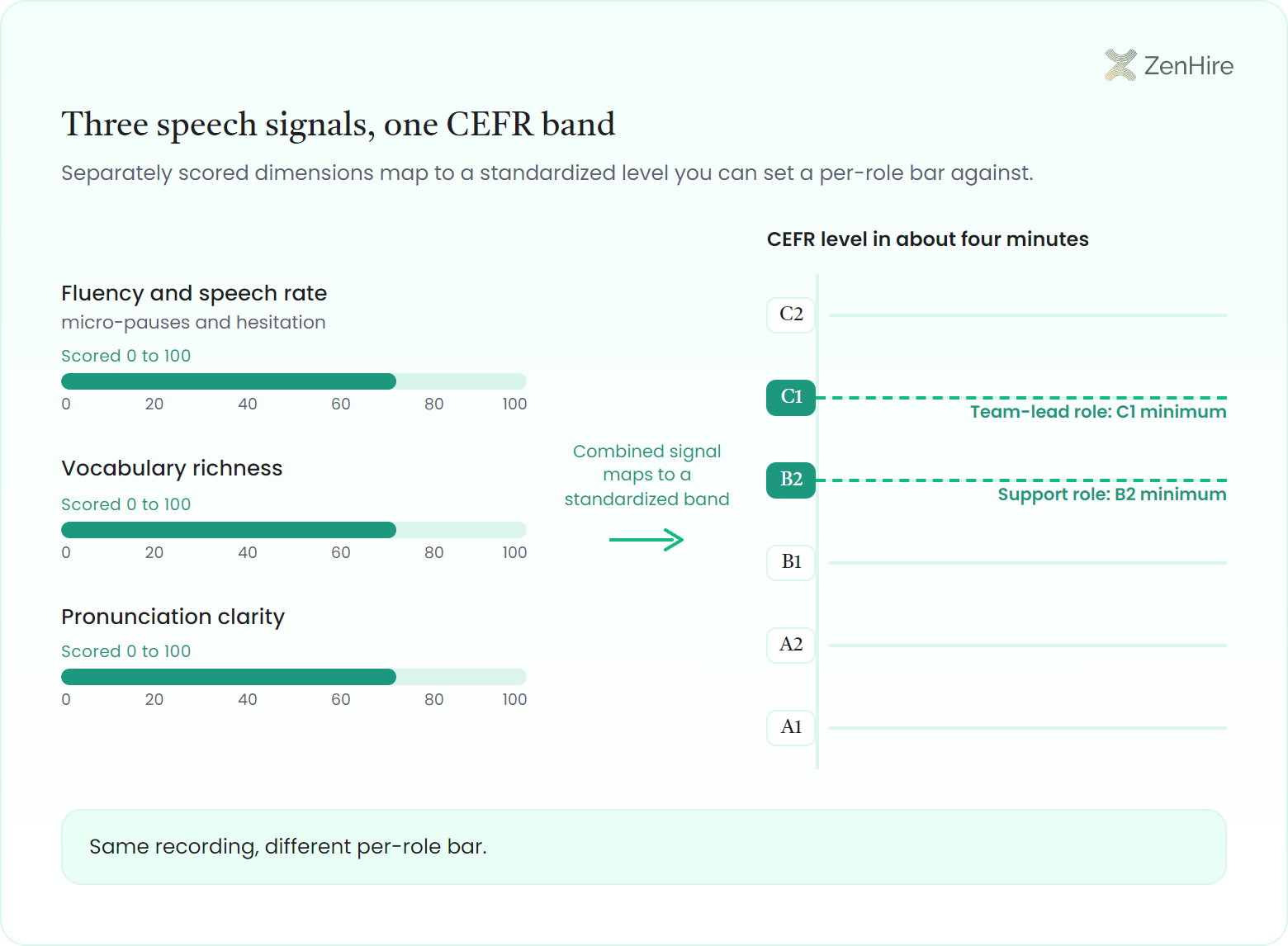
Yes. Each of those qualities is scored on its own 0 to 100 scale with its own CEFR level from a single short recording, and processing typically takes two to five minutes rather than the 25 to 30 minutes a traditional spoken test takes.
Here is the important distinction on accent: it is rated for clarity and intelligibility only, and a candidate is never marked down for sounding non-native. Some buyers argue that any accent scoring must therefore be biased against offshore talent. It is the opposite in practice, because the engine excludes sensitive attributes by design and judges only whether the speech is understandable, which is exactly what a customer needs on the line when you run high-volume call center hiring. One concrete example: two agents with very different accents can both score B2 if both are clearly intelligible. The edge case: a candidate who mumbles in any accent scores lower on clarity, because intelligibility, not origin, is what is being measured. The engine is not English-only either: it scores 16 languages, with English on a dedicated, most-tuned pipeline and Spanish, French, German, Portuguese, Hindi, Arabic, and nine more handled by a multilingual pipeline.
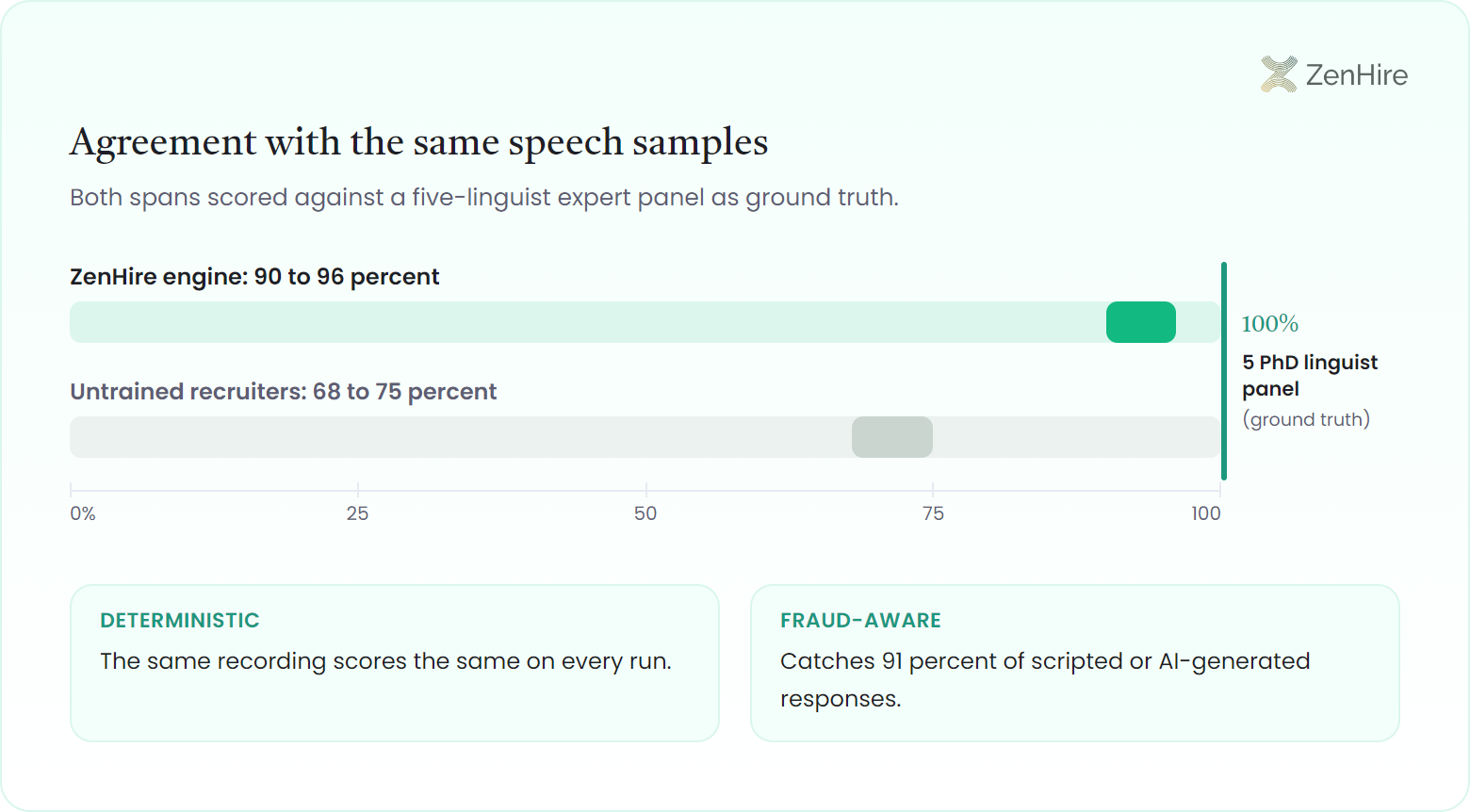
It agrees with a panel of five PhD linguists 90 to 96 percent of the time on the same speech samples, while untrained recruiters scoring those same samples land only 68 to 75 percent. The result is also stable: the same recording scores the same way every run.
The mechanism behind that accuracy is a glass-box, feature-engineered model rather than an opaque black box, so each dimensional score traces back to a measurable speech signal and ships with two plain-language explanation sentences per dimension, written to be safe to show directly to hiring managers, candidates, and audit reviewers. Some teams argue an automated scorer cannot be trusted over a seasoned human ear. The evidence cuts the other way, because a single human reviewer is inconsistent across a long day of screens, whereas a deterministic engine applies the same bar to candidate one and candidate three thousand, the way ZenHire keeps an ai interview consistent across an entire campaign. One concrete example: a recruiter who rates the first applicant generously and the fiftieth harshly introduces drift the engine does not. The edge case: a corrupted or near-silent recording is flagged for manual review rather than scored, so a bad input never becomes a false pass.
A written CV never proves a candidate can actually hold a call in English, which is why its predictive validity for on-the-job performance sits near r = 0.14; a scored spoken sample is one of the validated, structured signals from interview analysis that lift a combined evaluation past 0.6.
Expert-aligned
90 to 96 percent agreement with five PhD linguists on the same speech.
Beats untrained review
Untrained recruiters agree only 68 to 75 percent on identical samples.
Deterministic
Glass-box scoring returns the same result on every run, fully auditable.
Fraud-aware
Reading detection and proxy-speaker checks run automatically, catching 91 percent of scripted or AI-generated responses.
Language assessment software scores spoken English by analyzing a recorded answer and returning a CEFR level from A1 to C2 in about four minutes. It grades three dimensions separately, Fluency, Vocabulary, and Accent, each from 0 to 100 with its own CEFR level, then maps the combined signal to an overall band you can set a per-role hiring bar against.
This english proficiency testing software is accurate to within 90 to 96 percent agreement with a panel of five PhD linguists on the same speech samples. Untrained recruiters scoring those identical samples agree only 68 to 75 percent, and because the engine is deterministic, every recording scores the same way on each run.
Speech scoring for hiring does not penalize candidates for their accent. Accent is rated for clarity and intelligibility only, never for sounding non-native, and sensitive attributes are excluded from the model by design, so two agents with very different accents can both clear a B2 bar if both are clearly understandable.
The language assessment works with any interview format because it is context-agnostic and reads the speech itself, not a fixed question set. It scores one-way, two-way, structured, and open-ended answers alike, accepts MP3, WAV, OGG, FLAC, M4A, and AIFF recordings of at least three minutes, and embeds into an existing AI interview or ATS through a simple API.
The language assessment is fair and auditable because it runs on a glass-box engine that excludes race, gender, ethnicity, and age, and returns two plain-language explanation sentences for every dimension, safe to share with hiring managers, candidates, and audit reviewers alike. It is SOC 2 Type II certified and GDPR compliant, supporting a defensible right-to-explanation record for each decision.
Free for Speech and language assessment
A one-page reference for setting per-role spoken-English thresholds: what each CEFR band sounds like on a live call, where to put the bar for agents versus team leads, and the dimensional scores behind every level.


Start with a pilot on 50-100 assessments. See accuracy firsthand—scale when you're convinced.