
One system runs your entire hiring operation, finding and matching candidates, screening, interviewing, scheduling, and the admin, orchestrated by a master AI agent commanding a fleet of specialised sub-agents. You are the CEO. The OS is the COO and every employee beneath them, so you spend your week on the two things only a human should: winning clients and closing candidates.
Wider and deeper than anyone. It should feel like magic, and run like a company.
A Recruitment OS is one AI-native system that owns every hiring stage rather than a stack of tools you wire together. A master AI agent orchestrates specialised sub-agents that source and match candidates, run structured AI interviews and assessments, handle scheduling and admin, and return a shortlist you can defend, so the work that used to fill a recruiter's week happens before you open your laptop.
The clearest way to hold the vision is an org chart. Every recruiter or lean team becomes a one-person company, and the OS is the leadership team beneath them, doing every low-value task so the human can run the business.
You — the CEO
Set strategy · pitch clients · close candidates
The OS — your COO
A master AI agent that runs everything else and hands you only the calls that matter
CRO
LotusSourcing & outreach
Finds live roles, clients, and candidates, and runs the outreach.
CHRO
ZenHireScreening & assessment
Matches, screens, interviews, and assesses every candidate.
Chief of Staff
AgentsScheduling & admin
Owns the calendar, inbox, follow-ups, and the to-do list.
CFO
In-appProposals & invoicing
Handles proposals, contracts, invoicing, and client financing.
In the age of AI, a recruiter should spend their week on the two acts that genuinely need a human being, and nothing else: pitch clients, win the account and build the relationship, and close candidates, convince the right person that this is their move. Everything in between, Boolean searches, triaging 200 CVs, one-by-one messages, chasing replies, reformatting CVs, CRM hygiene, is busywork that does not, by itself, make money.
You can't grow the 10% by doing more of the 90%. The OS does the 90% so you can live in the 10%, the white space on your calendar is the product.
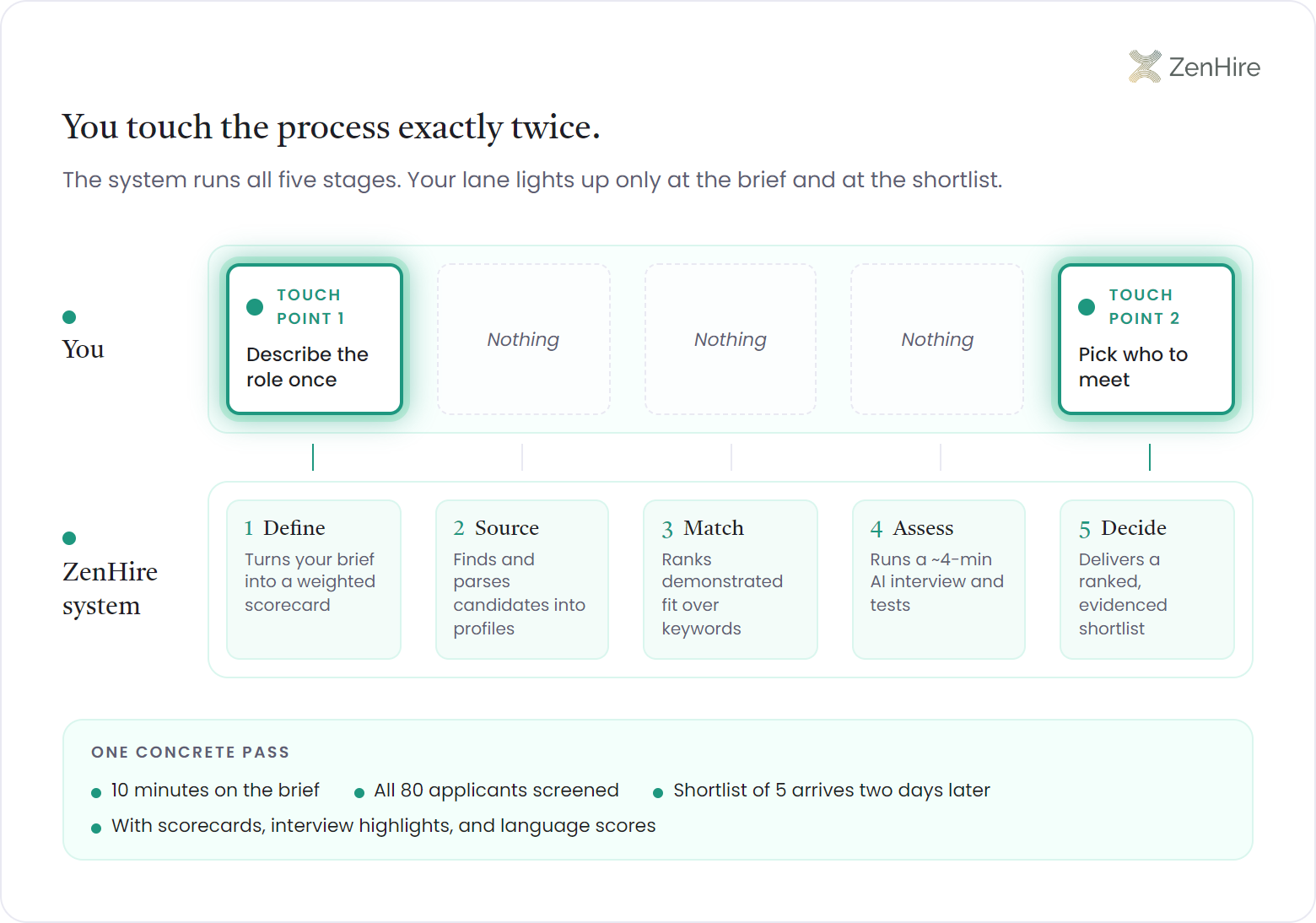
You describe the role once, and the system carries it to a shortlist. Each stage feeds the next, and every decision keeps the evidence behind it.
1. Define the role
Set the must-haves once; the system builds the scorecard and intake.
2. Source & parse
Roles, contacts, and candidates are found and parsed into structured profiles.
3. Match by meaning
CVDeepMatch ranks candidates on demonstrated fit, not keywords.
4. Interview & assess
The AI Interviewer screens every candidate; assessments add objective signal.
5. Shortlist with evidence
You get a ranked shortlist with the reasons behind each score.
6. You decide & close
A human makes the call and closes, faster, on better information.
Most tools compete on a single axis. Doing more, and doing each part better than anyone, is the combination a competitor cannot copy, and it compounds: five PhDs, hundreds of specialised micro-models, custom-labelled datasets, and a growing proprietary candidate database.
Wide — we do everything
The full lifecycle in one place: clients, candidates, sourcing, assessment, interviews, scheduling, admin, invoicing. One system, one cable in, instead of stitching five to eight disconnected tools together.
Deep — each piece is best-in-class
Flagship Speech Intelligence, CV DeepMatch, proprietary anti-fraud, and real psychometrics built by PhDs. Glass-box and bias-blind by design, EU AI Act and GDPR Article 22 as a foundation, not a retrofit.
Wider than anyone, and deeper than anyone. That two-dimensional edge is the whole moat, a wide-but-shallow suite loses on quality; a deep-but-narrow point tool loses on scope.
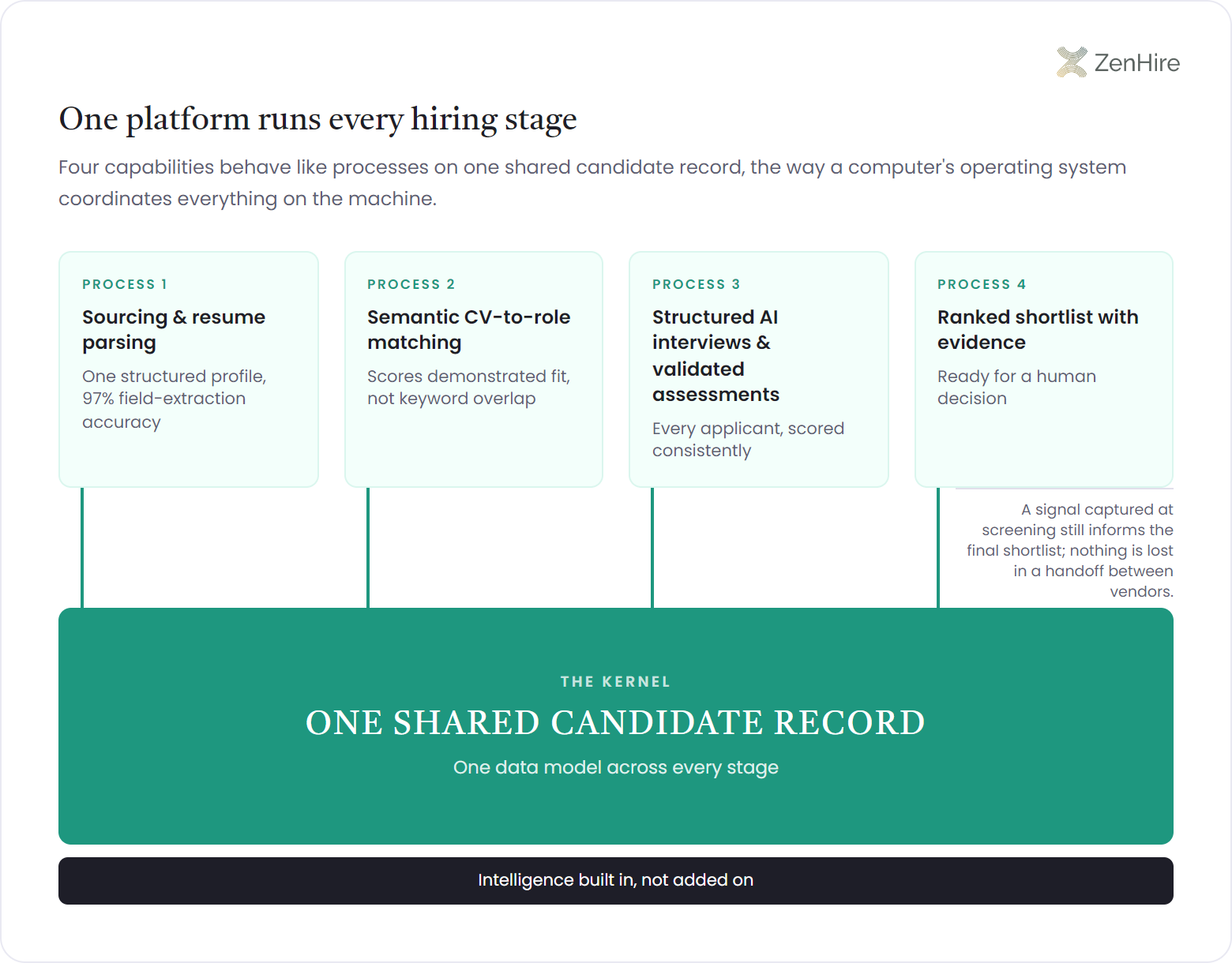
Three products converge into one chat-driven OS, connected by an MCP and agent layer that turns manual steps into agents you can drive in plain language.
The core · Shipped
ATS, CV DeepMatch, multilingual AI assessments, two-way AI interviews, anti-fraud, and Speech Intelligence, also sold standalone via API.
The wedge · Live
The outbound engine that finds agencies their clients and candidates and runs the outreach, on autopilot but never out of your hands.
The flywheel · Coming
Free AI career orientation for job-seekers that builds a proprietary candidate database, feeding the OS richer people to place.
The connective tissue
An MCP + agent layer that lets the whole operation be driven autonomously, in one conversation
Two structural shifts make this the moment. The best recruiters are going solo, because one person armed with AI can now do what used to take a whole team. And both sides of hiring are hiding behind AI, so trust is collapsing, which is exactly where a human bridge, made scalable by the OS, wins.
The model is not to carve a slice off a recruiter's income, it is to multiply it and share the upside we create. A solo recruiter earning $50–100k today could reach $100–300k with the OS pitching more clients and placing more candidates, on an 85/15 split in the recruiter's favour.
Conservative ARR trajectory (US$, illustrative)
$1.2M
2026
$6M
2027
$20M
2028
Worst-case and illustrative, 2028 is still under 0.3% of the market.
An applicant tracking system organizes a pipeline; a Recruitment OS moves it. The ATS tells you where a candidate is, while the Recruitment OS tells you whether that candidate is any good, and does the work to find out.
| Traditional ATS | Recruitment OS | |
|---|---|---|
| Core job | Track & store applicants | Run & evaluate hiring end to end |
| Screening | Manual, by your team | AI matching, interviews, assessments |
| Output | Status updates | Ranked shortlist with evidence |
| Best for | Teams with recruiters | Teams hiring without a recruiting desk |
Go deeper on the AI recruiter, done-for-you hiring, the OS category, and what it costs.
ZenHire takes a role from brief to shortlist to hire for you, for founders who hire occasionally.
What an AI recruiter owns end to end, and how it differs from a chatbot.
Run a rigorous hiring process without hiring or paying a recruiter.
The Recruitment Operating System category, and why it beats point tools.
Which recruiter tasks AI takes first, and where recruiters stay essential.
How AI is reshaping hiring, and how to future-proof your stack.
Where each wins, and how to combine an AI recruiter with a human one.
A founder's step-by-step guide to a great first hire.
Which roles to hire first, and how to keep quality high while moving fast.
What a recruiter or agency costs versus done-for-you hiring.
A Recruitment OS is a single AI-native system that runs every stage of hiring (finding candidates, matching, screening, interviewing, assessment, and shortlisting) instead of stitching separate point tools together. A master AI agent orchestrates specialised sub-agents, so the repetitive 90% runs on autopilot and a person makes the final call faster.
Every recruiter or lean team becomes a one-person company. The human is the CEO who sets strategy, pitches clients, and closes candidates. The Recruitment OS is the COO and the executive team beneath them: a sourcing agent, a screening-and-assessment agent, a scheduling and admin agent, and a proposals-and-invoicing agent, each doing the low-value work a person should never have to.
No. It removes the busywork so people focus on the two acts that genuinely need a human: pitching clients and closing candidates. The model is simple, AI measures and a human decides. You cannot grow the valuable 10% of the job by doing more of the 90%, so the OS does the 90%.
An ATS tracks applicants and workflow but does not evaluate them. A Recruitment OS adds the intelligence layer, AI matching, two-way interviews, and assessments, on top, so it both manages and judges the pipeline and returns a ranked, evidence-backed shortlist. You can run it standalone or alongside an existing ATS.
It is built for solo recruiters and agencies who want to run their whole desk from one place, for founders and lean teams hiring without a recruiter, and for high-volume teams that screen at scale. It scales from an occasional critical hire to hundreds of roles a month.
See how the Recruitment OS sources, screens, and shortlists, so you only spend time on the two things that need you: winning clients and closing candidates.