
Done-for-You Hiring for Founders Who Hire Occasionally


· 11 min read
Done-for-you hiring means ZenHire runs the entire search for founders who hire occasionally, and you keep the final decision. Your hands touch it only at the brief and again at the shortlist; in between, the system drafts a weighted scorecard, pulls structured fields off each CV at 97% accuracy, and puts every applicant through the same ~4-minute AI interview. That matters because the CV you would normally judge on tracks job performance at only about r = 0.14, whereas methods stacked and validated together clear 0.6+, and a hire that goes wrong runs SHRM's 50-200%-of-salary tab, an outsized bill for someone who hires twice a year.
What does done-for-you hiring include for a founder?
Done-for-you hiring hands a founder everything between writing the role and choosing a person, from sourcing, parsing, matching, and interviewing to assessment, run by one AI-native system instead of a stack of point tools. You bring the need and the final call; the platform absorbs the labor-intensive middle that usually eats a founder's week.
Concretely, the service turns your rough idea of the role into a scored rubric, sources and parses candidates into structured profiles at 97% field-extraction accuracy, ranks demonstrated fit over keyword overlap, runs a structured AI interview plus validated assessments, and returns a ranked shortlist with the evidence behind each score. Because every stage shares one candidate record, a signal captured at screening still counts at the final ranking. It is the same end-to-end logic behind a full recruitment operating system, pointed at one founder's single open role.
- Role definition: your plain-language draft becomes a weighted scorecard of must-haves and nice-to-haves.
- Sourcing and parsing into one structured profile, with 97% CV-extraction accuracy and no re-keying between tools.
- Evidence-based matching that scores whether a skill was actually used, not merely mentioned on the page.
- A structured ~4-minute AI interview given to every applicant, not just the handful you would otherwise have found time to call, plus PhD-designed cognitive and skills tests.
- [Spoken-language scoring](/assessments/english-proficiency) across the full CEFR A1-C2 range when the role is voice-facing, run audio-only so accent or name never colors the read.
- A ranked shortlist with the glass-box evidence behind every score, ready for your decision.
What you still own as the founder
You own the role's intent, the cultural read, and the offer. The system never auto-rejects on a sensitive attribute and never hires anyone; it excludes demographic factors from scoring and keeps an auditable log, so the work stays defensible while the judgment stays human. If you would rather run the pipeline yourself with the same tooling, hire without a recruiter covers that path instead.
How does done-for-you hiring go from role to hire for you?
The hire-for-you service moves a role to a finished shortlist in five tight stages, each feeding the next on the same candidate record, so nothing is re-keyed and no strong applicant slips through a handoff. You touch the process exactly twice: at the brief, and at the shortlist.
First, you describe the role in plain language and the system builds a scorecard. Second, it sources and parses applicants into structured profiles. Third, it ranks them on demonstrated evidence of fit. Fourth, the strongest take a structured AI interview and assessments that score logic, communication, and language. Fifth, you receive a ranked shortlist and decide who to meet. The work that powers stages three and four is the same AI recruiter that runs inside the platform; here it is simply pointed end to end at your one role.
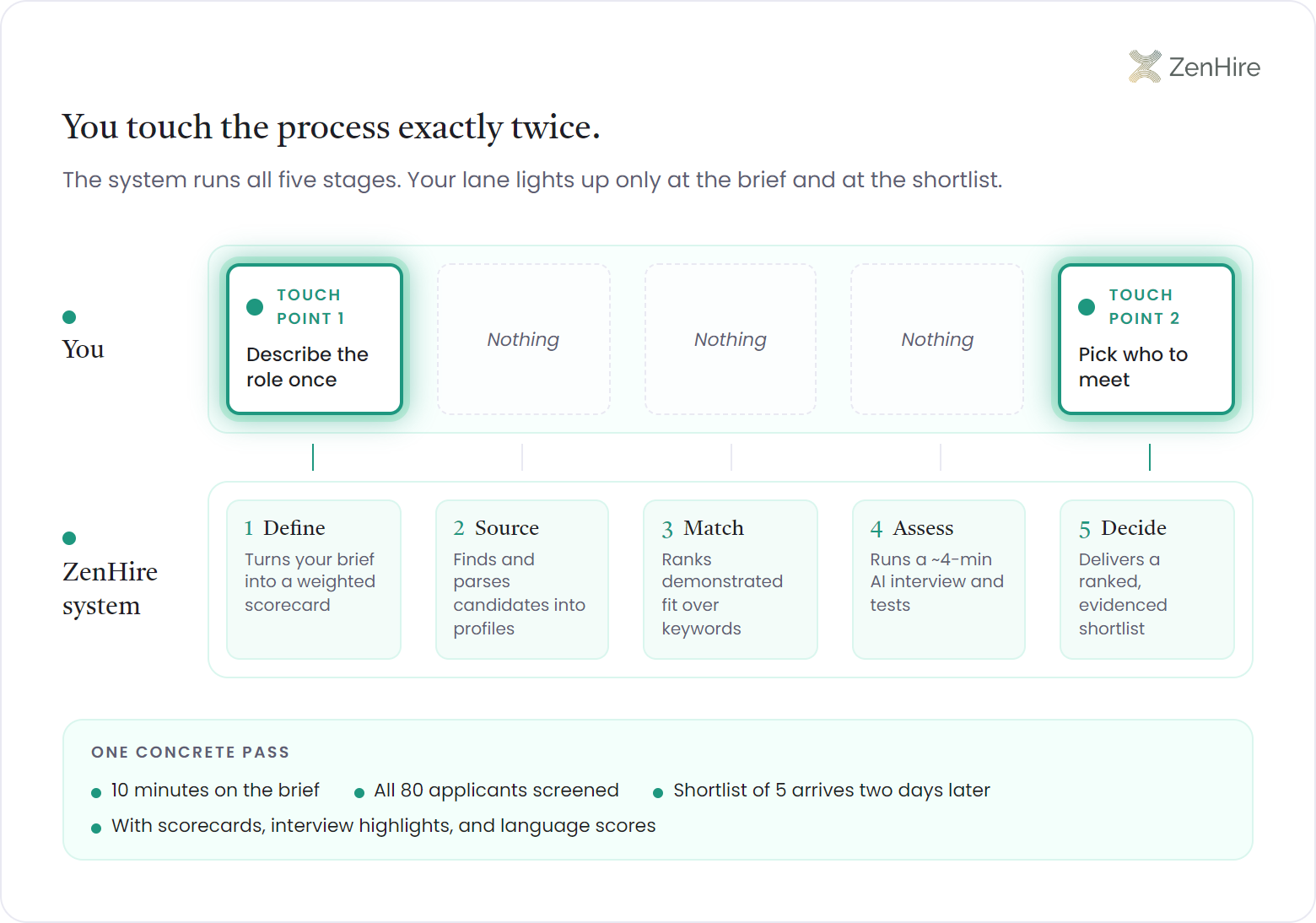
The founder version of this trade is stark. Left to yourself, a rare hire usually rests on an unstructured chat worth about 0.18 in predictive validity; imposing structure on that same conversation lifts it to roughly 0.28, and ZenHire's language scoring matches five PhD linguists 90-96% of the time against 68-75% for untrained recruiters. Done for you, that discipline lands on all eighty applicants at once, not on the three you would have squeezed into a busy week.
| Stage | What the system does | What you do |
|---|---|---|
| 1. Define | Turns your brief into a weighted scorecard | Describe the role once |
| 2. Source | Finds and parses candidates into profiles | Nothing |
| 3. Match | Ranks demonstrated fit over keywords | Nothing |
| 4. Assess | Runs a ~4-min AI interview and tests | Nothing |
| 5. Decide | Delivers a ranked, evidenced shortlist | Pick who to meet |
A concrete pass through the flow
Say a solo founder needs a first customer-success hire and has eighty applicants. Instead of reading every CV after dinner, they spend ten minutes on the brief, the system screens all eighty, and two days later a shortlist of five arrives with scorecards, interview highlights, and language scores. The edge case worth naming: if the role is genuinely novel and you cannot yet articulate what good looks like, the scorecard is only as sharp as the brief, so it pays to calibrate against the first batch before trusting the ranking. That one constraint aside, the founder spends their attention on five finalists rather than eighty strangers.
When does done-for-you hiring beat doing it yourself?
Done-for-you hiring wins over DIY when the hire is rare, important, and no one's job is to run searches. Both the cost of a wrong choice and the hours you would burn rise sharply for occasional, critical roles, exactly where a structured, run-for-you process earns its place.
The arithmetic punishes low-volume hiring specifically. SHRM puts the cost of replacing the wrong employee at 50-200% of salary, and the CV a busy founder leans on carries a predictive validity near 0.14 against 0.6+ for combined, validated methods. So the DIY founder pairs the weakest available signal with the highest stakes, and has no recruiter to spread the load. Done-for-you recruiting inverts both: every candidate is measured on the same rubric, and your time goes only to the finalists. For how the bill compares with an agency, see the recruiter vs done-for-you cost breakdown.
Some founders argue the opposite: that hiring rarely makes each search too bespoke to hand off, and that doing it themselves keeps them close to candidates. The instinct that founder judgment matters is right, but it conflates judgment with labor. You can stay fully in the decision while delegating the sourcing and screening grind; the shortlist arrives with evidence, so you end up closer to the signal, not further from it. The cases where DIY genuinely wins are narrow: a single referral you already trust, or a role so unusual that no rubric can yet capture it.
- You hire only a few times a year, so you never build steady screening muscle.
- The role is critical and a mis-hire is slow and expensive to unwind.
- You have no recruiter on staff and your own hours are the scarcest resource.
- You want a defensible, documented decision rather than a gut call you cannot explain.
- AI screening is now the default, not the edge case: industry research puts roughly 70% of employers using AI somewhere in the funnel by 2025, so the founder still reading every CV unaided is the one out of step, not the one being careful.
| Doing it yourself | Done-for-you hiring | |
|---|---|---|
| Screening | Read every CV by hand, late at night | All applicants scored the same way |
| Signal | A CV and a gut-feel chat (~0.14-0.18) | Combined validated methods (0.6+) |
| Your hours | The whole search lands on you | Two touch points: brief and shortlist |
| Wrong-hire risk | High, with no documented basis | Defensible, evidence-backed decision |
DIY in-house vs a staffing agency vs done-for-you: how do the three options compare?
For a founder who hires occasionally, the three realistic paths are running the search yourself, paying a staffing agency, or using a done-for-you platform, and they diverge most on cost structure, speed, and how much control you keep. DIY is cheapest in cash but most expensive in founder hours and most exposed to a weak-signal mis-hire; an agency buys you back time but charges a placement fee and hands you resumes without the reasoning; done-for-you aims to keep the agency's time savings while measuring every applicant the same way and leaving the decision with you.
Treat the figures below as industry research, not ZenHire's own numbers. Published data puts staffing-agency placement fees at 15-25% of first-year salary, which on a $90k role is roughly $13,500-$22,500 a hire. DIY sends no invoice at all, yet the same research pegs a wrong hire at 50-200% of salary (SHRM), the silent bill a founder eats when a rare, high-stakes call rests on the weakest signal there is, a CV read alone at a predictive validity near 0.14, against 0.6+ for combined validated methods.
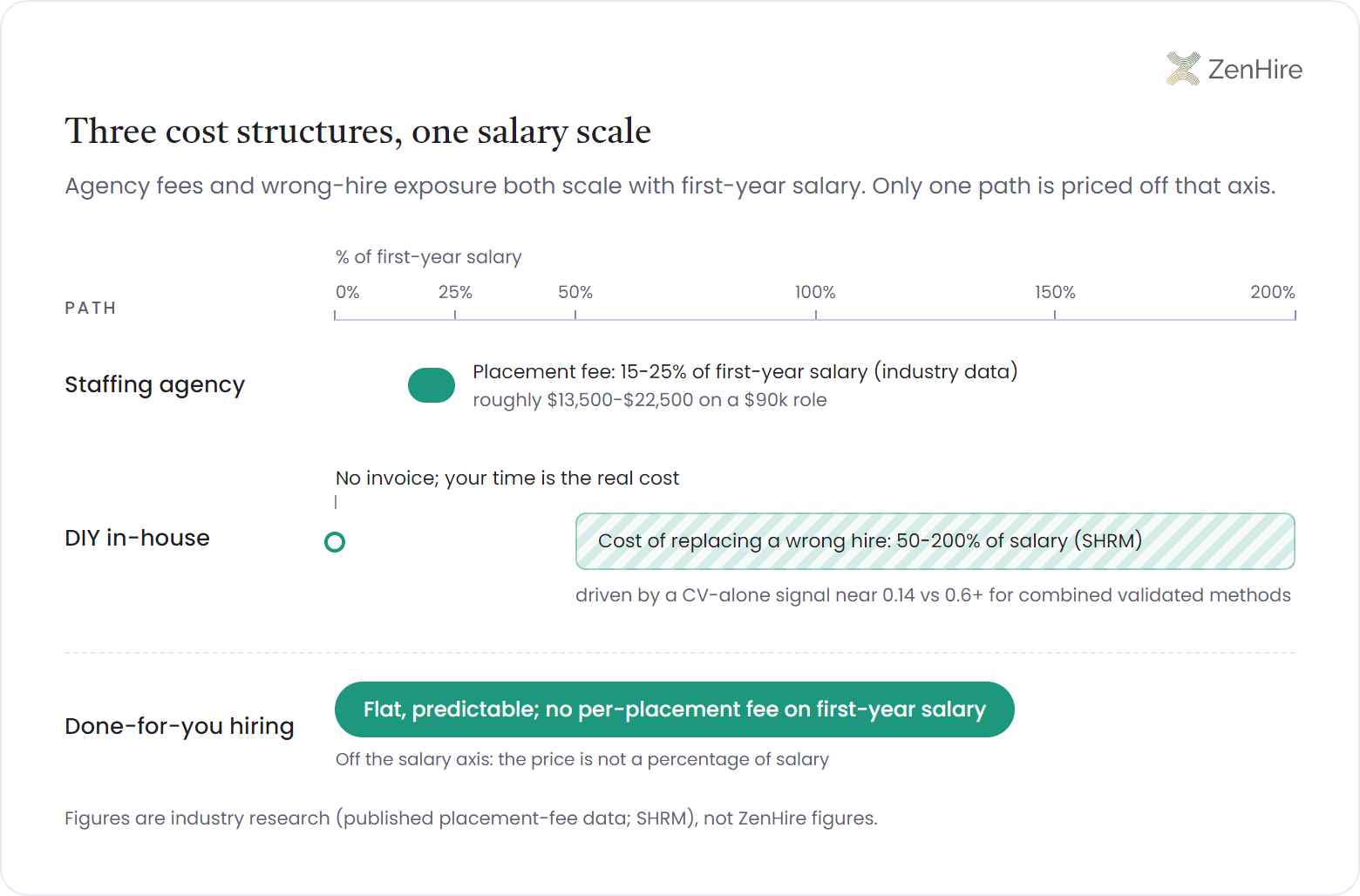
The honest read: an agency and done-for-you both buy back your hours, but they buy different things with the fee. An agency buys sourcing reach and hands you a filtered stack; done-for-you buys consistent, explainable measurement on every applicant and hands you a ranked shortlist with the reasoning attached. For a founder whose scarcest resource is a defensible decision, not a bigger pile of resumes, the second trade tends to fit the occasional, critical hire better. For a line-by-line look at the bill, see the recruiter vs done-for-you cost breakdown.
| DIY in-house | Staffing agency | Done-for-you hiring | |
|---|---|---|---|
| Cash cost | Lowest out of pocket; your time is the real cost | 15-25% of first-year salary per placement (industry data) | Flat, predictable; no per-placement fee on first-year salary |
| Speed | Slow; the search competes with running the company | Fast to a stack of resumes, then it waits on you | Fast to an evidenced shortlist, all applicants screened in parallel |
| Control | Full, but you also do all the labor | Low; the agency filters before you ever see candidates | Full on the decision: the system measures, you choose |
| Quality signal | CV plus a gut-feel chat (~0.14-0.18) | Recruiter judgment; usually opaque, rarely structured | Combined validated methods (0.6+), scored the same for everyone |
| Transparency | Whatever you remember writing down | Resumes forwarded, reasoning rarely shown | Glass-box evidence behind every score, auditable |
| Best-fit situation | A single referral you already trust, or a role no rubric fits yet | High-volume or hard-to-source roles where you want hands off sourcing | Rare, high-stakes hires with no recruiter on staff |
Most founders I meet treat their rare hires as a tax to pay alone: eighty CVs at midnight, a couple of gut-feel calls, and a hope it works out. I think that is exactly backwards. The fewer times you hire, the less you should trust the unaided gut, because you never build the reps a real recruiter has. Done-for-you hiring is not about handing over the decision; it is about refusing to make the most expensive decision of your quarter on the weakest evidence available. You still pick the person. You just stop screening eighty strangers to find them.
Frequently asked questions
What is done for you hiring?+
Done for you hiring is a service that runs your entire search and leaves you the decision. ZenHire writes the role into a scorecard, sources, screens each applicant with a structured ~4-minute AI interview and validated assessments, and hands back a ranked shortlist with the evidence, while the final call stays yours. It is built for the founder who hires occasionally and keeps no recruiter on staff.
How is a hiring for you service different from a recruiting agency?+
A hiring for you service differs from an agency in transparency and cost structure. A staffing agency forwards resumes and typically charges 15-25% of first-year salary; a done-for-you platform measures every candidate the same way and shows the glass-box evidence behind each score. You see why someone ranks where they do, not just a stack of CVs with no reasoning attached.
Does done for you recruiting work for a low-volume founder?+
Done for you recruiting is most valuable for low-volume founders, not least. Hiring rarely means you never build screening reps, so the one search you do run carries more risk, not less, and a single mis-hire can cost 50-200% of salary. Consistent, structured evaluation therefore matters more the less often you hire. The system takes on exactly the work that occasional hiring makes uneconomical to do by hand.
Will an AI doing the hiring for you introduce bias?+
An AI doing the hiring for you can [reduce bias](/ethical-hiring/reduce-bias) rather than add it when it is built correctly. ZenHire excludes demographic factors from scoring, runs audio-only language assessment, keeps explainable glass-box scores, and maintains auditable logs under GDPR and SOC 2. Transparent, consistent evaluation tends to surface less hidden bias than informal manual screening.
Do I lose control if ZenHire handles hiring for me?+
You keep full control when ZenHire handles hiring for you, because the system measures and you decide. It runs sourcing, screening, and assessment, then stops at a ranked shortlist; no candidate is hired or rejected without you. The principle is fixed: AI measures, humans decide.
Free for first-hire planning
The occasional-hire scorecard template
A one-page template for turning a fuzzy role into a weighted scorecard before you ever read a CV: must-haves vs. nice-to-haves, how to weight them, and the calibration step founders skip.