
ZenHire's library offers cognitive, job-specific, and personality tests designed to fit every hiring need.

Customizable Assessments
Gamified Tests
Real-Time Analytics


Access a wide range of assessments covering cognitive ability, personality, and job-specific skills, all backed by scientific validation for precise measurements.
Traditional methods can only go so far in predicting on-the-job success. ZenHire combines all methods to give you the most accurate possible predictions.


Create custom tests for your specific hiring needs
Build tests specific to your company's needs by customizing questions, scoring metrics, and evaluation criteria for any role.

Engage candidates with fun, interactive assessments
Increase engagement with game-based assessments that evaluate problem-solving and creativity in an enjoyable interactive way.

Continuous improvement with candidate feedback
Collect Net Promoter Scores at the end of each assessment to enhance the candidate experience and fine-tune your hiring process.
Built with insights from psychometric experts, ZenHire’s assessments are scientifically sound, ensuring fair, accurate, and unbiased evaluations.

Pre employment assessment software lets you measure what a CV cannot: cognitive ability, personality, and job-specific skill, then weight each into one scorecard. ZenHire ships 150+ PhD-validated assessments plus a custom builder, so you score on evidence instead of gut. That moves screening from opinion to a defensible ranking that lifts your quality of hire.
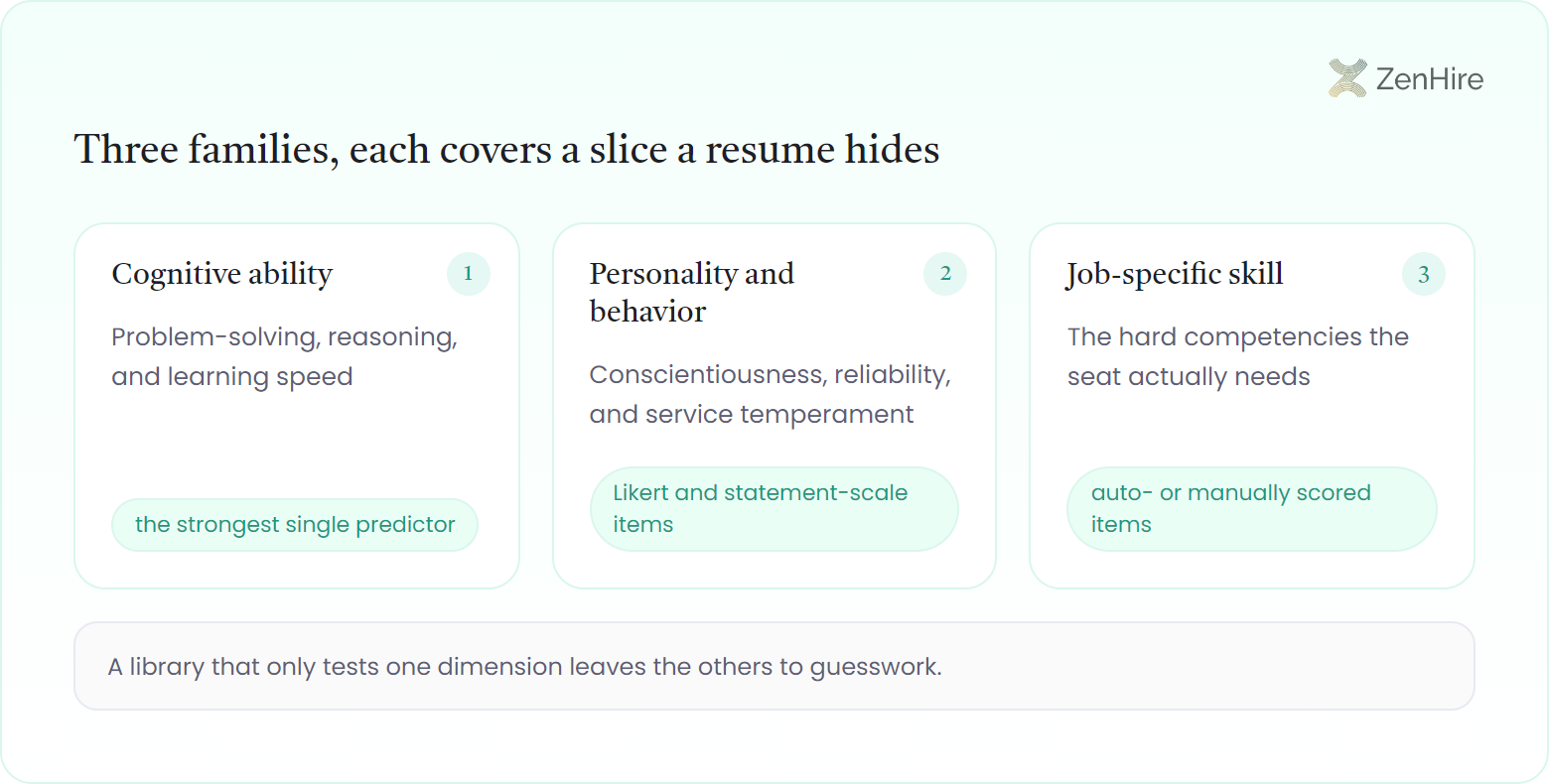
It should measure the traits a resume hides: reasoning, behavior under pressure, and the specific competencies the role demands. Each of these predicts a different part of performance, so a library that only tests one dimension leaves the others to guesswork.
In practice that means three families of tests working together. Cognitive tests gauge problem-solving and learning speed; personality and behavioral tests profile reliability, conscientiousness, and customer-service temperament; job-specific tests check the hard skills the work actually requires. One concrete example: for a contact-center agent you might run a cognitive screen, a customer-service behavioral profile, and a short typing or product-knowledge check, then weight them by how much each matters for the seat. Pair the result with ai cv-to-job matching so the resume signal feeds the same ranking. The edge case worth flagging is creative or deeply senior roles, where a structured test bank covers less of the picture and you should lean on a portfolio review or work sample alongside it.
Why three families instead of one: decades of selection research put a plain resume review near 0.14 predictive validity, while combining cognitive, behavioral, and job-specific signals pushes the combined score past 0.6, more than four times the predictive power of a CV alone (third-party research).
You define the competencies the seat needs, pick or build a test for each one, and assign a weight that reflects how much each matters. The platform then rolls those weighted signals into a single ranked number per candidate.
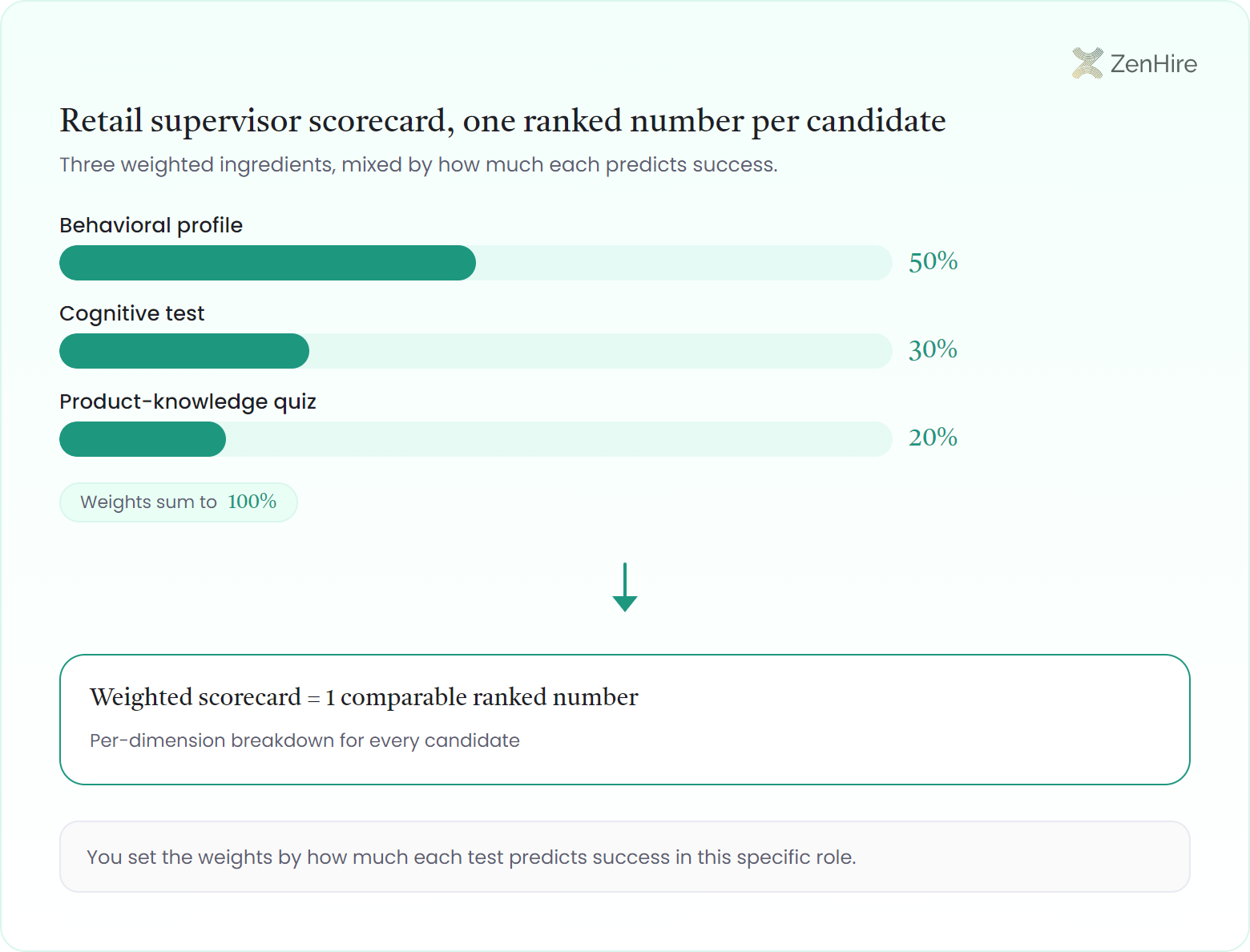
With ZenHire you start from the 150+ validated tests or open the WYSIWYG builder to create custom items: multiple-choice, short answer, essay, Likert statement scales, or audio and video responses, with timing and randomization. You set the weights, and the scorecard combines auto-scored and human-reviewed components into one comparable result with a per-dimension breakdown. For voice-heavy seats you can fold a CEFR-aligned ai interview software score into the same weighting, or a standalone spoken-English proficiency rating. A concrete example: a retail supervisor scorecard might weight a behavioral profile at 50 percent, a cognitive test at 30 percent, and a product-knowledge quiz at 20 percent, so the ranking reflects what success in that store really takes. The edge case to plan for is a brand-new role with no track record; start with a balanced default, then recalibrate the weights once you have hired a cohort and can see which signals tracked performance.
Built for high volume: a single scorecard runs cleanly across 3,000+ candidates per role and a 1,000+ resume bulk import, so the same weighted test set scales from a niche req to a campaign hire without a separate workflow.
1. Map competencies
List what the seat actually requires: reasoning, behavior, and the hard skills the work demands.
2. Pick or build tests
Pull from 150+ validated assessments or build custom items in the WYSIWYG builder.
3. Weight each signal
Assign each test a weight by how much it predicts success in this specific role.
4. Rank on one score
The scorecard combines weighted results into a comparable number with per-dimension explanations.
Yes, because fairness and prediction are not a trade-off when the scoring is built right. ZenHire excludes sensitive attributes from inputs and models, keeps the logic glass-box and explainable, and still surfaces the traits that forecast who performs.
Some teams assume any custom test you write yourself drifts toward bias or loses rigor the moment it leaves a standardized bank. That concern is fair about ad-hoc, gut-built quizzes graded by inconsistent reviewers. ZenHire refutes it structurally: custom items inherit the same bias-excluded, deterministic scoring as the validated library, every score carries a per-dimension explanation, and results stay auditable across runs the way ethical hiring practice expects. A concrete example: a custom service-temperament test can require a clear behavioral threshold while never reading demographic signals, so two candidates with the same answers get the same score. The honest edge case is validation: a brand-new custom test predicts best after you check its scores against real outcomes for a first cohort, so treat early weights as a starting hypothesis, not a verdict.
| Predictor | Predictive validity | What it captures |
|---|---|---|
| CV / resume screen | ~0.14 | Claimed history, easy to inflate |
| Cognitive assessment | 0.5+ | Reasoning and learning speed |
| Combined data-driven assessments | 0.6+ | Cognitive plus behavioral plus job-specific signal |
Pre employment assessment software is a tool that scores candidates on cognitive, personality, and job-specific tests before you interview them. ZenHire pairs 150+ PhD-validated assessments with a custom builder so you rank applicants on evidence instead of a resume scan.
This skills testing software differs from a generic test bank by combining a validated library with a WYSIWYG builder and weighted scorecards. You are not locked into fixed quizzes; you build role-specific items and roll auto-scored and human-reviewed results into one comparable, explainable score.
A candidate assessment platform reduces bias when it excludes sensitive attributes and keeps scoring explainable. ZenHire architecturally removes race, gender, ethnicity, and age from inputs and models, applies the same glass-box scoring to custom and validated tests, and keeps auditable logs for every decision.
Assessment scores are far more predictive than a resume, according to third-party research: cognitive tests reach 0.5+ and combined data-driven assessments 0.6+, against roughly 0.14 for a CV alone. That is why a scorecard ranks who can do the job with a single candidate skill score rather than who described it best.
You can create custom tests or use the validated library, or mix both in one scorecard. The WYSIWYG builder supports multiple-choice, short answer, essay, Likert statement scales, and audio or video responses, with weighted scoring, timing, and randomization.
Free for Assessment scorecard design
A practical spec sheet for designing weighted assessment scorecards: which tests to combine per role, how to set weights, and how to keep custom items bias-excluded and explainable.


Empower your retail stores with ZenHire - AI-powered, ethical, and built for a faster, fairer future.