
ZenHire’s ATS brings your entire hiring process into one seamless platform, from job posting to employee onboarding.
Book a demoSave time by letting ZenHire handle interview scheduling and candidate follow-ups.
Easily drag and drop modules to turn your existing hiring steps into a seamless, digital workflow, from screening to assessment to onboarding.

Scientifically validated tests that measure vital traits for success. Design assessments specific to your niche needs, aligning every hire with their goals.
Learn More

Track time-to-hire, candidate quality, and turnover with ZenHire’s real-time dashboards. Get actionable insights at every stage to make faster, smarter decisions and continuously optimize your hiring process.
What traditional CV parsers do is only the tip of the iceberg. ZenHire’s CVDeepMatch plunges into the depths with:
Deep contextual skill matching
Multi-format support (PDF, DOCX, JPG)
Detects education, gaps, and job hopping

Communicate directly from the platform, track conversations and manage candidate engagement. Every message is logged, ensuring smooth handovers between team members.
Built-in inbox for rectruiters
Centralized applicant data and communication
Internal comments and team collaboration


Ensures only real and qualified candidates make it through your hiring process with AI-powered anti-fraud systems.
An all in one applicant tracking system runs your whole hire on one platform, from the first sourced lead to a filled seat. ZenHire pairs dashboard analytics, position management, and bulk operations with native AI screening, so sourcing, evaluation, and onboarding never split across disconnected tools.
It should carry one candidate through every stage on a single platform, from first contact to signed offer, with nothing re-keyed between tools. That means parsing, screening, scoring, scheduling, decisions, and onboarding all read and write to the same record.
Position management is the backbone: a portfolio view of every open role, stage-level conversion stats, reusable templates that launch a proven workflow in minutes, and lifecycle status from Active to Hired to Archived with audit history. One concrete example, a recruiter opens a role from a template, and applicants flow in, get parsed by the nlp resume parsing api, and rank automatically without a separate spreadsheet. The edge case worth flagging is a role with near-zero applicant flow, where the system speeds screening but cannot manufacture candidates, so you still pair it with active sourcing channels.
Volume is where stitched-together stacks break first: ZenHire is engineered to run a single role with 3,000+ candidate applications and ingest 1,000+ PDF resumes in one bulk import without performance degradation, so a high-volume hiring campaign never stalls the system.
| Stage | What the platform does |
|---|---|
| Source | Import applications from job boards, careers page, email, and 1,000+ bulk resume upload. |
| Parse | NLP CV parser extracts experience, education, skills, and contacts automatically. |
| Screen | AI scores and ranks candidates against the role; auto-qualify against thresholds. |
| Evaluate | Custom scorecards and assessments standardize scoring across hiring managers. |
| Decide | Bulk hire, reject, or stage-move across thousands of candidates at once. |
| Onboard | Move the hired candidate forward with full history preserved in one record. |
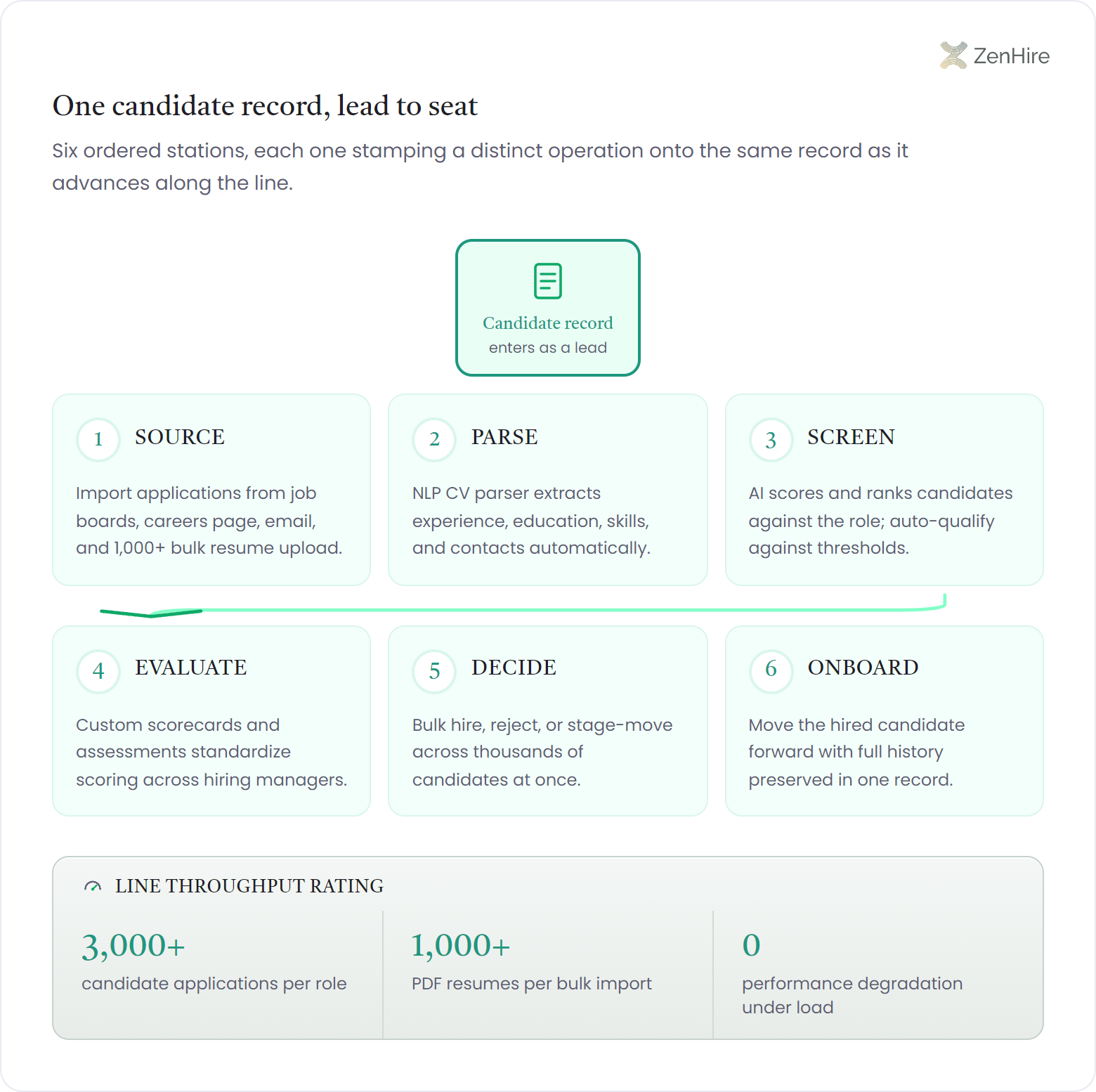
It runs as a native layer, not a bolted-on integration: every applicant is parsed, matched, and scored in the same record where you track them. Inside the ATS pipeline, CVDeepMatch turns each CV into a percentage compatibility score against the job description, and ai interview software adds a roughly four-minute async interview that grades communication and rates spoken language on the CEFR A1-C2 scale, all writing back to one applicant record. That async read is a form of interview analysis applied at pipeline scale.
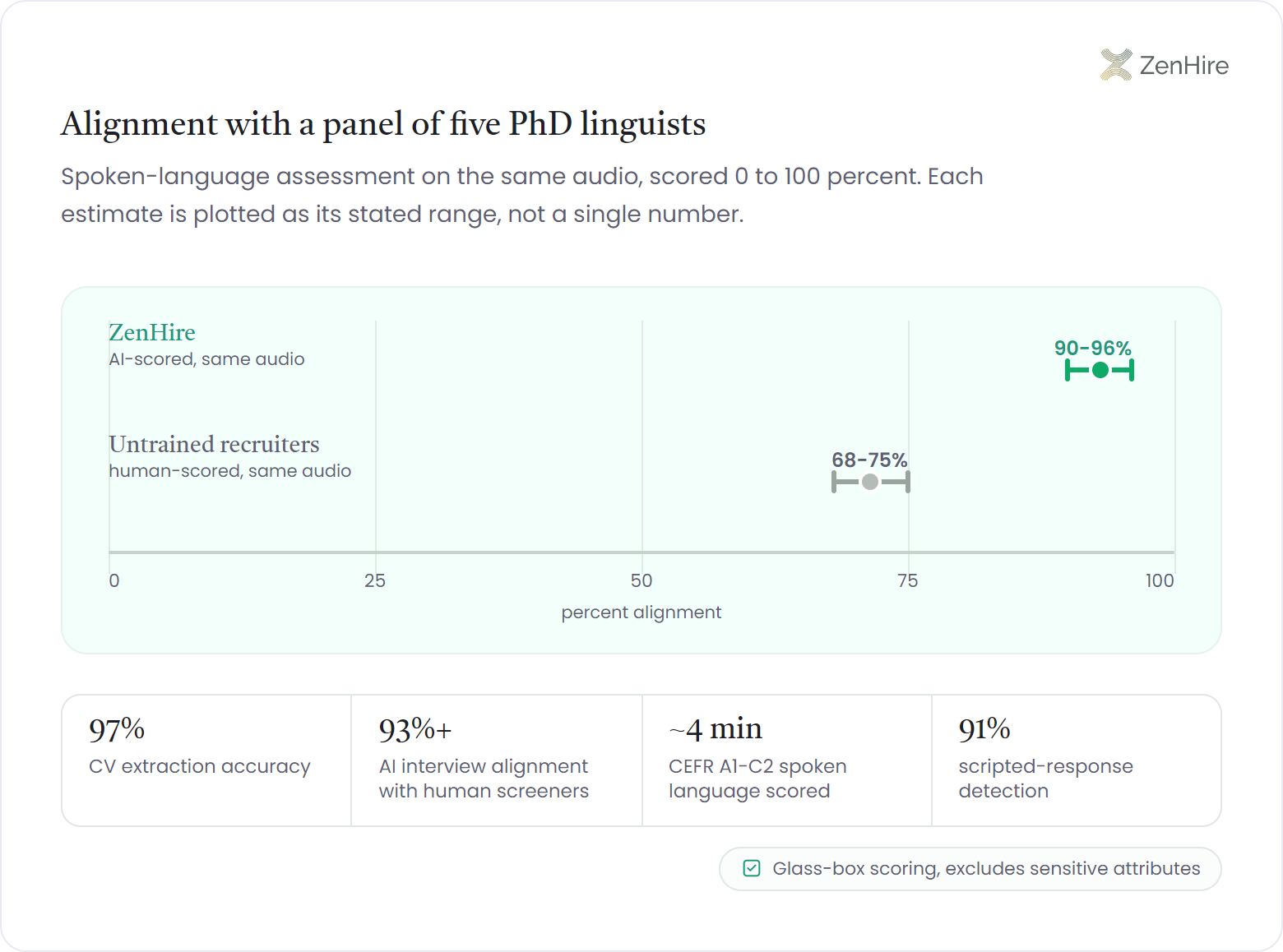
Because scoring is glass-box and excludes sensitive attributes, you get a defensible, ranked shortlist rather than a black-box verdict, with CV extraction at 97 percent and 93 percent or higher alignment with human screeners. One concrete example, an ats with ai screening auto-qualifies candidates above a threshold and routes flagged responses to a manual review queue. The edge case to plan for is a highly specialized role where the rubric needs human calibration first, so recruiters set the weights before the AI ranks.
Some argue native screening locks you into one vendor and that best-of-breed point tools score better. In practice, stitched tools create data silos, duplicate candidate records, and re-keying that slow the hire and hide where bias enters. A single platform keeps one auditable record, one scorecard standard, and one explainable score, which is why an end to end hiring platform beats a tool chain on both speed and fairness.
That consistency is what makes the ranked shortlist trustworthy at ATS scale: judged against a panel of five PhD linguists on identical interview audio, ZenHire's spoken-language scoring holds 90-96 percent agreement, whereas untrained recruiters manually reviewing the same clips reach only 68-75 percent — a gap that compounds fast across thousands of applicants in one pipeline.
Because every handoff between separate tools costs time, data, and consistency. When sourcing, screening, scoring, and onboarding share one record, a candidate never gets re-entered, a score never gets lost, and analytics cover the whole funnel instead of one slice.
One concrete example, a candidate rejected for one role surfaces automatically when a fitting position opens, because their full cross-position history lives in the same system rather than a forgotten spreadsheet. The edge case is a team mid-migration off a legacy ATS, where you can run ZenHire as an intelligence layer over the existing system via recruitment api for ats, push a ranked shortlist back, and consolidate once the value is proven.
Some teams argue a few point tools are cheaper than one platform. That math ignores the hidden cost of silos: duplicate licenses, integration upkeep, re-keyed data, and bias that hides in the gaps between systems. Running lead-to-seat in one all-in-one ATS removes that overhead and gives you one explainable, auditable trail end to end.
1. Source in
Applications arrive from job boards, careers page, email, and bulk import into one pipeline.
2. Screen and rank
AI parses, matches, and scores every candidate automatically as they enter.
3. Evaluate and decide
Standardized scorecards and bulk actions move qualified candidates through stages fast.
4. Onboard in place
The hired candidate advances with full history intact, no re-entry, no lost context.
An all-in-one applicant tracking system runs every hiring stage on one platform, from sourcing through onboarding. ZenHire combines position management, AI screening, scorecards, bulk operations, and dashboard analytics in a single system, so candidate data never splits across disconnected tools.
This ATS includes AI screening natively, not as a separate integration. An ats with ai screening parses, matches, and scores every applicant in the same record where you track them, with 97 percent CV extraction and 93 percent or higher alignment with human screeners.
One platform runs sourcing through onboarding when it is built as an end to end hiring platform rather than a tracker with add-ons. ZenHire keeps one candidate record from first contact to signed offer, preserving full cross-position history and audit trail throughout.
The all-in-one ATS handles high volume without slowing down, supporting 3,000+ candidates per role and bulk import of 1,000+ resumes at once. Bulk operations move many candidates through stages together, so large campaigns do not stall the system.
If you already have an ATS, ZenHire can run as an intelligence layer over it via REST API before any full switch. Legacy trackers manage workflow but do not evaluate candidates, so you add native AI screening, push a ranked shortlist back, and consolidate once the value is clear. It works well for call center and BPO hiring where volume overwhelms a legacy tracker.
Free for All-in-one ATS evaluation
A one-page checklist for moving from a legacy tracker to an AI-native ATS: how to run ZenHire as an intelligence layer first, which data to map, the volume and bias questions to ask, and how to prove value before you consolidate.


Empower your retail stores with ZenHire — AI-powered, ethical, and built for a faster, fairer future.
