
What Is Talent Acquisition?


· 9 min read
Talent acquisition is the strategic, long-term function of attracting, evaluating, and hiring the people an organization needs, run as a continuous system of workforce planning, employer brand, talent pipelines, and structured evaluation. That system is what turns hiring from a lottery into a repeatable outcome: the same scorecards and screening methods that a resume scan (r = 0.14) can never match, combined into a stack whose predictive validity clears 0.6. And the function is being rebuilt around exactly that evidence, inside a recruitment market climbing from roughly $450B in 2023 toward $870B by 2032, with about 70% of hiring teams expecting to use AI by 2025.
What is talent acquisition?
Talent acquisition is the strategic, long-term function of attracting, evaluating, and hiring the people an organization needs to grow, a continuous capability rather than a reaction to a single open role. It owns the whole system that produces good hires: workforce planning, sourcing channels, employer brand, candidate experience, the evaluation rubric, and the data that tells you whether any of it is working.
The mechanism is compounding. A team that invests in a talent pipeline and a clear employer brand does not start from zero each time a role opens; warm candidates, a known process, and a tested scorecard are already in place. A concrete example: a contact-center operator that has to stand up 300 agents for a new account in 60 days cannot recruit its way there one req at a time; it needs a talent-acquisition engine that was sourcing, screening, and warming candidates before the contract was even signed.
The edge case is the small team that genuinely hires twice a year. There, a full talent-acquisition apparatus is overkill, but even then the strategic mindset pays off, because every hire matters more and a single mis-hire is proportionally far more costly than at scale.
The strategic version of the function is now a technology discipline. The global recruitment market it sits inside is projected to grow from roughly $450B in 2023 to about $870B by 2032 (a ~7.5% CAGR), and roughly 70% of hiring teams expect to use AI by 2025, which means the workforce-planning and evaluation layers of talent acquisition are being run on data rather than instinct.
- Workforce planning: deciding what roles the business will need before they are urgent
- Employer brand and sourcing: building channels and reputation that pull candidates in
- Evaluation systems: consistent, structured assessment that predicts who will perform
- Pipeline and relationships: keeping strong past candidates warm instead of re-sourcing at cost
How does talent acquisition differ from recruitment?
Talent acquisition differs from recruitment in time horizon and scope: recruitment fills a specific open role now, while talent acquisition builds the ongoing capability to fill roles well. Recruitment is transactional and reactive: a vacancy appears, you source, screen, and close it. Talent acquisition is strategic and proactive; it plans for roles before they open, nurtures talent pools, and treats every hire as part of a system rather than an isolated event.
The mechanism behind the distinction is that quality is decided upstream. A recruiter racing to fill a seat takes whoever clears a low bar this week; a talent-acquisition function has already built the pipeline and the scorecard, so it selects rather than settles. For a deeper side-by-side, see talent acquisition vs recruitment; for the tactical mechanics of filling a role, see recruitment.
A concrete example: two companies both need a bilingual support agent. The reactive recruiter posts a job, waits, and phone-screens the first ten applicants. The talent-acquisition team already has a warmed pool, a CEFR-aligned language screen, and a structured rubric, so it shortlists in days, not weeks, with documented evidence. The edge case is genuine emergency backfill, where speed beats strategy and pure recruitment is the right tool; mature functions keep a fast lane for exactly this, fed by the pipeline the strategic work built.
| Dimension | Recruitment | Talent acquisition |
|---|---|---|
| Horizon | Fill the role now | Build the capability to fill roles |
| Trigger | A vacancy opens | Workforce plan anticipates need |
| Scope | Sourcing to offer for one role | Brand, pipeline, evaluation, data |
| Mindset | Reactive, transactional | Proactive, strategic |
What does the talent acquisition process look like?
The talent acquisition process looks like a funnel: workforce planning, sourcing, screening, structured interviewing, selection, offer, and onboarding, each stage narrowing a wide top into a few strong hires, with feedback loops that improve the next cycle. The decisive stages are screening and interviewing, because that is where consistency either holds or breaks and where most quality is won or lost.
The mechanism that separates a strong process from a leaky one is structure. Replacing gut-feel phone screens with a structured, scored evaluation is the single highest-leverage change a team can make, because method predicts performance far better than effort does. A concrete example: a team standardizing on a structured interview and a defined scorecard finds that two interviewers now reach the same verdict on the same candidate, and variance that used to lose strong people on a busy day disappears.
The edge case is high-volume hiring, where the funnel must absorb thousands of applicants without adding recruiters. There the process leans on automated, consistent first-pass screening so a strong communicator is not buried under a resume avalanche; the strategic layer lives in talent acquisition strategy, and the operational system that runs it day to day is an intelligent ATS.
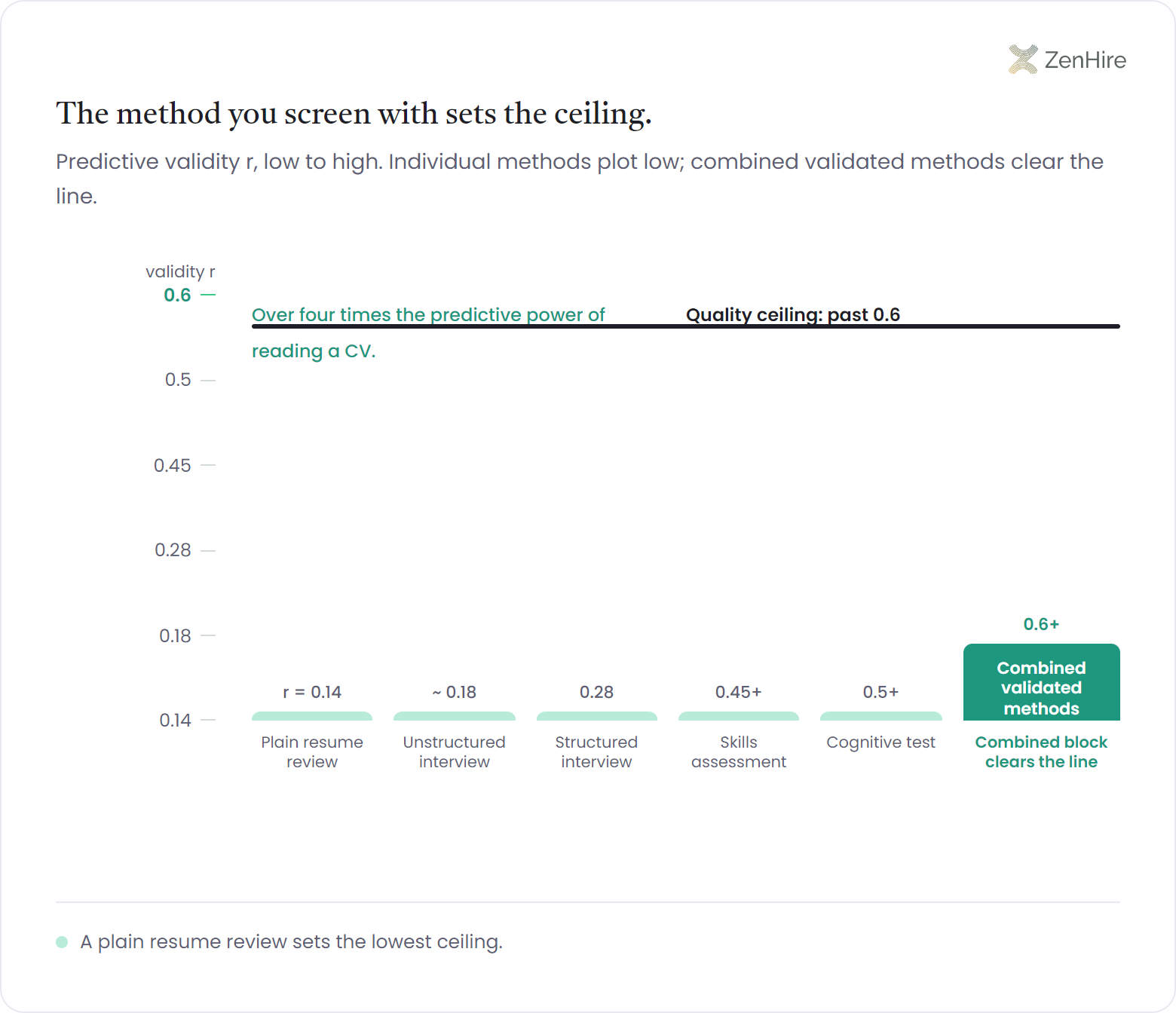
The stage where you screen is the stage that sets your ceiling, and the numbers are not close: a plain resume review tracks on-the-job performance at about r = 0.14, an unstructured interview at ~0.18, but structured interviews (0.28), cognitive tests (0.5+), and skills assessments (0.45+) stack past 0.6, over four times the predictive power of reading a CV. A talent-acquisition process that keeps its screening loose throws away most of that gain before selection even begins.
- Workforce planning: forecast the roles the business will need and when
- Sourcing: attract candidates through brand, referrals, and channels
- Screening: filter consistently for the signals that predict success
- Structured interviewing and selection: score every candidate against the same rubric
- Offer and onboarding: close the hire and support the critical first 90 days
How does AI support talent acquisition?
AI supports talent acquisition by removing repetitive screening work and making evaluation consistent at scale: it measures, while a person decides. It reads and structures CVs, runs first-pass interviews, scores communication and skills against a fixed rubric, and surfaces a ranked shortlist, so recruiters spend their time on judgment, relationships, and the close rather than on reading every resume.
The mechanism is consistency plus throughput. Every candidate clears the same bar, scored the same way, whether you hire ten people or ten thousand, which is exactly what a busy human panel cannot guarantee. That consistency is what lets a talent-acquisition function scale its pipeline without diluting its scorecard: ZenHire's AI interview software reads communication, soft skills, and reliability signals in roughly four minutes, while its CV extraction runs at about 97% accuracy and job-description matching aligns 93%+ with human evaluators, so what reaches the recruiter is evidence, not a gut rank. A concrete example: a team screening 3,000 applicants for 50 seats lets AI handle the consistent first pass and reviews decision-ready scorecards instead of raw resumes.
The edge case is fairness and trust, and it is where method matters most. The real risk is not AI; it is opaque, undocumented human screening that hides bias. A glass-box, explainable approach that excludes demographic signals, keeps auditable logs, and is SOC 2 and GDPR compliant can reduce exposure rather than add it. For the broader view, see AI for talent acquisition.
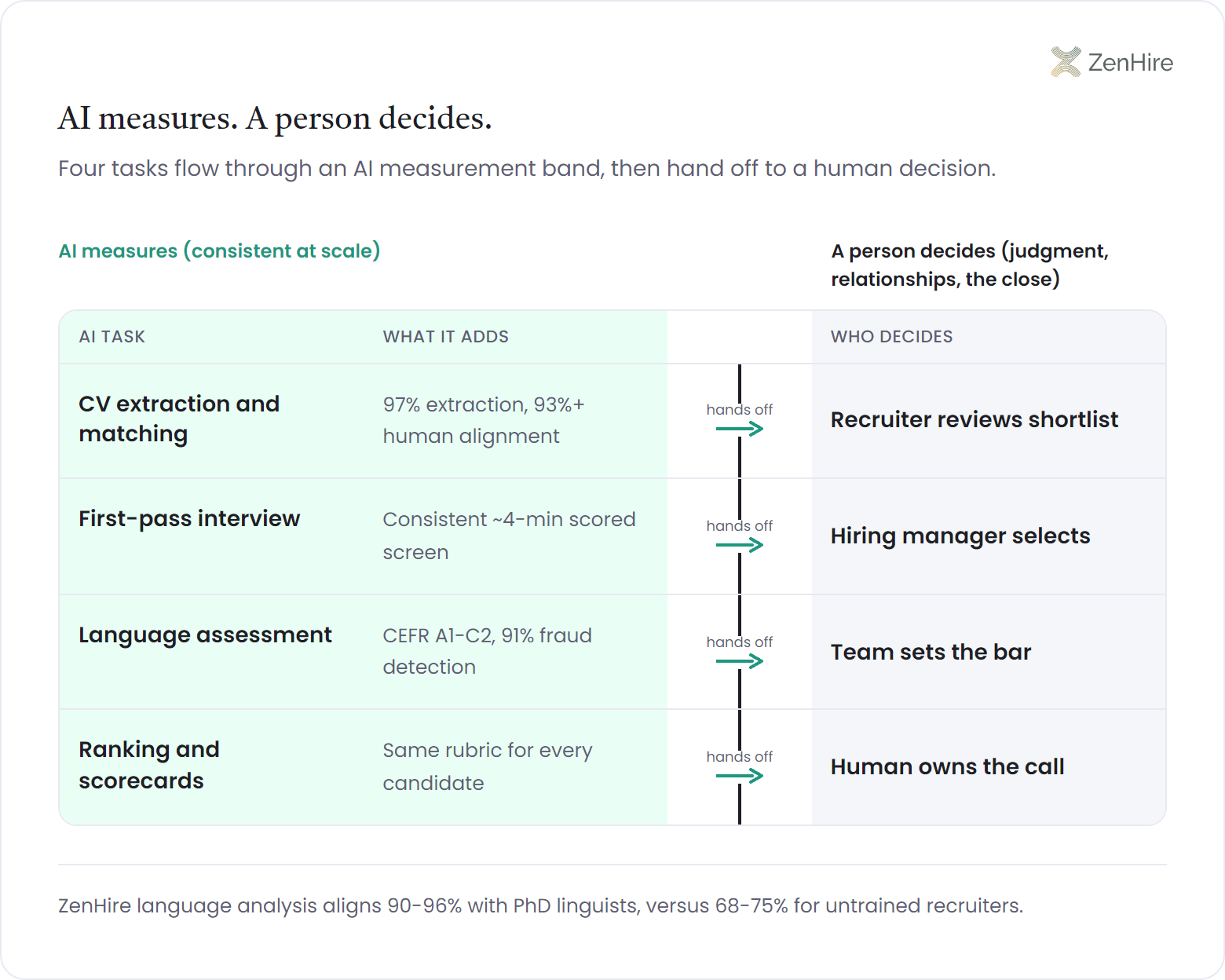
For talent-acquisition teams this is no longer an early bet: roughly 70% of hiring teams expect to use AI by 2025, and those already using it report around 62% faster hiring and ~59% lower cost (industry research), gains that come from automating the repetitive screen rather than from outsourcing the decision. ZenHire's language analysis aligns 90-96% with PhD linguists against 68-75% for untrained recruiters, and flags scripted or AI-generated answers at ~91%.
| AI task | What it adds | Who decides |
|---|---|---|
| CV extraction and matching | 97% extraction, 93%+ human alignment | Recruiter reviews shortlist |
| First-pass interview | One ~4-min scored screen per applicant | Hiring manager selects |
| Language assessment | Placement across CEFR A1-C2, 91% fraud detection | Team sets the bar |
| Ranking and scorecards | Same rubric for every candidate | Human owns the call |
I am building an AI recruiter, so people expect me to say AI should run hiring. I do not believe that. The job of talent acquisition has never really been to fill seats faster; it is to make decisions that change people's lives well, and to do it consistently across thousands of candidates a human panel could never judge the same way twice. What I want for an in-house team is leverage, not replacement: let the machine do the repetitive, consistent measurement, and let your recruiters spend their hours where judgment actually moves the needle. AI should measure. A person should decide. A team that gets that split right stops drowning in resumes and starts doing the strategic work talent acquisition was always supposed to be.
Frequently asked questions
What is talent acquisition in simple terms?+
Talent acquisition is the strategic, ongoing work of attracting, evaluating, and hiring the people a company needs, not just filling today's open role, but building the brand, pipeline, and evaluation systems that make every future hire easier and better matched.
What is the difference between talent acquisition and recruitment?+
The difference is time horizon and scope: recruitment fills a specific role now, while talent acquisition builds the long-term capability to fill roles well. Recruitment is reactive and transactional; talent acquisition is proactive and strategic, planning for roles before they open and nurturing talent pools over time.
What does the talent acquisition process include?+
The talent acquisition process includes workforce planning, sourcing, screening, structured interviewing, selection, offer, and onboarding, a funnel that narrows many applicants into a few strong hires, with feedback loops that improve each cycle. Quality is mostly set in the screening and interviewing stages.
How does AI help talent acquisition?+
AI helps talent acquisition by removing repetitive screening and making evaluation consistent at scale: it measures, while a person decides. It reads CVs, runs first-pass interviews, and scores candidates against a fixed rubric, so teams report faster, cheaper hiring while keeping the human in charge of the final call.
Is talent acquisition a part of HR?+
Talent acquisition usually sits within HR but operates as its own strategic discipline. It is more specialized and forward-looking than general HR administration, focused specifically on building the systems, brand, and pipelines that bring the right people into the organization.
Free for talent acquisition strategy
The talent acquisition maturity checklist
A one-page checklist for moving from reactive recruitment to a strategic talent-acquisition function: what to plan, what to standardize, and which signals to weight when you screen.