
How Do You Build a Talent Acquisition Strategy?


· 8 min read
You build a talent acquisition strategy by converting the approved headcount plan into five linked parts: demand, supply channels, structured evaluation, employer brand, and measurement. Funnel math sets the sourcing load: at 50 applicants per hire, 20 engineering hires in a quarter mean a 1,000-candidate pipeline to build and screen. The part that decides whether the strategy actually produces good hires is evaluation, where a gut-feel interview carries a predictive validity of just r = 0.18 while a structured interview paired with skills assessments clears 0.6+, and four metrics, time-to-hire, cost-per-hire, quality-of-hire, and pipeline conversion, close the loop.
What goes into a talent acquisition strategy?
A talent acquisition strategy goes well beyond posting jobs; it is the documented system that turns workforce demand into hires through defined channels, evaluation methods, and metrics. It answers four questions in order: who are we hiring, where do we find them, how do we decide, and how do we know it worked. Skip any one and the others quietly break.
Mechanically, a strategy is a closed loop. Demand comes from the headcount plan; supply comes from your sourcing strategy and an always-on talent pipeline; evaluation is the structured screen that ranks who fits; employer brand is the pull that lowers your cost to source; and measurement feeds back into all of it. The piece most in-house teams underbuild is evaluation: they invest in channels to get applicants, then decide with a gut-feel phone screen, which is where most of the predictive signal leaks out.
A concrete example: a 200-person SaaS company planning to add 40 roles next year does not write 40 separate hiring plans. It segments demand into three role families (engineering, go-to-market, support), assigns a primary channel and a standard scorecard to each, and sets one shared dashboard. The edge case is the bursty, high-volume hire (a support team scaling for a product launch), where the same framework must flex to thousands of applicants per req without adding recruiters, which is exactly where consistent, automated screening earns its keep.
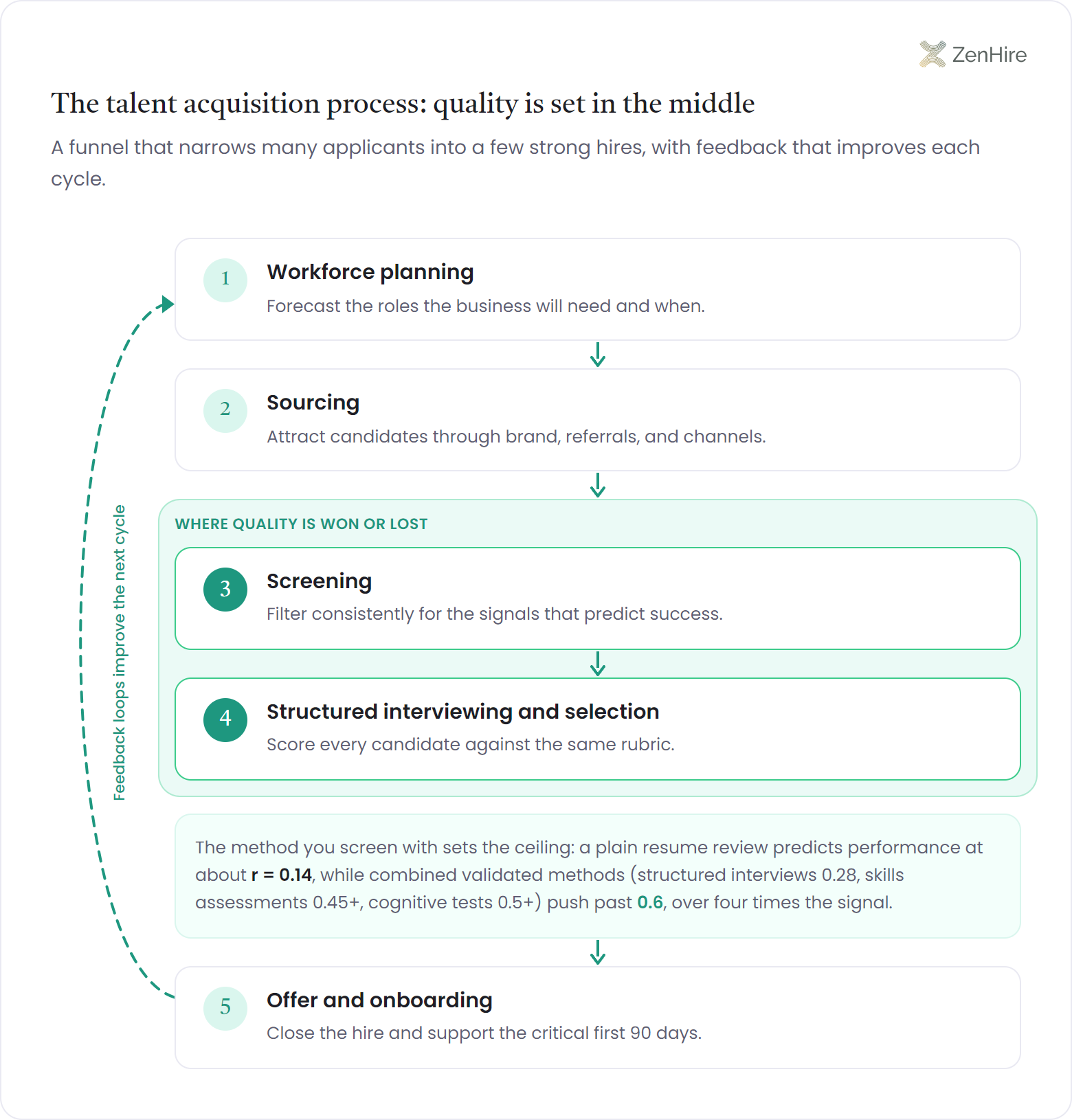
Where you spend the evaluation budget matters more than where you spend the sourcing budget: reading a CV predicts on-the-job performance at about r = 0.14, and letting a manager wing the interview lands near ~0.18, but building the strategy around structured interviews layered with cognitive and skills assessments carries the signal past 0.6, roughly four times the predictive power drawn from the same pool of candidates.
- Demand: the headcount plan, covering roles, levels, timing, and locations
- Supply: sourcing channels and a warm talent pipeline per role family
- Evaluation: standardized structured interviews and skills assessments that predict fit
- Employer brand: the employer branding that lowers cost to source
- Measurement: a fixed set of TA metrics read by role and channel
How does a talent acquisition strategy align with headcount plans?
A talent acquisition strategy aligns with headcount plans by treating the approved headcount plan as the demand input that drives every sourcing, capacity, and budget decision in the strategy. The headcount plan says what the business needs and when; the TA strategy says how it gets filled and what it costs. When they are disconnected, you get the two classic failures: open reqs no one is sourcing for, and a recruiting team busy on roles finance already froze.
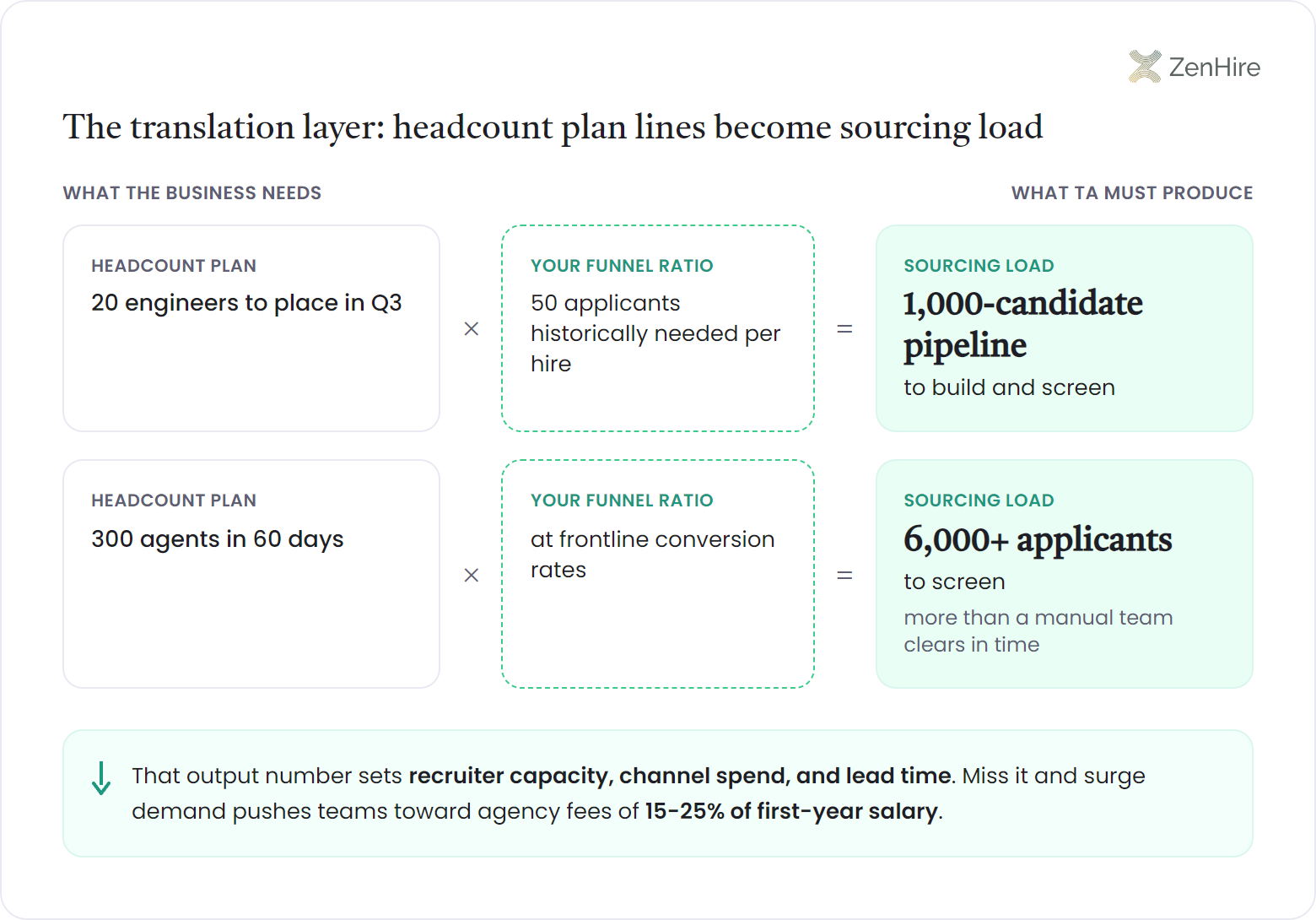
The mechanism is a translation layer. You convert each line of the headcount plan into a sourcing load using your own funnel math. If a role historically needs 50 applicants to make one hire and you must place 20 engineers in Q3, that is a 1,000-candidate pipeline to build and screen, not a vague intention. That number sets recruiter capacity, channel spend, and lead time. Run the conversion against your recruitment funnel ratios so the plan is grounded in real conversion, not optimism.
A worked example: a contact-center operator wins a new account and must stand up 300 agents in 60 days. The headcount plan gives the number and the deadline; the TA strategy back-solves the pipeline: at frontline conversion rates that can mean 6,000-plus applicants to screen, which no manual team clears in time. The edge case is the reverse shock: a hiring freeze mid-quarter. A strategy aligned to the plan reallocates that screening capacity to a warm pipeline for when hiring reopens, rather than letting sourced candidates go cold. This is also where the in-house vs agency decision gets made: surge demand is what pushes teams toward agency fees of 15-25% of first-year salary, a cost an aligned, automated pipeline can often avoid.
| Headcount plan input | What the TA strategy must produce |
|---|---|
| Roles and levels | Channel and scorecard assigned per role family |
| Hire count and timing | Pipeline size and lead time from funnel conversion math |
| Locations and languages | Sourcing reach and objective screening (e.g., CEFR language proof) |
| Budget and freezes | Recruiter capacity and build-vs-buy sourcing decisions |
How do you measure a talent acquisition strategy?
You measure a talent acquisition strategy with a small, fixed set of throughput and quality metrics, namely time-to-hire, cost-per-hire, quality-of-hire, and pipeline conversion, read by role and by source, not as one company-wide average. The average hides the problem; the segments reveal it. A strategy that looks healthy in aggregate can be quietly failing in the one role family that matters most this quarter.
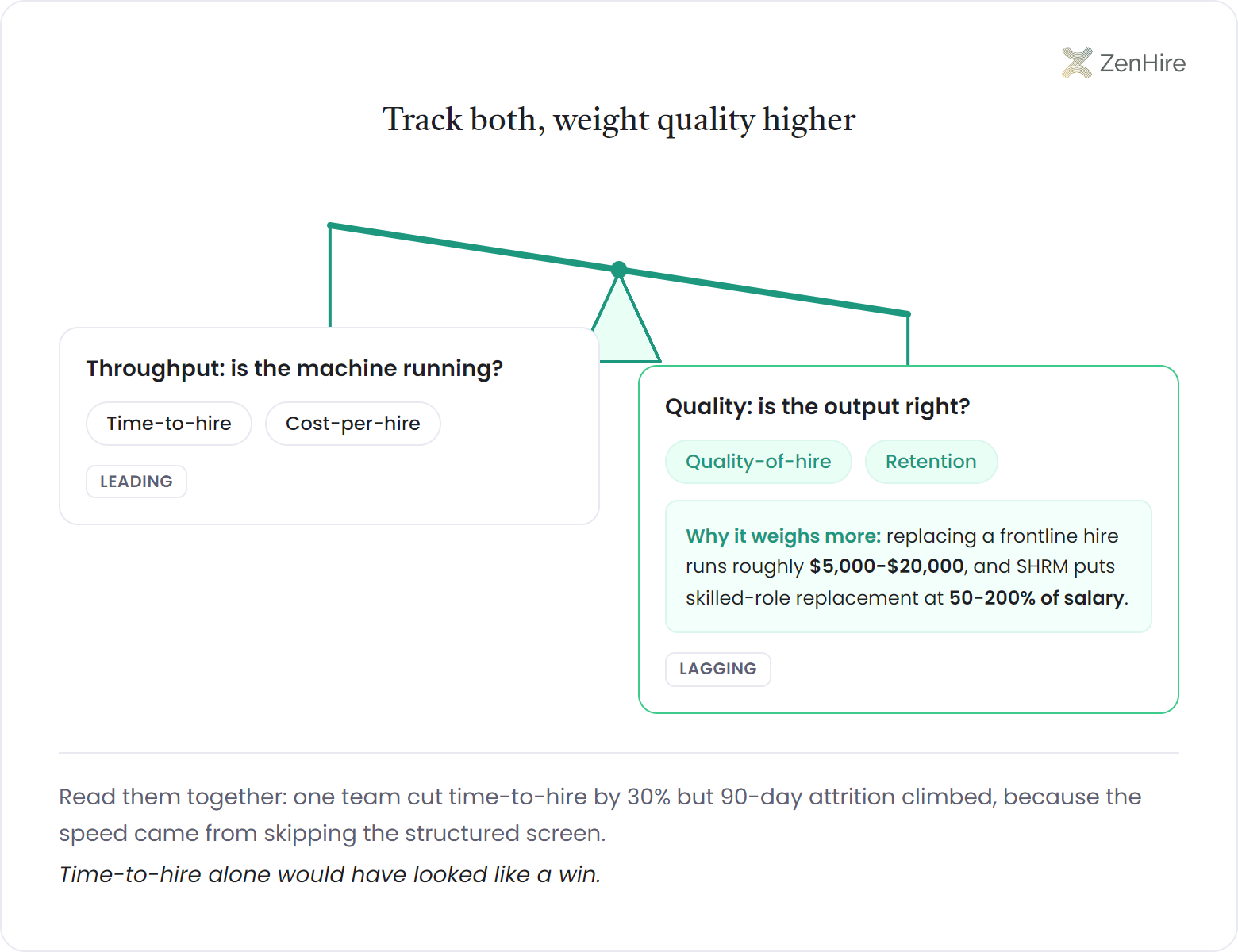
The mechanism is leading-versus-lagging. Throughput metrics like time-to-hire and cost-per-hire tell you whether the machine is running; quality-of-hire and retention tell you whether it is producing the right output. Track both, and weight quality higher, because a fast, cheap process that ships mis-hires is more expensive than a slightly slower one that does not, since replacing a frontline hire runs roughly $5,000-$20,000 and SHRM puts skilled-role replacement at 50-200% of salary. For the full scorecard, pair this with the talent acquisition metrics you report to leadership.
A concrete example: a TA team cut time-to-hire by 30% but watched 90-day attrition climb, because the speed came from skipping the structured screen. Reading the metrics together caught it; reading time-to-hire alone would have looked like a win. The edge case is the brand-new program with no baseline: here you measure against external benchmarks and your own first 90 days, then switch to internal trends once you have data. Measurement discipline is also what keeps tooling decisions honest as the market shifts: with roughly 70% of hiring teams projected to run AI by 2025 and adopters citing about 62% faster and 59% cheaper hiring, only a strategy that reads these four metrics by role and source can prove whether a new tool actually moved the number or just moved the story.
Pick the smallest scorecard that still drives decisions. Four metrics read by role and source, time-to-hire, cost-per-hire, quality-of-hire, and pipeline conversion, answer the only two questions leadership asks: is hiring keeping pace with the plan, and are the people we hire any good?
Most in-house TA teams I meet have a sourcing strategy and call it a talent acquisition strategy. The two are not the same. Sourcing fills the top of the funnel; strategy is the discipline of deciding, consistently, who comes out the bottom. I am building an AI recruiter precisely because the decision layer is where strategy usually collapses. You can pour budget into channels and still hire the wrong person if every recruiter screens to a different bar on a different day. Get the evaluation consistent and measured, tie it to the headcount plan, and your strategy stops being a document nobody reads and starts being a forecast you can defend to the CFO.
Frequently asked questions
What is the difference between a talent acquisition strategy and recruiting?+
A talent acquisition strategy is the long-term system; recruiting is the act of filling a specific role. Strategy plans demand, channels, evaluation, and measurement across the whole hiring function, while recruiting executes against it req by req. For the full distinction, see talent acquisition vs recruitment.
How do you build a talent acquisition strategy from scratch?+
You build a talent acquisition strategy by starting from the headcount plan and working outward to channels, a standard scorecard, and a metrics dashboard. Map demand to role families, assign each a sourcing channel and a structured evaluation, then set the small set of metrics you will read by role and source.
What are the components of a TA strategy framework?+
A TA strategy framework has five components: demand, supply, evaluation, employer brand, and measurement. Demand is the headcount plan, supply is your sourcing and talent pipeline, evaluation is the structured screen, brand is the pull that lowers cost to source, and measurement is the feedback loop.
How often should you update a talent acquisition strategy?+
You should update a talent acquisition strategy whenever the headcount plan changes, and review it at least quarterly. Because the strategy is driven by demand, a new account win, a freeze, or a reorg should trigger a recalculation of pipeline size and recruiter capacity, not a wait for the annual planning cycle.
Does a talent acquisition strategy need its own software?+
A talent acquisition strategy needs a system of record and consistent evaluation, which is what [talent acquisition software](/talent-acquisition/software) provides. The strategy is the plan; the software is how you run the same scorecard at scale and measure the result without adding recruiters as volume grows.
Free for talent acquisition strategy
The TA strategy framework worksheet
A one-page worksheet that walks your team from headcount plan to pipeline size to scorecard to metrics: the five parts of a talent acquisition strategy, with the funnel math filled in.