
How Do You Build Employer Branding for Talent Acquisition?


· 8 min read
You build employer branding for talent acquisition by making every candidate touchpoint deliver on the promise you market: fast answers, consistent evaluation, and personalized feedback for every applicant, including the rejected majority. A 48-hour response SLA and one fair rejection reason fix the top candidate complaint, ghosting, at zero media spend, and a strong brand cuts reliance on agency fees running 15-25% of first-year salary. Measure impact with offer-acceptance rate, application-to-interview conversion, source-of-hire quality, and candidate-experience scores, not follower counts.
Why does employer branding matter for talent acquisition?
Employer branding matters for talent acquisition because it decides who applies, who accepts, and what they tell the next candidate. It is the multiplier on every sourcing dollar you spend. A strong brand pulls qualified people toward you so you compete less on cash and recruit more on reputation; a weak one means you pay agency fees, post longer, and lose finalists at the offer stage.
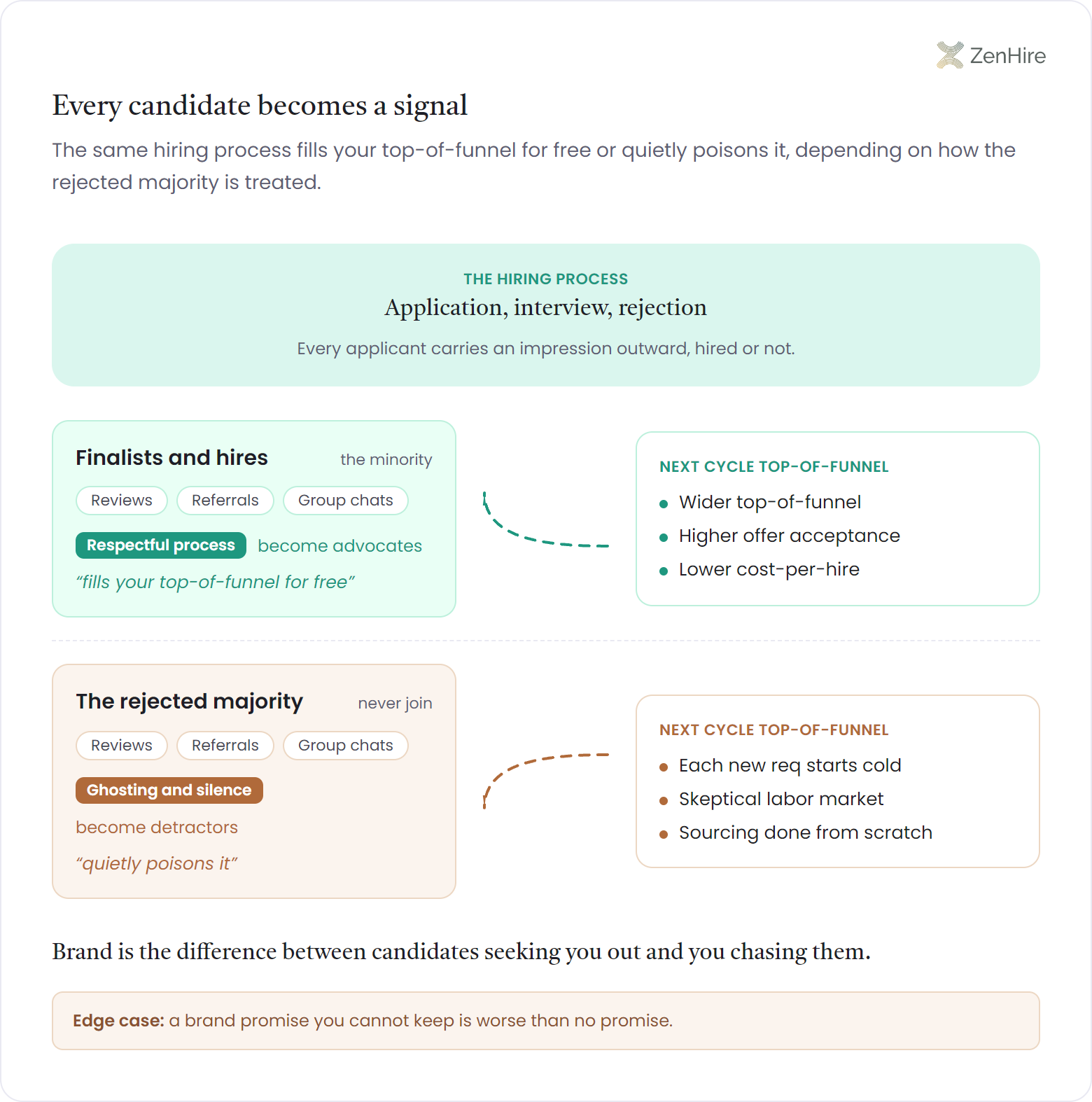
The mechanism is simple: candidates talk. Every person who applies experiences your brand whether you manage it or not, and the rejected majority, who never join, still carry an impression into reviews, referrals, and group chats. For an in-house talent acquisition team, that word-of-mouth either fills your top-of-funnel for free or quietly poisons it. Brand is the difference between candidates seeking you out and you chasing them.
Consider a mid-size BPO standing up a 300-seat campaign in 60 days. A reputation for ghosting applicants means each new req starts cold, fighting the same skeptical labor market. A reputation for fast, respectful, feedback-rich hiring means referrals and repeat applicants do half the sourcing, and the brand compounds with every cohort. The edge case worth naming: a brand promise you cannot keep is worse than no promise. Marketing a warm, human culture and then running a cold, silent process creates a credibility gap candidates feel immediately and repay with bad reviews.
A weak employer brand has a direct price tag: when inbound dries up, you backfill with agencies charging 15-25% of first-year salary per placement, and you sit inside a recruitment market projected to grow from roughly $450B in 2023 to about $870B by 2032 (~7.5% CAGR, industry estimates). Competition for the same candidates is only intensifying, and brand is the cheapest way to stand out in it.
- Wider top-of-funnel: a trusted brand attracts qualified inbound instead of paid-for applicants
- Higher offer acceptance: finalists who already respect you say yes more often
- Lower cost-per-hire: referrals and repeat applicants reduce reliance on agency and job-board spend
- Reputation insurance: the rejected majority become advocates, not detractors, when treated well
How do you build employer branding on a budget?
You build employer branding on a budget by fixing the candidate experience first, because the experience is the brand and it is mostly free to improve. Responsiveness, clarity, and feedback cost process discipline, not media spend. Before you commission a single culture video, close the gaps that already damage your reputation: applications that vanish, interviews that drag, and rejections that arrive as silence.
The highest-leverage, lowest-cost move is to give every candidate a clear, timely answer and, where you can, useful feedback. Ghosting and non-responsiveness are among the most common candidate complaints across hiring segments, and they cost nothing but attention to fix. Structured, consistent evaluation makes this scalable: when every applicant is screened against the same bar, you can return a fair decision and a reason quickly even at high volume. ZenHire generates personalized feedback for every applicant from their own assessment results, so a rejection becomes a brand-positive touchpoint instead of a dead end, a candidate experience upgrade that doubles as employer branding. Pair it with an assessment short enough to feel like a courtesy rather than a chore: ZenHire's async interview runs about 4 minutes, and a candidate who can complete your first step over a coffee break leaves with a warmer impression of the brand than one dragged into a 45-minute scheduling marathon.
A concrete budget play: an in-house team with no marketing budget rewrites its rejection email to include one specific, fair reason and a thank-you, and commits to a 48-hour response SLA on every application. Within a hiring cycle, employer-review sentiment shifts and referral volume rises, with zero dollars spent. The edge case to manage: feedback must be consistent and defensible, or it backfires. Inconsistent, off-the-cuff feedback invites disputes and bias claims, which is exactly why an explainable, glass-box evaluation that documents every score is safer to share than a recruiter's gut impression. Authenticity is the other guardrail: borrow real employee stories and candidate language, not stock-photo slogans.
Free brand-building beats paid brand-building because it is provable: candidates trust the experience they had over the ad they saw. A short, consistent, feedback-rich process is also defensible, which matters the moment a rejected candidate questions your reasoning in public. ZenHire's evaluation aligns 93%+ with human evaluators on matching and 90-96% with PhD linguists on language, so the fair reason you put in that rejection email is one your brand can actually stand behind under scrutiny.
- Answer everyone: a 48-hour response SLA and a real rejection reason cost nothing and fix the top complaint
- Respect their time: a ~4-minute assessment tells candidates you value them more convincingly than any careers-page tagline
- Feedback as a gift: personalized, consistent feedback turns a no into an advocate
- Borrow real voices: employee stories and candidate language out-convert polished stock messaging
How do you measure employer branding impact?
You measure employer branding impact with funnel and outcome metrics: offer-acceptance rate, application-to-interview conversion, source-of-hire quality, and candidate-experience scores, not vanity follower counts. Brand is real only when it moves a hiring number, so anchor every measurement to a decision a candidate makes: to apply, to stay in the process, or to accept.
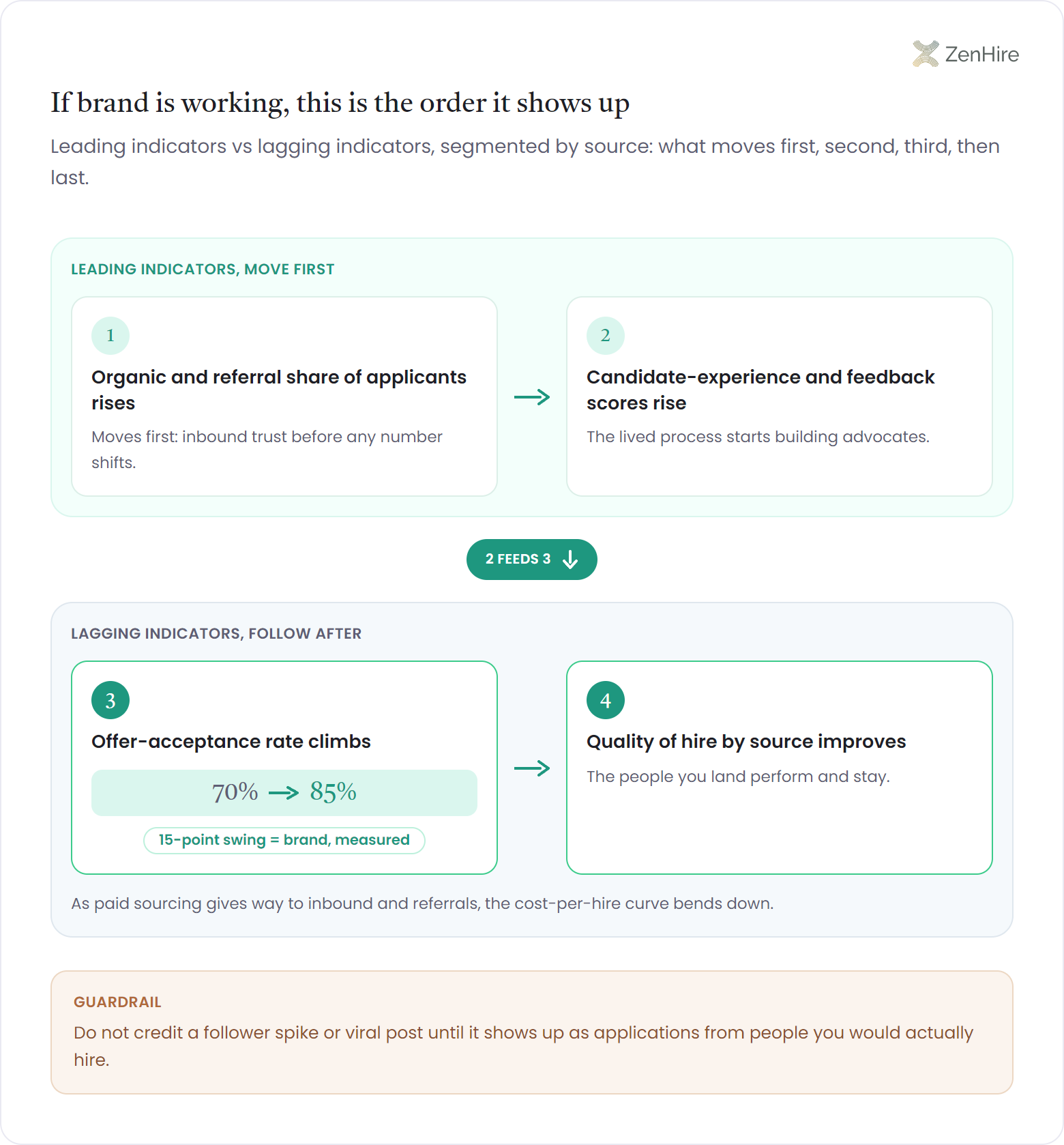
Track the leading indicators (application volume from organic and referral channels, candidate-experience and feedback scores) alongside the lagging ones (offer-acceptance rate and quality of hire by source). If a brand investment is working, organic applications and referral share rise first, then acceptance climbs, then the quality of who you land improves. Segment everything by source so you can tell which channel and which message actually earned trust. Read brand against cost-per-hire too: a strengthening brand should bend that curve down as paid sourcing gives way to inbound and referrals.
A concrete example: a team watches offer-acceptance climb from 70% to 85% after tightening response times and adding feedback. That 15-point swing is brand, measured. The edge case to avoid: do not credit a follower spike or a viral post until it shows up as applications from people you would actually hire. Vanity metrics flatter the dashboard; the metrics below tie brand to hires.
| Metric | What it tells you about your brand |
|---|---|
| Offer-acceptance rate | Do finalists respect you enough to say yes when they have other options? |
| Application-to-interview conversion | Are you attracting qualified inbound, or just volume? |
| Source-of-hire quality | Which channels and messages deliver hires who perform and stay? |
| Candidate-experience / feedback score | Is the lived process building advocates or detractors? |
| Organic & referral share of applicants | Is brand pulling people in without paid spend? |
I am building an AI recruiter, and the thing that surprised me is how much of employer brand is just whether you bother to reply. We obsess over careers pages while the rejected 95% (the people who actually outnumber your hires) walk away in silence and tell everyone. To an in-house TA team I would say this: your brand is not your tagline, it is the email a candidate gets at 9pm after a no. Automate the screening so a human is never the bottleneck, then send everyone a fair, specific answer fast. Done right, AI does not make hiring feel colder; it gives you the time to make it feel human at a scale you never could by hand.
Frequently asked questions
What is employer branding in talent acquisition?+
Employer branding in talent acquisition is the reputation that determines who applies and who accepts, built across every application, interview, and rejection, not just the careers page. For an in-house team it is the multiplier on sourcing: a strong brand brings qualified people to you, a weak one sends you chasing and paying for them.
How do you improve your employer brand quickly?+
You improve your employer brand quickest by fixing responsiveness and feedback, because ghosting is the top candidate complaint and it costs nothing but discipline. Commit to a 48-hour response SLA, give every rejected candidate one fair reason, and keep the process short; those changes move sentiment within a single hiring cycle.
Can you build an employer brand without a budget?+
You can build a strong employer brand with almost no budget, because the experience is the brand and most of it is free to improve. Consistent evaluation, fast clear answers, and personalized feedback turn even rejected candidates into advocates, far more persuasive than paid ads, and provable because candidates lived it.
How do you measure employer brand impact on hiring?+
You measure employer brand impact with offer-acceptance rate, application-to-interview conversion, source-of-hire quality, and candidate-experience scores, segmented by source. Vanity metrics like follower counts do not count until they show up as applications from people you would actually hire.
Does a good employer brand lower hiring costs?+
A good employer brand directly lowers hiring costs by replacing paid sourcing with organic and referral inbound. The more qualified applicants you attract for free, the less you spend on agency fees that run 15-25% of first-year salary and on job-board ads, and the faster strong finalists accept.
Free for employer branding
The candidate-experience employer-brand audit
A one-page audit for in-house TA teams: the response-time SLAs, feedback templates, and funnel metrics that turn your hiring process into your strongest, cheapest employer brand.