
How Do You Build a Talent Sourcing Strategy?


· 8 min read
You build a talent sourcing strategy by mapping the roles you hire most to the channels that reach them and pre-qualifying candidates before the requisition opens. Weight referrals, your own talent pool, communities, direct outreach, and job boards per role: one high-volume post can pull 2,000-5,000 applications, while an agency placement costs 15-25% of first-year salary. The pre-qualifying step is what keeps a busy channel useful, because a scored screen forecasts on-the-job success at 0.28 where a quick gut-feel pass sits near 0.18, and AI applies that score to the whole flood overnight with roughly 97% parsing accuracy.
What is a talent sourcing strategy?
A talent sourcing strategy is a deliberate, repeatable plan for finding and engaging candidates: it names the roles you hire most, the channels that reach the right people for each, and the screening that turns raw inbound into a ranked shortlist, and it is the difference between answering an open requisition with a fresh job post and answering it with a pool you have already built and qualified.
Mechanically, the strategy works backwards from your hiring pattern. You look at the roles you fill every quarter, decide whether each is best served by referrals, communities, direct outreach, or your own past applicants, and set a consistent way to screen what comes in. Sourcing is the top of the recruitment funnel: get the inputs right and every stage below it gets cheaper.
A concrete example: an in-house team that hires twenty support agents a quarter does not run twenty separate searches. They keep a standing pool of pre-screened agents, refresh it from referrals and re-engaged past applicants, and pull from it the day a seat opens. The edge case to plan for is the rare, senior, or niche role, where proactive outreach and a curated talent pipeline matter more than volume channels, because the candidate may not be looking at all.
Sourcing is where in-house teams quietly differentiate from agencies. An agency placement costs 15-25% of first-year salary in fees (industry norm); a sourcing strategy that builds your own warm pool turns that recurring spend into an internal asset you own and reuse.
- Recurring roles first: map the jobs you hire repeatedly before the niche one-offs
- Channel per role: referrals and communities for some, direct outreach for others
- Pre-qualification built in, so every source feeds the same consistent screen
- A pool you own: re-engaged past applicants and silver-medalists, not just new inbound
Which channels power a talent sourcing strategy?
The channels that power a talent sourcing strategy are referrals, your own talent pool, communities and niche networks, direct outreach, and job boards, used as a deliberate mix, not a single bet. Each surfaces a different kind of candidate, so a strategy is defined by how you combine and weight them for a given role, not by which one you default to.
The mechanism behind the mix is that channels trade reach against fit. Job boards and paid posts give the widest reach but the lowest signal, and they are where a single role can draw thousands of applications. Referrals and re-engaged past applicants give the narrowest reach but the highest fit, because the candidate already maps to your context. The job of an in-house sourcer is to spend the most effort where fit is highest and lean on volume channels only when the warm pool runs dry. This is exactly how you source candidates in-house without an agency's headcount.
An example: for a recurring bilingual support role, a team might fill 40% from referrals, 30% from re-engaged past applicants, and 30% from a targeted board post, and only widen the board spend during a campaign spike. The edge case is the role no channel reaches well; for genuinely scarce skills you switch from sourcing volume to a named, researched outreach list, accepting fewer candidates in exchange for far better fit, and you protect that work with strong candidate relationship management so the connection survives between openings.
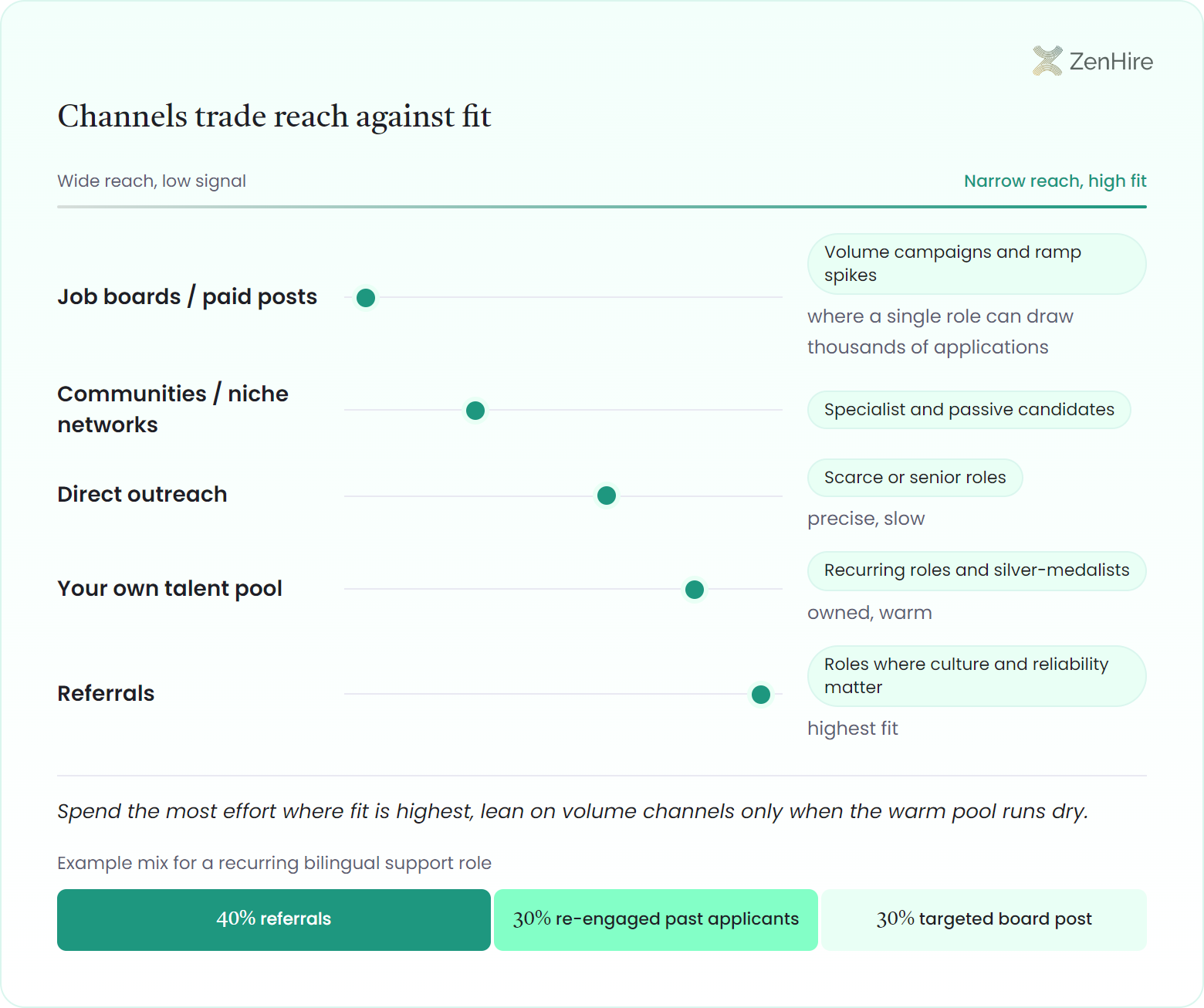
| Channel | Reach vs. fit | Best for |
|---|---|---|
| Referrals | Narrow reach, high fit | Roles where culture and reliability matter |
| Your own talent pool | Owned, warm | Recurring roles and silver-medalists |
| Communities / niche networks | Targeted | Specialist and passive candidates |
| Direct outreach | Precise, slow | Scarce or senior roles |
| Job boards / paid posts | Wide, low signal | Volume campaigns and ramp spikes |
How does AI scale a talent sourcing strategy?
AI scales a talent sourcing strategy by doing the volume work a sourcing mix creates (parsing, matching, scoring, and giving feedback to every candidate consistently), so a small in-house team can run agency-scale sourcing without agency-scale headcount. The strategy decides where candidates come from; AI decides what happens to the flood once they arrive, which is where most in-house teams break.
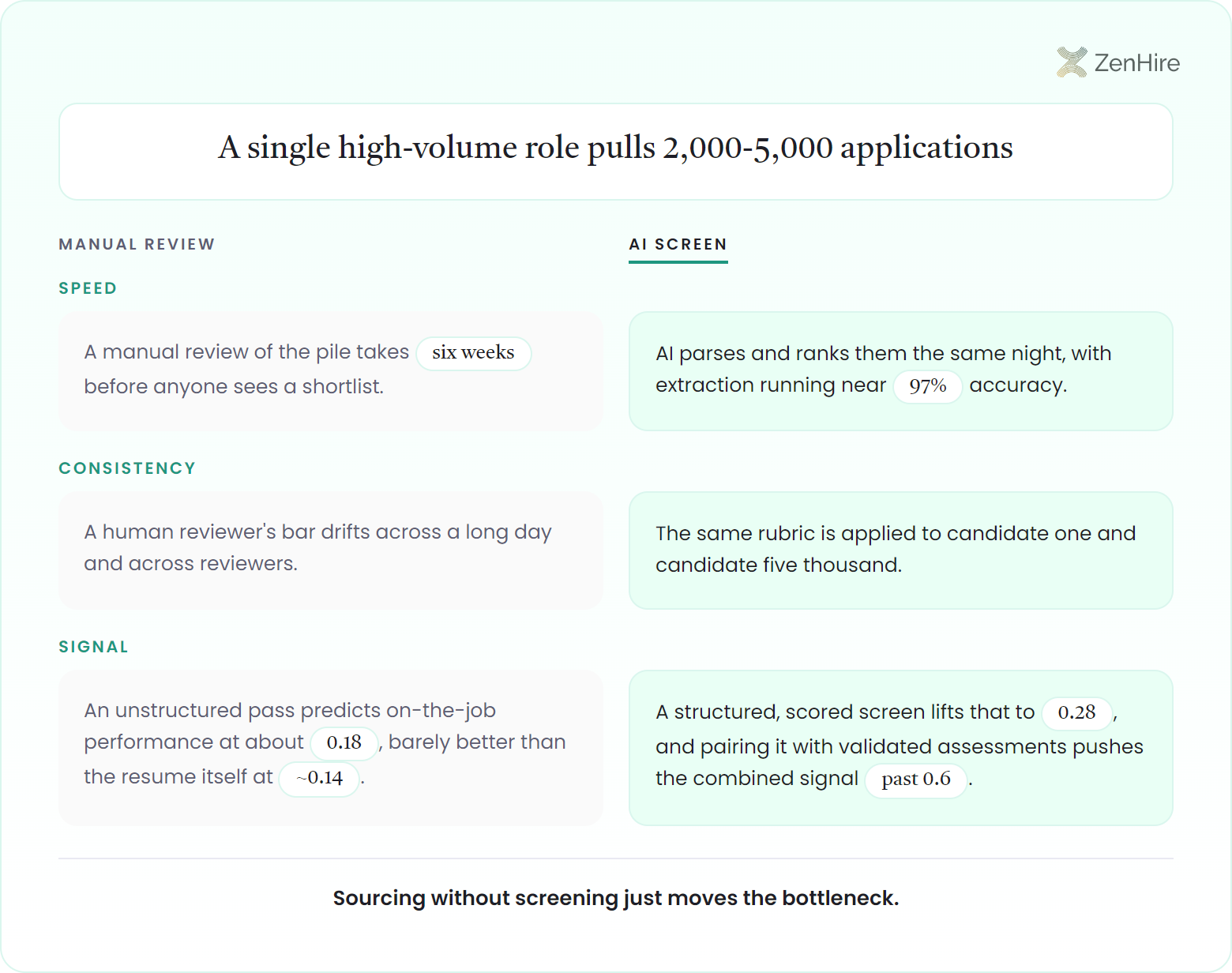
The mechanism is consistency at scale. Sourcing rewards volume, but volume is exactly where a human reviewer's bar slips, both across a long day and between different reviewers. Read the numbers as a ladder: the resume alone predicts on-the-job performance at ~0.14, an eyeball pass over that same resume adds almost nothing at about 0.18, imposing a structured, scored screen lifts it to 0.28, and layering in validated assessments carries the combined signal past 0.6. ZenHire holds the top of that ladder for candidate one and candidate five thousand alike: semantic CV matching that tells whether a skill was used or merely mentioned, a roughly four-minute AI interview that reads communication and soft skills, and personalized feedback for everyone, which keeps your sourcing channels healthy because applicants do not feel ghosted.
A concrete example: a high-volume role pulls 2,000-5,000 applications, and AI parses and ranks them the same night rather than over the six weeks a manual review would eat, with extraction landing near 97% accuracy so the ranking is trustworthy and not merely quick. What a strong channel quietly hands you alongside the good candidates is the edge case worth naming: duplicate CVs, AI-written answers, and proxy interviews all ride in on the same flood, so glass-box, bias-mitigated screening with fraud detection earns its keep next to raw speed. A sourcing strategy that scales unfairly does not scale at all.
Roughly 70% of hiring teams expect to use AI in recruiting by 2025, reporting around 62% faster processes and 59% lower cost (industry research). For an in-house sourcer the payoff reads differently: the strategy no longer collapses the moment a channel succeeds, because consistent scoring stops your carefully built warm pool from decaying back into an unsorted pile.
- Parse and rank inbound the same day: turn an application flood into a scored shortlist
- Score every candidate the same way, with a consistent rubric, not interviewer drift
- Feed feedback to all applicants to protect channel health and your employer brand
- Flag fraud and bias: fair, explainable screening at volume, not just fast screening
When I talk to in-house teams about sourcing, the conversation almost always jumps to channels: which job board, which outreach tool, which referral bonus. I think that is the second question. The first is what happens to the people once they arrive, because the moment a channel works it drowns you, and a drowning team screens worse, not better. I am building an AI recruiter precisely so the strategy survives its own success: source from wherever fits the role, and let the system give every one of those candidates the same fair, consistent read. The best sourcing strategy is the one you can still run honestly on the day a great channel sends you five thousand applications.
Frequently asked questions
What is the first step in building a talent sourcing strategy?+
The first step in building a talent sourcing strategy is mapping the roles you hire most often, before you pick any channel. Once you know which jobs recur every quarter, you can match each to the channels that reach those people and decide what to pre-qualify, so sourcing starts from your hiring pattern rather than from whatever req is open today.
How do you source candidates in-house without an agency?+
You source candidates in-house by building and re-using a warm talent pool instead of paying placement fees per hire. Lean on referrals, re-engaged past applicants, and targeted communities for fit, use boards for reach during spikes, and add a consistent screen so volume does not bury you. That turns the 15-25% of salary an agency would charge into an internal asset you own.
What makes a sourcing strategy proactive instead of reactive?+
A sourcing strategy is proactive when you reach and pre-qualify candidates before the role opens, not after. Reactive sourcing starts a cold search the day a seat is approved; proactive sourcing keeps a pre-screened pool warm so the shortlist already exists, which is the single biggest lever on time-to-hire.
Which sourcing channel is best?+
No single sourcing channel is best; the strategy is the mix. Referrals and your own talent pool give the highest fit, communities reach specialists, direct outreach wins scarce roles, and boards give the widest reach for volume campaigns. The right answer is weighting them per role, then leaning on volume channels only when the warm pool runs dry.
How does AI help an in-house team source at scale?+
AI helps an in-house team source at scale by handling the volume work consistently: parsing, matching, scoring, and giving feedback to every candidate. When a strong channel sends thousands of applications, AI ranks them the same night with a structured screen that predicts performance far better than a gut-feel pass, so the team works from a trustworthy shortlist instead of a backlog.
Free for talent sourcing strategy
The in-house sourcing channel playbook
A one-page playbook for mapping recurring roles to channels: which mix to weight for volume versus niche roles, how to re-engage your own talent pool, and where to add a structured screen so a strong channel never becomes a backlog.