
What Is Time to Hire (vs Time to Fill)?


· 8 min read
Time to hire is the number of days from a candidate's application to their offer acceptance; time to fill starts earlier, when the requisition opens. Because time to fill includes sourcing and posting, it is almost always the longer number, while time to hire isolates screening, scheduling, and decision speed. A good benchmark runs two to four weeks for most professional roles, and teams using AI-assisted screening report roughly 62% faster hiring at about 59% lower cost.
What is time to hire as a metric?
Time to hire as a metric is the elapsed days from the moment a candidate enters your pipeline to the moment they accept your offer, typically measured from application date, or from first qualified contact for sourced candidates. It is a candidate-level clock, averaged across hires, that tells you how efficiently your team evaluates and decides once someone real is in the funnel.
Mechanically, you take the offer-acceptance date, subtract the application date for each hire, and average those gaps over a period. Because it starts only when a candidate appears, time to hire isolates the part of hiring you actually control: screening speed, interview scheduling, scorecard turnaround, and how long approvals sit in an inbox. It is the cleanest read on internal process drag, which is why it sits alongside cost per hire and quality of hire as a core recruiting hiring metric.
An edge case worth flagging: time to hire can look deceptively good when you reject strong-but-slow candidates and only keep the fast yeses. If your average drops but your 90-day attrition climbs, you optimized the clock at the expense of the hire. Always read the speed number against retention, never alone.
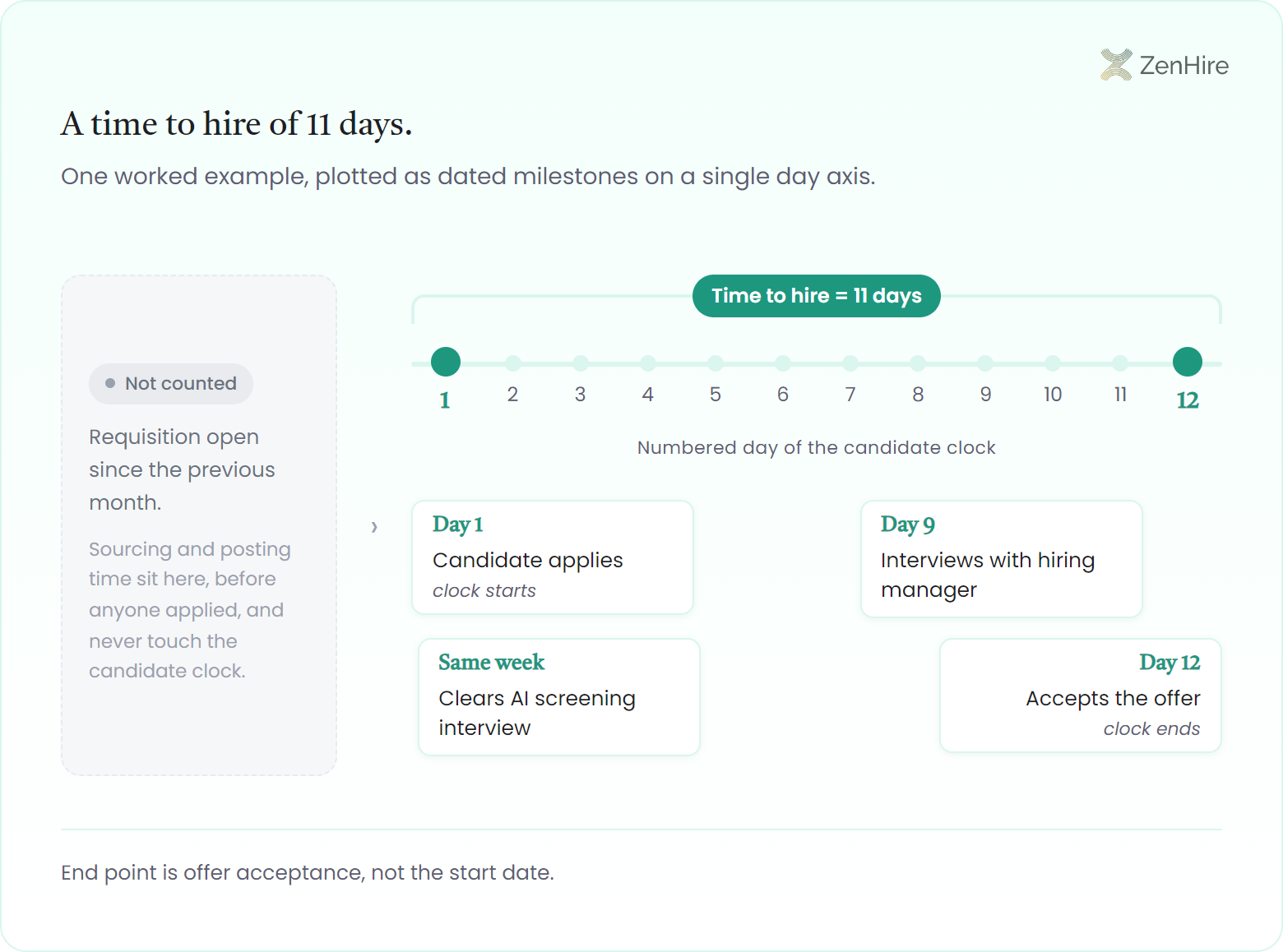
A concrete example: a candidate applies on the 1st, clears an AI screening interview the same week, interviews with the hiring manager on the 9th, and accepts on the 12th. That is a time to hire of 11 days. The requisition may have been open since the previous month, but the candidate-level clock only counts the 11 days they were actually in play.
- Start point: application date, or first qualified contact for sourced candidates
- End point: the date the candidate accepts the offer (not the start date)
- What it measures: the efficiency of evaluation and decision-making you control
- What it misses: sourcing time and the days before anyone applied
How is time to hire different from time to fill?
Time to hire differs from time to fill in where the clock starts: time to fill begins when the job requisition opens, while time to hire begins only when a candidate applies. Time to fill therefore includes everything before an applicant exists (job posting, sourcing, advertising, and the dead time while you wait for a pipeline to build), so it is almost always the larger of the two numbers.
The distinction matters because the two metrics point you at different fixes. A long time to fill with a short time to hire means your problem is upstream: weak sourcing, a slow-filling pipeline, or an unattractive posting. A short time to fill with a long time to hire means the opposite: candidates are there, but your evaluation and decision process is the bottleneck. Diagnosing which one is broken stops you from throwing job-board spend at what is really an interview-scheduling problem. For roles measured in seats per week, pair this read with how you reduce time to hire across a high-volume hiring pipeline.
An edge case: for an evergreen or pipelined role where you keep a warm bench of pre-screened candidates, time to fill can be shorter than time to hire, because the requisition opens against an already-vetted pool. That inversion is a signal your sourcing strategy is working, not a measurement error.
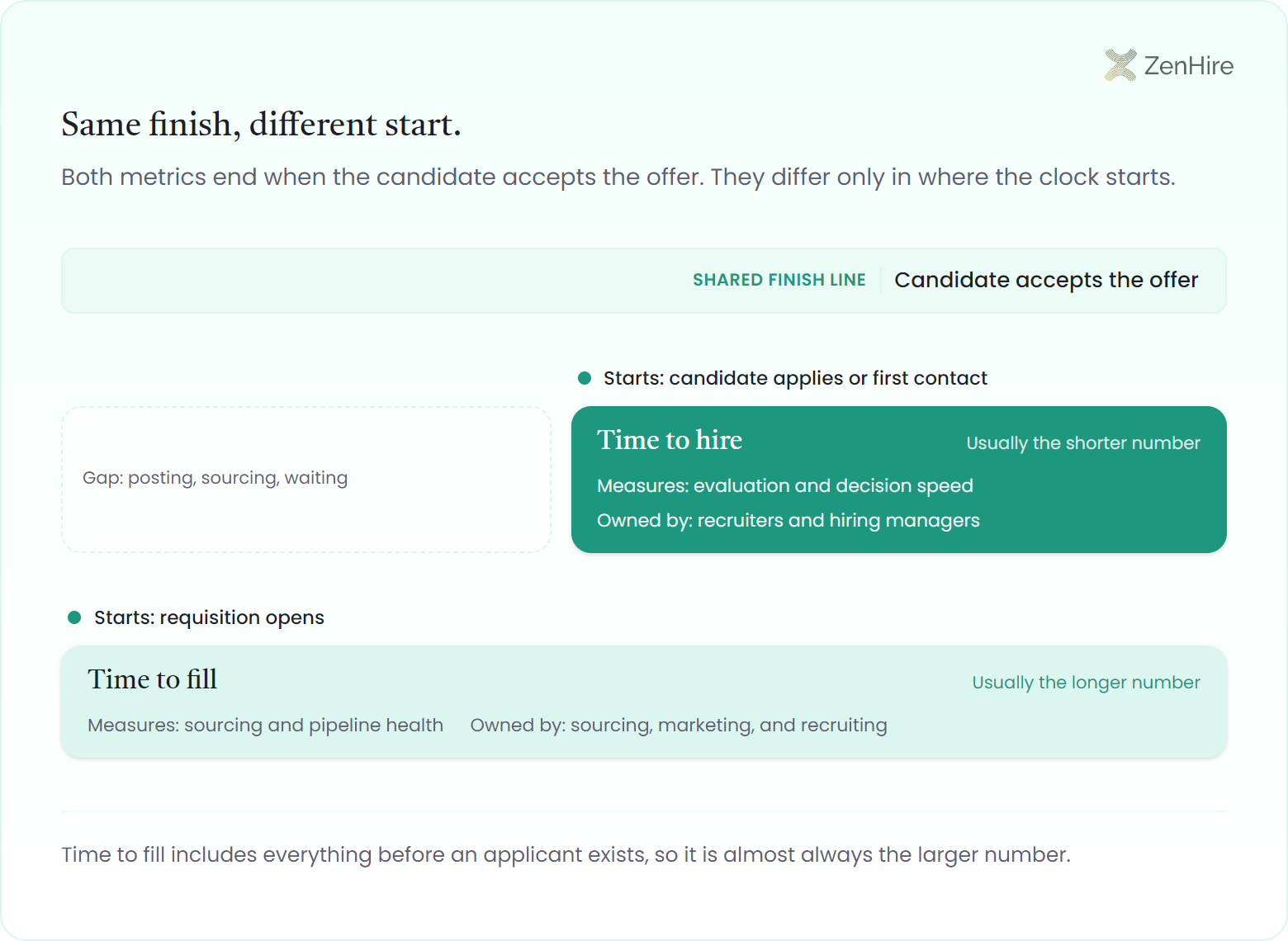
| Time to hire | Time to fill | |
|---|---|---|
| Clock starts | Candidate applies / first contact | Requisition opens |
| Clock ends | Candidate accepts the offer | Candidate accepts the offer |
| Mainly measures | Evaluation & decision speed | Sourcing + pipeline health |
| Usually the | Shorter number | Longer number |
| Owned by | Recruiters & hiring managers | Sourcing, marketing, & recruiting |
What is a good time to hire benchmark?
A good time to hire benchmark for most professional roles is roughly two to four weeks, with frontline and high-volume roles expected to run much faster, often days, not weeks. The right target is not a single universal number; it is the fastest pace at which your team can still apply consistent, validated evaluation to every candidate.
The mechanism behind a healthy benchmark is removing the slow middle without removing the rigor. Most of the calendar in a typical time to hire is not interviewing; it is waiting: waiting for a recruiter to get to a resume stack, waiting to schedule, waiting for a scorecard. Structured, AI-assisted screening collapses that queue because every candidate clears the same evaluation in minutes rather than waiting in a manual review backlog. ZenHire's AI interview software returns a scored, consistent read in roughly four minutes per candidate, which is where most of the compressible time lives. Just be sure faster does not mean looser; see how a structured interview keeps the bar identical even as the clock shrinks.
An important edge case: benchmark against your own segments, not a blanket industry figure. A two-week target that is excellent for a specialist engineering hire would be a disaster for a contact-center class where attrition runs 30-45% a year and every open seat is lost revenue. Set the benchmark by role family, location, and hiring source, then watch the trend rather than the absolute number.
The reason speed and quality are not opposites: roughly 70% of hiring teams are expected to use AI in their process by 2025, and those teams report about 62% faster hiring at roughly 59% lower cost (industry research). The gain comes from automating the review queue, not from skipping evaluation, which is exactly why the fast teams are not the ones trading away hire quality.
When people ask me to make hiring faster, I tell them speed is a symptom, not the goal. Almost every team I meet thinks they have a sourcing problem, and almost every one actually has a decision problem: good candidates sitting in a queue because no human had time to evaluate them this week. That is the gap I built ZenHire to close. We do not cut corners to save days; we give every candidate the same rigorous evaluation in minutes, so the time you save comes out of the waiting, not out of the judgment. Fast and fair are the same project.
Frequently asked questions
What is time to hire in simple terms?+
Time to hire in simple terms is how many days it takes from a candidate applying to that candidate accepting your offer. It is a per-candidate measure of how efficiently your team evaluates and decides, averaged across hires, and it excludes the sourcing time before anyone applied.
What is the difference between time to hire and time to fill?+
The difference between time to hire and time to fill is where the clock starts. Time to hire starts when a candidate applies; time to fill starts when the requisition opens and includes all the sourcing and posting time before applicants arrive. Both end at offer acceptance, so time to fill is almost always the larger number.
What is a good average time to hire?+
A good average time to hire is roughly two to four weeks for most professional roles, and far faster for frontline and high-volume hiring. The better target is the quickest pace at which you can still evaluate every candidate consistently, benchmarked by role family, location, and source rather than against one universal figure.
Does cutting time to hire hurt quality?+
Cutting time to hire only hurts quality if you cut it by dropping evaluation. The tempting shortcut is to decide faster off the resume alone, but a resume screen predicts performance at about r = 0.14, so those recovered days come straight back as turnover. Take the time out of the review queue instead of out of the assessment, and speed and accuracy stop competing.
How do you reduce time to hire without lowering the bar?+
You reduce time to hire without lowering the bar by automating the slow review queue, not the evaluation itself. Structured, AI-assisted screening gives every candidate the same scored read in minutes, so the days you recover come from eliminated waiting while the hiring bar stays identical for everyone.
Free for time to hire
The time to hire diagnostic
A one-page worksheet to separate your time to hire from your time to fill, find the slow stage that is actually costing you, and set a realistic benchmark by role.