
What Is a Structured Interview?


· 8 min read
A structured interview asks every candidate the same job-related questions in the same order and scores each answer against a fixed, anchored rubric, so hiring decisions compare evidence, not impressions. What standardization buys you is prediction: an interview that improvises sits near r = 0.18, but locking the questions and the rubric lifts it to about 0.28, and layering validated assessments on top carries the combined signal past 0.6 — well over the ~0.14 a resume review manages on its own. The rubric is also what keeps that gain from eroding across a panel: ZenHire's anchored scoring matches human evaluators 93%+ of the time, against the ~68-75% agreement untrained reviewers reach on the same answers.
What makes an interview a structured interview?
An interview becomes a structured interview when three things are fixed before the first candidate ever speaks: the questions, the order, and the scoring rubric. Every candidate for a role answers the same set of job-related questions, and each answer is rated against the same anchored scale, for example, a 1-to-5 rubric where a 4 has a written definition of what a strong answer contains. Take any of those three away and the interview drifts back toward an unstructured chat scored on impression.
The contrast with an unstructured interview is sharp. In an unstructured interview, the interviewer improvises questions, follows tangents, and forms a holistic gut impression. That feels thorough, but it means two candidates are rarely judged on the same evidence, and the interviewer's first-impression bias gets to run unchecked. A structured interview deliberately removes that latitude so the role, not the rapport, decides the score.
This is also where consistency becomes a scale problem. A single hiring manager can hold a rough rubric in their head for five candidates; across ten interviewers and ten thousand applicants, that rubric quietly fractures. Structured, AI-assisted interviewing keeps the question set and scoring identical for everyone. ZenHire's AI interview software asks the same job-related prompts and scores communication, reasoning, and reliability the same way whether you screen ten people or ten thousand, which is exactly the consistency high-volume hiring breaks without it.
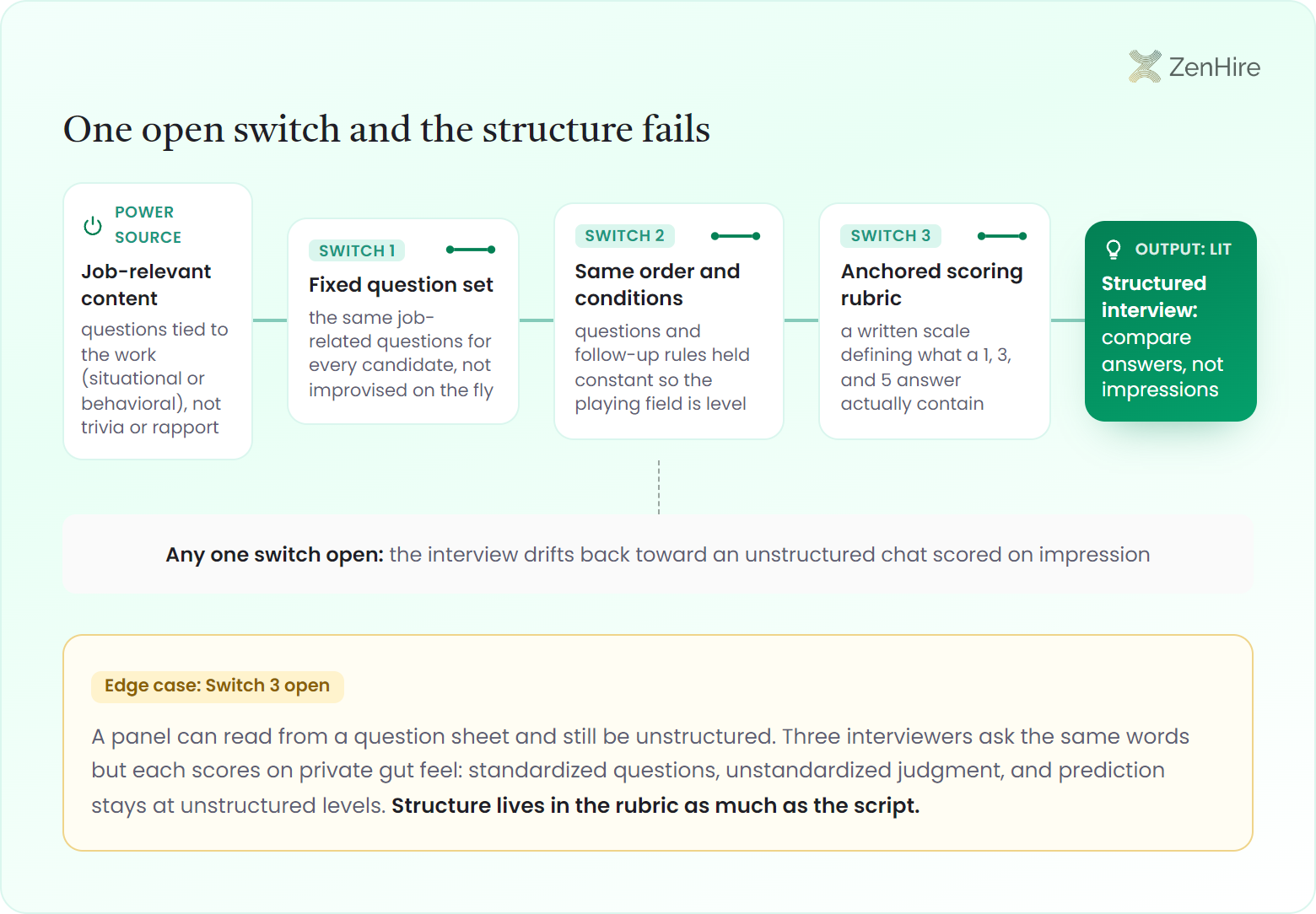
The edge case worth naming: a panel can read from a question sheet and still be unstructured. If three interviewers ask the same words but each scores on private gut feel, you have standardized questions and unstandardized judgment, and the prediction stays at unstructured levels. Structure lives in the rubric as much as the script. A defined, anchored scoring scale is what converts a consistent script into a consistent decision.
- Fixed question set: the same job-related questions for every candidate, not improvised on the fly
- Same order and conditions: questions and follow-up rules held constant so the playing field is level
- Anchored scoring rubric: a written scale defining what a 1, 3, and 5 answer actually contain
- Job-relevant content: questions tied to the work (situational or behavioral), not trivia or rapport
Why does a structured interview predict performance?
A structured interview predicts performance because it measures the same job-relevant signal in every candidate and strips out the noise of inconsistent questions and gut-feel scoring. When everyone answers the same prompts against the same rubric, the score reflects the candidate's actual answer rather than the interviewer's mood, the order in the day, or how much small talk warmed them up. Less noise means more signal, and signal is what correlates with whether someone can do the job.
The numbers make the case concrete. Rank the selection methods by how well they forecast on-the-job performance and an unstructured interview lands around r = 0.18 — a hair above the ~0.14 you get from reading resumes. Impose structure and the same conversation moves to about 0.28; add a validated cognitive test (0.5+) or skills test (0.45+) and the blended signal clears 0.6. None of that comes from the interview being longer or harder. It comes from every candidate facing the same questions and the same rubric, which is what makes their scores comparable in the first place.
There is a real edge case here. Structure improves prediction only when the questions are actually job-relevant. A perfectly standardized interview built on irrelevant brain-teasers is consistent noise: repeatable, but not predictive. The lift comes from pairing standardization with content tied to the role, which is why a structured interview pairs naturally with quality-of-hire measurement: you score on what the job needs, then check the score against how hires actually perform and stay.
| Selection method | Predictive validity (r) |
|---|---|
| Resume / CV review | ~0.14 |
| Unstructured interview | ~0.18 |
| Structured interview | ~0.28 |
| Cognitive ability test | 0.5+ |
| Skills test | 0.45+ |
| Structured interview + assessments combined | 0.6+ |
How do you design a structured interview?
You design a structured interview by starting from the job, writing job-relevant questions, building an anchored scoring rubric, and then holding all three constant across every candidate. Begin with a job analysis: list the few competencies that actually predict success in the role. Write two or three questions per competency, situational ("what would you do if...") or behavioral ("tell me about a time you..."), and for each, define what a weak, adequate, and strong answer looks like on a 1-to-5 scoring scale before any interview happens.
A concrete example: hiring a contact-center agent, you might score "communication under pressure" with a situational prompt about an irate caller. A 2 is a vague, scripted reply; a 4 is a calm, specific de-escalation with a clear next step. Every candidate gets that same prompt and is rated against that same anchor, so the agent who interviewed on a quiet Tuesday and the one on a chaotic Friday are judged identically. Documenting those scores also gives you an auditable trail, which matters when you need to defend a hiring decision or run a bias audit on the process.
The edge case in design is over-rigidity. A structured interview should still allow scripted, neutral follow-up probes ("what was the result?") so a strong candidate is not penalized for a thin first pass; the discipline is that the probes are planned and applied to everyone, not invented for the people you happen to like. ZenHire ships that discipline as the default: the same job-relevant prompts for every applicant, an interview that runs about four minutes, and a glass-box scoring scale you can inspect line by line — one that lands within 93%+ of how trained human evaluators would rate the same answers, so the rubric stays intact whether you run five interviews or fifty thousand.
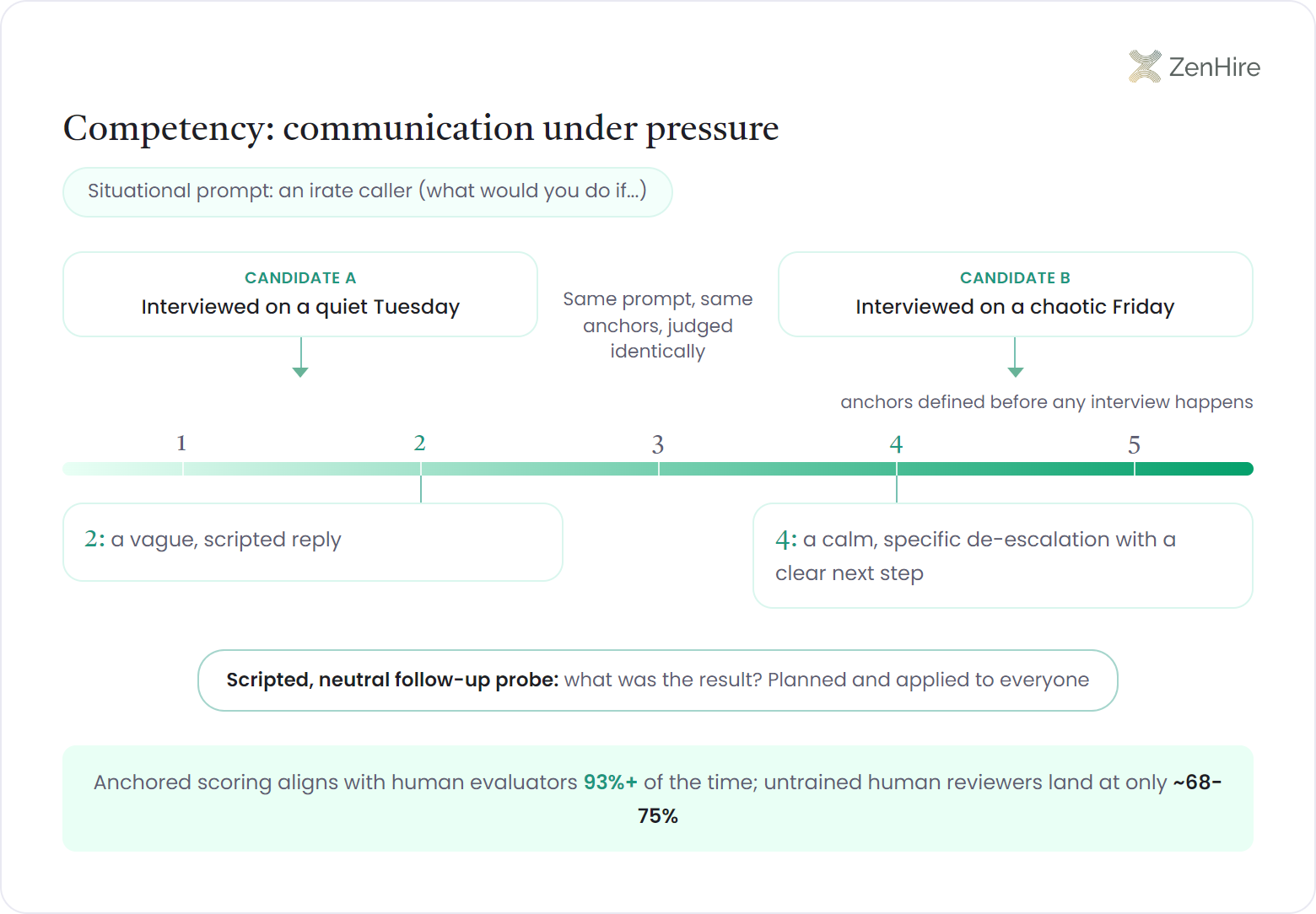
One design metric to keep honest: scoring consistency. Put ZenHire's rubric-based scores next to trained human evaluators and they agree 93%+ of the time — 90-96% when PhD linguists check the language ratings — whereas untrained reviewers scoring the same answers only line up ~68-75% of the time. That spread is the whole argument in miniature: the distance between a structured and an unstructured interview is the distance between a defined rubric and an undocumented gut call. Anchored scoring is the cheapest reliability you can buy.
Most people think the interview is where you discover the candidate. I have come to believe it is mostly where you discover your own biases. The first time we scored the same answers two ways, once on gut feel and once against a fixed rubric, the rankings barely matched, and the rubric was the one that tracked who actually performed later. Structure is not bureaucracy. It is the only honest way I know to make sure the quiet candidate who gave the better answer beats the charming one who gave the worse one.
Frequently asked questions
What is the difference between a structured and unstructured interview?+
A structured interview fixes the questions, order, and scoring rubric for every candidate, while an unstructured interview improvises both. The structured version compares candidates on the same evidence; the unstructured version drifts toward whoever the interviewer liked. That difference shows up in the prediction: an unstructured interview tracks performance near ~0.18, and holding questions and rubric constant moves it to ~0.28.
What does structured interview mean exactly?+
Structured interview means a standardized interview: the same job-related questions, asked in the same order, scored against the same anchored rubric. The defining feature is consistency: remove the fixed questions or the rubric and it stops being structured, regardless of how formal it feels.
Are structured interviews better than unstructured ones?+
Structured interviews are measurably better at predicting performance than unstructured ones. In selection research an unstructured interview sits around ~0.18 and a structured one around ~0.28; add validated assessments to the structured version and the combined signal passes 0.6 — a level a ~0.14 resume scan comes nowhere near.
What kinds of questions go in a structured interview?+
Structured interviews use job-relevant questions, usually situational or behavioral. Situational questions ask what a candidate would do in a realistic scenario; behavioral questions ask about a past example. Each is tied to a competency from the job analysis and scored on a pre-written rubric.
Can an AI interview be a structured interview?+
Yes, an AI interview is structured by design, because it asks every candidate the same job-related prompts and scores them on the same explainable rubric. ZenHire's interview runs about four minutes, keeps the questions and scoring identical no matter the volume, and rates answers within 93%+ of trained human evaluators.
Free for structured interviewing
The structured interview starter kit
A practical template: how to run a job analysis, write situational and behavioral questions, and build an anchored 1-to-5 rubric your whole panel can score the same way.