
What Is Skills Analysis in an Interview?


· 4 min read
Skills analysis in an interview is the AI-scored read of the competencies a role demands: communication, reasoning, and role-specific soft skills, measured from a candidate's answers in one short structured interview. A skimmed resume tells you what someone lists, and on its own it tracks on-the-job performance at only about r = 0.14; skills analysis instead grades what a candidate actually demonstrates in their answers, against one rubric applied identically to every applicant. Each score ships with its evidence, keeps sensitive attributes out of the model, and pairs with CEFR A1-C2 language analysis to grade both what a candidate says and how clearly they say it.
What does interview skills analysis measure?
[Interview skills analysis](/interview-analysis) measures the role-specific competencies that predict performance: how clearly someone explains a problem, how they reason under pressure, and the soft skills the job actually runs on. It reads these from a candidate's spoken answers, so you are scoring behaviour, not a list of claims.
The competencies are chosen per role: a support hire is scored on de-escalation and clarity, an engineer on explaining a trade-off, a server on warmth and recovery. This is the same engine behind ai interview software, tuned to what each role demands rather than a generic template.
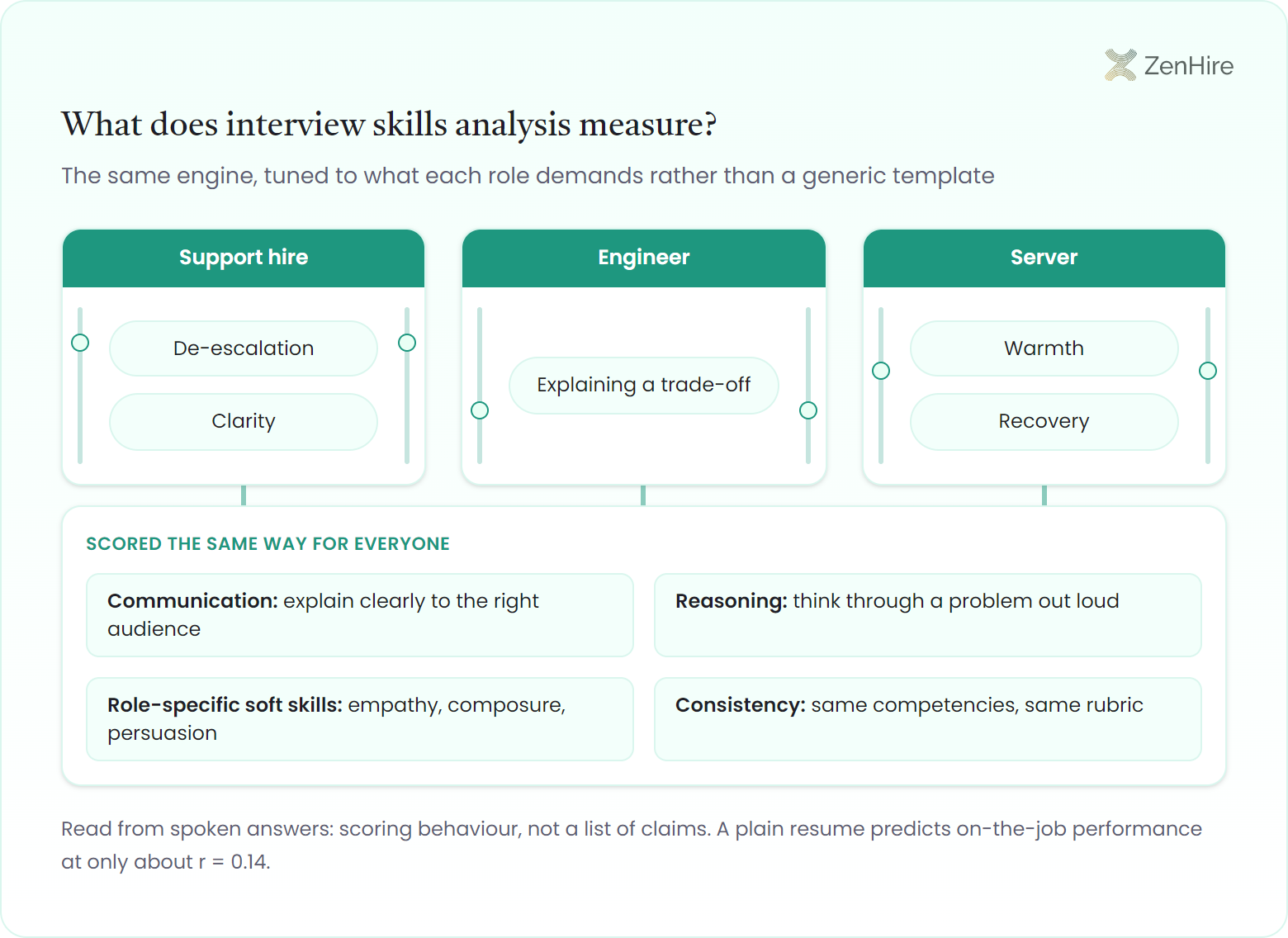
The paper trail is a weak proxy for the work: a resume on its own predicts on-the-job performance at only about r = 0.14. Grading the competencies a candidate shows inside a structured interview is far more predictive, because a de-escalation or a trade-off explained out loud is the job, not a bullet point about it.
- Communication: can they explain something clearly to the right audience?
- Reasoning: do they think through a problem out loud, or guess?
- Role-specific soft skills: empathy, composure, persuasion, as the job needs
- Consistency: the same competencies scored the same way for everyone
How does skills analysis score a candidate?
Skills analysis scores a candidate against a fixed rubric, then attaches the evidence behind every number. Each competency gets a score derived from what the candidate actually said, so a recruiter can see why someone landed where they did, and override it when judgment disagrees.
Because the rubric is identical for every applicant, a strong candidate is not lost for applying on a busy day, and a weak one is not advanced on charisma alone. Pair the result with quality of hire and you can tie screening decisions back to who actually performed.
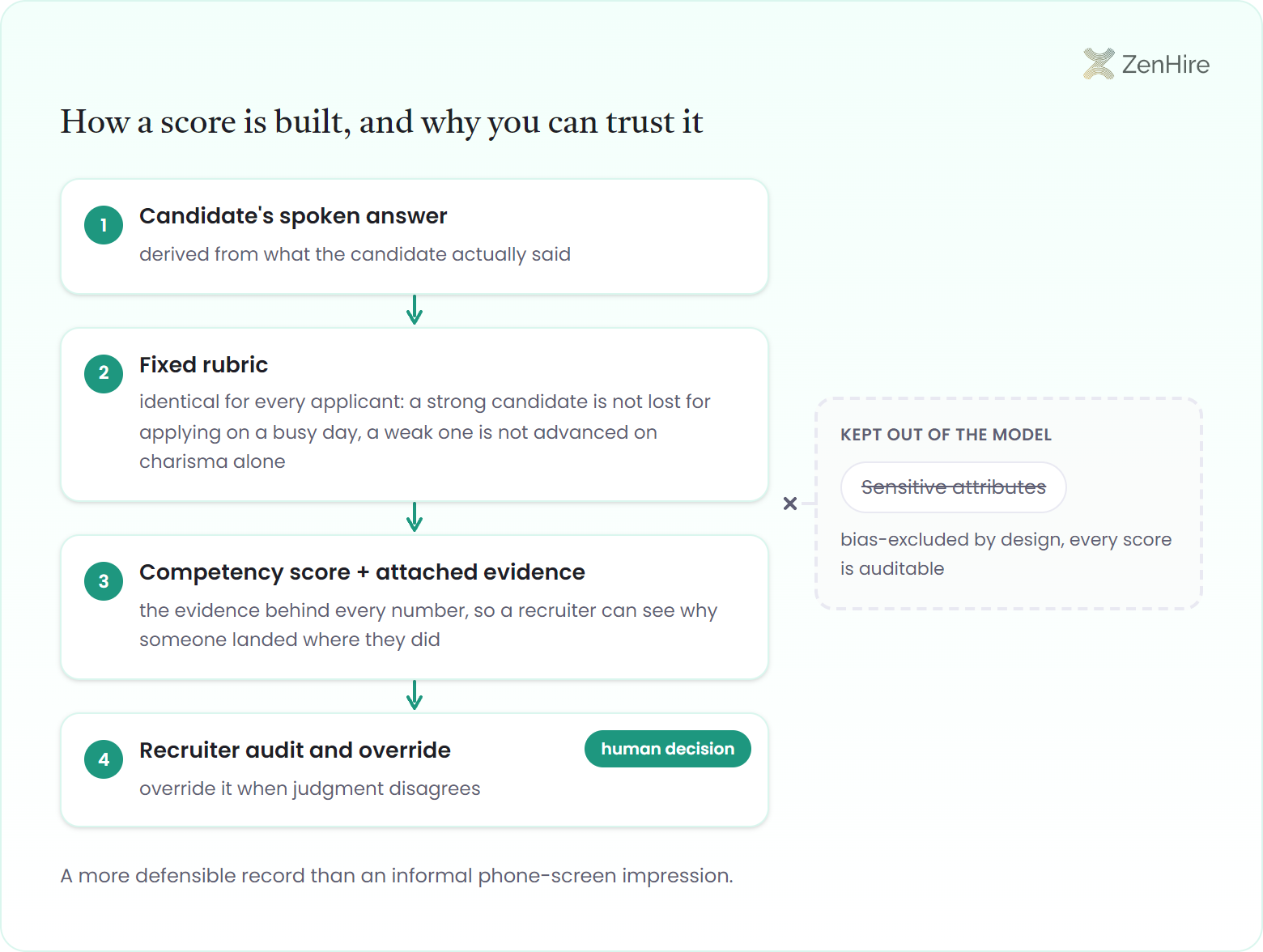
Scoring is explainable and bias-excluded by design: sensitive attributes are kept out of the model, and every score is auditable, a more defensible record than an informal phone-screen impression.
How does skills analysis differ from language analysis?
Skills analysis scores what a candidate can do; language analysis scores how clearly they say it. Skills analysis reads competencies and reasoning, while language analysis rates spoken English on the CEFR scale (A1-C2) for fluency, clarity, and pronunciation; see how English proficiency is assessed for the full breakdown.
They are complementary, not interchangeable. A guest-facing or contact-centre role needs both a competency read and a language bar; a back-office role may weight skills heavily and language lightly. Running both from one short interview means you set each bar deliberately instead of conflating them.
The phrase I hear most from hiring managers is 'I just know it when I see it.' The problem is that everyone's 'it' is different, and none of it is written down. Skills analysis is just the discipline of writing it down: deciding what the role actually needs, then scoring every candidate on it the same way. The AI measures; a person still decides.
Frequently asked questions
Is skills analysis the same as a skills test?+
Skills analysis is not the same as a separate skills test. It scores competencies from a candidate's interview answers, so you read communication, reasoning, and soft skills in the same short session, though it pairs well with a dedicated assessment from a test library for hard skills.
Which skills can interview analysis score?+
Interview analysis can score the role-specific soft skills and reasoning that resumes hide: communication, composure, empathy, persuasion, and structured problem-solving, chosen per role rather than from a fixed template.
Is skills analysis fair to candidates?+
Skills analysis is built to be fair: every candidate is scored on the same rubric, sensitive attributes are excluded from the model, and each score ships with its evidence so it can be audited and overridden. This is how structured AI screening reduces bias in hiring rather than amplifying it.
Does skills analysis replace the recruiter?+
Skills analysis does not replace the recruiter; it informs them. It is one measurement layer inside an AI recruiter: the AI scores competencies consistently and surfaces the evidence, while the hiring decision, and the judgment around it, stays with a person.
Free for interview skills analysis
The interview skills rubric template
A starting rubric for scoring the competencies that matter per role: what to measure, how to weight it, and how to keep it consistent across interviewers.