
What Is Cost per Hire (and How Do You Lower It)?


· 8 min read
Cost per hire is total internal and external recruiting spend divided by the number of hires in a period, and you lower it by automating early screening and hiring people who stay. The reported figure skips the largest lines: recruiter hours never hit an invoice, agency placement fees run 15-25% of first-year salary, and a 90-day exit resets the whole spend. SHRM puts replacement at 50-200% of annual salary, while AI-assisted teams report roughly 59% lower cost per hire and 62% faster hiring by removing manual resume review.
Cost-per-hire calculator
Calculate your true cost per hire
Most teams report only the visible spend. Add recruiter hours and early re-hires to see what a hire really costs.
Agencies typically charge 15-25% of first-year salary.
Across sourcing, screening, and interviews for the period.
SHRM puts full replacement at 50-200% of salary; 100% is a safe midpoint.
Your result
Your real cost per hire is $11k, 13% above the $6k most teams report, once recruiter hours and early re-hires are counted. Cutting 90-day attrition is the biggest lever: ZenHire screens for fit and reliability before the offer.
How cost per hire is calculated+
- 1.Reported cost per hire = (job boards + agency + assessments + other) / hires: the number most teams cite, but it leaves out recruiter hours.
- 2.True cost per hire adds internal time: (visible costs + recruiter hours x loaded rate) / hires. Most of the hidden cost is manual resume review.
- 3.Real cost per hire adds early re-hires: true cost + (90-day leavers x replacement cost) / hires. A miss inside 90 days resets the meter.
- 4.SHRM puts full replacement cost at 50-200% of annual salary (recruiting, training, lost productivity); frontline roles often run $5k-$20k.
- 5.Screen for fit up front and the structure shifts: fewer expensive early exits, less time rehiring, and a lower real cost per hire.
What is cost per hire?
Cost per hire is the total cost of filling a role divided by the number of hires in a period: the single number that tells you what your recruiting process actually costs to produce one accepted offer. It bundles everything you spend to find, screen, and close a candidate, then averages it across the people you hired.
The standard cost per hire formula is simple: add all internal recruiting costs and all external recruiting costs over a period, then divide by the number of hires in that period. The trap is in the inputs, not the math. Most teams count the invoices they can see, like job-board postings, agency fees, and background checks, and quietly skip the largest line, which is the salaried time their own recruiters and hiring managers pour into screening. That is why a reported figure of a few hundred dollars often hides a true cost several times higher. For a fuller picture of recruiting economics, pair this with time to hire and quality of hire: speed and stickiness both move the per-hire cost.
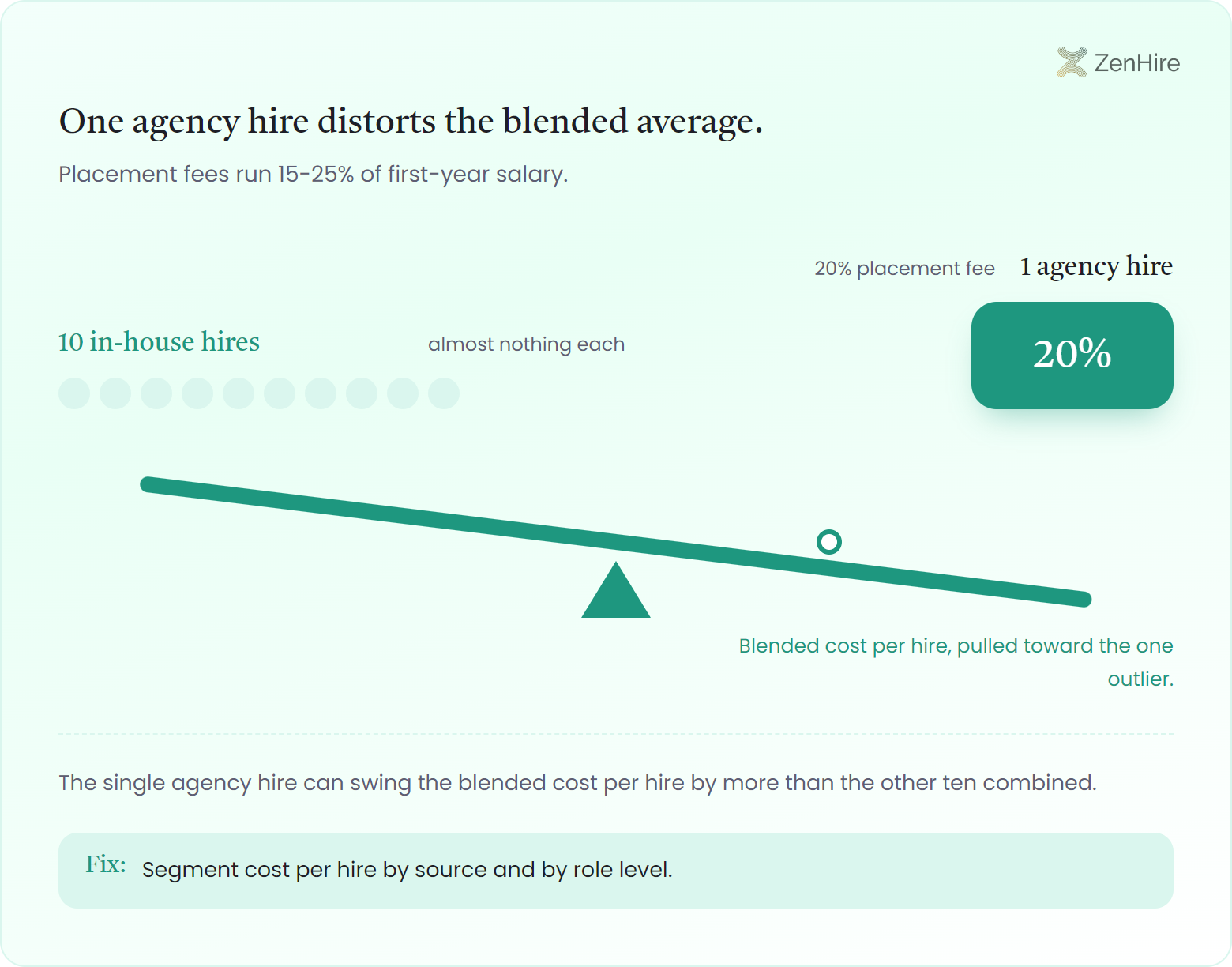
Edge case: a single expensive hire can distort the average. If you make ten in-house hires for almost nothing and one through an agency at a 20% placement fee, the agency hire can swing the blended cost per hire by more than the other ten combined. That is why mature teams segment cost per hire by source and by role level rather than reporting one headline number.
The line that quietly dominates cost per hire is the one no invoice captures: recruiter and hiring-manager hours. That is precisely the line automation attacks first, which is why the roughly 70% of hiring teams on AI by 2025 land near 59% lower cost and 62% faster hiring, mostly by taking manual resume review off the recruiter's clock instead of trimming ad budgets.
| Cost type | What it includes |
|---|---|
| Internal costs | Recruiter and hiring-manager time, referral bonuses, ATS and tooling allocation |
| External costs | Job-board ads, agency placement fees, assessments, background checks, events |
| The hidden cost | Re-hiring after an early exit: the spend that resets when a hire does not stay |
What should you include in cost per hire?
You should include every internal and external cost tied to filling a role, and the cost of replacing the ones that do not work out. The SHRM-style definition counts internal costs (recruiter and manager time, referral payouts, in-house tooling) plus external costs (advertising, agency fees, assessments, travel) divided by hires. The honest version adds the part most calculators ignore: a hire who leaves early forces you to spend the whole sum again.
Concrete example: imagine filling a frontline role. Job ads cost a few hundred dollars, an assessment a few dollars per candidate, and background checks a bit more, so call the visible spend modest. But a recruiter screening 200 resumes by hand at a loaded hourly rate can easily be the biggest line on the sheet, and it never shows up on an invoice. Count the time, and the same role that looked cheap to fill turns out to cost real money. This is exactly the gap covered in how to lower recruitment costs: the savings live in the hours, not the ad budget.
Edge case worth flagging: the cost of a mis-hire is mostly invisible to a standard formula. Replacing one frontline worker runs about $5,000-$20,000 by industry estimates, and SHRM puts total replacement at 50-200% of annual salary once you add recruiting, training, and lost productivity. If your cost per hire looks great but your 90-day attrition is high, your real cost per hire is the reported figure plus a full re-hire for everyone who walks.
- Internal costs: recruiter and hiring-manager time, referral bonuses, in-house tooling
- External costs: job-board ads, agency placement fees (15-25% of first-year salary), assessments, background checks
- Replacement costs: the full re-hire triggered when a new hire leaves inside 90 days
- Segmentation: split the number by role level and source so one agency hire does not hide the average
How do you lower cost per hire?
You lower cost per hire by cutting the manual hours in early screening and by hiring people who stay: the two levers that move the largest, least-visible costs. Trimming a job-board contract saves the spend you can see; automating resume review and getting the fit right the first time saves the spend you cannot.
The mechanism is straightforward. Most recruiter time is spent reading resumes and running first-round screens that mostly confirm what a structured assessment could have flagged in minutes. Move that stage to consistent, scored evaluation and you reclaim the hours that dominate cost per hire, without losing the quality signal that prevents expensive re-hires. ZenHire's AI interview software reads communication, soft skills, and reliability in a roughly four-minute interview, pulling CV data at 97% accuracy and scoring that aligns 93%+ with human reviewers, so the per-hire cost of screening stays flat whether you fill ten roles or ten thousand. The point is not to hire faster and worse; it is to hire faster and better, because a good hire who stays is the only thing that keeps the meter from resetting.
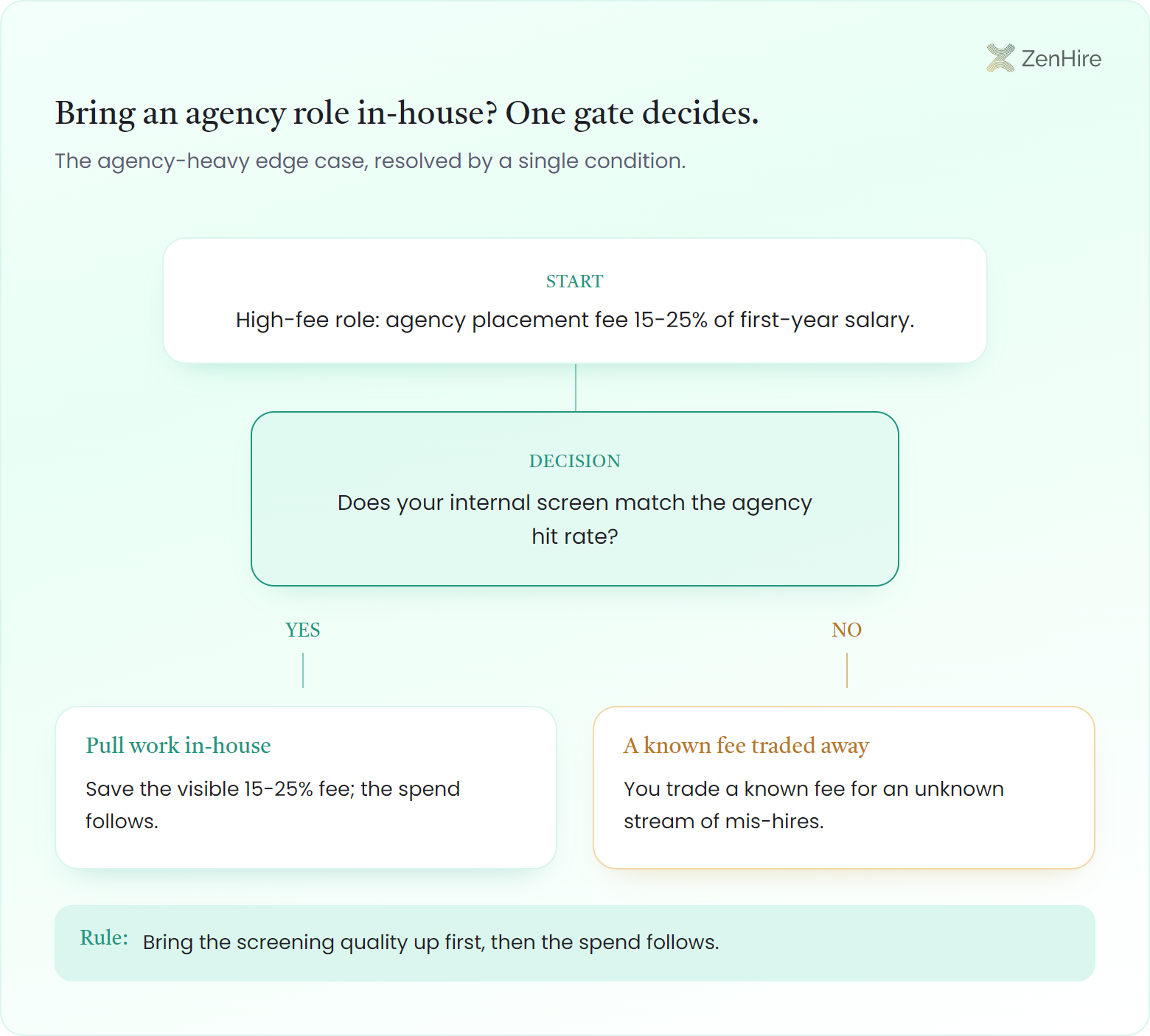
Edge case: agency-heavy hiring is where cost per hire is most reducible, but also where cutting blindly hurts. A 15-25% placement fee on a senior role is a large, visible cost, yet pulling work in-house only saves money if your internal screen is good enough to match the agency's hit rate. Otherwise you trade a known fee for an unknown stream of mis-hires. Bring the screening quality up first, then the spend follows.
Method, not effort, is what protects you from the most expensive cost of all: the re-hire. Read cost per hire through predictive validity and the cheap-looking screens are the pricey ones: a resume scan forecasts on-the-job performance at about r = 0.14 and an unstructured interview at ~0.18, while structured interviews stacked with cognitive and skills tests push the combined signal past 0.6. The stronger the screen, the fewer seats you pay to fill twice, which is why better screening is cheaper screening.
- Automate early screening: replace manual resume review with consistent, scored evaluation
- Screen for fit and reliability: cut the 90-day exits that force a second full spend
- Right-size agency use: bring high-fee roles in-house only after the internal screen matches the hit rate
- Segment and track: watch cost per hire by source so you double down on the channels that deliver people who stay
When a team tells me their cost per hire is low, I ask one question: does that number include the people you had to hire twice? It almost never does. The cheapest hire is the one you make once, yet most calculators reward you for spending less on the screen, which is exactly how you end up paying for the same seat three times in a year. I would rather spend a little more to be sure on day one than a lot more to do it all again in week twelve. Get the screen right and cost per hire takes care of itself.
Frequently asked questions
What is the cost per hire formula?+
The cost per hire formula is total internal costs plus total external costs, divided by the number of hires in a period. Internal costs are recruiter and manager time and referral payouts; external costs are advertising, agency fees, assessments, and background checks.
What is a good cost per hire?+
A good cost per hire depends on the role and industry, so the more useful comparison is your own number over time, segmented by source and role level. A blended average can be misleading because one agency hire at a 15-25% placement fee can outweigh many in-house hires.
Why is my reported cost per hire so low?+
A low reported cost per hire usually means recruiter time and re-hiring are missing from the calculation. Salaried screening hours rarely appear on an invoice, and a calculator that ignores 90-day attrition hides the biggest cost of all: paying to fill the same seat twice.
Does lowering cost per hire hurt quality of hire?+
Lowering cost per hire does not have to hurt quality of hire; done right, it improves it. Automating manual resume review cuts cost without weakening the signal, and screening for fit reduces the early exits that quietly inflate cost per hire through re-hiring.
How does AI lower cost per hire?+
AI lowers cost per hire mainly by removing the manual hours in early screening. Those hours are the biggest uninvoiced line in the formula, so shifting resume review to consistent scored evaluation is what puts AI-assisted teams at roughly 59% lower cost and 62% faster.
Free for lowering cost per hire
The true cost-per-hire worksheet
A one-page worksheet that counts the lines most calculators miss: recruiter hours, agency fees, and the re-hire cost of early attrition, so you see your real number, not the flattering one.