


What Is AI Candidate Matching?
AI candidate matching uses machine learning to automatically evaluate and rank candidates against job requirements.
ZenHire Team
What is AI-powered candidate matching?
AI candidate matching is the automated process of scoring how well each applicant's skills, experience, and qualifications fit a job's requirements, using AI recruitment technology to rank every resume against the role. Matching engines work in five layers: data extraction, semantic mapping, requirement matching, contextual weighting, and predictive scoring. Best-in-class systems identify qualified candidates with 90%+ accuracy versus 60-70% for basic keyword matching, and evaluate 250+ resumes per minute where a manual reviewer spends 6-8 seconds per resume.
Modern candidate matching goes far beyond simple keyword matching. AI systems employ:
- Semantic understanding: Recognize equivalent skills even when expressed differently
- Contextual analysis: Evaluate experience quality, not just quantity
- Predictive modeling: Forecast candidate success based on historical hiring data
- Skills inference: Identify likely competencies based on career progression patterns
These capabilities enable organizations to process thousands of applications quickly while surfacing candidates who might be overlooked by traditional screening methods.
How candidate matching algorithms work
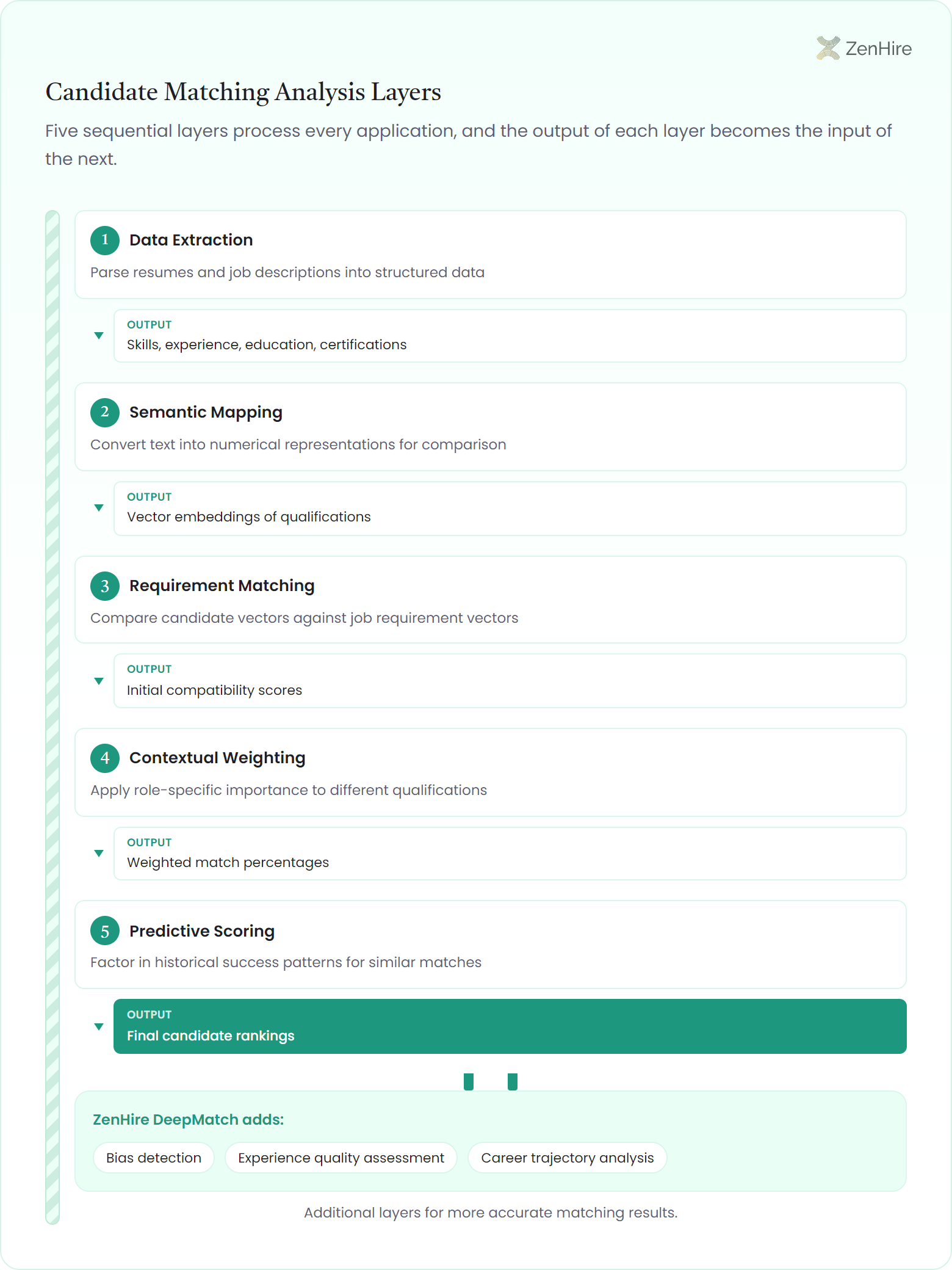
Candidate matching systems process information through multiple analytical layers:
| Layer | Function | Output |
|---|---|---|
| Data Extraction | Parse resumes and job descriptions into structured data | Skills, experience, education, certifications |
| Semantic Mapping | Convert text into numerical representations for comparison | Vector embeddings of qualifications |
| Requirement Matching | Compare candidate vectors against job requirement vectors | Initial compatibility scores |
| Contextual Weighting | Apply role-specific importance to different qualifications | Weighted match percentages |
| Predictive Scoring | Factor in historical success patterns for similar matches | Final candidate rankings |
Advanced systems like ZenHire's DeepMatch engine add additional layers including bias detection, experience quality assessment, and career trajectory analysis to produce more accurate matching results.
AI matching vs. traditional resume screening
Traditional resume screening relies on recruiters manually reviewing applications against job requirements, a process that introduces significant limitations:
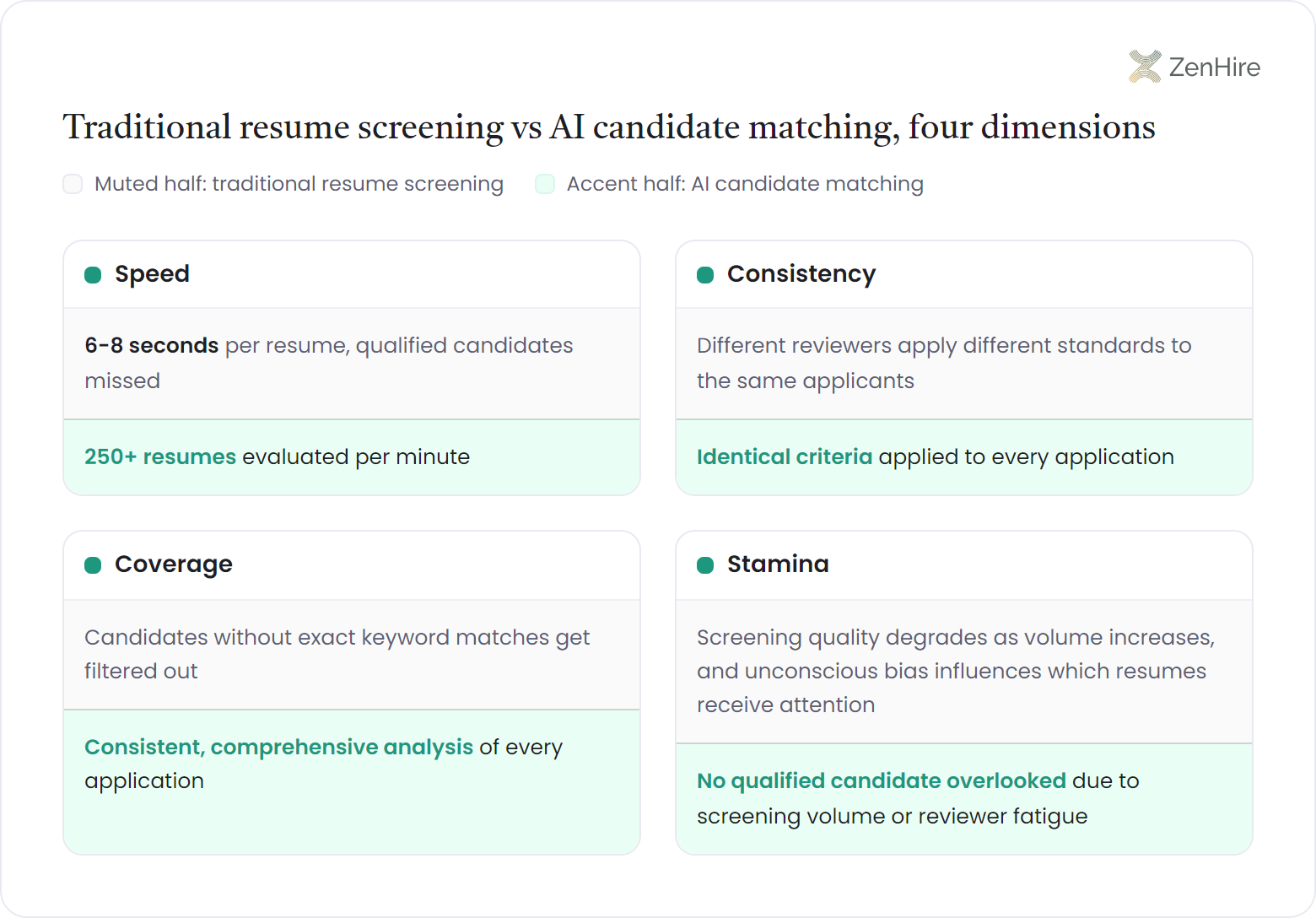
- Time constraints: Recruiters spend 6-8 seconds per resume, missing qualified candidates
- Inconsistency: Different reviewers apply different standards to the same applicants
- Keyword dependency: Candidates without exact keyword matches get filtered out
- Fatigue effects: Screening quality degrades as volume increases
- Bias vulnerability: Unconscious preferences influence which resumes receive attention, undermining ethical hiring goals
AI matching addresses these limitations by providing consistent, comprehensive analysis of every application. Systems can evaluate 250+ resumes per minute with identical criteria, ensuring no qualified candidate is overlooked due to screening volume or reviewer fatigue.
Types of candidate matching technology
The candidate matching landscape includes several technology approaches with distinct capabilities:
- Keyword-based matching: Simple systems that count keyword occurrences (least accurate)
- Semantic similarity: NLP systems that understand meaning relationships between terms
- Machine learning models: Systems trained on historical hiring data to predict matches
- Knowledge graph matching: Advanced systems using structured skill taxonomies
- Deeptech feature engineering: Scientific approaches extracting precise qualification signals
Each approach offers different accuracy levels and implementation requirements. Organizations should evaluate matching technology based on their hiring volume, role complexity, and accuracy requirements.
Factors that affect matching accuracy
Candidate matching accuracy depends on multiple variables:
- Job description quality: Clear, specific requirements produce better matches
- Resume formatting: Standardized structures are easier to parse accurately
- Training data quality: Systems learn from historical hiring decisions
- Skill taxonomy depth: Comprehensive skill databases improve semantic understanding
- Feedback loops: Continuous learning from hiring outcomes refines predictions
Best-in-class matching systems achieve 90%+ accuracy in identifying qualified candidates, compared to 60-70% accuracy from basic keyword matching approaches.
How ZenHire DeepMatch delivers precision candidate matching
ZenHire's DeepMatch engine combines multiple matching technologies to deliver industry-leading accuracy:
- Multi-dimensional scoring: Evaluate candidates across skills, experience, education, and cultural indicators
- Explainable matches: Understand exactly why candidates scored high or low
- Bias-aware processing: Monitor for and mitigate discriminatory matching patterns
- Continuous learning: Improve accuracy based on your organization's hiring outcomes
- Custom weighting: Adjust importance of different factors for specific roles
Explore our detailed guide on CV to Job Description matching to learn how modern matching algorithms analyze candidate qualifications with precision.
Related Articles

How CV-to-Job Description Matching Works
How CV-to-Job Description Matching Works
CV matching technology analyzes resumes against job descriptions to identify the best-fit candidates.
