
Retail hiring software screens frontline applicants for reliability, availability, and customer-service soft skills the moment they apply, so a store can move from application to offer within a day instead of waiting on manager call-backs.
It must judge every frontline applicant the same way in every location, then hand each store a ranked shortlist instead of a raw resume pile. Multi-store retail lives on consistency: the same cashier or sales-associate bar has to hold whether you hire in one city or fifty, and gut-feel manager screening cannot deliver that.
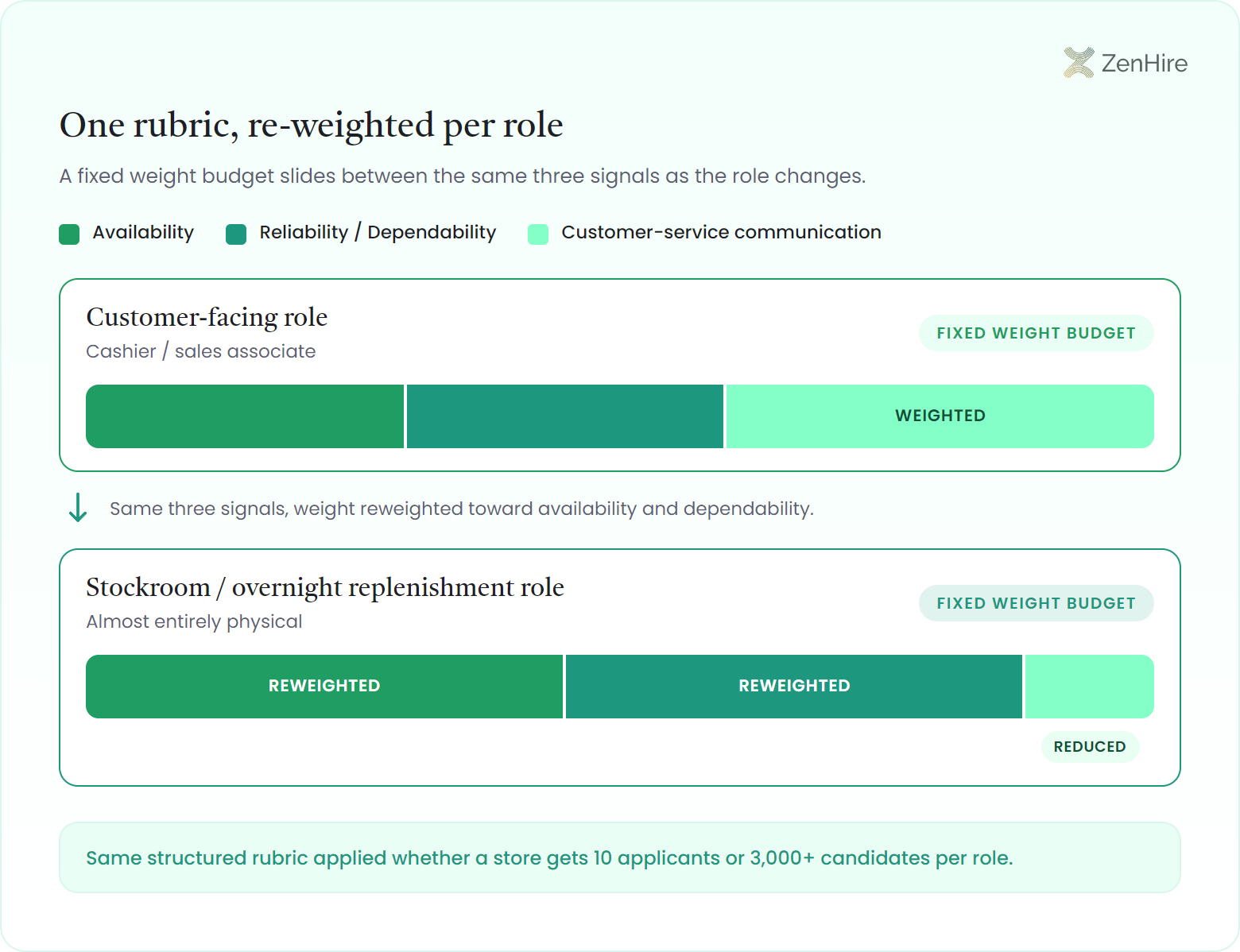
The engine evaluates availability, reliability signals, and customer-service communication up front, so a regional manager sees one comparable scorecard per candidate across the whole estate. ZenHire applies the same structured rubric whether a store gets ten applicants or three thousand, because the platform is engineered to handle 3,000+ candidates per role without slowing down. One concrete example: a chain opening three stores in a new market gets identical structured scoring in all three, rather than three managers each inventing a standard, with consistent scoring across every store location instead of fifty separate bars. The edge case worth naming: a stockroom or overnight-replenishment role that is almost entirely physical gains less from communication scoring, so you reweight that scorecard toward availability and dependability instead.
Retail hiring software earns its keep on turnover math: roughly half of frontline leavers quit inside their first 90 days (before training has paid back) and replacing one frontline hire can run $5,000 to $20,000 (industry estimates). Screening for reliability and service fit before the offer is the cheapest place to cut that bill.
| What a multi-store team needs | What the software delivers |
|---|---|
| Consistent quality bar across locations | One structured scorecard applied to every applicant, every store |
| Visibility for regional leaders | Comparable rankings and funnel analytics across the whole estate |
| Frontline-relevant signals | Availability, reliability, and customer-service communication scored up front |
| Defensible, fair decisions | Glass-box scoring with sensitive attributes excluded and audit trails |
It absorbs the screening and scheduling grind that eats a manager's floor time. Candidates apply, complete an async AI interview around the clock, and get scored automatically, so the manager opens a pre-ranked shortlist rather than reading every application and chasing phone screens between shifts. Teams that move this work to ZenHire report up to 87% less manual screening, which is hours of floor time handed back to every store manager each week.
Bulk import handles large applicant pools at once, and bulk stage-moves advance qualified candidates in batches instead of one click at a time. Some teams worry that automating screening means managers lose control of who gets hired. The opposite holds: managers still make every offer, but they spend their judgment on a short list of pre-qualified people instead of burning it on unqualified resumes; the software runs automated frontline candidate screening so people decide and AI only measures. One concrete example: a store manager covering a Saturday rush no longer interrupts the floor for walk-in screening, because qualified applicants are already ranked and waiting. The edge case: the software speeds screening, not sourcing, so a location with thin applicant flow still needs its job-board and referral channels feeding the top of the funnel.
1. Applicants self-screen
Candidates apply and complete an async AI interview 24/7, off the shop floor.
2. Auto-score and rank
Each applicant is scored for availability, reliability, and service skills as they come in.
3. Manager reviews a shortlist
The store opens a pre-ranked list instead of reading every resume.
4. Bulk-advance to offer
Move qualified candidates through stages in batches, then make the call.
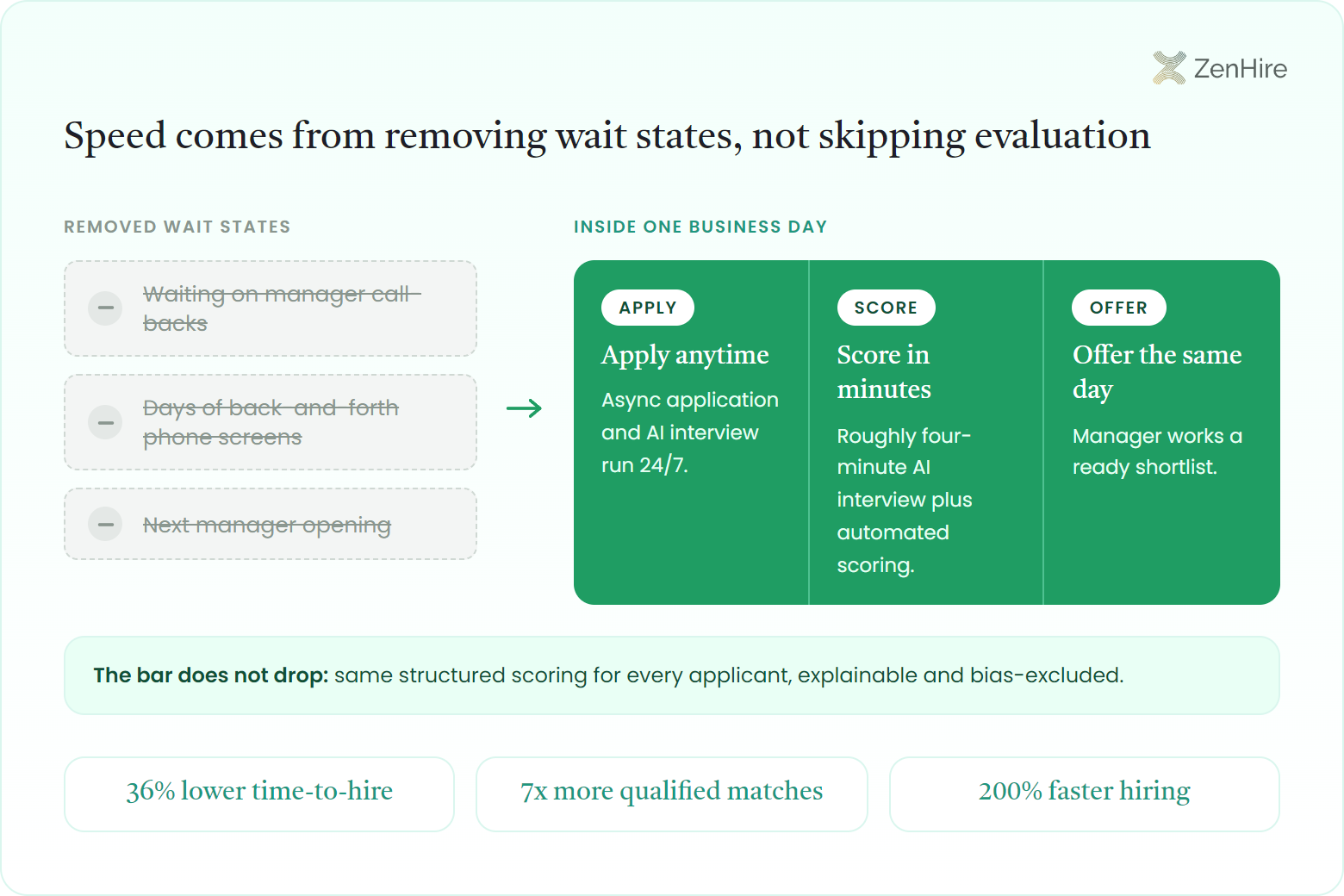
Yes, when applicant flow is healthy. Because screening is async and automated, a candidate can apply in the morning, finish a roughly four-minute AI interview by lunch, and surface on a manager's ranked shortlist the same afternoon, ready for a same-day offer call.
Some argue a one-day turnaround must mean rushed, lower-quality hiring. It is the reverse: the speed comes from removing wait states, not from skipping evaluation. Every applicant still gets the same structured scoring, and decisions stay explainable and bias-excluded, so you compress the calendar without lowering the bar, and the same async pattern powers our high-volume seasonal hiring playbook during peak ramps. One concrete example: a store backfilling a no-show before a weekend peak can screen and shortlist a fresh pool within hours. The honest limit: the software accelerates screening-to-offer, not sourcing, so the one-day path depends on enough qualified applicants already in the funnel.
Public ZenHire benchmarks point the same direction: 36% lower time-to-hire, 7x more qualified matches, and 200% faster hiring: the difference between staffing a store before the weekend peak and watching the shift go uncovered.
Retail hiring software is a system that screens and ranks frontline store applicants automatically, scoring availability, reliability, and customer-service communication so managers interview a shortlist instead of a resume pile. It runs the same structured evaluation across every location for consistent, defensible decisions.
Store hiring software is not only for large chains. It scales from a handful of locations to hundreds because screening is automated and consistent, and a single store gains the same fair, fast shortlist a 500-store estate does, without adding recruiters.
Frontline retail recruitment software handles seasonal peaks with bulk resume import of 1,000+ candidates, 24/7 async screening, and bulk stage-moves that push large applicant pools through quickly. It shrinks time-to-shortlist dramatically so you ramp for the holidays without a hiring backlog.
Retail hiring software reduces frontline turnover by screening for the reliability and customer-service fit that predict who stays, before the offer. With roughly half of frontline leavers gone inside 90 days, evaluating dependability and communication up front means fewer early exits than hiring on a rushed application scan.
Retail hiring software can be fairer than manual screening when it is built right. ZenHire uses glass-box, explainable scoring that excludes sensitive attributes, with audit trails and a SOC 2 Type II and GDPR-aligned posture, so store decisions are consistent and defensible.
Free for Retail hiring playbook
A practical guide to screening frontline applicants for availability, reliability, and customer-service fit: the scorecard fields to weight, the seasonal-ramp checklist, and how to get from application to offer in a day across every location.


See how ZenHire screens frontline retail applicants for reliability and service skills the moment they apply.