
Grocery store hiring software screens cashiers, stockers, and frontline staff with async AI interviews and bulk operations, so a chain can keep tills open and shelves filled across every store without a recruiter buried in resumes.
It has to move fast and stay consistent. A chain refills the same hourly roles constantly, so the tool must score every applicant for reliability and service the moment they apply, and judge them the same way in store one and store two hundred.
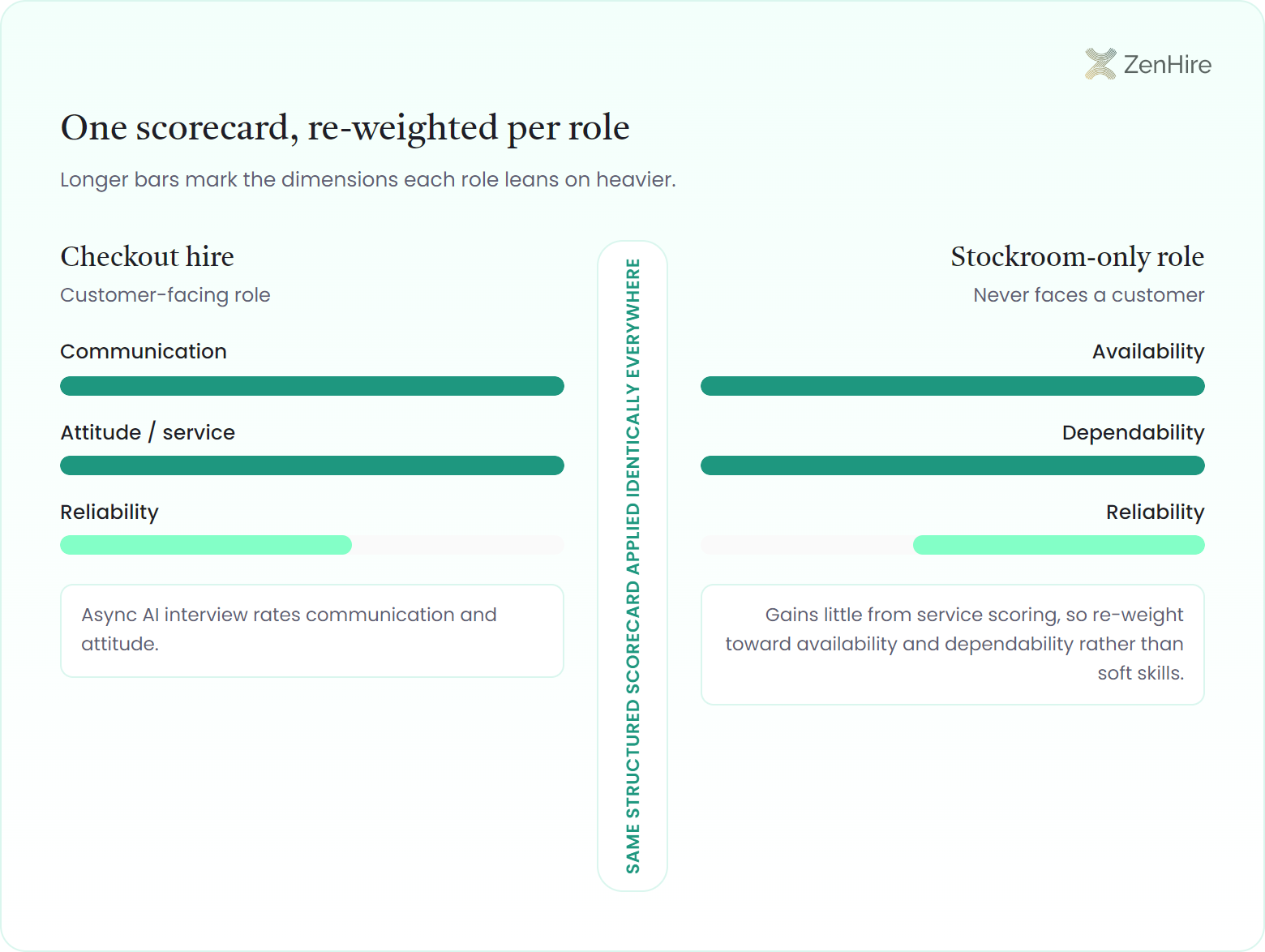
The mechanism is structured AI screening on top of a high-volume ATS: an async ai interview rates communication and attitude, the test library checks job fit, and bulk operations move whole batches of candidates through stages at once. One concrete example: a 200-store chain refilling checkout lanes posts a single position template and gets a ranked, comparable shortlist from every location instead of 200 managers each judging by gut. The edge case worth flagging: a stockroom-only role that never faces a customer gains little from service scoring, so you re-weight the scorecard toward availability and dependability rather than soft skills.
Grocery sits inside the same frontline pattern as the rest of retail, where replacing one hourly hire runs roughly $5,000 to $20,000 and about half of frontline leavers walk inside the first 90 days (industry estimates). Screening for reliability before the interview slot is where a chain stops paying that turnover bill twice.
| What the chain needs | How the software delivers it |
|---|---|
| Speed at volume | Async AI screening auto-scores applicants as they arrive |
| Store-to-store consistency | One structured scorecard applied identically everywhere |
| Manager time back | Only ranked, qualified candidates reach the interview slot |
| No system slowdown | Engineered for 3,000-plus applicants per role |
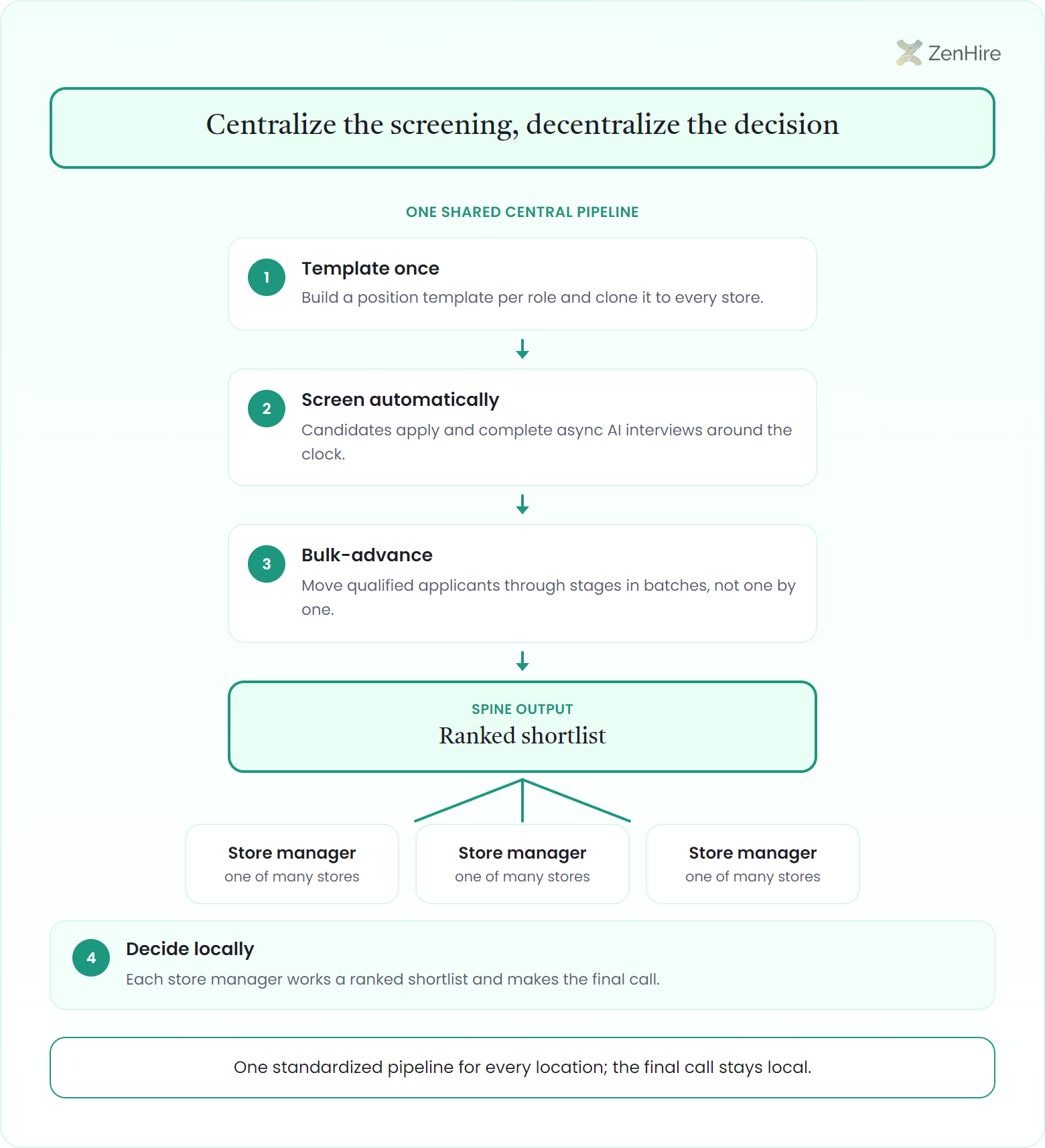
You centralize the screening and decentralize the decision. The platform runs one standardized pipeline for every location, scores applicants automatically, and hands each store manager a ranked shortlist to make the final call on.
Reusable position templates launch the same proven workflow in minutes per store, bulk operations advance qualified candidates in batches instead of one click at a time, and a shared talent pool lets any store redeploy a strong applicant another location already screened. The same multi-store, multi-location playbook that powers broader retail hiring software applies store for store across a grocery banner. One concrete example: a regional ramp can clone a single cashier template across forty stores in an afternoon. The honest limit: the software speeds screening, not sourcing, so a store in a thin local labor market still needs enough applicant flow at the top, which means pairing it with your job-board and referral channels.
1. Template once
Build a position template per role and clone it to every store.
2. Screen automatically
Candidates apply and complete async AI interviews around the clock.
3. Bulk-advance
Move qualified applicants through stages in batches, not one by one.
4. Decide locally
Each store manager works a ranked shortlist and makes the final call.
Yes, by turning every seasonal ramp into an always-on pipeline. Async screening runs 24/7, scoring applies the moment someone applies, and the chain works a continuously refreshed shortlist instead of racing live phone screens against a holiday deadline.
Some argue automation cannot keep pace with a holiday surge because hourly hiring is too unpredictable to systematize. That falls short of how the surge actually breaks down: the bottleneck is screening throughput, not decision-making, and async AI interviews plus bulk operations remove exactly that bottleneck while a manager still owns every hire. The same engine handles a winter peak the way it handles any seasonal hiring campaign. One concrete example: proven seasonal staff from last winter can be re-engaged in a click, with their history already on file, rather than re-sourced cold. The edge case: a single-day store opening with a hard cutoff still depends on top-of-funnel volume, so the software shortens time-to-shortlist dramatically but does not replace sourcing.
Because screening is automated rather than manual, grocery teams lean on the same public ZenHire results frontline operations see: 87% less manual screening and a 36% lower [time-to-hire](/metrics/time-to-hire), the difference between racing a holiday deadline and working a shortlist that is already ranked.
Grocery store hiring software is a platform that screens and ranks hourly retail applicants automatically so stores fill cashier, stocker, and frontline roles faster. It runs async AI interviews and bulk operations on top of an applicant tracking system built to handle 3,000-plus applicants per role.
Supermarket recruitment software handles hundreds of stores by running one standardized screening pipeline and one structured scorecard everywhere, then handing each store manager a ranked shortlist. Reusable position templates and a shared talent pool keep every location consistent without central recruiters reviewing each applicant.
A grocery chain hiring platform keeps up with holiday and seasonal surges by screening candidates 24/7 and advancing them in bulk, so a ramp becomes an always-on pipeline. One-click re-hiring of proven past seasonal staff cuts time-to-shortlist dramatically; pair it with sourcing to fill the top of the funnel.
Grocery hiring software works for non-customer-facing roles like stockers by re-weighting the scorecard toward reliability, availability, and dependability instead of service soft skills. The same async assessment and bulk operations apply, so backroom and checkout roles run through one consistent pipeline.
Grocery store hiring software will not replace store managers; it removes the manual screening and hands them a ranked shortlist so they decide faster. The AI measures communication, reliability, and fit, while the manager keeps the final hiring call on every candidate.
Free for Grocery hiring playbook
A practical guide to screening cashiers, stockers, and frontline staff at store scale: how to standardize one scorecard across every location, run async screening 24/7, and ramp fast for every holiday surge without adding recruiters.


See how ZenHire screens hourly grocery applicants in minutes and ramps fast for every seasonal peak.