
Restaurant hiring software screens hourly applicants for reliability and customer fit in minutes, so your managers spend shifts on the floor instead of buried in phone screens. ZenHire runs async AI interviews that rank applicants the moment they apply, then flags the ones likely to last past 90 days.
It has to clear applicants faster than a busy shift leaves room for. The right tool screens for reliability and customer fit automatically, ranks who is worth a conversation, and hands your manager a short list instead of a stack of look-alike resumes that all need a phone call.
The mechanism is simple: every applicant completes a short async AI interview the moment they apply, and the system scores communication, attitude, and dependability signals before anyone reads a resume. Concretely, a quick-service location hiring three line staff this week gets a ranked shortlist by morning instead of a manager calling forty numbers between rushes. ZenHire pairs this with ai interview software so the screen runs the same way at every location. The edge case worth flagging: roles that are almost entirely back-of-house and non-customer-facing gain less from communication scoring, so weight the scorecard toward availability and reliability there.
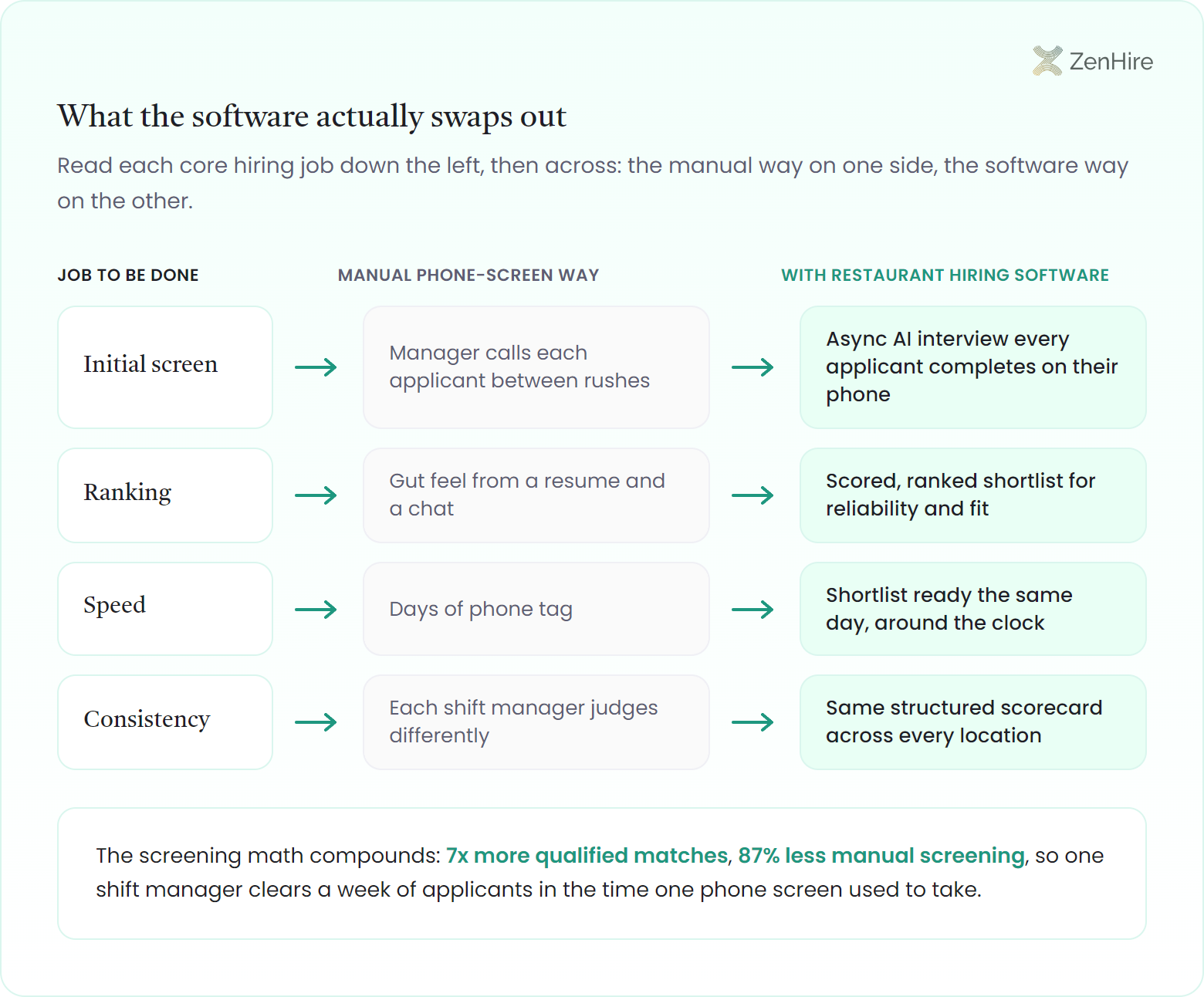
Across a hiring season the screening math compounds: ZenHire delivers 7x more qualified matches and 87% less manual screening, so a single shift manager can clear a week of applicants in the time one phone screen used to take.
| Job to be done | Manual phone-screen way | With restaurant hiring software |
|---|---|---|
| Initial screen | Manager calls each applicant between rushes | Async AI interview every applicant completes on their phone |
| Ranking | Gut feel from a resume and a chat | Scored, ranked shortlist for reliability and fit |
| Speed | Days of phone tag | Shortlist ready the same day, around the clock |
| Consistency | Each shift manager judges differently | Same structured scorecard across every location |
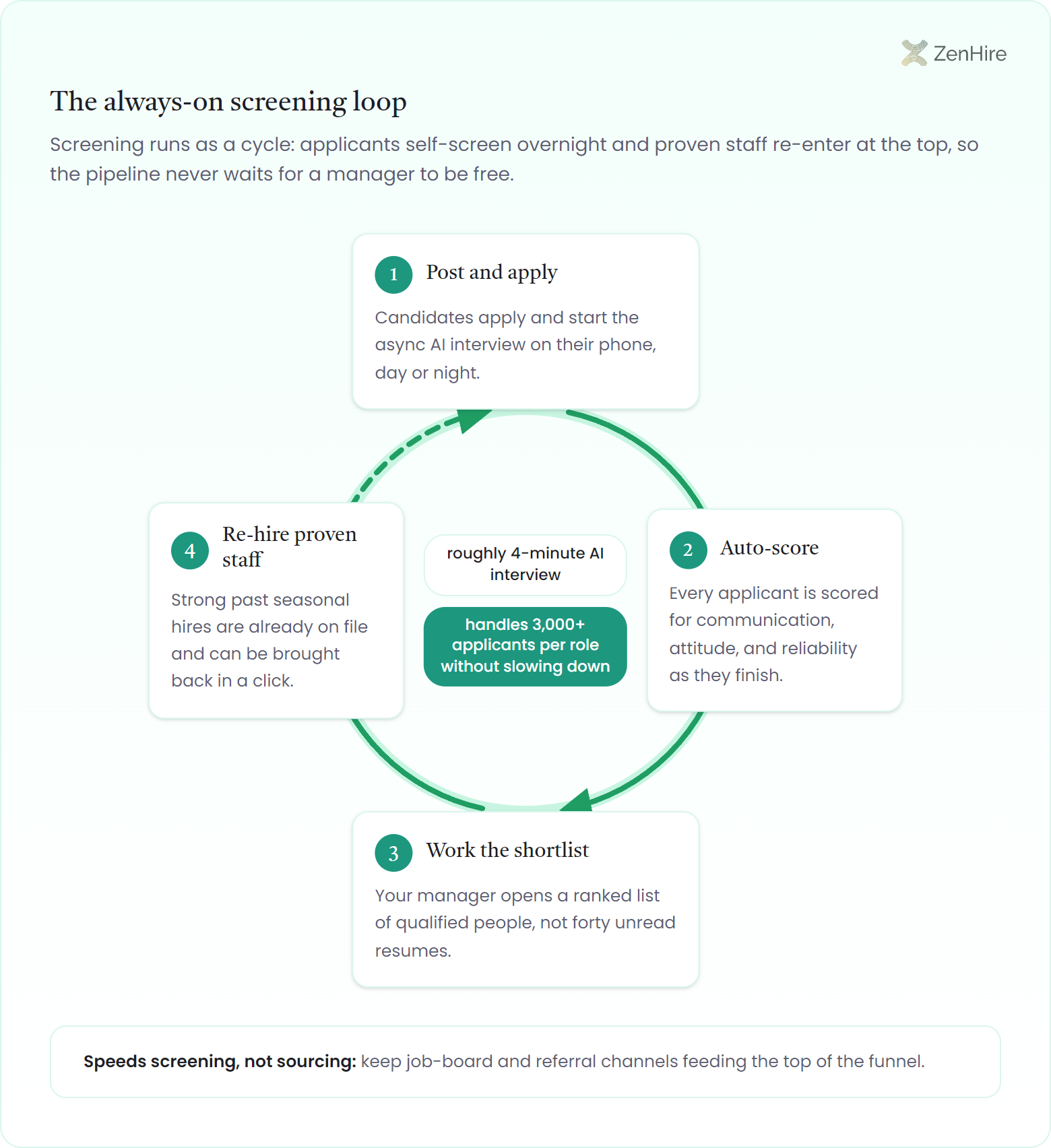
By turning screening into an always-on pipeline that never waits for a manager to be free. Applicants apply and complete a roughly four-minute AI interview at any hour, the system scores them as they come in, and your team works a ranked list instead of scheduling live screens against a dinner rush.
Here is the mechanism end to end, with a concrete example: a multi-unit operator posts a server role, candidates self-screen overnight, and by the time the GM opens the laptop the qualified people are already at the top. Under the hood, ai candidate matching ranks each applicant against the role before a human looks, and the same engine handles 3,000+ applicants per role of high-volume hiring without slowing down. One edge case to set expectations: the software speeds screening, not sourcing, so if applicant flow is thin at a single location you still need your job-board and referral channels feeding the top of the funnel.
Speed shows up in the numbers: teams using AI screening report roughly 36% lower [time-to-hire](/metrics/time-to-hire) and up to 200% faster hiring: the difference between filling a shift this week and losing a candidate to the restaurant down the street.
1. Post and apply
Candidates apply and start the async AI interview on their phone, day or night.
2. Auto-score
Every applicant is scored for communication, attitude, and reliability as they finish.
3. Work the shortlist
Your manager opens a ranked list of qualified people, not forty unread resumes.
4. Re-hire proven staff
Strong past seasonal hires are already on file and can be brought back in a click.
It can stack the odds in your favor by scoring the signals that early turnover usually comes from. Frontline exits in the first few months are often a fit problem, not a skill problem, so screening for reliability, communication, and customer-service temperament up front catches the mismatches a rushed resume scan misses.
Some will argue no tool can really predict who stays, and on any single line-cook or server hire that is fair. But across a full hiring season the odds tilt: the crumpled two-line resume a shift manager scans between rushes carries a predictive validity of only about 0.14, whereas a structured screen of reliability and temperament clears that bar by a wide margin, and every mis-hire that walks costs roughly $5,000 to $20,000 to re-hire and retrain. ZenHire's scoring is glass-box and explainable, so a GM sees exactly why an applicant landed where they did instead of trusting a black box, and you can bolt on a pre-employment skills test for stations where knife skills or POS speed matter as much as attitude. The honest edge case: a score nudges the odds, it does not guarantee any one hire, so back it with clean onboarding and a fair schedule, because even a perfect-fit server quits if their first week is chaos.
Restaurant hiring software is a tool that screens and ranks hourly applicants automatically so managers interview fewer, better-fit people. ZenHire runs short async AI interviews that score reliability and customer fit before anyone reads a resume.
A hiring app for restaurants lets candidates apply and complete a roughly four-minute AI interview from their phone, day or night. Your manager then opens a ranked shortlist instead of playing phone tag between rushes.
QSR recruitment software is built for high-volume, multi-location hiring, handling 3,000+ applicants per role and bulk actions without slowing down. Every location uses the same structured scorecard, so quality stays consistent across the brand.
Restaurant hiring software reduces 90-day turnover by scoring reliability and customer-service fit before the hire, not after. Catching mismatches up front means fewer early exits than hiring on a thin resume and a rushed phone screen, and roughly half of frontline leavers go within the first 90 days, before training pays back.
Candidate drop-off stays low because the AI interview is short, mobile, and available any hour, which fits hourly applicants' schedules. A roughly four-minute screen also self-selects for motivated people who actually want the shift.
Free for Restaurant hiring scorecard
A ready-to-use scorecard for hourly QSR and restaurant roles: the reliability, availability, and customer-service signals to score, the red flags to screen out, and how to keep every location grading the same way.


See how ZenHire screens hourly applicants for reliability and fit in minutes, then ranks the ones likely to last.