
Recruitment agency software runs every client briefing through one shared ATS, scores candidates with explainable AI, and produces client-ready scorecards that win deals and justify your fee. If you run recruitment process outsourcing for those clients, the same platform carries the whole book. You stop forwarding resumes and start placing assessed candidates.
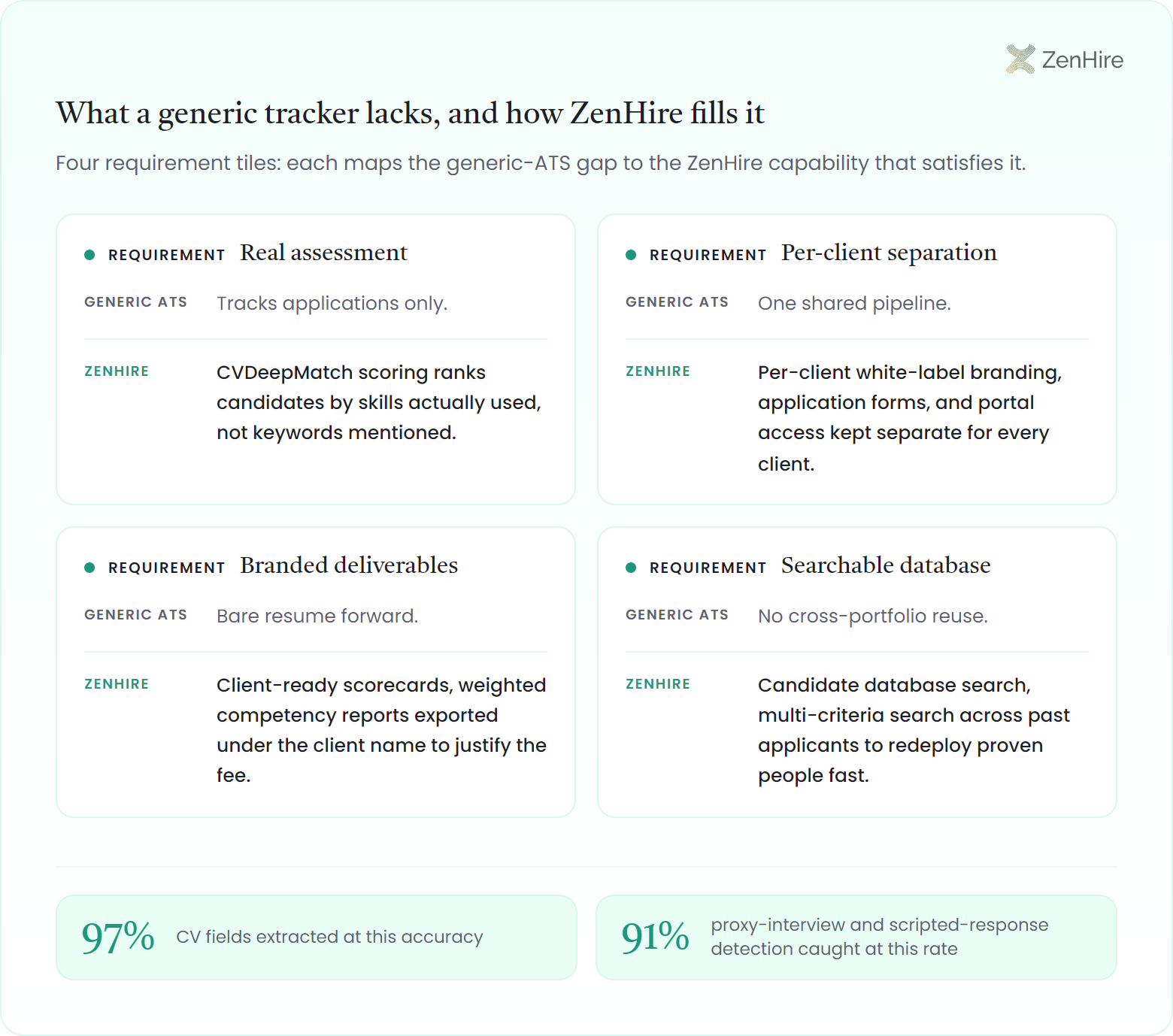
It needs four things a generic tracker lacks: real assessment, per-client separation, branded deliverables, and a searchable database. Tracking applications is table stakes; the agency-specific work is proving candidate quality to a paying client and doing it across many briefs at once.
A specialist firm placing for finance, healthcare, and sales clients in the same week is the clear case. With one ATS it scores each candidate against that client's job using semantic cv-to-job matching, applies the client's own competency weights, and exports a branded report under the client's name. This is the kind of work in-house recruiting or an agency each handles differently, and volume is where the agency model earns its fee. The edge case worth flagging: a retained executive search with three finalists leans far less on volume features and far more on depth, so you weight the scorecard toward nuanced judgment and use bulk tooling barely at all. ZenHire extracts CV fields at 97% accuracy, so the structured profile you score from is reliable even on a messy resume.
On a blind test, sorting CVs by ZenHire's score and comparing the top and bottom 10% against human review showed 93%+ alignment with human screeners, so the shortlist you submit is one you can defend in a client review.
| Capability | What it does for the agency |
|---|---|
| CVDeepMatch scoring | Ranks candidates against each client job by skills actually used, not keywords mentioned. |
| Per-client white-label | Branding, application forms, and portal access kept separate for every client. |
| Client-ready scorecards | Weighted competency reports exported under the client's name to justify the fee. |
| Candidate database search | Multi-criteria search across past applicants to redeploy proven people fast. |
| Anti-fraud integrity | Proxy-interview and scripted-response detection (caught at a 91% rate) so submitted scores are defensible. |
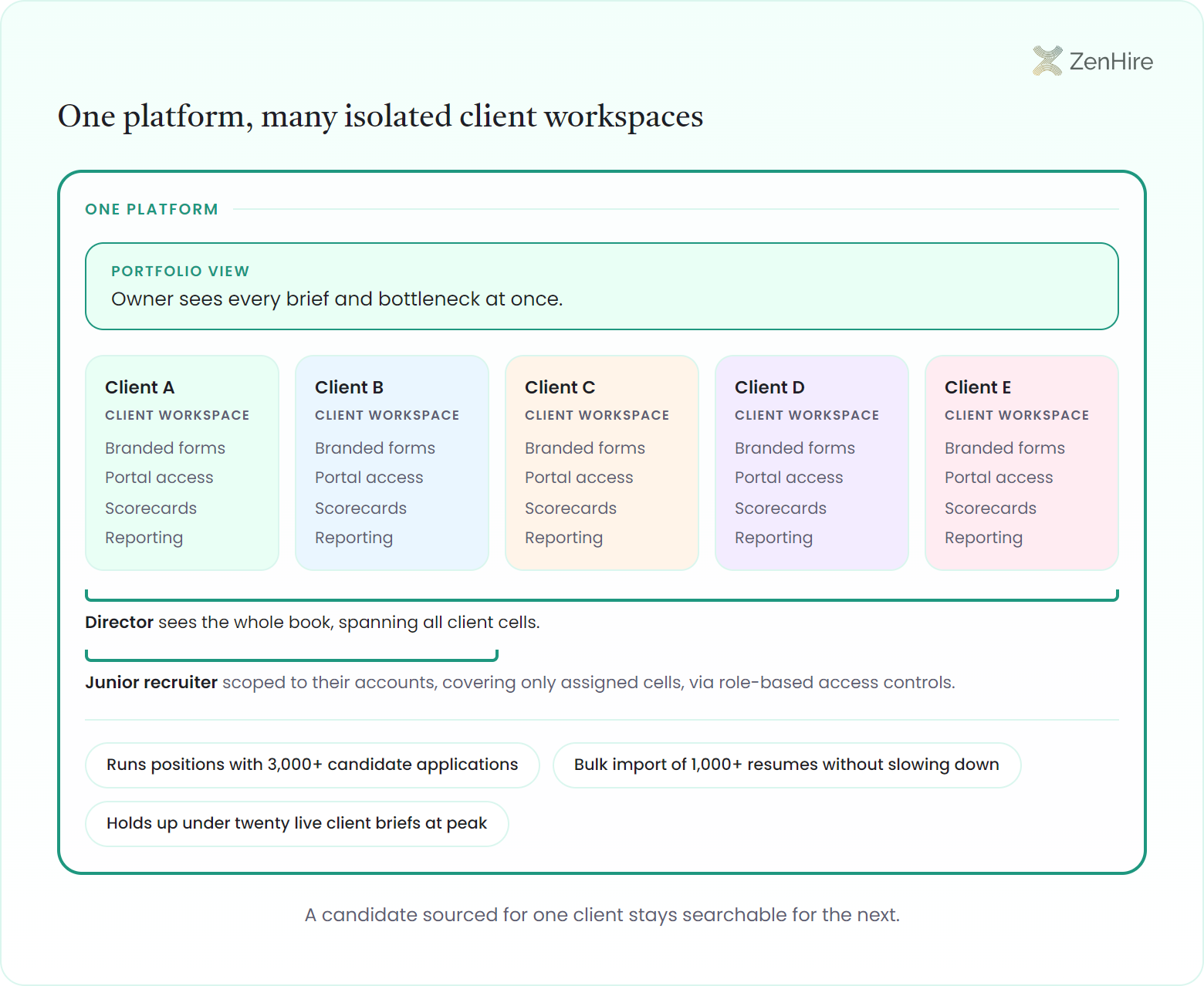
Each client gets its own branded workspace inside a single platform: separate application forms, portal access, scorecards, and reporting, all run by one team without juggling five logins. The portfolio view sits on top, so an owner sees every brief and bottleneck at once.
Picture a firm carrying twenty live client briefs at peak. The platform holds up under that load, engineered for high-volume hiring with positions carrying 3,000+ candidate applications and bulk import of 1,000+ resumes without slowing down, while role-based access controls keep a junior recruiter scoped to their accounts and the director sees the whole book. A candidate sourced for one client stays searchable for the next. The honest limit: white-labelling controls how deliverables look and who sees what, not your contractual obligations, so confidentiality terms and exclusivity between competing clients still need handling in your agreements, not the software.
1. Spin up the client
Create a branded workspace with the client's logo, forms, and reporting in minutes.
2. Score against the brief
Match and assess candidates with that client's competency weights, not a generic rubric.
3. Submit with proof
Send a branded scorecard instead of a bare resume, so the shortlist defends itself.
4. Reuse the pool
Search past candidates across the portfolio to redeploy proven people for the next brief.
Yes, because it submits candidates assessed for fit rather than candidates who merely read well on paper, and a resume is a weak predictor on its own. Industry research puts the predictive validity of a resume around 0.14, while an AI interview paired with structured cognitive and behavioral assessment reaches 0.6 or higher, more than four times the signal of a CV alone.
Some argue AI matching is just faster keyword screening that floods clients with near-misses and erodes trust. That misreads how it works: CVDeepMatch is semantic and context-aware, distinguishing a skill a candidate used from one they only mentioned, and ZenHire's scoring aligns 93%+ with human screeners on the same shortlist. Pairing matching with anti-fraud assessment integrity means a proxy interview or scripted answer is caught before it ever reaches a client. One concrete result of submitting assessed candidates is fewer guarantee-period fall-offs, which is the metric that actually protects your margin. The edge case: for a hyper-niche role where the true candidate pool is tiny, matching still helps you rank the few you have, but it cannot manufacture a fit that the market does not contain.
Scoring is [glass-box and bias-excluded](/ethical-hiring/reduce-bias): sensitive attributes are architecturally kept out of the model and every score ships with its evidence, so a client (or an audit) can see exactly why a candidate ranked where they did under GDPR and SOC 2 Type II.
Recruitment agency software is a staffing agency ATS that runs multiple client portfolios from one platform, adding AI candidate matching, white-label branding, and client-ready scorecards on top of basic application tracking. It is built for placement work, not for a single in-house hiring team.
Software for recruitment agencies differs from a generic ATS by treating many clients as the unit of work, not one company. It adds per-client white-label branding, weighted client scorecards, and cross-portfolio candidate search, where a standard ATS only tracks one organization's pipeline.
A staffing agency ATS reduces placement fall-off by assessing candidate fit before submission rather than after a client complaint. Because ZenHire scores align 93%+ with human screeners and combined assessment far outpredicts a resume, fewer hires fail inside the guarantee period.
Recruitment agency software white-labels deliverables per client by giving each account its own branded workspace, application forms, and scorecards. Reports export under the client's name, so your submissions look like a bespoke service rather than a forwarded resume.
AI matching does not replace recruiters at an agency; it removes the repetitive screening so recruiters focus on relationships, client advisory, and closing. ZenHire scores candidates with explainable, bias-mitigated AI, but the recruiter still owns the submission and the human judgment.
Free for Recruitment agency scorecard template
A ready-to-use weighted scorecard layout for justifying a placement fee: the competencies to score, how to weight them per client, and the evidence to attach so a shortlist defends itself.


See how ZenHire scores candidates, brands every deliverable, and reduces fall-off across your whole client portfolio.