
What Is RPO (Recruitment Process Outsourcing)?


· 9 min read
RPO (recruitment process outsourcing) hands all or part of your hiring to an external provider that runs sourcing, screening, scheduling, and offers as a managed service measured on time-to-fill, cost-per-hire, and quality of hire. Unlike a staffing agency charging 15-25% of first-year salary per placement, an RPO owns the whole funnel for a process fee, in end-to-end, project-based, or selective form. The economics have shifted, though: with about 70% of employers now using AI screening (and users reporting hiring roughly 62% faster at 59% lower cost), what an RPO sells is drifting away from recruiter hours and toward evaluation that holds its bar at any funnel size.
What is RPO (recruitment process outsourcing)?
RPO (recruitment process outsourcing) is a model where an external provider takes over all or part of your hiring process and runs it as a managed service: sourcing candidates, screening and assessing them, scheduling interviews, and managing offers, often working inside your systems and under your employer brand. Unlike a contingency agency that gets paid only when it places a candidate, an RPO partner owns the funnel itself and is measured on process outcomes like time-to-fill, cost-per-hire, and quality of hire.
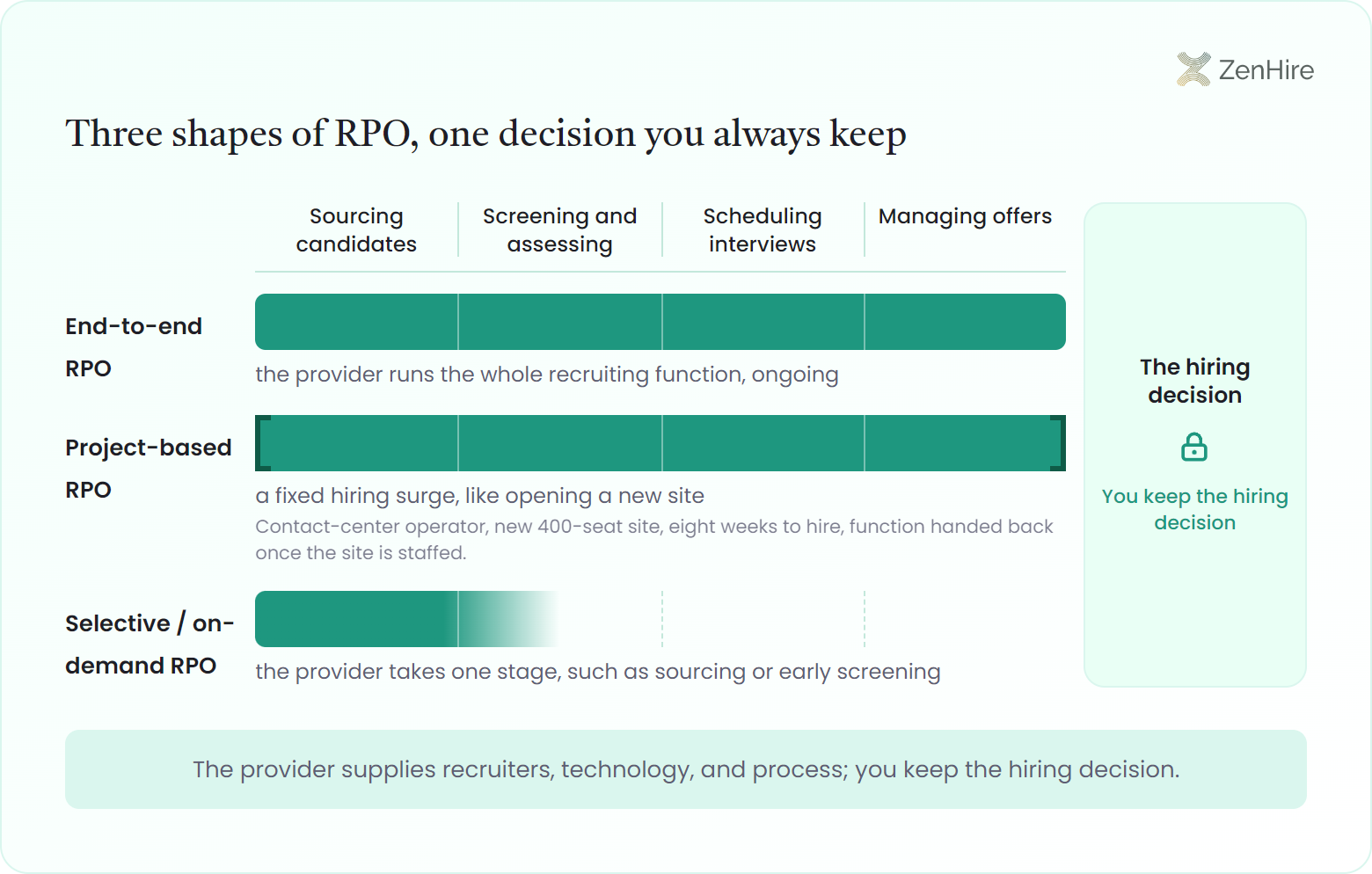
Mechanically, RPO comes in three common shapes: end-to-end (the provider runs the whole recruiting function), project-based (a fixed hiring surge, like opening a new site), and selective or on-demand (the provider takes one stage, such as sourcing or early screening). The provider supplies recruiters, technology, and process; you keep the hiring decision. Because the provider absorbs the operational load, RPO is most attractive when hiring is continuous, high-volume, or hard to staff internally. For teams weighing models, the deeper question is usually in-house versus outsourced recruiting cost, not the label.
A concrete example: a contact-center operator opening a new 400-seat site has eight weeks to hire and no internal recruiting muscle for that scale. A project RPO drops in a team that sources, screens for spoken-English and reliability, and books interviews, then hands the function back once the site is staffed. The edge case is the small, specialized hire: outsourcing a single niche senior role to a managed-process model rarely pays, because the fixed cost of standing up an RPO outweighs the value of one placement, which is exactly where a contingency agency or in-house search fits better.
Context for the scale of the market: the global recruitment market was roughly $450B in 2023 and is projected to reach about $870B by 2032 (around 7.5% CAGR), and there are an estimated 160,000 recruitment agencies worldwide. RPO grows fastest where hiring is continuous and volume-driven, because that is where running recruiting as a repeatable process beats filling roles one at a time.
When do you choose RPO over in-house hiring?
You choose RPO over in-house hiring when hiring volume is high or unpredictable and your internal team cannot scale screening fast enough without dropping quality or blowing out time-to-fill. The decision is rarely about whether your recruiters are good; it is about whether a fixed in-house team can flex to a spiky, high-volume funnel. RPO converts a hiring surge into a managed process; in-house keeps control and institutional knowledge but caps your throughput at whatever your headcount can handle.
The mechanism that makes RPO worth it is unit economics under load. When you are hiring hundreds of frontline workers a quarter, the cost that matters is not the per-hire fee. It is screening consistency. An RPO that standardizes evaluation protects your quality of hire and your cost-per-hire at the same time, because every candidate clears the same bar. The risk is the opposite: an RPO that throws bodies at a req and screens inconsistently will fill seats fast and refill them just as fast.
A concrete example: a retailer staffing for a seasonal peak needs 1,200 hires in six weeks across 40 locations. In-house, that means hiring temporary recruiters who never reach proficiency before the peak ends; an RPO already has the team and the playbook, so it absorbs the spike and releases it cleanly. The edge case runs the other way: a company hiring steadily but slowly (a dozen roles a quarter, mostly specialized) usually keeps hiring in-house, because the institutional context and culture knowledge it builds outweighs the throughput an RPO would add.
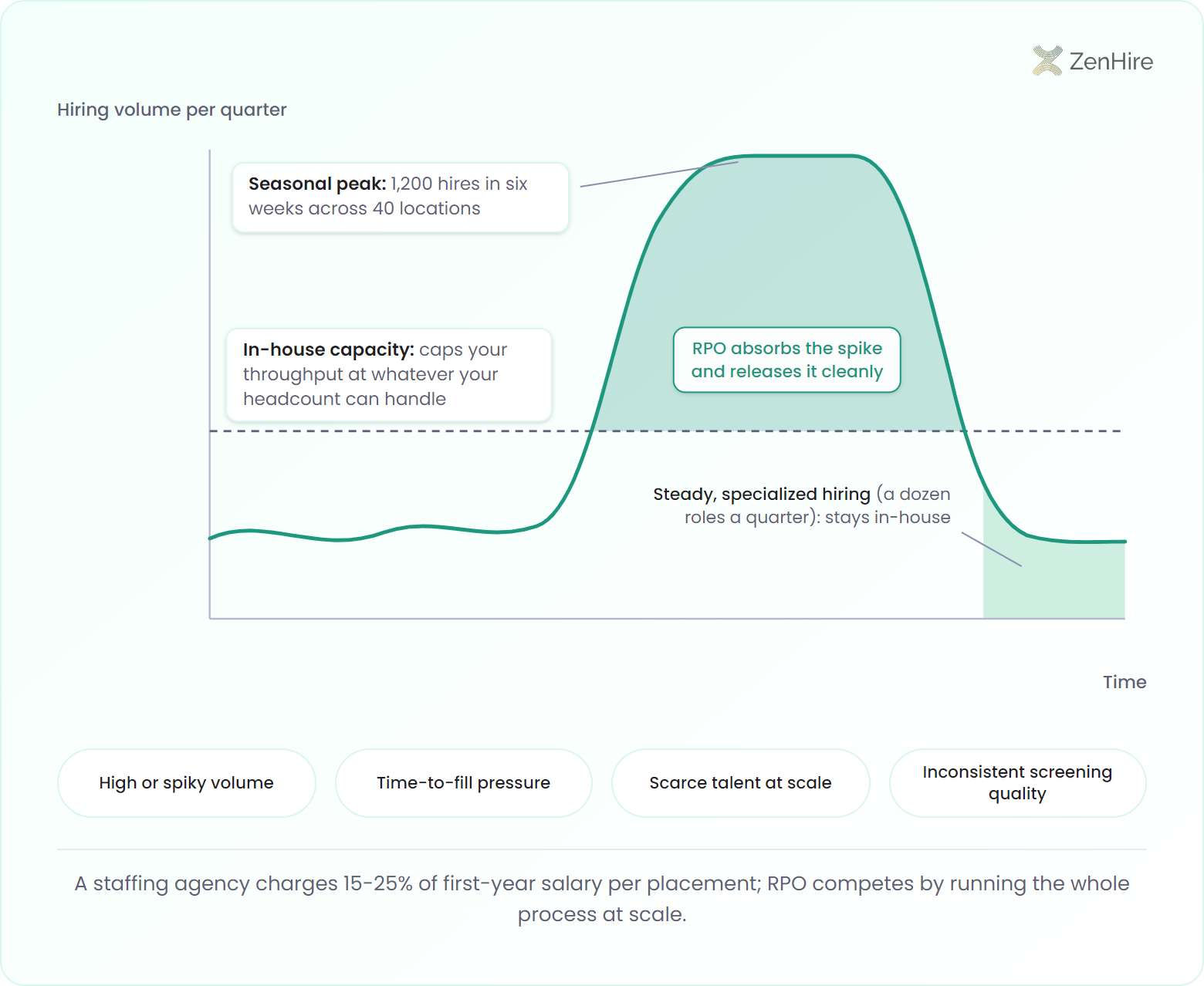
The math that decides it: replacing one frontline hire costs roughly $5,000-$20,000 (industry estimates), and SHRM puts replacement at 50-200% of annual salary for more complex roles. A staffing agency typically charges 15-25% of first-year salary per placement. RPO competes on whether running the whole process, at scale and consistently, beats paying per-head fees or stretching an in-house team past its limit.
- High or spiky volume: seasonal peaks, new-site launches, or hundreds of hires a quarter your team cannot absorb
- [Time-to-fill pressure](/metrics/time-to-hire): open seats are leaking revenue and in-house throughput is the bottleneck
- Specialized or scarce talent at scale: you need repeatable sourcing reach, not a single search
- Inconsistent quality: different recruiters, different bars, and turnover that traces back to screening
How does AI change the RPO model?
AI changes the RPO model by moving the value from recruiter headcount to evaluation quality. The repetitive sourcing, screening, and scheduling that RPOs historically sold as labor can now be automated, so the differentiator becomes how accurately and consistently candidates are evaluated, not how many recruiters sit on the account. When the screening layer is AI-assisted, an RPO can run a much larger funnel with the same team while keeping every candidate scored against the same rubric.
The mechanism is consistency at scale. A structured interview scored the same way for every candidate predicts performance far better than ad-hoc human screening, and AI makes that structure cheap to apply to ten thousand applicants instead of ten. ZenHire's evaluation layer reads communication, soft skills, and reliability signals (with CV extraction around 97%, language assessment aligning 90-96% with PhD linguists, and 91% fraud detection) and produces the same glass-box scorecard whether the RPO is screening 50 candidates or 50,000. That is the part an RPO cannot easily replicate by adding people.
A concrete example: an RPO running offshore English screening swaps a 30-minute recruiter phone screen for a roughly four-minute async interview that places each candidate on the CEFR A1-C2 scale, so its team opens decision-ready scorecards instead of dialing down the applicant list one call at a time: same evidence, a sliver of the labor. The edge case is over-automation: an RPO that leans on a generic resume-keyword filter instead of a validated method just scales the wrong signal and rejects strong candidates faster, which is why the durable RPO advantage is structured, reduced-bias evaluation, not raw automation.
| RPO capability | Traditional model | AI-assisted model |
|---|---|---|
| Screening throughput | Bound by recruiter headcount | Scales without adding recruiters |
| Evaluation consistency | Varies by recruiter and day | Same rubric for every candidate |
| Spoken-language check | ~30-min recruiter phone screen | ~4-min async interview, CEFR A1-C2 |
| Decision evidence | Recruiter notes, gut feel | Glass-box, auditable scorecard |
People hear RPO and picture a room of recruiters you rent by the head. I think that framing is already dated. The reason a company outsources hiring is almost never that it lacks people willing to read resumes; it is that it cannot evaluate candidates consistently at the volume it needs. So the real product of an RPO is not labor, it is judgment applied the same way every time. The moment you can deliver that judgment as software, the math flips: you stop paying for headcount and start paying for accuracy. That is the version of RPO I want to exist: measure with the machine, decide with the human, and never let the bar drift just because the funnel got bigger.
Frequently asked questions
What is the difference between RPO and a staffing agency?+
The difference between RPO and a staffing agency is ownership of the process versus the placement. A staffing agency hands you candidates and charges a placement fee (typically 15-25% of first-year salary) per hire, while an RPO runs your recruiting function as a managed service for a process fee, owning sourcing, screening, and coordination rather than just delivering a shortlist.
Is RPO cheaper than in-house hiring?+
RPO is cheaper than in-house hiring mainly at high or spiky volume, not at low steady volume. When you must hire hundreds of people in a compressed window, an RPO absorbs the surge without you carrying permanent recruiters you do not need year-round. For a dozen specialized roles a quarter, in-house usually wins on cost and on the institutional knowledge it builds.
What types of RPO are there?+
There are three common types of RPO: end-to-end, project-based, and selective. End-to-end RPO runs your whole recruiting function ongoing; project-based RPO covers a defined surge like a new-site launch; and selective or on-demand RPO takes one stage, such as sourcing or early screening, while your team keeps the rest.
How does AI affect RPO providers?+
AI shifts RPO value from recruiter headcount to evaluation quality. Automating sourcing, screening, and scheduling lets an RPO run a far larger funnel with the same team, so the differentiator becomes how consistently candidates are scored. That shift is already mainstream: about 70% of employers now use AI screening, and users report hiring roughly 62% faster at 59% lower cost, which is exactly the pressure that turns recruiter hours into a commodity and puts evaluation quality up front.
Does RPO work for high-volume frontline hiring?+
RPO works best for high-volume frontline hiring, where continuous, repeatable sourcing and screening beat filling roles one at a time. The risk is inconsistent screening at scale: an RPO that fills seats fast but screens loosely will refill them just as fast, which is why structured, validated evaluation matters more than raw throughput.
Free for evaluating RPO
The RPO vs. in-house decision checklist
A one-page checklist for deciding when to outsource hiring: the volume, time-to-fill, and quality thresholds that tip the math toward RPO, and the screening standards to hold any provider to.