
How Do You Hire Your First Employee?


· 13 min read
You hire your first employee by running six steps in order: scorecard, focused sourcing, an identical structured screen, a work-sample assessment, reference checks, then a clean offer with a 90-day plan. On a team of one, the person you like most in conversation is a coin flip: that unstructured chat carries roughly 0.18 predictive validity, whereas a scorecard, a work-sample, and a consistent screen stacked together clear 0.6, more than triple the signal you can act on. Get it wrong and the unwind runs 50-200% of annual salary (SHRM), with about half of frontline leavers walking inside 90 days, so the first seat is decided by the process, not the founder's read of the room.
When should you hire your first employee?
The right time to make your first hire arrives when the same revenue-blocking task keeps stalling because only you can do it, and the cost of that bottleneck now exceeds a loaded salary. That is the test, not how busy or buried you feel.
Busy is not the signal. Plenty of founders feel underwater and still do not need an employee; they need to drop low-value work or buy a tool. The real trigger is a recurring, definable job that directly moves revenue or unblocks customers, week after week, that you can hand to one person with a clear scope. If you cannot write that scope in a single sentence, you are not ready to hire; you are ready to think. This is also the moment to decide whether you want to run the process yourself or lean on a system that does the heavy lifting; if the answer is the latter, see how teams hire without a recruiter using structured tooling.
Concrete example: a solo founder running demos, onboarding, and support starts losing deals because follow-up slips for days. Support is now costing pipeline, it is repeatable, and it has a clean boundary: that is a hire. The edge case cuts the other way: when the work is real but erratic, a few hours one week and forty the next, a full-time first employee will sit idle or drown. A contractor or fractional hire fits better until the load is steady enough to justify a permanent seat. If you are mapping out several roles rather than one, our guide to how to build a team as a CEO covers hiring order.
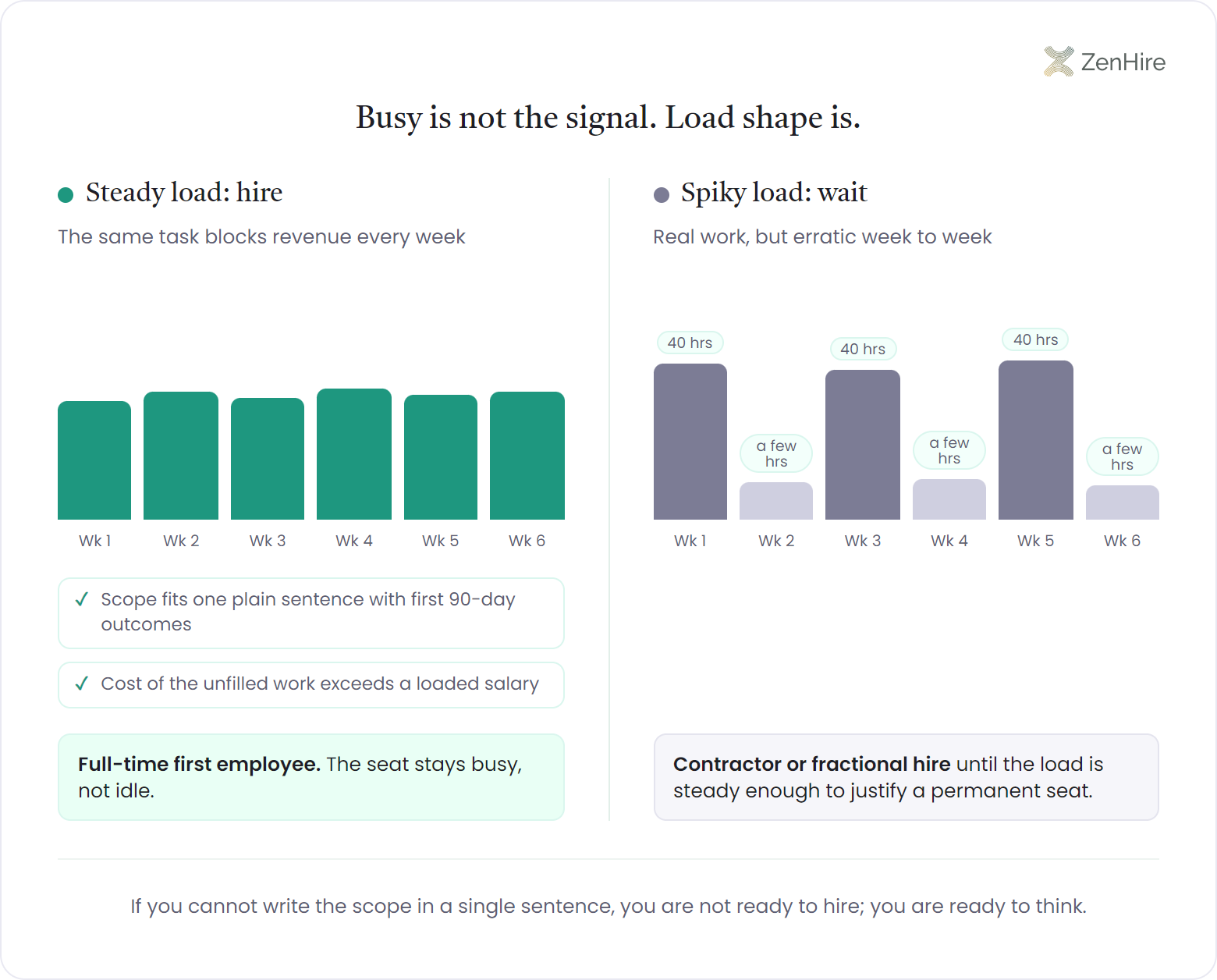
- The same task blocks revenue every week and only you can clear it right now
- You can describe the role and its first 90-day outcomes in one plain sentence
- The cost of the unfilled work exceeds a loaded salary for that role
- The work is steady, not spiky, so a full-time seat stays busy rather than idle
Are you ready to make your first hire?
You are ready to hire when the role, the runway, and the paperwork all clear at once, not when any single one of them does. Founders usually feel ready the moment the workload spikes, but readiness is a checklist, not a feeling: a scoped role, the cash to carry the seat through ramp, a legal way to employ someone, and the bandwidth to actually manage them. Miss one and the hire stalls before it starts.
Run the readiness checklist below before you write a single job post. Every item is a gate: if you cannot tick it honestly, you have a problem to solve first (widen runway, register as an employer, or carve out real onboarding time) rather than a candidate to find. Treating readiness as binary up front is what stops a rushed first hire from becoming an expensive unwind later, where replacing the wrong seat can run 50 to 200 percent of salary (SHRM) on a team that can least afford it.
- The role is scoped in one sentence: you can name the mission and its first 90-day outcomes without hand-waving
- The runway covers the loaded cost: salary plus roughly 20 to 30 percent for taxes, benefits, tools, and equipment, carried for at least six to twelve months including a slow ramp
- You can legally employ someone: employer registration, payroll, a written offer and contract, and the right worker classification (employee vs contractor) are sorted
- There is real onboarding capacity: you have the hours in week one to set context, not just a desk and a login
- Comp is benchmarked, not guessed: you know the market band for the role and can make a fair, defensible offer
- Success and failure are defined in advance: you have written what "working out" looks like at 30, 60, and 90 days before anyone starts
Common first-hire mistakes (and how to avoid them)
The costly first-hire mistakes are predictable, which means they are preventable: almost all of them come from compressing the process to reach a person you already like. Each pattern below maps to a fix you can apply before you ever extend an offer.
Hiring a clone of yourself: founders reach for someone who thinks exactly as they do, then end up with two people who are weak at the same things. Fix it by scorecarding the competencies the business needs, not the ones you already have. Deciding on charisma in one conversation: a first-time hirer has no calibration and leans hardest on rapport, yet an unstructured chat predicts performance at only ~0.18 validity in selection research, so a great talker sails through on signal you cannot bank on; anchor the call on a work-sample instead. Skipping references or a trial to move fast: roughly half of frontline leavers are gone inside 90 days by industry estimates, and a paid trial task or a reference tied to your scorecard outcomes catches the mismatch the interview hid. Over-hiring for spiky work: a full-time seat sits idle when the load swings, so start with a contractor or fractional hire until the work is genuinely steady. Lowballing or fuzzing the offer: an unbenchmarked or vague offer either loses the candidate or breeds resentment later, so benchmark the band and put scope, pay, and a written 90-day plan in writing.
What steps does hiring your first employee involve?
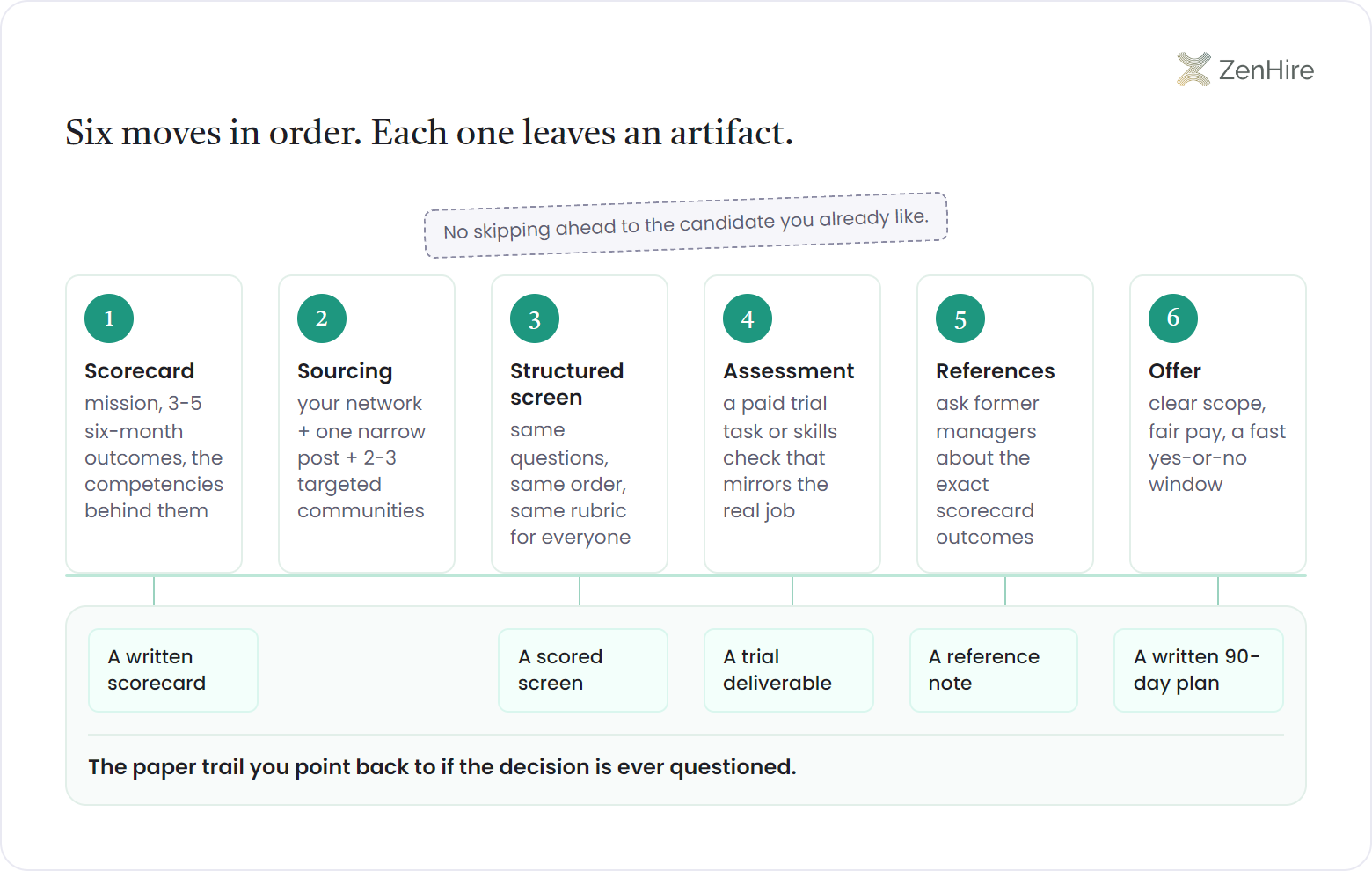
Making your first hire involves six moves run in order: define the role on a scorecard, source a focused pool, screen everyone identically, assess the real skill, check references, then extend a clean offer. The discipline is running them in sequence instead of skipping ahead to the candidate you already like.
Start with the scorecard, because it is the artifact that keeps everything after it honest. List the mission of the role, three to five outcomes you expect in the first six months, and the competencies that produce them. Now you have something concrete to source against and score against, instead of a fuzzy sense of fit. Sourcing then becomes targeted: your network, one narrow job post, and two or three communities where the right people already gather, not a hundred channels at once.
The screen is where most first-time hirers go wrong, so make it identical for every candidate: the hallmark of a structured interview is the same questions, the same order, the same rubric. Add a short assessment that mirrors the real work, whether a paid trial task, a writing sample, or a structured skills check, because the work-sample, not the interview charm, surfaces the strongest hire. References come last and confirm patterns; ask former managers about the specific outcomes on your scorecard, not for a character endorsement. If you would rather a system run the repeatable parts, ZenHire's structured AI screening for candidates puts every applicant through the same roughly four-minute async interview, scores demonstrated competencies rather than keywords, and excludes sensitive attributes from the result, giving a founder screening their first pool the even hand that is nearly impossible to hold by instinct.
Concrete example: a founder hiring a first operations lead builds a four-line scorecard, posts to two operator communities, runs the same six-question screen on five finalists, and sets a paid half-day trial on a real backlog. The trial breaks the tie that the interviews could not. Edge case: in a tiny pool of three referrals you cannot truly rank anyone, so widen sourcing before you screen; a structured process on too few people just formalizes a coin flip.
Why the screen outweighs the coffee chat for a first hire: decades of selection research put an unstructured interview at about 0.18 predictive validity and a plain CV skim near 0.14, while stacking a structured interview, a cognitive check, and a skills test lifts the signal past 0.6, more than triple the read you get from talking things over. With exactly one seat to fill and no second opinion in the room, that gap is the difference between a defensible bet and a hunch.
- Scorecard: mission, three to five 6-month outcomes, the competencies behind them
- Sourcing: your network plus one narrow post plus two or three targeted communities
- Structured screen: the same questions and rubric for every candidate, scored not vibed
- Assessment: a paid trial task or structured skills check that mirrors the real job
- References: ask former managers about the exact outcomes on your scorecard
- Offer: clear scope, fair pay, a fast yes-or-no window, and a written 90-day plan
- Lean on tooling without losing the human call: even solo founders have company here, since by 2025 roughly 70% of hiring teams use AI somewhere in the funnel, with AI-enabled hiring cited as about 62% faster and 59% lower cost (industry estimates), so point it at the repeatable screen and keep the final yes for yourself
A first hire checklist you can reuse
Keep the checklist short enough that you actually follow it on hire number two as well. Each item maps to one of the six steps and produces an artifact you can point back to if the decision is ever questioned: a written scorecard, a scored screen, a trial deliverable, a reference note.
How do you avoid a costly mistake with your first employee?
You avoid a costly first-hire mistake by replacing instinct with evidence at every gate: a scorecard, an identical screen, and a work-sample that tests the real skill. The mis-hires that hurt most come from deciding on charisma in a single conversation, then bending the data to fit.
The cost is the reason this matters more for hire number one than hire number ten. Replacing an employee runs 50 to 200 percent of their annual salary once you count the true cost per hire, lost productivity, and the ramp you repeat, per SHRM, and in frontline roles, replacing a single hire can run $5,000 to $20,000 by industry estimates, with roughly half of leavers gone inside the first 90 days, before training has paid back; hiring for fit is the surest way to reduce that early turnover. For a small team, one wrong seat can stall the roadmap for a quarter. The mechanism that prevents it is structure: same questions, a work-sample that tests the actual skill, and a written record of why each candidate scored as they did, so the decision is defensible and so you can learn from it if it goes wrong.
Some founders argue the opposite, that early hires are about conviction and chemistry, and that process kills the gut instinct that finds a rare A-player. There is a grain of truth there, but it confuses where judgment belongs. Structure does not remove your judgment; it feeds it cleaner inputs. AI measures the repeatable signals (communication, demonstrated competence, consistency under pressure) and you decide on the things only a founder can weigh, like trust, mission, and risk appetite. The honest division of labor is simple: AI measures, humans decide. The difference between an AI recruiter and a human recruiter is not who wins; it is who does which half of the job, and that split is what turns a gut call into a defensible one.
Concrete example: two finalists interview equally well, but the structured work-sample shows one ships clean output under a deadline while the other freezes. Gut alone would have split that coin; the assessment broke the tie on evidence. Edge case: the AI flags a candidate as a borderline pass and your instinct says exceptional. Treat the disagreement as a prompt to dig, not a verdict to override blindly; re-check the work-sample and references before you commit either way.
| Decision approach | Gut-first hiring | Structured first hire |
|---|---|---|
| What you decide on | Charisma in one conversation | Evidence on a scorecard |
| Predictive validity of the read | Unstructured chat ~0.18 | Combined methods 0.6+ |
| When it goes wrong | No record of why you chose | A defensible, auditable trail |
| Typical failure cost | 50-200% of salary to unwind | Caught before the offer |
My first hire kept me up at night more than any funding round, because there was no one to blame but me if it went wrong. What I learned the hard way: I did not trust the warm, easy conversations; I trusted the candidate who did the trial task well, even when the chemistry was only fine. On a team of one, a single bad seat does not just cost money, it sets the whole culture, so I would rather measure everything I can and reserve my gut for the one thing it is actually good at: deciding whether I want to build something with this person.
Frequently asked questions
How do you hire your first employee with no HR experience?+
Hiring your first employee with no HR experience comes down to running one repeatable process instead of trusting a single gut feeling. Write a one-page scorecard, screen every candidate with the same questions and rubric, add a paid trial task, and check references against your stated outcomes. A structured screen predicts on-the-job performance far better than an unstructured chat, so on your very first hire the process stands in for the instincts you have not built yet.
What belongs on a first hire checklist?+
A first hire checklist covers six steps in order: a scorecard defining the role, focused sourcing, an identical structured screen, a work-sample assessment, reference checks tied to your outcomes, and a clean offer with a 90-day plan. Each step leaves an artifact, so the decision stays defensible and you can reuse the same checklist for the next hire.
How much does a bad first hire cost?+
A bad first hire costs far more than the salary you paid: typically 50 to 200 percent of annual pay once recruiting, lost productivity, and re-ramp are counted, per SHRM, and $5,000 to $20,000 for frontline roles by industry estimates. For a small team the hidden cost is worse, since one wrong seat can stall the roadmap for a quarter, which is why structure beats instinct when making your first hire.
Should you use AI when making your first hire?+
Using AI for your first hire helps most on the repeatable parts of screening, not the final decision. A structured AI screen scores demonstrated competencies consistently, excludes sensitive attributes, and runs in minutes, which a first-time hirer cannot replicate by hand. The rule to hold onto is simple: AI measures, you decide who joins the team.
Do you need a recruiter to hire your first employee?+
Hiring your first employee rarely requires a recruiter if you have a structured process and a clear scorecard. Founders can run sourcing, a consistent screen, and a work-sample themselves with the right tooling, weighing the cost of a recruiter versus a done-for-you system. A recruiter adds the most value at higher volume or for senior roles; for one early hire, disciplined process plus AI-assisted screening usually does the job.
Free for first-hire planning
The first-hire scorecard and checklist
A fill-in-the-blank scorecard plus the six-step checklist founders use to make their first hire on evidence: the questions to ask, the work-sample to set, and the references to chase.