
How Do You Build a Team as a CEO?


· 12 min read
You build a team as a CEO by hiring in survival order: the revenue role first, the product builder second, operations third, scoring every candidate against a written rubric instead of gut feel. At founder stage the math is unforgiving, a single miss costs 50-200% of that salary to unwind (SHRM), and a resume read alone predicts who will actually perform at only about 0.14 while a scorecard built from combined structured methods clears 0.6. Once applicants outnumber the hours in your week, pass the repeatable middle to a Recruitment OS; teams that do report 87% less manual screening and land hires 36% faster.
Which roles does a CEO hire first when building a team?
A CEO hires the revenue role first, the product builder second, and the operations role third, in the order of what the company would collapse without soonest, not in the order of what looks complete on an org chart.
The mechanism is a survival test, not a wish list. For each open seat, ask one question: what breaks first if it stays empty for ninety days? Revenue roles top the list because cash extends the runway that funds every later hire. A builder comes next, because a product nobody can ship has nothing to sell. An operations hire follows, because finance, payroll, and customer logistics quietly eat a founder's week once the first two seats are filled. Fill the seat whose absence is most expensive, then re-run the test from scratch. This same logic governs how to hire your first employee when there is only one seat to get right.
A concrete example: a two-person software startup with early revenue and a backlog of broken onboarding should not hire a marketer first. The survival test points to a second engineer who clears the backlog, because retention, not awareness, is what is leaking customers this quarter. The marketing hire becomes correct later, once the product holds the customers it already wins.
The edge case is building a founding team around relationships rather than gaps. It breaks down when a CEO slots a trusted friend into a role the company does not yet need, then bends the work around the person instead of the other way around. Building a founding team well means writing the role first and filling it second, even when a willing acquaintance is standing right there.
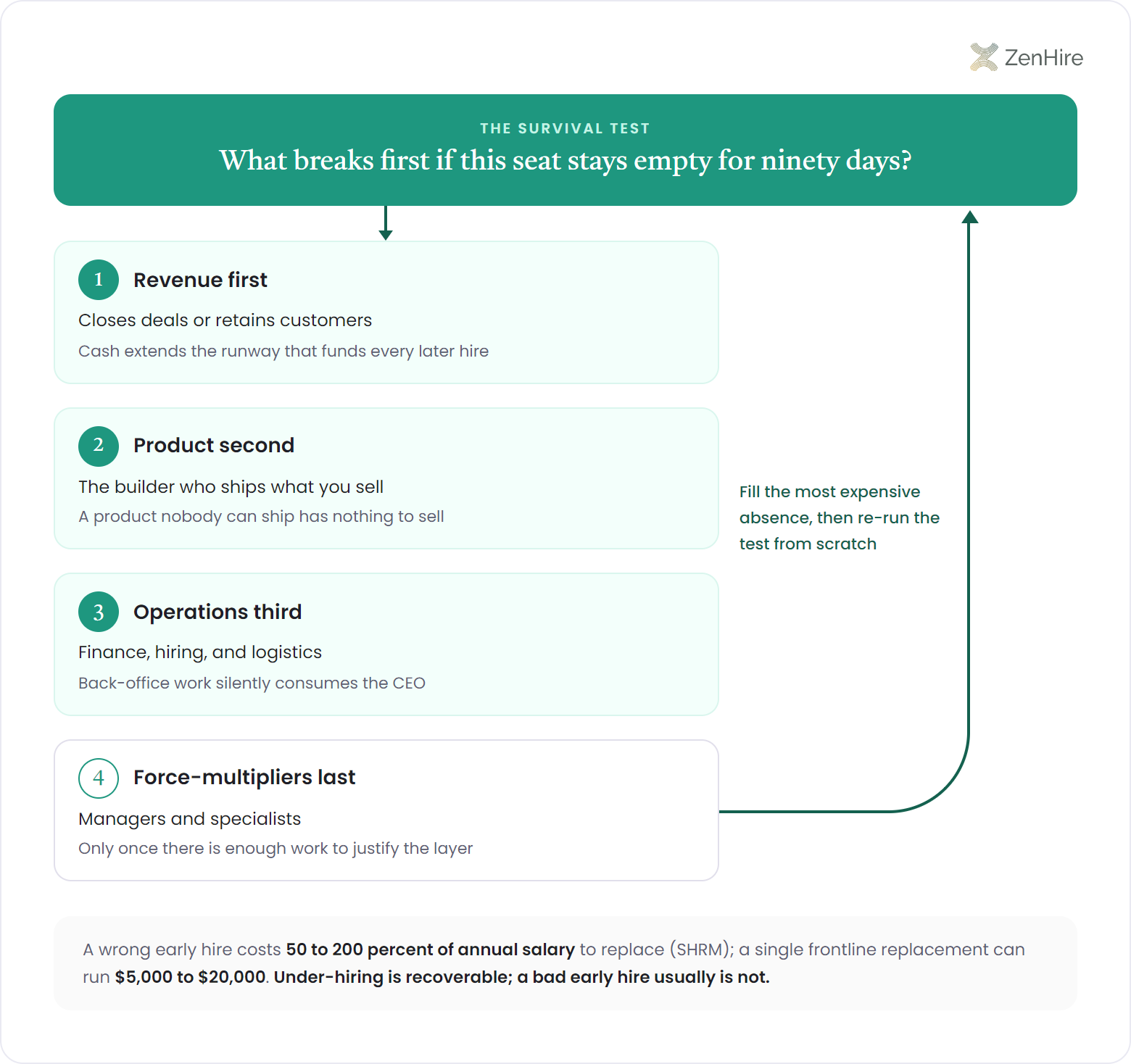
Every early seat is a high-stakes bet, because a wrong hire is expensive to unwind: industry research from SHRM puts the cost of replacing an employee at 50 to 200 percent of annual salary, and for frontline roles a single replacement can run $5,000 to $20,000. Under-hiring is recoverable; a bad early hire usually is not.
- Revenue first: the role that closes deals or retains customers, because cash buys every later hire.
- Product second: the builder who ships what you sell, so revenue has something to stand on.
- Operations third: finance, hiring, and logistics, before back-office work silently consumes the CEO.
- Force-multipliers last: managers and specialists, once there is enough work to justify the layer.
How should a CEO sequence hires by company stage?
Sequence hires by the signal the company is missing at its current size: 0-5 people hire for revenue and shipping, 5-15 people hire the first layer that makes the founder optional in daily work, and 15-40 people hire the managers and specialists that turn a group into an org. The survival test still decides the next single seat; company stage tells you which kind of signal that seat should add.
The mechanism is that each stage has a different bottleneck. Below five people, nothing matters except proving the product earns money, so every seat must either close revenue or ship what is sold. Between five and fifteen, the constraint flips from proving the model to running it without the founder in every loop, which is when first operations, first dedicated sales or success, and first non-founder engineering hires earn their place. Between fifteen and forty, the constraint becomes coordination itself, spans of control break, so the company hires its first true managers and the specialists (finance, people, senior individual contributors) that a generalist can no longer cover. The table below maps the typical order and the signal each role adds at each stage.
Read the table as a default, not a law. A capital-intensive or regulated company pulls finance and compliance forward; a self-serve product with no salespeople pulls a growth or product hire forward. The stage tells you what kind of gap is most likely binding; the survival test still confirms which exact seat is bleeding worst right now.
Consider an illustrative, hypothetical 12-person B2B startup with growing revenue but a founder still personally running every sales call and every first-round interview. The stage signal says the binding gap is no longer proof. It is the founder's calendar. The right next two seats are a dedicated account executive to own the pipeline and an operations generalist to own onboarding and finance hygiene, freeing the CEO to do the senior hiring only a founder can do. A marketing or management hire would look tidy on the org chart but would not relieve the constraint that is actually slowing the company down.
| Company stage | Hire in roughly this order | Signal each role adds |
|---|---|---|
| 0-5 people | Founder-seller, then first or second builder, then a generalist who absorbs everything else | Proof the product earns money and can ship: survival, not structure |
| 5-15 people | First dedicated sales or customer success, first non-founder engineer, first operations or finance generalist | The founder becomes optional in daily delivery; the model runs without a hero |
| 15-40 people | First line managers, first specialist functions (finance, people, senior ICs), first recruiter or Recruitment OS owner | Coordination at scale: spans of control, repeatable hiring, and a real org chart |
How does a CEO keep hiring quality high while moving fast?
A CEO protects hiring quality at speed by fixing the standard before the first interview, defining what good looks like in writing, then judging every candidate against that fixed bar instead of against whoever was last in the room.
The mechanism is a structured scorecard plus a consistent evaluation method. A CEO names the three or four competencies a role actually requires, weights them, and scores each candidate on the same evidence. This matters because the resume and the casual chat that founders lean on are weak predictors of performance. The comparison below uses predictive-validity figures from decades of selection research: the correlation between a hiring method and on-the-job success, where higher is better.
A concrete example: instead of asking three finalists open-ended questions in whatever order they surface, a CEO gives all three the same scenario, scores their answers against a defined rubric, and only then compares totals. The founder still reads the room, but the decision rests on like-for-like evidence rather than on who interviewed most recently or charmed best.
Some founders argue that scorecards strip the human read out of hiring and slow a fast-moving team down. The opposite tends to hold. Unstructured judgment is exactly where bias and recency effects hide, and it is slower in aggregate because every disagreement reopens from zero. A shared rubric speeds debate by giving the team a common language, and it keeps decisions explainable later, which matters as scrutiny of hiring practices grows. The edge case is the rare first-of-its-kind role with no comparable benchmark; there, score the underlying competencies you can name and accept a wider confidence band rather than abandoning structure entirely. A modern AI recruiter applies that same rubric identically to candidate number one and candidate number three hundred.
For a CEO, structure is the accelerator, not the tax on speed. A resume glance forecasts on-the-job performance at only about r = 0.14, and the founder's favorite tool, a friendly unstructured chat, barely improves on it at 0.18. Ask every finalist the same scored questions and you reach 0.28; add a skills test and you clear 0.45+; stack those validated methods together and the signal passes 0.6, roughly quadrupling what a founder learns from a CV alone.
| Hiring method | Predictive validity | What it tells you |
|---|---|---|
| CV review alone | ~0.14 | Weak signal: keywords, not capability |
| Unstructured interview | ~0.18 | Mostly rapport and recency bias |
| Structured interview | ~0.28 | Same questions, scored consistently |
| Skills / cognitive tests | 0.45+ | Demonstrated ability, not claimed |
| Combined structured methods | 0.6+ | The standard a CEO should aim for |
When should a CEO hand team-building to a system?
A CEO should hand team-building to a system the moment one person can no longer interview every applicant well, the moment volume outpaces the founder's calendar, screening quality drops silently, and that drop is the signal to let software run the repeatable middle of hiring.
The mechanism is a clean division of labor. A Recruitment OS sources, parses, interviews, and assesses candidates on one shared data model, then returns a ranked, evidence-backed shortlist, while the CEO spends the saved hours closing the hires that actually matter. Every applicant gets the same structured ZenHire interview, about four minutes each, with resume data pulled at roughly 97 percent accuracy and spoken language scored inside a glass-box architecture that keeps sensitive attributes out of the scoring, all under a GDPR and SOC 2 posture a founder can defend to a board. Founders who would rather run it as a service can lean on done-for-you hiring for founders and still keep the final call. The thesis holds throughout: AI measures the field, the founder decides who joins.
A concrete example: a CEO opening five support seats receives 300 applicants in a week. Reading every resume and running every first-round call would cost days the founder does not have, so quality erodes under the pile. Routing that volume through a Recruitment OS returns a shortlist scored the same way for all 300, and the CEO interviews only the top candidates with the full evidence already in hand, the practical version of how to hire without a recruiter on staff.
The edge case is the senior or culture-defining hire, where handing the close to a system is the wrong call. For a first executive or a co-founder-adjacent role, let the OS measure competencies and surface the field, but keep the final conversations, the negotiation, and the judgment with the CEO. Automate the repeatable; never automate the irreplaceable.
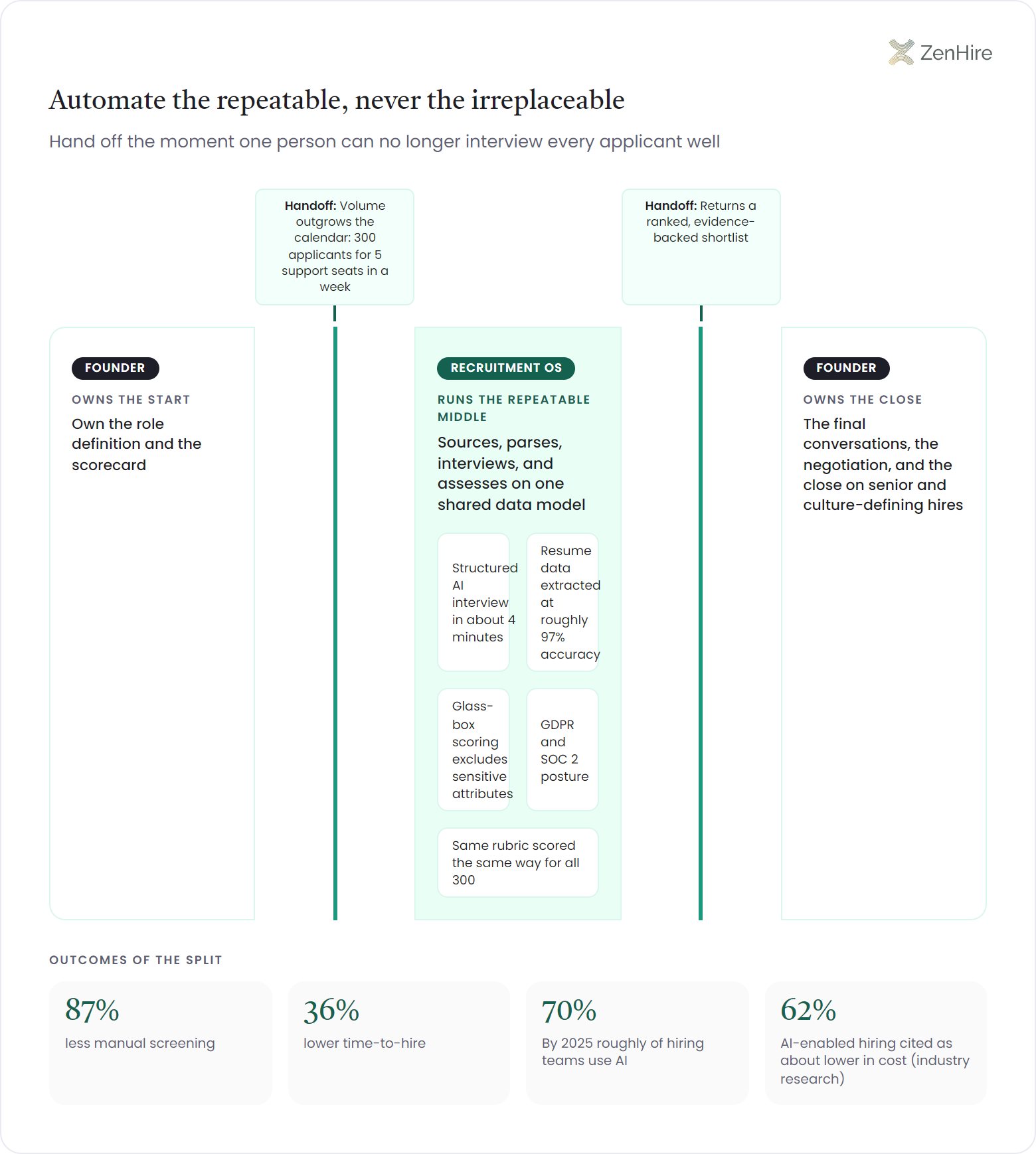
For a CEO the real return is a calendar, not a faster funnel. Pipelines that hand the middle to software cut manual screening by 87% and shave 36% off time-to-hire, hours the founder gets back to sell, ship, and close the senior seats only they can fill. And it is no longer the exception: by 2025 about 70% of hiring teams use AI in some form, with AI-enabled hiring running roughly 62% cheaper than doing the same work by hand (industry research).
My first hires at ZenHire taught me the lesson the hard way: I hired around people I liked instead of the seat the company was bleeding from, and I paid for it in lost quarters. So my rule now is blunt: write the role before you fill it, and rank seats by which absence would kill you fastest, not by who is already in your contacts. The contrarian part founders resist is that structure makes you faster, not slower: a scorecard you apply to candidate one and candidate three hundred is the only thing that lets a CEO scale hiring without quietly lowering the bar every week.
Frequently asked questions
How do you build a team as a CEO without a recruiter on staff?+
Building a team as a CEO without a recruiter means owning the role definition and the final decision yourself, then letting a Recruitment OS handle everything in between. You write the scorecard and close the hire; the system sources, screens, and assesses, returning a ranked, evidence-backed shortlist so a single founder can hire well without a full talent function. ZenHire is built to run exactly that middle layer for you.
What is the right order for building a founding team?+
The right order for building a founding team follows a survival test, not a headcount plan. Hire the revenue role first, the product builder second, and the operations role third, judging each open seat by what breaks soonest if it stays empty for ninety days. Force-multiplier roles such as managers and specialists come once there is enough work to justify the layer.
How many people should a CEO hire in the first year?+
The number a CEO should hire in the first year depends on runway and revenue, not on a fixed target. Add a seat only when its absence is the most expensive problem you have, and keep the team small enough that every hire is deliberate. Under-hiring is recoverable, while a wrong early hire is costly to unwind. SHRM puts the cost of replacing an employee at 50 to 200 percent of salary.
How does a CEO keep hiring quality high while scaling fast?+
A CEO keeps hiring quality high while scaling by fixing the standard before the speed. Write a scorecard and score every candidate on the same evidence, because that is what turns a rushed decision into a defensible one: a stack of validated, structured methods predicts real performance at 0.6 or higher, while the resume-and-a-chat approach most founders default to sits near 0.14. Speed without that scaffolding is just faster misfiring.
When should a CEO stop interviewing every candidate personally?+
A CEO should stop interviewing every candidate personally once applicant volume outgrows the founder's calendar and screening quality starts to slip. At that point, hand repeatable sourcing and screening to a Recruitment OS and reserve your time for the senior and culture-defining hires where the close belongs to a person. This CEO guide to team building treats automating the repeatable as the way to protect, not replace, founder judgment.
Free for first-team planning
The founder's first-team hiring scorecard
A one-page scorecard plus a survival-order checklist for your first 5 to 10 hires: how to rank which seat to fill next, the three or four competencies to score per role, and the questions that keep speed from eroding quality.