
What Is the Future of Recruitment?


· 11 min read
The future of recruitment is human-in-the-loop hiring: AI runs the repeatable evaluation (parsing, structured interviews, scoring) on every candidate while people own judgment, relationships, and the final decision. What makes that split durable for a decade is the math underneath it. A resume, read on its own, tracks who will actually perform at only about 0.14; stack a structured interview, a skills test, and a cognitive-ability check on top and that combined signal clears 0.6. The direction of travel is already set: near 70% of hiring teams lean on AI by 2025, and the recruitment market widens from roughly $450B in 2023 toward $870B by 2032 at close to 7.5% CAGR.
How is AI reshaping the future of recruitment?
AI is reshaping recruitment by moving the repeatable evaluation off the recruiter's desk (parsing, matching, structured interviewing, and scoring) so people stop reading every resume and start deciding from evidence instead.
The mechanism is predictive validity, not hype, and it is the reason this shift outlasts any single hiring cycle. Decades of selection research place a plain resume review near 0.14 and an unstructured interview around 0.18, barely better than a coin flip for forecasting performance. [Structured interviews](/interview/structured-interview) reach about 0.28, skills tests around 0.45, cognitive ability past 0.5, and combined validated methods exceed 0.6. For most of recruiting's history, those rigorous methods were too slow to use on anyone but the final few; the future flips that, because AI makes them cheap enough to run on every applicant, so screening quality rises instead of merely speeding up. That is the whole argument for an AI-native recruitment platform: the measurement gets better, not just faster.
Picture a high-volume support role drawing hundreds of applicants a week. In the old model a coordinator skims resumes by keyword; in the emerging one, an AI recruiter that screens and ranks candidates holds a roughly four-minute, audio-only conversation with each person, grades spoken English on the CEFR A1-C2 scale using neutral engineered features, and pulls the resume into structured fields at 97% accuracy, so the shortlist reflects demonstrated ability rather than who applied first.
The edge case is where this breaks down: novel, ambiguous, or deeply relational roles where the real signal is judgment rather than measurable competency. AI can rank communication clarity under pressure; it cannot weigh whether a founding hire shares your appetite for risk. That is exactly why the model is AI measures, humans decide, not AI decides.
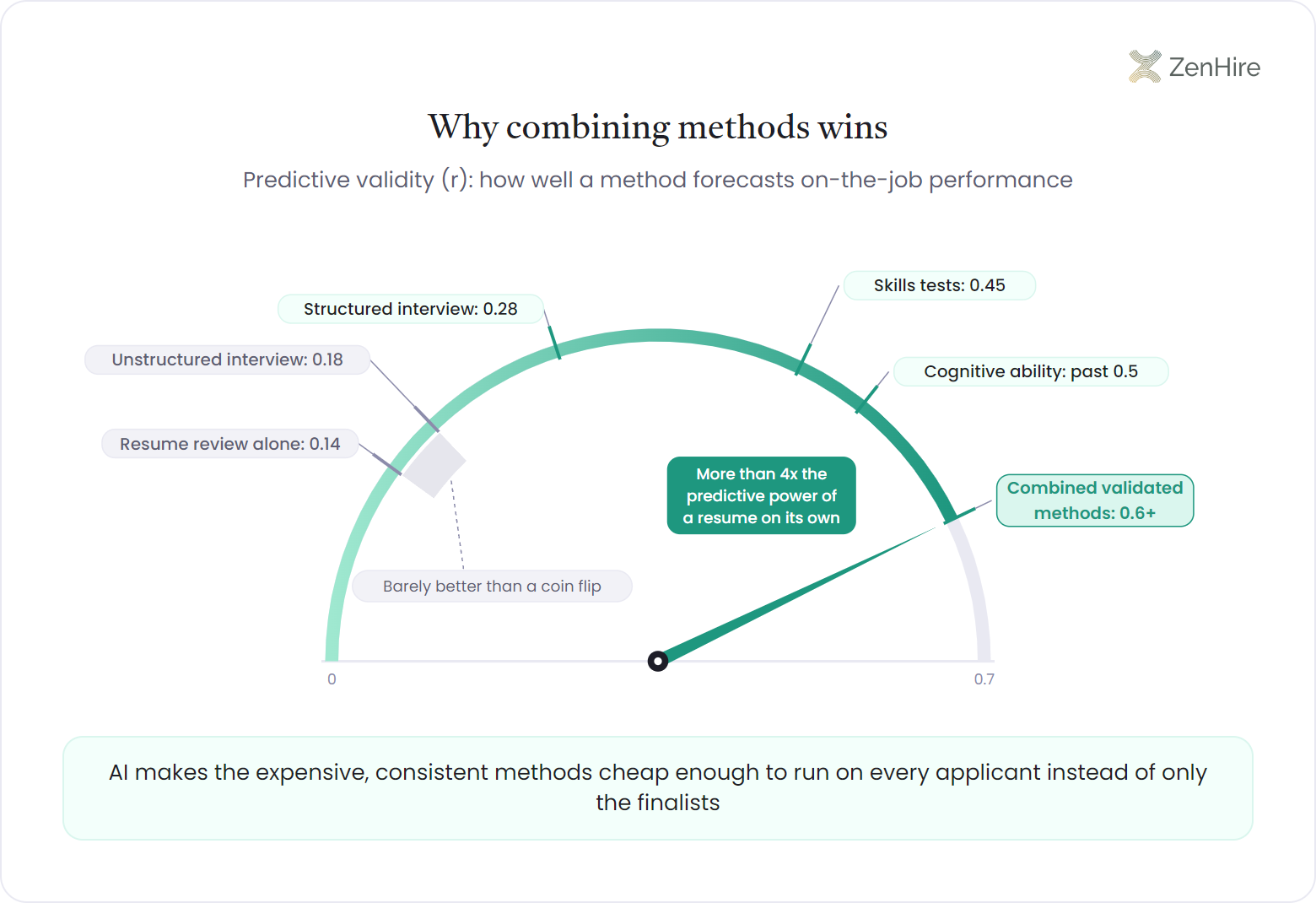
Why combining methods wins: a resume read alone predicts on-the-job performance at about r = 0.14, barely above chance. Layer structured interviews, cognitive ability, and skills tests and the combined signal climbs past 0.6, more than four times the predictive power of a resume on its own. Strip away the futurism and that is all the future of recruitment really is: running that full combination on every candidate, not just the finalists.
- Sourcing and resume parsing collapse into one structured profile at 97% field-extraction accuracy, not a folder of PDFs.
- Semantic CV-to-role matching scores whether a skill was actually used, not just mentioned. See semantic candidate matching beyond keywords.
- Structured, scorecard-driven AI interviews run on every candidate, not a lucky few, so evaluation is consistent end to end.
- Built-in [fraud and integrity checks](/ethical-hiring/recruitment-fraud) flag duplicate CVs, scripted or AI-generated answers, and proxy interviews at 91% scripted-response detection.
What actually shifts from the old way to the emerging way?
The shift is concrete, not abstract: each stage of hiring moves from a slow, sampled, opinion-led process to a fast, applied-to-everyone, evidence-led one. The four stages that change most are sourcing, screening, decisioning, and candidate experience, and in every case the emerging way runs the rigorous method on the whole pipeline rather than only on the lucky finalists who survived a keyword filter.
Read the table as a migration plan, not a binary switch. Most teams modernize one stage at a time, and the order that pays off fastest is usually screening first (it is where the most hours are burned and where consistent, scorecard-driven evaluation lifts predictive validity the most), followed by decisioning, then sourcing and candidate experience.
This migration is where the whole industry is heading, not one vendor's wager. Third-party market research sizes the recruitment market at roughly $450B in 2023 growing toward about $870B by 2032 (near 7.5% CAGR) and finds roughly 70% of hiring teams already using AI by 2025. The reason the capital follows is buried in the validity numbers: a resume read alone forecasts performance at about 0.14, a structured interview at 0.28, and combined validated methods past 0.6. So the emerging way is not merely quicker, it is measurably better at naming who will actually succeed, which is what a decade of buyers are moving toward.
| Stage | Old way (sampled and manual) | Emerging way (applied to everyone) |
|---|---|---|
| Sourcing | Keyword search over job-board piles; strong applicants buried by phrasing | Semantic matching on whether a skill was actually used, run across 3,000+ applications per role, not a sampled few |
| Screening | A coordinator skims resumes; only finalists get a real conversation | A structured, scorecard-driven assessment on every candidate: a roughly four-minute, audio-only interview that grades language on the CEFR A1-C2 scale |
| Decisioning | Gut feel on an unstructured interview, which forecasts performance at only ~0.18 in selection research | A calibrated human decision on an evidence-backed shortlist, with each score shipped alongside its reasoning for a real override |
| Candidate experience | Silent rejection, slow loops, inconsistent questions | Fast, consistent, same-questions-for-everyone evaluation with fraud and integrity checks at 91% scripted-response detection |
What will hiring teams look like in the future of recruitment?
Tomorrow's hiring teams are smaller, more senior, and built around decisions instead of throughput. The administrative middle thins out, and the people who remain spend their hours on calibration, candidate relationships, and the judgment calls that close hires.
Mechanically, the team's work product changes. Today a screener's output is a filtered pile of resumes; in the future of recruitment, the human's output is a calibrated decision on an AI-curated, evidence-backed shortlist, with the score and its reasoning attached. Reviewing a ranked shortlist with scorecard summaries takes a fraction of the time of reading every resume and watching every interview, which is how public stats like 87% less manual screening and 36% lower [time-to-hire](/metrics/time-to-hire) become normal rather than remarkable. Headcount that was spent on volume gets redirected to hiring-manager partnership and candidate experience.
A concrete example: recruiting in 2030 for a contact center, a two-person team can run the pipeline that needs a screening pod today. The AI carries the language assessment and skills tests inside a roughly four-minute conversation with each candidate; the recruiters spend their week coaching finalists, tuning the scorecard with the hiring manager, and managing offers, work that actually lowers attrition rather than just filling the seat. For founders without a TA function at all, the same engine is what makes it realistic to hire your first employee without a recruiter.
Some will argue this hollows out the profession and that AI simply replaces recruiters. The evidence points the other way. Volume screening was never the high-value part of recruiting; it was the part nobody had time to do well. When that is automated, the constraint becomes human judgment, which gets scarcer and more valuable, not less. The longer argument lives on whether AI will replace recruiters. The edge case worth naming: a team that adopts the tooling but never re-skills toward judgment and relationships does shrink its own relevance. The technology rewards teams that move up the value chain and penalizes those that stand still.
Who steers this is the whole game. The wave has already arrived: industry research finds roughly 70% of hiring teams use AI by 2025, with AI-enabled hiring reported as around 62% faster and about 59% lower cost. The teams that consciously own that buying decision, rather than inherit it from a vendor, are the ones who walk out of this decade with leverage. Once the tooling is the default rather than the differentiator, the edge moves to whoever configures it with the sharpest judgment.
How do you future-proof your stack for the future of recruitment?
You future-proof a hiring stack by going AI-native on one candidate record, keeping every decision explainable, and keeping a person accountable on each call. Stitched-together point tools age badly; a unified, intelligent foundation absorbs change instead of breaking under it.
The mechanism is where the intelligence lives. When matching, interviewing, and scoring run on one shared record, a new capability lands across the whole pipeline at once rather than as another integration to wire up, and a signal captured at screening survives all the way to the shortlist. Bolt-on AI cannot do that, because each tool owns its own siloed copy of the candidate, which is the core argument for a single recruitment operating system. Explainability is the other half: as scrutiny of AI hiring grows, every score needs to ship with its evidence, which is why a glass-box approach that excludes sensitive attributes and holds a GDPR and SOC 2 posture is the defensible default, not a nice-to-have.
Use this decision rule when you evaluate any vendor for the next decade of hiring trends:
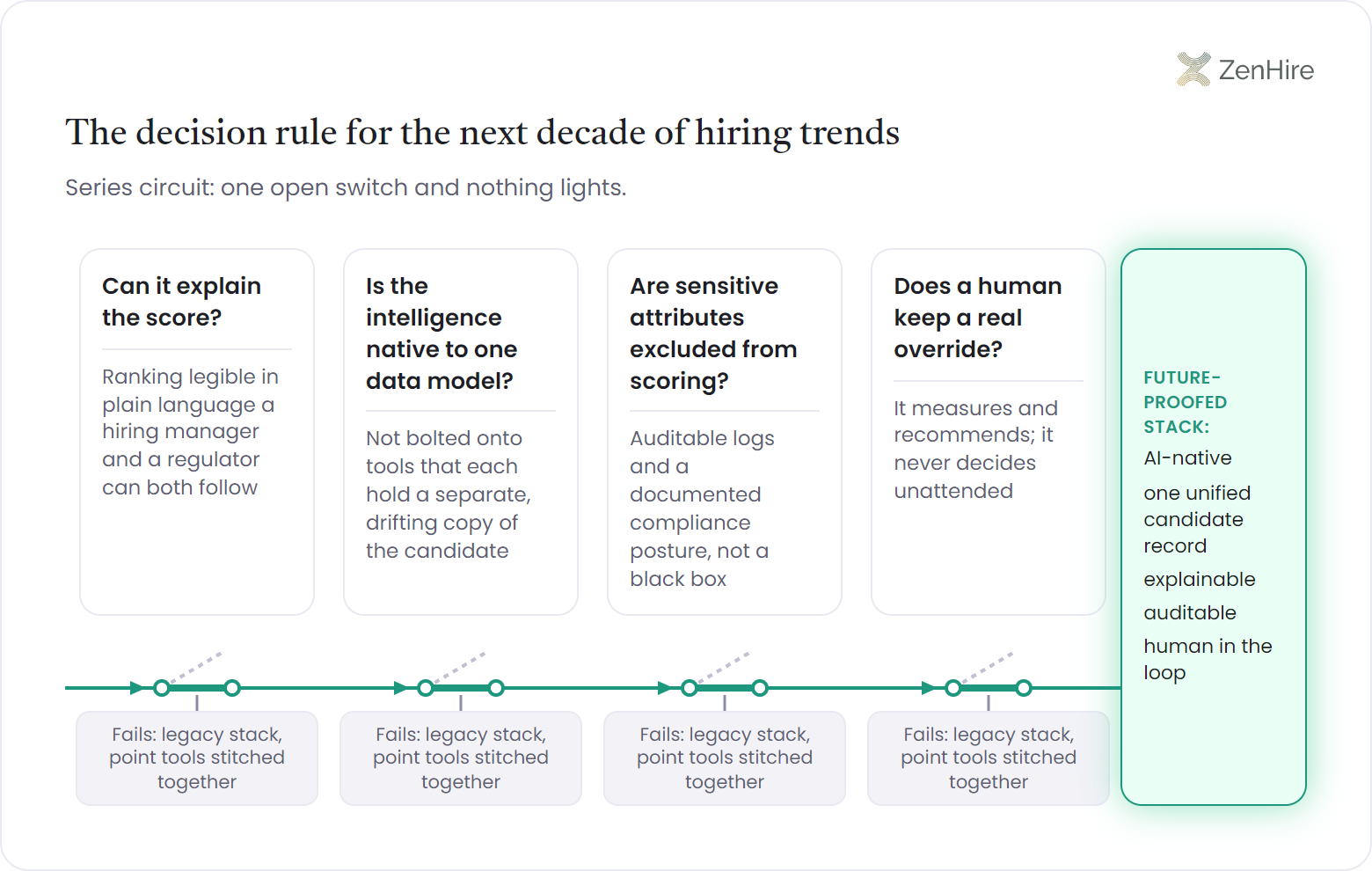
- Can it explain the score? A candidate's ranking should be legible in plain language a hiring manager and a regulator can both follow.
- Is the intelligence native to one data model? Or is it bolted onto tools that each hold a separate, drifting copy of the candidate?
- Are sensitive attributes excluded from scoring? Look for auditable logs and a documented compliance posture, not a black box.
- Does a human keep a real override? A future-proof system measures and recommends; it never decides unattended.
| Legacy stack today | Future-proofed stack | |
|---|---|---|
| Architecture | Point tools stitched together | AI-native, one platform |
| Candidate data | Siloed copy per tool | One unified candidate record |
| New capability | Another integration to wire up | Lands across the pipeline at once |
| Accountability | A score with no reasoning | Explainable, auditable, human in the loop |
History rhymes on every new hiring technology
Writing, the printing press, and broadcast were each feared as the end of some human faculty before becoming ordinary infrastructure. AI in hiring is following the same arc, which argues for radical nuance over both hype and panic. The honest framing is statistical: the right question is how often a method is right versus wrong, not whether it is ever wrong, the same standard we apply to autonomous driving, which is imperfect yet safer per mile than the average human.
An example of getting this right is treating AI as a consistent baseline that humans can override, not an oracle. When the AI ranking disagrees with a recruiter's gut, that disagreement is a calibration opportunity: it surfaces hidden potential or an unstated bias, and the human still decides. The edge case is over-trust: a team that rubber-stamps AI output without review trades human bias for unexamined model bias, which is exactly the failure that auditable, explainable scoring exists to prevent.
Everyone wants a prediction about the future of recruitment. Mine is boring on purpose: the work that survives is the work a machine cannot do well, and that is judgment, not screening. I have watched recruiters apologize for spending their day reading resumes, as if that were the craft. It never was. The future I am building toward gives that hour back so people do the part only they can: read a room, take a bet on potential, and own the decision when it is hard. AI should measure tirelessly; a human should still be the one who looks a candidate in the eye and says yes.
Frequently asked questions
What is the future of recruitment in one sentence?+
The future of recruitment is a partnership in which AI runs the repeatable evaluation at scale and people own the judgment, relationships, and final decision. The economics come down to predictive validity: combined validated methods clear 0.6 while a resume alone sits near 0.14, so putting AI on the screening step lifts the quality of who you hire, not just the speed you hire them.
What are the biggest hiring trends for the next decade?+
The biggest hiring trends for the next decade are AI-native platforms replacing stitched-together point tools, explainable and auditable scoring becoming mandatory as regulation tightens, and recruiting teams shrinking toward senior, decision-focused roles. Across all three, the constant is a human-in-the-loop model where AI measures and people decide.
What will recruiting in 2030 actually look like day to day?+
Recruiting in 2030 looks like a small team working from evidence-backed shortlists instead of raw resume piles. AI carries parsing, structured interviews, and scoring (say, a roughly four-minute audio-only language and skills assessment run on every candidate) while recruiters give their day to calibration, candidate coaching, and closing.
Will AI replace recruiters in the future of recruitment?+
AI will not replace recruiters in the future of recruitment, but it will replace the manual screening that consumed most of their time. As volume work is automated, human judgment becomes the scarce constraint, so recruiters move up the value chain to relationships, calibration, and decisions rather than out of the profession.
Is AI hiring fair enough to bet a decade on?+
AI hiring is defensible when it is built glass-box rather than black-box: audio-only, sensitive attributes excluded from scoring, and a documented GDPR and SOC 2 posture. The real risk is opacity: undocumented manual screening often hides more bias than a transparent, audited system that ships every score with its evidence.
Free for future-proofing the hiring stack
The 2030 hiring-readiness scorecard
A short self-assessment that scores your current stack against the future of recruitment: AI-native architecture, explainability, human-in-the-loop accountability, and where you are quietly losing strong candidates today.