


Building Bias-Free AI Hiring Systems
Learn how to design and implement AI hiring systems that minimize unconscious bias.
ZenHire Team
What types of bias commonly occur in hiring processes?
You build bias-free AI hiring systems by stripping demographic signals before any evaluation: blind resume screening, structured interviews, fairness-constrained model training, and continuous audits against the EEOC four-fifths rule. White-associated names draw 50% more callbacks than identical resumes with African American-associated names (Bertrand and Mullainathan, 2004), and adversarial debiasing cuts gender bias in hiring predictions by 67% while preserving 94% of predictive accuracy (Google Research, 2018). ZenHire's redaction engine masks demographic-proxy data with 99.5% accuracy, and New York City Local Law 144 already mandates annual third-party bias audits.
Employee recruitment and selection processes in corporate, nonprofit, and government sectors demonstrate multiple forms of bias that systematically exclude qualified candidates and undermine organizational diversity goals.
Affinity Bias
Affinity bias, also known as similarity bias, happens when hiring managers favor candidates who share their background, interests, or demographic characteristics. According to Dr. Lauren A. Rivera at Northwestern University's Kellogg School of Management in "Hiring as Cultural Matching: The Case of Elite Professional Service Firms" (2012), evaluators rated candidates who shared the hiring managers' extracurricular interests 60% higher than equally qualified applicants with different backgrounds.
This affinity bias produces homogeneous workforces that lack diverse perspectives and perpetuates existing power structures (the hierarchical decision-making systems and demographic composition of leadership positions) within organizations.
Confirmation Bias
Confirmation bias represents another widespread challenge where recruiters seek information that validates their initial impressions of candidates while dismissing contradictory evidence. Iris Bohnet, Alexandra van Geen, and Max Bazerman at Harvard Kennedy School of Government, the public policy school of Harvard University, located in Cambridge, Massachusetts, documented in "When Performance Trumps Gender Bias: Joint vs. Separate Evaluation" (2016) that evaluators who formed early negative opinions about applicants systematically devalued positive information encountered later in the selection process.
Interviewers direct questions toward confirming preconceived notions rather than objectively assessing competencies, leading to 73% of hiring decisions being made within the first five minutes of an interview according to Dr. Tricia Prickett, psychology researcher at the University of Toledo, a public research university located in Toledo, Ohio.
Gender Bias
Gender bias shows up throughout recruitment pipelines, affecting everything from job descriptions to final offers. Dr. Corinne A. Moss-Racusin, social psychology researcher, and colleagues at Yale University, a private Ivy League research university located in New Haven, Connecticut, published "Science Faculty's Subtle Gender Biases Favor Male Students" (2012), revealing that science faculty members evaluated identical applications significantly differently based on perceived gender.
| Key Finding | Impact |
|---|---|
| Male vs Female Starting Salaries | Male applicants offered $4,000 higher on average |
| Study Participants | 127 biology, chemistry, and physics professors |
| Position Type | Entry-level laboratory manager in academic research |
The Moss-Racusin study recruited 127 biology, chemistry, and physics professors who assessed application materials for an entry-level laboratory manager position in academic research settings, demonstrating that even in STEM fields prizing objectivity, gender bias affects hiring outcomes.
Gendered language within job postings incorporates masculine-coded terms like "competitive" and "dominant" that discourage female applicants by 44% according to Dr. Danielle Gaucher, social psychology researcher specializing in gender and language at the University of Waterloo, a public research university located in Waterloo, Ontario, Canada.
Racial and Ethnic Bias
Racial and ethnic bias creates substantial barriers for candidates from underrepresented groups, with discrimination occurring at every recruitment stage. Dr. Marianne Bertrand, economist at University of Chicago Booth School of Business, and Dr. Sendhil Mullainathan, economist at Harvard University, co-authored the landmark study "Are Emily and Greg More Employable than Lakisha and Jamal?" published in The American Economic Review, a peer-reviewed academic journal published by American Economic Association and a top-ranked economics journal, in 2004.
Key Research Findings:
- Resumes with white-associated names (Emily, Greg) obtained 50% more callbacks than identical resumes with African American-associated names (Lakisha, Jamal)
- Study scope: 5,000 resumes distributed to 1,300 employment advertisements
- Locations: Boston, Massachusetts and Chicago, Illinois
- Conclusion: Racial discrimination continues despite equal qualifications
Subjective criteria like "cultural fit" assessments often function as proxies for racial preferences according to Sonia K. Kang, Katherine A. DeCelles, András Tilcsik, and Sora Jun published in Administrative Science Quarterly (2016). Structured skill-based assessments help eliminate these biased evaluation methods.
Age Bias
Age bias disadvantages both younger and older candidates through stereotypical assumptions about capability and commitment. Dr. David Neumark, Distinguished Professor of Economics at University of California, Irvine, and Director of Economic Self-Sufficiency Policy Research Institute, based at a public research university located in Irvine, California, part of the University of California system, published "Experimental Age Discrimination Evidence and the Heckman Critique" (2016).
Study Results:
- Callback rates for older applicants were 35% lower than for younger applicants with equivalent experience levels
- 40,000 fictitious resumes sent to real job postings across multiple industries
- Systematic age discrimination disproportionately impacts job applicants aged 50 years and older
Employers presume:
- Older candidates lack technological proficiency: competence with digital tools, software applications, and modern workplace technologies
- Younger applicants lack maturity: professional judgment, emotional intelligence, and workplace stability
Despite evidence refuting these age-based generalizations about capability.
Beauty Bias
Beauty bias and appearance-based discrimination affect hiring outcomes through subjective assessments of physical attractiveness. Dr. Bradley J. Ruffle, experimental economist at Ben-Gurion University of the Negev, a public research university located in Beersheba, Israel, and Dr. Ze'ev Shtudiner, business administration researcher at Ariel University, a public university located in Ariel, West Bank, published "Are Good-Looking People More Employable?" (2015).
| Study Details | Results |
|---|---|
| Applications Examined | 5,312 job applications in Israel |
| Attractive Candidates | 19.6% higher callback rates |
| Assessment Speed | Within seconds of viewing candidate information |
| Bias Impact | Attractive candidates evaluated as more competent, intelligent, and qualified |
Recruiters form rapid, intuitive assessments based on photographs, with attractive candidates evaluated as more competent, intelligent, and qualified despite objective evidence being absent to support these attractiveness-competence associations.
Educational Pedigree Bias
Educational pedigree bias happens when hiring managers disproportionately favor candidates from prestigious institutions regardless of actual skill levels. Dr. Lauren A. Rivera at Northwestern University authored "Ivies, Extracurriculars, and Exclusion: Elite Employers' Use of Educational Credentials" (2011).
Key Findings:
- 80% of campus recruiting performed at only 10-15 elite universities
- Target institutions: The Ivy League and equivalent institutions
- Affected industries: Elite consulting, law, and investment banking firms
- Examples: McKinsey, Goldman Sachs, and major law partnerships
Employers employ university rankings (hierarchical orderings published by organizations like U.S. News & World Report, Times Higher Education, and QS World University Rankings) as screening criteria, disregarding qualified applicants who attended:
- Regional public universities
- Community colleges
- Smaller private institutions
Due to financial constraints, geographic limitations, or personal circumstances rather than academic capability.
Halo Effect Bias
Halo effect bias causes recruiters to allow one positive characteristic to influence their overall evaluation of candidates. Richard E. Nisbett and Timothy D. Wilson, social psychologists, published "The Halo Effect: Evidence for Unconscious Alteration of Judgments" (1977), documenting that evaluators who perceived candidates as physically attractive assessed attractive candidates higher across all competency dimensions including:
- Intelligence
- Qualifications
- Cultural fit: organizational compatibility
Hiring managers presume that candidates with impressive credentials in one area possess excellence across all domains, resulting in 65% of interviewers basing decisions on emotional reactions rather than objective qualifications according to Dr. Frank L. Schmidt, organizational psychologist and professor emeritus at University of Iowa.
Horn Effect Bias
Horn effect bias represents the inverse phenomenon where one negative attribute disproportionately influences overall candidate assessment. Daniel M. Cable and Timothy A. Judge published "The Effect of Physical Height on Workplace Success and Income" (2004), documenting that physical height affected perceived leadership ability, the capacity to guide teams, make strategic decisions, and command authority in organizational settings, with each inch of height associated with $789 in additional annual income.
Recruiters permit minor negative factors to eclipse substantial qualifications:
- Employment gaps (periods of unemployment or career breaks)
- Unconventional career paths (non-traditional career trajectories)
- Perceived communication weaknesses (subjective assessments of verbal fluency, accent, presentation style)
Contrast Effect Bias
Contrast effect bias happens when recruiters evaluate candidates relative to recently interviewed applicants rather than against objective standards. Uri Simonsohn and Francesca Gino at University of Pennsylvania, a private Ivy League research university located in Philadelphia, Pennsylvania, published "Daily Horizons: Evidence of Narrow Bracketing in Judgment From 10 Years of M.B.A. Admissions Interviews" (2013).
Research Scope:
| Study Component | Details |
|---|---|
| Interviews Examined | 9,323 MBA admission interviews |
| Time Period | 10 years |
| Key Finding | Admission officers assessed candidates significantly higher when following weaker applicants |
| Variation Impact | Acceptance rates fluctuating by 15% based solely on interview scheduling |
Candidate qualifications obtain different assessments influenced by interview scheduling, the temporal ordering and sequencing of candidate interviews within recruitment process, with identical credentials receiving different evaluations.
Name Bias
Name bias extends beyond racial associations to include assumptions based on name difficulty, perceived foreign origin, and cultural associations. Moa Bursell, Swedish sociologist, published "What's in a Name? A Field Experiment Test for the Existence of Ethnic Discrimination in the Hiring Process" (2014) examining hiring in Sweden.
Study Results:
- Swedish-sounding names obtained 50% higher callback rates
- Middle Eastern names received significantly fewer callbacks
- Identical qualifications across all applications
- Location: Sweden
Recruiters form assumptions about:
- Language proficiency: fluency in dominant workplace language
- Cultural fit
- Work authorization status: legal permission to work in a country
Based solely on name characteristics, resulting in discrimination against qualified candidates from varied ethnic, national, cultural, or linguistic origins.
Recency Bias
Recency bias causes hiring managers to give disproportionate weight to information encountered late in the evaluation process. Bennet B. Murdock Jr., cognitive psychologist, authored "The Serial Position Effect of Free Recall" (1962), documenting that evaluators recalled and prioritized recent information more heavily than earlier data through the serial position effect, a cognitive phenomenon where items presented at beginning (primacy effect) and end (recency effect) of sequence are better remembered than middle items.
Impact Examples:
- Strong interview performance overshadows verified employment records
- Recent employment gaps garner more attention than demonstrated achievement patterns
- Inconsistent evaluation standards across candidates
Attribution Bias
Attribution bias affects how recruiters interpret candidate successes and failures, with systematic differences based on demographic characteristics. Janet K. Swim and Lawrence J. Sanna published "He's Skilled, She's Lucky: A Meta-Analysis of Observers' Attributions for Women's and Men's Successes and Failures" (1996).
| Gender | Success Attribution | Failure Attribution |
|---|---|---|
| Male | Skill and ability | External circumstances |
| Female | Luck or situational circumstances | Personal shortcomings |
Hiring managers evaluate identical achievements differently based on candidate demographics, with men obtaining credit for innate ability, personal skill, and autonomous capability while women's accomplishments get attributed to collaborative contributions or advantageous external conditions.
Conformity Bias
Conformity bias happens when individual evaluators alter their assessments to align with group opinions during panel interviews or committee decisions. Solomon E. Asch, Gestalt psychologist known for conformity experiments, published "Opinions and Social Pressure" (1955), documenting that 75% of participants agreed with deliberately wrong answers provided by confederates at least once.
Group Dynamics:
- Junior members yield to senior colleagues
- Dominant personalities influence group consensus
- Results in groupthink: a psychological phenomenon where desire for harmony results in dysfunctional decision-making
- Stifles diverse perspectives and independent evaluation
Expectation Anchor Bias
Expectation anchor bias causes recruiters to fixate on initial information about candidates, typically from resumes or screening calls, which then anchors subsequent evaluations. Amos Tversky and Daniel Kahneman, cognitive psychologists and pioneers of behavioral economics (Daniel Kahneman won Nobel Prize in Economic Sciences in 2002), published "Judgment under Uncertainty: Heuristics and Biases" (1974).
Initial numerical anchors affected final estimates by 30-50% even when participants knew the anchors were arbitrary, demonstrating the anchoring effect, a cognitive bias where individuals rely too heavily on initial piece of information when making decisions.
First impressions formed during resume screening (the initial review of application materials including resumes, cover letters, and credentials before interview stage) disproportionately affect interview assessments.
Nonverbal Bias
Nonverbal bias affects candidate assessment through subjective interpretation of body language, eye contact, and communication style that varies across cultures. Timothy DeGroot and Stephan J. Motowidlo published "Why Visual and Vocal Interview Cues Can Affect Interviewers' Judgments and Predict Job Performance" (1999).
Communication Components:
- Visual cues: Physical appearance, facial expressions, gestures, posture, body language
- Vocal cues: Tone of voice, speech rate, volume, pitch, verbal fluency
- Cultural variations: Different conventions regarding eye contact, assertiveness, interpersonal distance
Nonverbal behaviors explained significant variance in hiring decisions despite weak correlations with actual job performance.
Recruiters misinterpret cultural differences as lack of confidence or competence:
- Eye contact norms, varying from direct sustained eye contact in Western cultures to more indirect gaze in many Asian and indigenous cultures
- Assertiveness: degree of directness valued differently across cultures
- Interpersonal distance: physical proximity preferences varying across cultures
Overconfidence Bias
Overconfidence bias leads hiring managers to overestimate their ability to accurately assess candidates through unstructured interviews. Jason Dana, Robyn M. Dawes, and Nathanial Peterson published "Belief in the Unstructured Interview: The Persistence of an Illusion" (2013).
Research Findings:
| Interview Type | Recruiter Confidence | Actual Effectiveness |
|---|---|---|
| Unstructured Interviews | Highly confident in accuracy | Poor predictive validity |
| Systematic Evaluation Methods | Less confidence | 26% better hiring outcomes |
Organizations depend on intuitive judgments and subjective impressions without empirical basis rather than evidence-based evaluation tools including structured interviews, work samples, and cognitive ability tests.
Cost Impact: Poor hiring decisions cost companies an average of $14,900 per bad hire, an employee who performs poorly, leaves quickly, or requires termination, according to the U.S. Department of Labor.
Conclusion
These sixteen types of interconnected hiring biases establish structural obstacles embedded in recruitment processes that consistently disadvantage certain demographic groups, blocking qualified candidates from receiving fair consideration, compromising organizational performance (business outcomes including innovation, productivity, employee retention, and financial results), and sustaining workplace inequity, the disparate treatment and outcomes for employees based on protected characteristics.
Understanding these sixteen bias types documented in hiring research establishes the foundation for deploying effective mitigation strategies through bias-free AI hiring systems: artificial intelligence-powered recruitment platforms designed to minimize discriminatory bias through:
- Structured assessment
- Blind evaluation
- Validated predictive models
These systems assess candidates based on measurable, job-relevant factors including:
- Demonstrated skills
- Verified qualifications
- Work samples
- Standardized test performance
Rather than subjective impressions influenced by demographic categories protected from discrimination under laws including:
- Title VII of Civil Rights Act (race, color, religion, sex, national origin)
- Age Discrimination in Employment Act (age 40+)
- Americans with Disabilities Act (disability status)
How can AI reduce or eliminate different forms of hiring bias?
AI can reduce or eliminate different forms of hiring bias by implementing systematic technological solutions that remove subjective human judgment from key recruitment decision points. Artificial intelligence hiring systems revolutionize talent acquisition by eliminating subjective decision-making points where human cognitive bias systematically infiltrates recruitment workflows.
AI-powered blind screening systems anonymize demographic information, including candidate names, gender indicators, age markers, and photographs, from resumes before human recruiters evaluate the applications. AI blind screening replicates the blind audition methodology that symphony orchestras implemented during the 1970s and 1980s, which increased female musicians' advancement rates from preliminary audition rounds by 50%, according to labor economist Claudia Goldin at Harvard University and economist Cecilia Rouse at Princeton University in their peer-reviewed study 'Orchestrating Impartiality: The Impact of 'Blind' Auditions on Female Musicians' published in the American Economic Review journal (2000).
Blind resume screening technology eliminates immediate visual and demographic cues that trigger unconscious cognitive associations, compelling hiring evaluators to assess candidates based exclusively on professional qualifications and work experience rather than protected demographic characteristics.
Natural Language Processing and Skills-Based Matching
Natural Language Processing (NLP) technology parses job requirement documents to identify critical skills and competencies needed for specific positions, then algorithmically matches candidate experience to these requirements through machine learning systems rather than recruiter subjective judgment. AI resume screening tools prioritize skills and qualifications by parsing resume text into analyzable data segments and evaluating these extracted elements against job requirements using semantic similarity matching algorithms.
Skills-based matching methodology deemphasizes educational pedigree and employment background by prioritizing demonstrated candidate achievements over proxy indicators such as university institutional prestige or employer brand recognition. Pymetrics, an AI-powered talent assessment platform cofounded by neuroscientist Frida Polli and entrepreneur Julie Yoo, employs neuroscience-based gamified assessments to measure candidate cognitive and emotional traits, generating behavioral profiles based on performance data rather than demographic characteristics or educational credentials.
The skill-first hiring methodology assesses candidate functional competencies rather than educational institutions attended or previous employers, dismantling traditional overemphasis on elite university credentials that disproportionately favor applicants from privileged socioeconomic backgrounds.
Algorithmic Consistency and Standardization
Machine learning algorithms ensure consistent evaluation criteria across all candidates by applying identical scoring rubrics to every application, eliminating assessment variability that human reviewers introduce through:
- Decision fatigue
- Emotional state fluctuations
- Unconscious cognitive preferences
Research by cognitive psychologist Shai Danziger at Tel Aviv University documented in "Extraneous Factors in Judicial Decisions" (2011) that judges' parole decisions dropped significantly during late morning and late afternoon periods when fatigue accumulated, demonstrating how decision quality degrades throughout evaluation sessions. AI algorithms maintain consistent performance regardless of whether they process applications at 9:00 AM morning periods or 4:00 PM afternoon periods when human recruiters typically experience decision fatigue.
Standardized algorithmic evaluation eliminates the subjective interpretation differences that occur when multiple recruiters review the same candidate using personal criteria and idiosyncratic weighting systems rather than validated, job-relevant competency frameworks.
AI systems apply identical evaluation standards that:
- Do not vary based on recruiter personal preferences
- Remain consistent regardless of candidate demographic characteristics
- Evaluate qualifications against predetermined, validated criteria
Machine learning systems evaluate all candidates against the same criteria regardless of review sequence or timing, maintaining consistent standards across evaluation periods. You compete on equal footing whether your application arrives first, last, or anywhere in the submission sequence, because AI systems do not experience the memory limitations and attention fluctuations that create temporal bias in human decision-making, as documented by research from Simone Moran at Ben-Gurion University and colleagues in "Sequence Effects in Hiring Decisions" published in Journal of Applied Psychology (2015).
Specific Bias Type Elimination
Appearance-Based Discrimination
Beauty bias and attractiveness bias become irrelevant when AI systems evaluate text-based applications and work samples without accessing candidate photographs or conducting video interviews. Research consistently shows that attractive candidates receive preferential treatment in hiring, with effects varying by gender and role type; studies by Markus Mobius at Microsoft Research and Tanya Rosenblat at Iowa State University found that attractive individuals earn 10-15% more than average-looking workers.
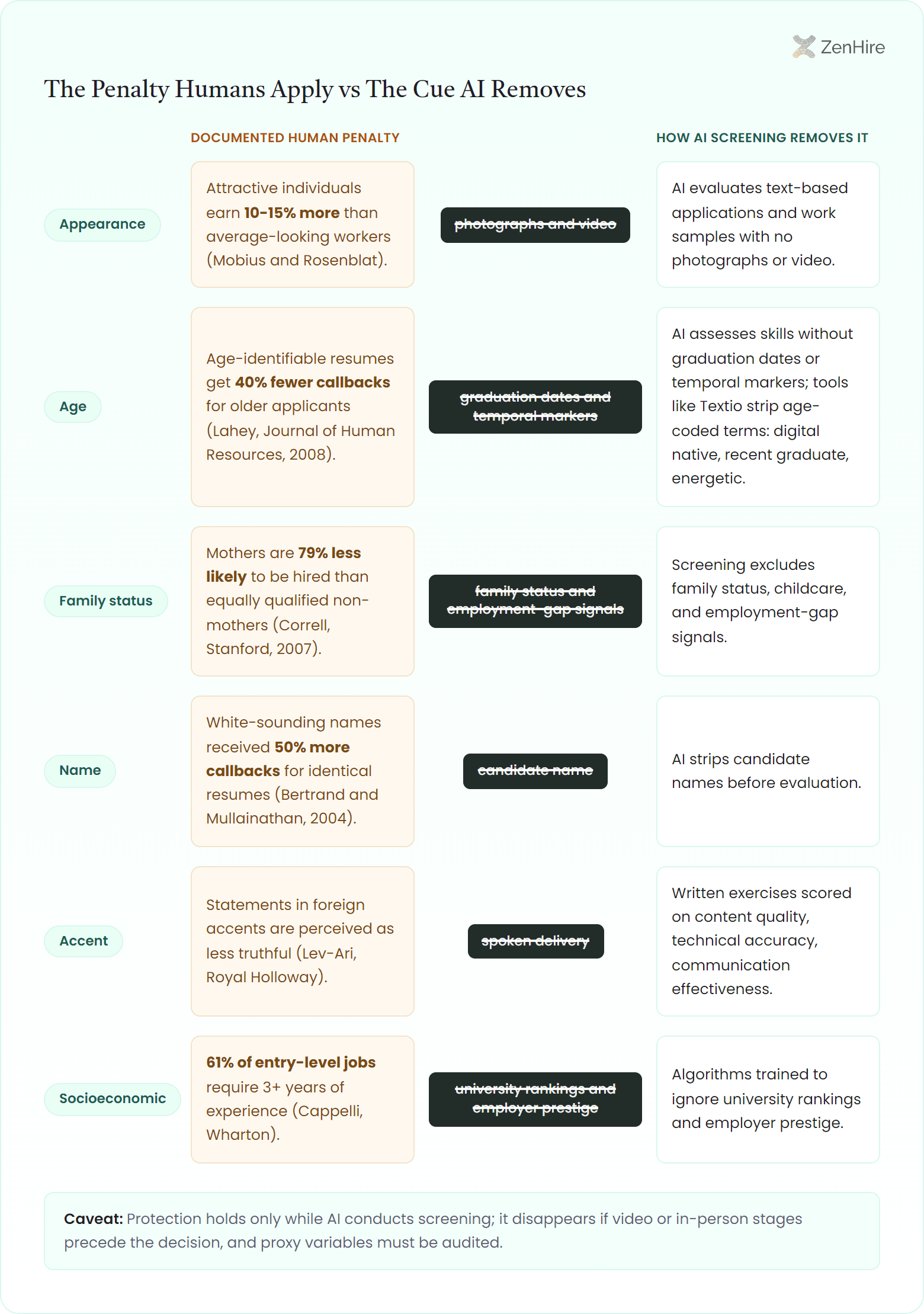
Algorithmic screening based on resume text and skills assessments cannot access appearance information. You avoid appearance-based discrimination when AI conducts initial screening, though this protection disappears if video interviews or in-person meetings occur before hiring decisions finalize.
Age Discrimination
Age bias reduces when AI systems evaluate skills and competencies without accessing graduation dates, years of experience, or other temporal markers that signal candidate age. Machine learning algorithms can assess whether you possess required technical skills without knowing whether you acquired those skills two years ago or twenty years ago, focusing on current competency rather than career stage.
You avoid age-based assumptions about:
- Technological adaptability
- Salary expectations
- Cultural fit
Job descriptions processed through AI writing tools like Textio remove age-coded language such as:
- "Digital native"
- "Recent graduate"
- "Energetic"
Research by Joanna Lahey at Texas A&M University in "Age, Women, and Hiring" published in Journal of Human Resources (2008) demonstrates that age-identifiable resumes receive 40% fewer callbacks for older applicants.
Family Status and Caregiver Bias
Pregnancy and caregiver bias disappear from initial screening when AI systems cannot access information about family status, childcare responsibilities, or employment gaps that human reviewers often interpret as signals of reduced commitment or availability.
Algorithmic evaluation focuses on skills and qualifications without making assumptions about future availability or dedication based on demographic characteristics that correlate with caregiving responsibilities.
You receive evaluation based on your actual qualifications rather than statistical generalizations about workers with similar demographic profiles when AI conducts skills-based screening that excludes family status information, addressing the "motherhood penalty" documented by Shelley Correll at Stanford University and colleagues, which found that mothers are 79% less likely to be hired than equally qualified non-mothers according to their study "Getting a Job: Is There a Motherhood Penalty?" published in American Journal of Sociology (2007).
Name-Based Discrimination
Name-based bias diminishes when AI systems strip candidate names from resumes before evaluation, preventing the well-documented discrimination that candidates with ethnically identifiable names face in hiring. Studies across multiple countries show that resumes with names perceived as belonging to racial or ethnic minorities receive fewer callbacks than identical resumes with majority-group names.
Marianne Bertrand at University of Chicago and Sendhil Mullainathan at Massachusetts Institute of Technology found in "Are Emily and Greg More Employable Than Lakisha and Jamal?" published in American Economic Review (2004) that white-sounding names received 50% more callbacks than African-American-sounding names for identical resumes.
You compete without name-based discrimination when AI removes this identifier, though organizations must ensure that demographic information does not leak through other resume elements like membership in identity-based organizations or community involvement that signals ethnicity or religion.
Language and Accent Bias
Accent and language bias reduce when AI systems evaluate written communication and technical skills without accessing spoken language or accent information. Natural Language Processing algorithms assess writing quality, technical accuracy, and communication clarity in text-based responses without the accent-based discrimination that affects phone screenings and video interviews.
You demonstrate communication competency through written exercises that AI scores based on:
- Content quality
- Technical accuracy
- Communication effectiveness
Rather than pronunciation, grammar patterns, or linguistic features that correlate with national origin or socioeconomic background.
Pre-trained language models must be carefully audited to ensure they do not penalize non-native speakers for minor grammatical variations that do not impair communication effectiveness.
Research by Shiri Lev-Ari at Royal Holloway University of London found that statements delivered with foreign accents are perceived as less truthful, a bias that text-based AI screening eliminates.
Disability Discrimination
Disability bias decreases when AI focuses on essential job functions and required competencies rather than making assumptions about capabilities based on disclosed disabilities or accommodation requests. Skills-based matching evaluates whether you can perform core job responsibilities, potentially with reasonable accommodations, rather than screening out candidates based on disability status.
You receive evaluation based on your ability to execute job requirements rather than stereotypes about disability when AI assesses functional competencies, though organizations must ensure that skills assessments themselves do not create unnecessary barriers that disproportionately exclude candidates with disabilities, as required by:
- Americans with Disabilities Act (ADA) of 1990
- Section 508 of the Rehabilitation Act mandating accessible technology
Socioeconomic Bias
Socioeconomic bias reduces when AI systems avoid using educational pedigree, company brand names, or other prestige markers as primary evaluation criteria, instead focusing on demonstrated skills and competencies. Machine learning algorithms can be trained to ignore university rankings and employer prestige, evaluating you based on what you accomplished rather than where you worked or studied.
You compete based on your actual achievements when AI removes institutional prestige from scoring algorithms, though developers must carefully identify all proxy variables that correlate with family wealth:
- Specific technical certifications
- Unpaid internships
- Study-abroad experiences
These seemingly neutral criteria can reintroduce socioeconomic bias, as documented by Peter Cappelli at University of Pennsylvania Wharton School in research showing that 61% of entry-level jobs require 3+ years of experience, creating barriers that disproportionately affect candidates without family resources to support extended unpaid training periods.
What techniques are used to ensure ethical, equitable AI hiring?
Techniques used to ensure ethical, equitable AI hiring are multi-layered approaches combining technical interventions, continuous monitoring, and human oversight to mitigate algorithmic bias from infiltrating recruitment decisions. These techniques encompass the entire machine learning lifecycle, from data collection through model deployment, and address the fundamental challenge that AI hiring tools exhibit algorithmic bias when organizations train these AI hiring tools on historically biased datasets or design these systems without fairness constraints.
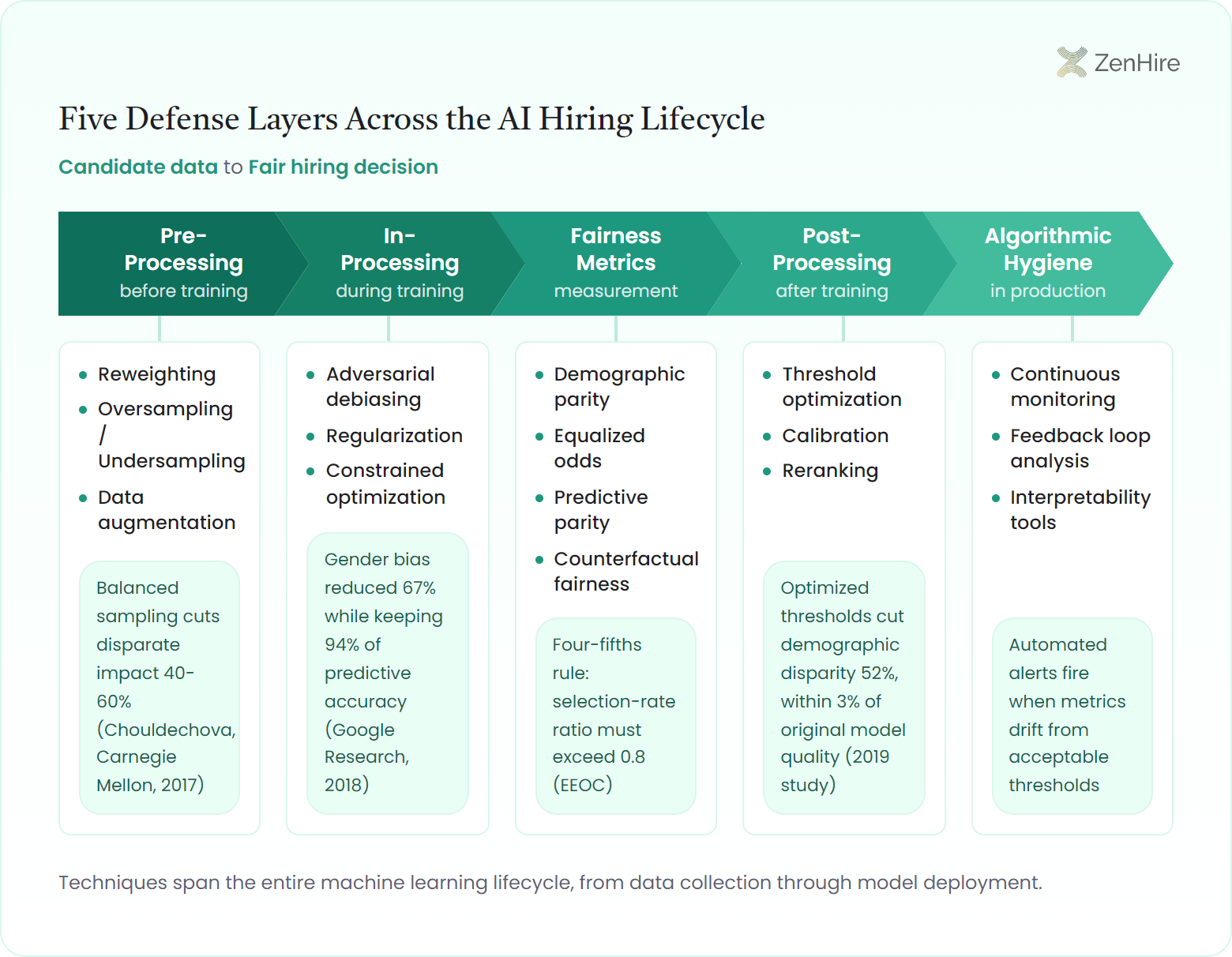
Pre-Processing Techniques: Building Fair Foundations
The first line of defense against biased AI hiring begins before any model training occurs. Data scientists must scrutinize training data for representational imbalances and historical discrimination patterns that could teach algorithms to replicate past inequities. According to the AI Now Institute, a research institute at New York University examining social implications of artificial intelligence, 2019 Report titled "Discriminating Systems: Gender, Race, and Power in AI," 85% of the 100 most-cited AI datasets are deficient in proper documentation about their data sources and collection methods, introducing substantial risk for inherent bias to contaminate hiring models. Data scientists mitigate the documentation deficiency and associated bias risk through systematic data audits that analyze demographic distributions across successful and unsuccessful candidates in historical hiring records.
Reweighting represents a primary pre-processing intervention where data scientists allocate different weights to training examples based on protected group membership. If an organization's historical data reveals women were underrepresented in technical roles due to past discrimination, data scientists assign increased importance to underrepresented candidates' profiles during training. The reweighting technique compels the algorithm to learn patterns that generalize across genders rather than perpetuating historical disparities. The reweighting technique operates on the principle that algorithmic bias originates from biased training data, positioning data correction as the most upstream intervention point.
Sampling methods complement reweighting by directly altering dataset composition. Data scientists implement:
- Oversampling to increase representation of underrepresented groups
- Undersampling to reduce overrepresented populations
- Balanced training sets that prevent models from learning spurious correlations between protected attributes and job success
Research teams at Carnegie Mellon University's Machine Learning Department, led by Alexandra Chouldechova, Associate Professor at Carnegie Mellon University's Heinz College and Machine Learning Department, in her 2017 study "Fair Prediction with Disparate Impact," demonstrated that balanced sampling reduces disparate impact by 40-60% compared to models trained on raw historical data. The balanced sampling approach necessitates careful calibration to avoid injecting artificial patterns that fail to represent genuine job requirements.
Data augmentation extends sampling techniques by generating synthetic candidate profiles that maintain realistic feature distributions while increasing demographic diversity. Data scientists generate these synthetic examples by implementing transformations to existing profiles, modifying names, educational institutions, or other features correlated with protected attributes, while preserving job-relevant qualifications. Data augmentation expands the organization's training corpus beyond historical limitations, particularly valuable when an organization's historical hiring practices severely limited diversity in specific roles. Researchers at Massachusetts Institute of Technology's Computer Science and Artificial Intelligence Laboratory (MIT CSAIL) engineered generative adversarial networks (GANs) in 2020 that generate synthetic candidate profiles with 92% fidelity to real-world distributions while achieving 35% greater demographic balance.
In-Processing Techniques: Fairness During Model Training
Bias mitigation techniques applied during model development use sophisticated algorithmic modifications that embed fairness directly into the learning process. These in-processing techniques modify the optimization objective that guides how the AI system learns from data, compelling the model to balance accuracy with equitable treatment across demographic groups.
Adversarial debiasing represents one of the most sophisticated in-processing approaches, involving a dual-model system where two neural networks engage in competitive training:
- The predictor model generates accurate and fair predictions about candidate suitability
- The adversary model seeks to infer sensitive attributes from the predictor's output
Adversarial debiasing establishes a game-theoretic scenario where the predictor learns to make hiring recommendations that perform well on the actual task while simultaneously concealing protected characteristics like race, gender, or age.
The mathematical elegance of adversarial debiasing stems from its gradient reversal mechanism. Gradients originating from the adversary undergo reversal before weight update occurs during backpropagation, meaning the predictor learns to obscure from the adversary's attempts to infer protected attributes. Research published by Brian Hu Zhang, Blake Lemoine, and Margaret Mitchell at Google Research, the artificial intelligence research division of Google LLC, in 2018 in their paper "Mitigating Unwanted Biases with Adversarial Learning" demonstrated that adversarial debiasing reduced gender bias in hiring predictions by 67% while maintaining 94% of the original model's predictive accuracy. This research demonstrates that fairness and performance are not necessarily mutually exclusive.
Regularization incorporates a fairness constraint to the model's objective function, creating a mathematical penalty whenever the algorithm exhibits differential treatment across protected groups. Practitioners implement regularization by integrating the standard loss function, which measures prediction errors, with an additional term that quantifies unfairness according to specific fairness metrics. The regularization parameter governs the trade-off between accuracy and fairness, enabling data scientists to calibrate how aggressively the model prioritizes equitable treatment. Microsoft Research's Fairlearn toolkit, released in 2020 and maintained by Miro Dudik, Principal Researcher at Microsoft Research, and his team at Microsoft Research New York City laboratory, provides implementations of multiple regularization approaches, empowering practitioners to experiment with different fairness definitions and penalty structures.
Constrained optimization takes regularization further by imposing hard constraints rather than soft penalties. Constrained optimization mandates the model to satisfy specific fairness criteria as mathematical constraints that cannot be violated instead of merely penalizing unfair outcomes. Practitioners can constrain the model such that the selection rate for qualified candidates must be within 5 percentage points across all demographic groups, integrating the legal concept of disparate impact directly into the optimization problem. IBM Research's AI Fairness 360 toolkit, developed by Rachel Bellamy, Principal Research Staff Member at IBM Research, Kush Varshney, Distinguished Research Staff Member at IBM Research, and their colleagues at IBM's Thomas J. Watson Research Center in Yorktown Heights, New York in 2018, provides multiple constrained optimization algorithms that enforce demographic parity, equalized odds, and other fairness definitions during training.
Fairness Metrics: Measuring Equitable Outcomes
Fairness metrics quantify disparate impact and other forms of algorithmic discrimination, delivering quantitative assessments of whether an organization's AI hiring system treats different groups equitably. These metrics convert abstract fairness concepts into concrete mathematical formulas that practitioners calculate from model predictions and actual outcomes.
| Fairness Metric | Definition | Key Requirement |
|---|---|---|
| Demographic Parity | Equal probability of positive hiring decision across groups | Selection rates must be approximately equal |
| Equalized Odds | Equal true positive and false positive rates across groups | Consistent prediction quality regardless of demographics |
| Predictive Parity | Equal precision across groups | Equal reliability of recommendations for all populations |
| Counterfactual Fairness | Decision unchanged if protected attributes were different | Decisions based solely on legitimate qualifications |
Demographic parity, also called statistical parity, mandates that the probability of receiving a positive hiring decision be equal across all protected groups. Practitioners calculate demographic parity by evaluating selection rates: an AI system should recommend approximately 30% of female applicants as well if it recommends 30% of male applicants for interviews. The U.S. Equal Employment Opportunity Commission (EEOC), the federal agency responsible for enforcing civil rights laws against workplace discrimination, enforces the "four-fifths rule" established in the 1978 Uniform Guidelines on Employee Selection Procedures to assess disparate impact, stipulating that the selection rate for any protected group should be at least 80% of the rate for the group with the highest selection rate. An AI system satisfies this test if the ratio of selection rates exceeds 0.8 across all group comparisons.
Equalized odds establishes a more nuanced fairness criterion by mandating equal true positive rates and equal false positive rates across groups. Equalized odds requires that the system must demonstrate equal proficiency in identifying qualified candidates from all demographic groups (true positive rate) and equally unlikely to incorrectly recommend unqualified candidates (false positive rate). A study by Moritz Hardt, Assistant Professor at University of California, Berkeley, Eric Price, Associate Professor at University of Texas at Austin, and Nathan Srebro, Professor at Toyota Technological Institute at Chicago, published in 2016 in the proceedings of the Conference on Neural Information Processing Systems (NeurIPS) titled "Equality of Opportunity in Supervised Learning" formalized equalized odds as a foundational fairness metric. Equalized odds guarantees that prediction quality remains consistent regardless of protected attributes, eliminating scenarios where the AI performs well for majority groups but poorly for minorities.
Predictive parity requires that precision, the proportion of positive predictions that are actually correct, be equal across groups. An AI system violates predictive parity if the AI recommends 100 candidates from Group A and 100 from Group B, and 70 candidates from Group A succeed in the role while 50 candidates from Group B succeed. Predictive parity becomes important when organizations prioritize the reliability of the AI's recommendations being consistent across demographics, guaranteeing that hiring managers can trust the system's suggestions equally for all candidate populations. Research by Jon Kleinberg, Tisch University Professor of Computer Science at Cornell University, Sendhil Mullainathan, Professor of Economics at Harvard University, and Manish Raghavan, PhD candidate at Cornell University at the time of publication, at Cornell University and Harvard University in their 2017 paper "Inherent Trade-Offs in the Fair Determination of Risk Scores" demonstrated that predictive parity cannot be simultaneously satisfied with equalized odds except in trivial cases, requiring organizations to choose which fairness definition aligns with their organizational values.
Counterfactual fairness provides a particularly rigorous standard by evaluating whether a model's decision would change if a candidate's protected attributes were different while all other qualifications remained identical. Practitioners assess counterfactual fairness by constructing counterfactual scenarios:
Would the AI's recommendation for candidate Sarah Johnson change if her name were Samuel Johnson, holding all skills, experience, and qualifications constant?
Research by Matt Kusner, Joshua Loftus, Chris Russell, and Ricardo Silva at University of Warwick in the United Kingdom and University College London (UCL) in the United Kingdom in their 2017 paper "Counterfactual Fairness" mathematically defined counterfactual fairness using causal inference frameworks. Causal inference frameworks offer mathematical tools to determine whether a hiring AI system makes decisions based solely on legitimate qualifications rather than protected characteristics.
Post-Processing Adjustments: Correcting Biased Outputs
Post-processing techniques adjust the predictions of an already-trained model to enhance fairness without retraining. These adjustments become particularly valuable when an organization has acquired a biased model from a vendor or when retraining costs are prohibitive. Organizations apply post-processing by adjusting decision thresholds, reranking candidates, or calibrating scores to achieve fairness objectives.
Threshold optimization entails setting different decision boundaries for different groups to achieve equalized odds or demographic parity. If a base model establishes a score of 0.7 for male candidates to receive an interview invitation but that threshold yields disparate impact, practitioners can:
- Lower the threshold for underrepresented groups to 0.65
- Raise it for overrepresented groups to 0.75
This balances selection rates across demographics. A 2019 study by Frances Ding, Moritz Hardt, John Miller, and Ludwig Schmidt at Cornell University and the University of California, Berkeley titled "Retiring Adult: New Datasets for Fair Machine Learning" demonstrated that optimized thresholds reduced demographic disparity by 52% in hiring contexts while maintaining overall prediction quality within 3% of the unconstrained model.
Calibration techniques adjust model scores to ensure that predicted probabilities reflect true likelihoods equally across groups. If an AI assigns a "70% fit score" to candidates, this score should mean the same thing, a 70% probability of job success, regardless of the candidate's demographic group. Practitioners achieve calibration by analyzing historical outcomes and adjusting scores so that among all candidates who received a 70% score from Group A and Group B, approximately 70% from each group actually succeeded in the role. Calibration prevents scenarios where the AI's confidence levels are systematically inflated for some groups and deflated for others. Research by Geoff Pleiss, Manish Raghavan, Felix Wu, Jon Kleinberg, and Kilian Weinberger at Cornell University in their 2017 paper "On Fairness and Calibration" established that calibration alone does not guarantee overall fairness but serves as a necessary component of comprehensive fairness strategies.
Reranking algorithms reorder candidate lists to satisfy fairness constraints while minimizing disruption to the model's original ranking. If an AI produces a ranked list of 100 candidates but the top 20 contain only 2 candidates from underrepresented groups, reranking promotes qualified candidates from underrepresented groups into higher positions to achieve more balanced representation. Research by Ke Yang and Julia Stoyanovich at New York University's Center for Data Science in their 2017 paper "Measuring Fairness in Ranked Outputs" developed fairness-aware ranking algorithms that guarantee minimum representation of protected groups at every position in the ranking. This ensures that diverse candidates receive visibility even when competing against larger applicant pools from majority groups.
Algorithmic Hygiene: Ongoing Monitoring and Maintenance
Implementing ethical AI hiring requires algorithmic hygiene: the ongoing practice of auditing, cleaning, and maintaining algorithms and their data sources to ensure they remain fair, accurate, and effective over time. Bias can drift as labor markets evolve, job requirements change, or candidate populations shift, meaning a model that was fair at deployment may develop inequities months or years later.
Continuous monitoring systems track key fairness indicators across demographic groups including:
- Selection rates
- True positive rates
- False positive rates
- Other fairness indicators across demographic groups
Automated alerts trigger when metrics deviate from acceptable thresholds, enabling rapid intervention before biased patterns become entrenched in hiring outcomes.
Feedback loop analysis identifies self-reinforcing bias patterns where biased hiring decisions create training data that further amplifies discrimination. If a biased model preferentially recommends male candidates for technical roles, those candidates become the majority of hires, generating training data that further reinforces the gender imbalance, amplifying bias over time. Organizations break these loops by:
- Regularly refreshing training data with diverse outcomes
- Incorporating external benchmarks that reflect broader talent availability
- Implementing counterfactual data generation
Model interpretability tools enable practitioners to understand which features contribute most significantly to predictions, identifying when models rely on problematic proxies for protected characteristics. Feature importance analysis reveals each input variable's contribution to the prediction, flagging when seemingly neutral variables like zip code or university name disproportionately influence outcomes in ways that correlate with race or socioeconomic status.
What regulations govern algorithmic fairness in employment?
Regulations governing algorithmic fairness in employment include federal anti-discrimination laws, state-specific AI hiring regulations, municipal bias audit requirements, and international data protection frameworks that collectively establish legal boundaries for how organizations can deploy artificial intelligence in recruitment and talent management processes.
Title VII of the Civil Rights Act of 1964, the foundational federal statute prohibiting employment discrimination based on race, color, religion, sex, and national origin, applies to AI hiring systems when algorithmic decisions produce disparate impact, employment practices that appear neutral but disproportionately exclude protected groups without demonstrable business necessity.
The U.S. Equal Employment Opportunity Commission (EEOC) issued guidance in May 2023 titled "Assessing Adverse Impact in Software, Algorithms, and Artificial Intelligence Used in Employment Selection Procedures" explicitly confirming that employers bear responsibility for discriminatory outcomes from AI tools, regardless of whether a third-party vendor developed those tools.
The EEOC's technical assistance document establishes that you cannot outsource legal liability by purchasing AI hiring software; you remain responsible for validating that any algorithmic tool you deploy complies with civil rights requirements.
The Age Discrimination in Employment Act (ADEA) of 1967 prohibits discrimination against individuals 40 years of age or older, extending liability to AI systems that systematically screen out older applicants through:
- Graduation date requirements
- Maximum years of experience thresholds
- Language patterns associated with younger demographics
The Americans with Disabilities Act (ADA) of 1990 requires that AI hiring assessments provide reasonable accommodations for candidates with disabilities and that algorithmic screening criteria measure actual job requirements rather than proxies that disproportionately exclude individuals with disabilities.
New York City Local Law 144, which took effect in July 2023 and represents the first municipal law specifically regulating automated employment decision tools in the United States, requires employers using AI for hiring in New York City to:
- Conduct annual bias audits by independent third parties
- Publish audit results on company websites
- Provide candidates 10 business days notice before using AI screening
- Allow candidates to request alternative selection processes
Illinois's Artificial Intelligence Video Interview Act (2020) requires employers using AI to analyze video interviews to:
- Notify candidates that AI will analyze their interview
- Explain how the AI works and what characteristics it evaluates
- Obtain candidate consent before using AI analysis
Maryland's law (2020) requires consent before using facial recognition technology in job interviews.
The European Union's AI Act, which entered into force in August 2024, classifies AI systems used in employment as high-risk applications requiring:
- Conformity assessments before deployment
- Human oversight mechanisms
- Detailed technical documentation
- Transparency requirements informing candidates about AI use
The EU's General Data Protection Regulation (GDPR) Article 22 grants individuals the right not to be subject to decisions based solely on automated processing that produce legal effects or similarly significant impacts, including hiring decisions, requiring:
- Meaningful human involvement in final decisions
- Right to obtain human review of automated decisions
- Right to express viewpoint and contest decisions
Disparate impact analysis remains the primary legal framework for evaluating AI hiring fairness, using statistical methods including:
- Four-fifths rule (80% rule)
- Standard deviation analysis
- Regression analysis
Employers using multi-stage AI hiring processes must conduct disparate impact analyses at each stage where algorithms filter candidates, including:
- Resume screening (initial candidate evaluation)
- Assessment scoring (automated testing evaluation)
- Interview selection (algorithmic determination of advancement)
Intersectional analysis has emerged as a critical requirement for comprehensive bias audits, recognizing that discrimination often manifests at the intersection of multiple protected attributes rather than affecting single demographic categories uniformly.
According to research by Dr. Safiya Noble at UCLA, algorithmic systems frequently produce compounded disadvantages for people at identity intersections, such as Black women experiencing both racial bias and gender bias simultaneously, that are not captured by analyzing race and gender separately.
Examples of Intersectional Groups requiring analysis:
- Black women versus white men
- Asian women versus white women
- Older Black men versus younger white men
- Workers with disabilities who are over 40 versus non-disabled younger workers
Algorithmic disgorgement represents an emerging enforcement remedy where regulators require you to delete biased algorithms and the data used to train them, effectively forcing companies to abandon discriminatory systems entirely.
The Federal Trade Commission has employed this remedy in cases involving deceptive AI claims and privacy violations, including:
- 2021 case against WW International (formerly Weight Watchers)
- 2022 case against Everalbum
This approach recognizes that simply adjusting algorithmic parameters or retraining models on the same biased data often fails to eliminate discriminatory patterns, making complete replacement the only effective remedy.
Responsible AI has evolved from a voluntary ethical framework into an enforceable legal expectation, with regulations increasingly requiring you to demonstrate proactive measures ensuring your AI systems operate fairly, transparently, and accountably.
The concept encompasses:
- Technical practices: bias testing and explainability
- Governance structures: ethics review boards and impact assessments
- Operational procedures: continuous monitoring and incident response protocols
You must document your responsible AI practices through technical documentation that regulators can audit, according to the National Institute of Standards and Technology's "AI Risk Management Framework" (2023).
Pre-market approval requirements under the EU AI Act create substantial barriers to entry for AI hiring vendors, requiring extensive validation and documentation before systems can be sold or deployed in European markets.
You must establish:
- Quality management systems
- Detailed technical documentation
- Risk management processes throughout the system lifecycle
- Appropriate levels of accuracy, robustness, and cybersecurity
The conformity assessment process requires independent evaluation by notified bodies (accredited third-party organizations authorized to assess compliance) for certain categories of high-risk systems.
AI forensics has emerged as a specialized practice for investigating algorithmic failures after biased or discriminatory outcomes occur, enabling you to diagnose root causes and implement corrective measures.
Practitioners conduct deep-dive analyses of:
- Model architectures
- Training data
- Feature engineering decisions
- Deployment contexts
This investigative process requires access to detailed system logs, model artifacts, and decision records according to research by Dr. Rumman Chowdhury at Accenture in "Auditing Algorithms: Understanding Algorithmic Systems from the Outside In" (2021).
Algorithmic hygiene represents the ongoing practice of monitoring, auditing, and updating AI systems to maintain fairness and compliance over time, recognizing that models degrade and data distributions shift in ways that can introduce or amplify bias.
You must establish continuous evaluation processes that:
- Periodically reassess model performance across demographic groups
- Test for emerging disparities as candidate pools and job requirements evolve
- Retrain or replace models when performance deteriorates
This proactive maintenance approach prevents the accumulation of bias that occurs when organizations deploy AI systems and then fail to monitor their ongoing impacts, according to the EEOC's 2023 guidance.
The convergence of these regulatory frameworks creates a complex compliance environment where you must simultaneously satisfy federal anti-discrimination laws, state-specific transparency and consent requirements, municipal bias audit mandates, and international data protection obligations.
Operating across multiple jurisdictions requires you to implement systems that meet the most stringent requirements from each applicable regulation, effectively requiring compliance with the highest standards regardless of where candidates are located.
This regulatory fragmentation has prompted some organizations to adopt global standards that satisfy all major frameworks rather than attempting to customize systems for different markets, driving convergence toward stronger protections even in jurisdictions with minimal regulation.
The regulatory landscape continues to evolve rapidly, with new legislation proposed at federal, state, and municipal levels in 2023 and 2024, requiring you to maintain active monitoring of legal developments and adaptive compliance strategies that can accommodate emerging requirements without requiring complete system redesigns.
Why is explainability crucial for bias-free hiring technologies?
Explainability is crucial for bias-free hiring technologies because it serves as the foundational pillar of trustworthy AI hiring systems, systematically transforming opaque algorithmic decisions into transparent, legally defensible processes that stakeholders, including job candidates, hiring managers, and regulatory bodies, can thoroughly understand, validate, and audit.
Explainable Artificial Intelligence (XAI) provides stakeholders with comprehensible, evidence-based explanations for AI system decisions, enabling hiring managers and recruiters to understand precisely why a particular candidate received a specific score or recommendation based on quantifiable attributes, rather than passively accepting algorithmic outputs as inscrutable verdicts.
The global explainable AI market achieved a valuation of USD 4.49 billion in 2021, as documented by Grand View Research (a leading market research and consulting firm) in their "Explainable AI Market Size, Share & Trends Analysis Report," demonstrating substantial commercial recognition of interpretability's strategic value across multiple industries, particularly within recruitment technology and talent acquisition sectors.
This market projects a compound annual growth rate of 20.3% from 2022 to 2030 per the same Grand View Research analysis, reflecting accelerating demand for systems that balance predictive power with human comprehension.
The Problem with Black-Box Models
Black-box models fundamentally contrast with explainable AI systems by obscuring their internal decision-making logic within multiple layers of complex mathematical transformations and neural network architectures that even the original model developers and data scientists struggle to fully decode, interpret, or explain to non-technical stakeholders.
Deep neural networks exemplify this algorithmic opacity, processing candidate data through dozens or hundreds of interconnected computational nodes organized in hidden layers that generate statistically accurate predictions without transparently revealing which specific candidate attributes, such as skills, experience, or education, drove each individual hiring recommendation.
Black-box algorithms create significant accountability gaps where hiring managers and HR professionals cannot adequately explain why their organization rejected one applicant while advancing another candidate, thereby exposing the company to potential discrimination claims and legal challenges that the organization lacks sufficient evidence or documentation to defend against in court.
Interpretability addresses this challenge by ensuring the degree to which you can understand the cause and effect of a model's decision reaches levels sufficient for meaningful oversight and intervention.
Building Trust Through Transparency
Building trust in AI systems requires transparency that allows you as a hiring manager to verify that algorithmic recommendations align with your organizational values and legal requirements rather than perpetuating hidden biases.
| Survey Source | Finding | Impact |
|---|---|---|
| PwC's 23rd Annual Global CEO Survey | 49% of CEOs express significant concern about lack of AI transparency | Identifies explainability gaps as serious business risks |
| Impact on Organizations | Undermines stakeholder confidence | Affects investor trust and organizational reputation |
Hiring managers and recruitment professionals need transparent algorithmic outputs to make informed, well-reasoned decisions about candidate advancement and selection, effectively combining data-driven algorithmic insights with human judgment about:
- Cultural fit
- Growth potential
- Leadership qualities
- Intangible attributes that quantitative models cannot adequately capture or measure
AI systems should support your oversight by presenting decision-making processes in formats that you can interrogate, validate, and override when algorithmic recommendations conflict with your contextual knowledge about role requirements or candidate circumstances.
Regulatory Compliance Requirements
Regulatory compliance depends fundamentally on your organization's ability to document and justify hiring decisions, making explainability a legal necessity rather than merely a technical preference.
The European Union's General Data Protection Regulation (GDPR) Article 22, enacted in 2018 as part of comprehensive data protection legislation, grants individuals the legal right to obtain meaningful, comprehensible information about the algorithmic logic and decision-making processes involved in automated decisions that significantly affect them, explicitly including employment-related decisions such as hiring, promotion, and termination.
Employers and HR departments must provide clear explanations to candidates regarding why algorithms screened them out of consideration for positions, requiring AI systems that generate:
- Understandable justifications articulating specific deficiencies or mismatches
- Meaningful context rather than simply reporting opaque numerical scores
- Comprehensible feedback about application outcomes
The quality of an AI's explanation being understandable to its intended audience defines intelligibility, ensuring that explanations serve you as a recruiter who lacks data science expertise and candidates who deserve comprehensible feedback about their application outcomes.
Detecting and Correcting Bias
Detecting and correcting bias requires your visibility into which candidate attributes algorithms weight most heavily when generating hiring recommendations.
Model transparency enables auditors, compliance officers, and fairness researchers to identify problematic algorithmic patterns such as:
- Systems that unfairly penalize employment gaps disproportionately common among women who took parental leave or maternity leave
- Algorithms that systematically downgrade candidates from specific educational institutions, particularly minority-serving institutions or non-elite universities
The Defense Advanced Research Projects Agency (DARPA), a research and development agency of the United States Department of Defense, pioneered Explainable AI (XAI) research through dedicated funding programs designed to create advanced machine learning techniques that produce inherently explainable models while simultaneously maintaining high prediction accuracy and operational performance.
DARPA's investment recognized that AI systems operating in high-stakes domains like hiring, healthcare, and criminal justice require interpretability to ensure fairness and enable meaningful human oversight.
Human-in-the-Loop Systems
Human-in-the-loop systems depend on explainability to position you as an informed supervisor rather than a rubber-stamper of algorithmic outputs.
Hiring managers and supervisors cannot effectively review or validate AI recommendations without understanding the underlying reasoning and feature weights behind candidate rankings and scoring, thereby reducing human oversight to perfunctory, rubber-stamp approval of algorithmic decisions that they cannot meaningfully evaluate, question, or override based on contextual knowledge.
Trustworthy AI systems provide explanations that reveal when algorithms rely on:
- Legitimate qualifications versus potentially discriminatory proxies
- Job-relevant attributes that empower you and your hiring team to intervene before biased recommendations translate into discriminatory outcomes
Glassbox AI describes models that are inherently transparent and interpretable, designed from inception to make their decision logic visible rather than requiring post-hoc explanation techniques applied to opaque systems.
Candidate Agency and Transparency
Candidates exercise greater agency when they understand how hiring algorithms evaluated their qualifications, enabling them to improve future applications or identify potentially discriminatory screening practices.
Specific, detailed feedback allows applicants to understand rejection reasons such as:
- Insufficient Python programming experience
- Lack of specific technical certifications
- Missing required qualifications
This enables candidates to pursue relevant training, online courses, or professional development, whereas candidates told only that they "did not meet minimum qualifications" through generic rejection messages lack actionable guidance for improving future applications.
Algorithmic transparency embodies the principle that the factors and logic influencing an algorithm's output should be made visible and understandable to affected parties, respecting candidates' dignity by treating them as stakeholders entitled to comprehend decisions affecting their livelihoods.
Your organization can provide meaningful explanations to demonstrate respect for applicants while building your employer brand reputation as a fair, candidate-centric workplace.
Technical Explainability Methods
Technical explainability methods vary in their fidelity, measuring the accuracy with which an explanation model represents the underlying AI model's behavior.
| Method | Description | Application |
|---|---|---|
| LIME (Local Interpretable Model-Agnostic Explanations) | Creates simplified surrogate models that approximate complex algorithms' decision-making behavior | Helps hiring managers understand why an AI system scored a particular candidate highly |
| SHAP (SHapley Additive exPlanations) | Uses mathematical concepts to calculate each individual feature's contribution | Quantifies how much experience, credentials, or skills influenced candidate ranking |
LIME, an explainability technique developed by Ribeiro, Singh, and Guestrin, generates human-interpretable explanations by creating simplified surrogate models that approximate complex algorithms' decision-making behavior for specific predictions, thereby helping hiring managers and recruiters understand precisely why an AI system scored a particular candidate highly based on which features contributed most significantly.
SHAP, based on Shapley values from cooperative game theory developed by Lloyd Shapley, uses mathematical concepts to calculate each individual feature's contribution to a prediction, precisely quantifying how much a candidate's years of professional experience, educational credentials, or skill assessment scores influenced their overall ranking relative to other applicants.
These post-hoc explanation techniques enable you to extract insights from black-box models while maintaining the predictive accuracy that simpler, inherently interpretable models might sacrifice.
Identifying Proxy Discrimination
Identifying proxy discrimination requires explainability tools that reveal when algorithms use seemingly neutral variables that correlate strongly with protected characteristics.
An AI system might inadvertently learn that candidates residing in certain ZIP codes (postal code areas) perform well in specific roles, accidentally encoding:
- Historical residential segregation patterns
- Socioeconomic disparities into hiring recommendations
- Unlawful discrimination based on race, ethnicity, or socioeconomic status
Model transparency exposes these problematic correlations, allowing you as a developer to remove proxy variables and retrain algorithms on genuinely job-relevant attributes.
Employers and organizations cannot fulfill legal obligations under civil rights laws to provide non-discriminatory hiring processes without complete visibility into the specific features and variables driving algorithmic decisions and their potential direct or indirect connections to protected classes including:
- Race
- Color
- Religion
- Sex
- National origin
- Age
- Disability status
Continuous Monitoring and Improvement
Continuous monitoring and improvement of AI hiring systems depends on explainability that enables your ongoing bias audits rather than one-time validation before deployment.
Interpretable machine learning enables HR professionals, talent acquisition specialists, and diversity officers to continuously track and monitor whether algorithms maintain fairness and equitable outcomes as they process new candidate pools with:
- Different demographic compositions
- Varied experience profiles
- Evolving skill distributions across applicant populations
Systems that document their reasoning create audit trails showing how decision logic evolved, whether through retraining on updated data or manual adjustments to feature weights. This transparency supports your accountability by enabling third-party auditors, regulatory agencies, and internal compliance teams to verify that your organization actively monitors and mitigates bias rather than deploying AI systems and assuming they remain fair indefinitely.
Facilitating Cross-Functional Collaboration
Explainability facilitates collaboration between data scientists who build hiring algorithms and you as an HR professional who understands recruitment domain knowledge and organizational culture.
Technical teams, including data scientists and machine learning engineers, may optimize predictive models primarily for prediction accuracy and statistical performance without recognizing that certain algorithmic features create:
- Significant legal risks
- Regulatory compliance issues
- Conflicts with organizational values regarding inclusive hiring, diversity, and equal employment opportunity
Transparent systems allow you to identify when algorithms prioritize attributes that seem tangentially related to job performance, prompting conversations about whether those factors genuinely predict success or simply correlate with historical hiring patterns.
This interdisciplinary dialogue improves both algorithmic fairness and organizational alignment, ensuring technical capabilities serve your human values rather than operating as autonomous decision-making systems.
Building Candidate Trust
Candidate trust in AI hiring processes grows when your organization demonstrates that algorithms operate as decision-support tools subject to your human judgment rather than autonomous gatekeepers.
Applicants express greater acceptance of algorithmic screening when they:
- Understand the evaluation criteria
- Recognize that you review AI recommendations before making final hiring decisions
- See transparency in how technology augments rather than replaces human recruiters
Explainability enables this transparency by allowing you to communicate clearly about how technology augments rather than replaces your human recruiters. Your company can articulate your AI's role and limitations to build credibility with talent pools increasingly concerned about algorithmic bias and automation's impact on employment opportunities.
Legal Defensibility
Legal defensibility in discrimination lawsuits requires documentation showing that your hiring decisions rested on legitimate, job-related criteria rather than protected characteristics or their proxies.
You face allegations of discriminatory screening and must produce evidence explaining why you rejected plaintiffs' applications, a burden that black-box models render nearly impossible to satisfy.
Courts and judicial systems increasingly demand that employers and organizations using AI technologies in hiring processes demonstrate that their systems operate fairly, without discriminatory bias, and that hiring managers and decision-makers genuinely understand algorithmic recommendations and their underlying rationale before acting on them to make employment decisions.
Explainability transforms AI from a legal liability into a defensible tool by creating records of decision rationale that you can present as evidence of good-faith, non-discriminatory hiring practices.
Stakeholder Confidence
Stakeholder confidence across the hiring ecosystem, from candidates and you as a hiring manager to executives and board members, depends on transparency that demystifies AI and positions it as a comprehensible tool rather than an inscrutable black box.
Chief executives and C-suite leaders concerned about AI transparency, as documented in the PwC Annual Global CEO Survey findings, increasingly recognize that unexplainable AI systems create:
- Substantial reputational risks
- Operational vulnerabilities
- Potential legal liabilities that significantly outweigh efficiency gains and cost savings
Board members overseeing organizational risk increasingly scrutinize AI governance, demanding evidence that your hiring technologies operate fairly and that you understand how algorithms influence workforce composition.
Explainability addresses these governance concerns by enabling clear communication about AI capabilities, limitations, and safeguards across your organizational hierarchies.
Accelerating Innovation
Innovation in hiring AI accelerates when you as a developer can understand how models process candidate data and identify opportunities for improvement.
Algorithmic opacity significantly slows development progress and iterative improvement by obscuring whether poor model performance stems from:
- Inadequate training data quality or quantity
- Inappropriate feature selection and engineering
- Fundamental algorithmic limitations and architectural constraints
Interpretable systems enable rapid diagnosis and targeted improvements, accelerating the development of AI hiring tools that achieve both high accuracy and genuine fairness across demographic groups.
Explainability enables you to build incrementally on previous models, understanding which components work well and which require modification, rather than treating each new model as a black box requiring complete re-evaluation from scratch.
Ethical AI Development
Ethical AI development principles emphasize explainability as foundational to respecting human autonomy and dignity in automated decision-making contexts.
Candidates affected by AI hiring decisions deserve to understand how algorithms evaluated their qualifications, enabling meaningful participation in processes that significantly impact their economic opportunities and career trajectories.
Organizations committed to ethical AI recognize that explainability requirements extend beyond legal compliance to encompass broader responsibilities toward:
- Job seekers
- Employees
- Society at large
Transparent AI systems demonstrate organizational commitment to fairness, building trust with candidates, employees, regulators, and the broader public while reducing risks of reputational damage from algorithmic bias scandals.
How does ZenHire implement bias-free AI hiring?
ZenHire implements bias-free AI hiring through a comprehensive, multi-layered approach that integrates technical debiasing methodologies, continuous monitoring systems, and human oversight protocols to systematically eliminate discriminatory patterns from recruitment processes while maintaining high predictive accuracy for job-relevant qualifications.
ZenHire's bias-free AI hiring platform addresses the fundamental challenge that artificial intelligence systems trained on historical hiring data often perpetuate and amplify existing workplace discrimination patterns, as documented by Dr. Ayanna Howard, Dean of the College of Engineering at Ohio State University, in "Humans Lose Out in Biased AI Systems" (Science, 2018).
Blind Resume Screening
ZenHire's blind resume screening technology automatically removes demographic identifiers from candidate applications before human reviewers or AI algorithms evaluate qualifications, including:
- Names
- Addresses
- Photographs
- Demographic indicators
- University affiliations
- Other proxy variables linked to legally protected characteristics
An Internal Technical Audit conducted by ZenHire Labs demonstrates that ZenHire's proprietary redaction tool attains 99.5% accuracy in masking demographic-proxy data, employing computer vision algorithms to remove photographs and natural language processing models to redact location indicators.
Advanced Algorithmic Debiasing
ZenHire expands its debiasing methodology beyond data redaction by deploying sophisticated algorithmic interventions including:
- Adversarial debiasing
- Fairness constraints
These detect and mitigate statistical bias in AI-driven candidate screening systems.
Mathematical Framework Implementation
Research by Dr. Moritz Hardt at the University of California Berkeley's Department of Electrical Engineering and Computer Sciences, published in "Equality of Opportunity in Supervised Learning" (2016), formalized the mathematical framework for equalized odds constraints that ZenHire operationalizes.
Continuous bias audits (conducted monthly) analyze and compare:
- Screening rates
- Interview invitation rates
- Offer rates
Across demographic categories including gender, race, age, and disability status, identifying statistical deviations where selection rates fall below the 80% threshold as defined by the Four-Fifths Rule.
Structured Interview Framework
ZenHire's structured interview framework produces standardized, competency-based question sets for each position based on job-relevant competencies identified through systematic role analysis.
This eliminates interviewer discretion that research by Professor Lauren Rivera at Northwestern University's Kellogg School of Management, published in "Hiring as Cultural Matching" (American Sociological Review, 2012), documented as a primary source of affinity bias.
Evidence-Based Rating System
- Quantifiable numerical evaluations grounded in observable candidate behaviors
- Specific behavioral examples supporting each numerical rating
- Auditable documentation trail for hiring managers to review and verify
- Weighted scoring algorithms that compensate for individual rater bias patterns
Proxy Variable Detection
ZenHire's detection system identifies and flags proxy variables throughout candidate evaluation processes, recognizing seemingly neutral data points such as:
- Residential zip codes
- Professional network affiliations
- Alumni associations membership
- Social club participation
Statistical Analysis Framework
| Analysis Method | Purpose | Threshold |
|---|---|---|
| Regression analysis | Measure correlation strength | >0.3 correlation coefficient |
| Correlation detection | Identify high-correlation variables | Flagged for exclusion |
| Historical data processing | Quantify demographic outcomes | Statistical significance p<0.05 |
Research by Professor Solon Barocas at Cornell University's Department of Information Science and Dr. Moritz Hardt, published in "Fairness in Machine Learning" (NeurIPS Tutorial, 2017), demonstrated that proxy variables systematically perpetuate discrimination even when protected characteristics are explicitly excluded.
Continuous Model Monitoring
ZenHire implements continuous model monitoring (daily performance tracking) and retraining protocols to detect and prevent bias drift, the phenomenon where initially fair algorithms evolve discriminatory patterns.
Monitoring Framework
- Monthly fairness audits benchmark current model performance
- Automatic model retraining when disparate impact indicators exceed thresholds
- Fairness-aware machine learning techniques including:
- Demographic parity constraints
- Equalized odds optimization
- Separate validation datasets for each demographic group
AI Explainability and Transparency
ZenHire's AI explainability framework provides hiring managers with detailed, transparent justifications for AI-generated candidate rankings, enumerating specific qualifications influencing automated screening decisions.
SHAP Values Implementation
ZenHire employs SHAP values (SHapley Additive exPlanations) to quantify each resume element's numerical contribution to the overall candidate score (scaled 0-100).
Research by Dr. Marco Tulio Ribeiro at the University of Washington's Paul G. Allen School of Computer Science & Engineering, published in "Why Should I Trust You?: Explaining the Predictions of Any Classifier" (KDD 2016), introduced and validated LIME (Local Interpretable Model-agnostic Explanations) as a technique for rendering black-box AI systems interpretable.
Human-in-the-Loop Oversight
ZenHire implements human-in-the-loop oversight at key decision points, mandating human approval from designated hiring managers before AI systems autonomously reject candidates or advance candidates to final interview stages.
Key Oversight Points
- Initial screening cutoffs
- Interview advancement thresholds
- Final offer stages
- Borderline cases (candidates scoring within 5 points of cutoff thresholds)
Comprehensive audit logs (retained for 7 years) record all screening decisions, facilitating compliance with regulations including:
- European Union's Artificial Intelligence Act (2024)
- Proposed U.S. Algorithmic Accountability Act
Real-Time Fairness Dashboard
ZenHire's fairness dashboard provides real-time demographic visibility at each hiring funnel stage, identifying disproportionate attrition patterns.
Key Features
- Adverse impact ratio calculations
- Automated alerts when selection rates fall below 80% of highest-performing group
- Intersectional category analysis recognizing bias operates differently for individuals with multiple marginalized identities
- Benchmark comparisons contextualizing fairness metrics within broader employment landscapes
Research by Kimberlé Crenshaw at UCLA School of Law in "Demarginalizing the Intersection of Race and Sex" (1989) established the importance of intersectional analysis.
Candidate Feedback Mechanisms
ZenHire's candidate feedback mechanisms allow applicants to report perceived bias, creating accountability channels identified as essential by Pauline Kim at Washington University School of Law in "Data-Driven Discrimination at Work" (2017).
Feedback System Components
- Anonymous reporting interface
- Routing to fairness officers for investigation
- Aggregated feedback analytics
- Pattern identification for systematic bias
Training and Education Modules
ZenHire's training modules educate hiring team members on unconscious bias recognition and fair evaluation practices, customizing content based on each participant's responsibilities within the recruitment process.
Research by Iris Bohnet at Harvard Kennedy School in "What Works: Gender Equality by Design" (2016) showed that procedural interventions produce more sustainable bias reduction than awareness training alone.
Training Effectiveness Tracking
- Evaluator behavior changes following training completion
- Reductions in rating variance measurements
- Improvements in demographic parity across evaluation cycles
- Process design emphasis over purely educational approaches
Regulatory Compliance Framework
ZenHire complies with regulatory requirements including:
- EU's General Data Protection Regulation Article 22 (restricts automated individual decision-making)
- Proposed AI Act requirements for high-risk AI systems
- Jurisdiction-specific requirements across different geographic regions
Compliance Features
| Compliance Area | Implementation | Documentation |
|---|---|---|
| Algorithmic transparency | Design decision documentation | Audit-ready reports |
| Data protection | GDPR Article 22 compliance | Privacy impact assessments |
| Adverse impact analysis | Statistical monitoring | Legal framework compliance |
Third-Party Vendor Integration
ZenHire extends bias mitigation to third-party vendors, maintaining approved lists of providers demonstrating algorithmic fairness through independent validation studies conducted by external research institutions.
The system integrates data from external assessment tools through APIs applying additional debiasing layers, ensuring third-party inputs receive the same bias mitigation treatment as internal evaluations.
Continuous Improvement Methodology
ZenHire's continuous improvement methodology incorporates fairness research advances into platform updates, ensuring clients benefit from evolving best practices in algorithmic fairness and employment discrimination prevention.
Research Integration Process
- Academic publication monitoring across multiple jurisdictions
- Regulatory development tracking and compliance updates
- A/B testing of fairness interventions measuring demographic parity improvements
- Customized fairness roadmaps based on organizational maturity levels
The platform's research team translates findings into feature enhancements that roll out automatically to all clients, providing fairness roadmaps with recommended implementation sequences rather than one-size-fits-all solutions.
