
How Do You Build a Candidate Profile That Gets Noticed?


· 10 min read
You build a candidate profile that gets noticed by front-loading provable, role-relevant skills and verifying the most important ones, so a skills-based matching engine ranks you on evidence instead of keywords. Every line you add lands on one of two very different scales: a resume-style claim carries the predictive weight of a plain CV, around r = 0.14, while a skill you verify is read at the 0.45-0.60+ level that structured assessments reach. Since roughly 70% of employers now run AI somewhere in screening, that gap decides whether your profile surfaces or sinks. On ZenHire you close it in one short async interview, roughly four minutes, which scores communication and reasoning and places spoken English on the CEFR scale (A1 through C2) using glass-box, bias-excluded scoring that reads ability rather than background.
What goes into a high-match candidate profile?
A high-match candidate profile goes deep on the skills a role actually needs and the evidence that you have them: concrete abilities, real outcomes, and the soft skills that decide who thrives, rather than a title-and-dates list a filter skims past. The mechanism is simple: skills-based matching engines read your profile for capability signal, so the more precise and provable your skills, the better you match a real opening instead of getting buried under keyword-stuffed resumes.
Think of your profile in three layers. First, the hard skills tied to the work (tools, languages, processes you have used, not just heard of). Second, the soft skills that predict success on the job: clear communication, reliability, problem-solving under pressure. Third, the proof: a result, a project, an assessment, or a verified skills badge that turns a claim into a signal. A modern matcher distinguishes a skill you *used* from one you merely *mentioned*, so specificity is what separates a high-match profile from a generic one.
Concrete example: instead of "experienced in customer service," write "handled 40+ inbound support calls a day, resolved billing disputes, and held a 4-minute average handle time." The first is a label; the second names tools, volume, and an outcome a matching engine and a hiring manager can both read. If you are not sure which skills to foreground for the jobs you want, start with what jobs fit my skills and work backward to the abilities those roles ask for.
Edge case: career-changers and first-job candidates often think a thin work history sinks them. It does not. On a skills-first profile, transferable skills count. A retail shift lead who coordinated staff, defused conflict, and hit targets has real, nameable abilities that map onto roles far from retail. Name those abilities plainly, and you give a fair screen something to match instead of a gap to penalize.
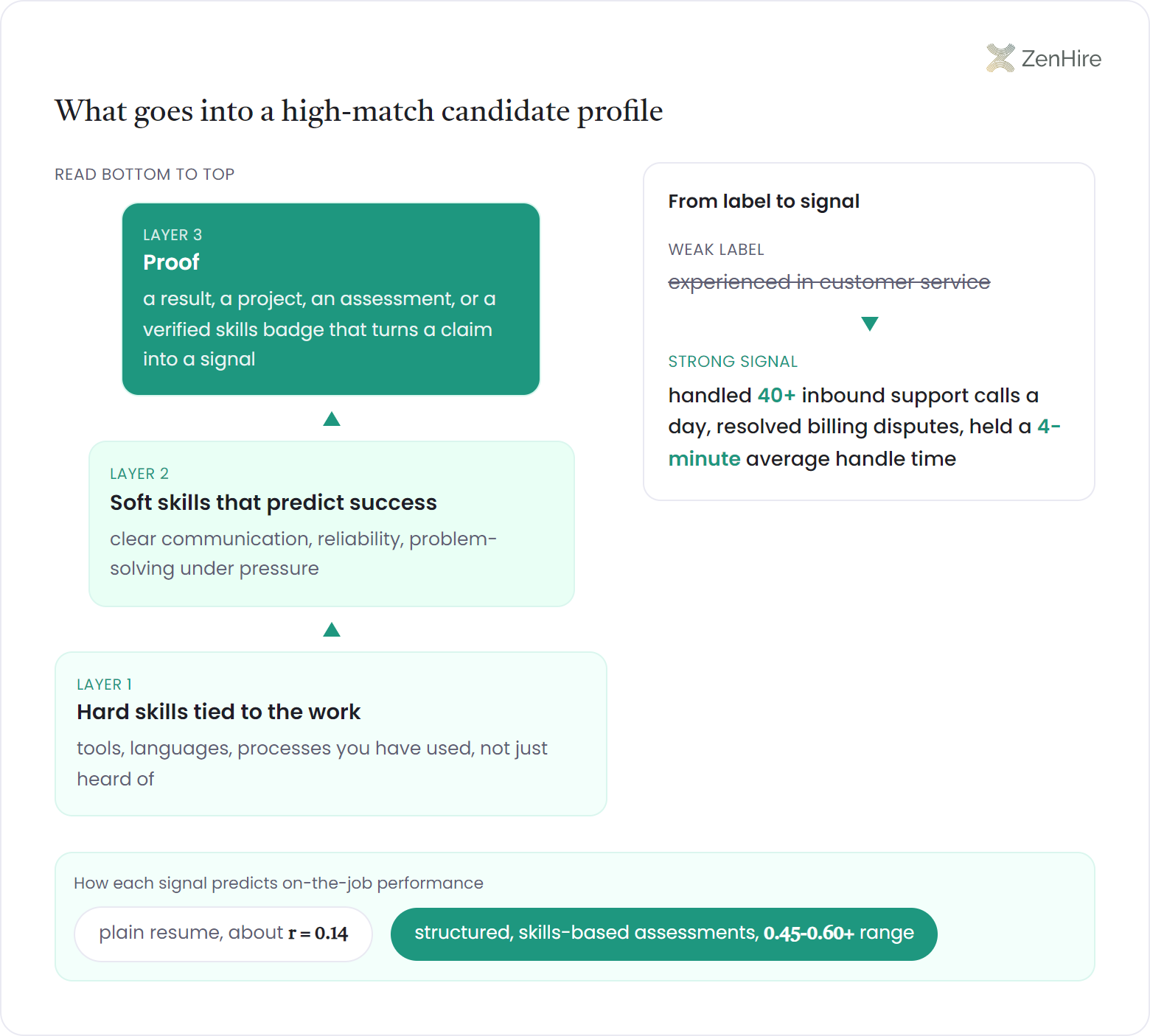
The layer you choose to lead with sets your ceiling. Written as a bare resume, your profile inherits the predictive power of a plain CV: about r = 0.14 against actual on-the-job performance. Rebuilt around a proven skill, the same profile is read at 0.45-0.60+, the range structured skills assessments hit. Same person, same abilities, three-to-four times the signal, purely because of how you chose to present it. That is the difference a well-built profile is designed to capture.
- Role-relevant hard skills: the tools, processes, and languages you have actually used, named specifically
- Soft skills that predict success: communication, reliability, problem-solving, named with a concrete instance
- Proof, not just claims: an outcome, a project, an assessment result, or a verified badge behind each skill
- Transferable skills: abilities from one context that map onto the roles you want, made explicit
How do verified skills change your candidate profile's visibility?
Verified skills change your candidate profile's visibility by replacing "trust me" with a result a system can actually weight: a verified ability survives the keyword filter and the resume scan that quietly drop strong candidates who simply phrased things differently. The mechanism: when a skill is backed by a structured assessment or a short, scored interview, it stops being an unverified self-rating and becomes evidence the matching engine can rank you on. That is the difference between being filtered out and being surfaced.
On a platform like ZenHire, adding that verified layer costs you one sitting, not a testing marathon. A single async interview, roughly four minutes for most roles, drives an interview analysis that listens to how you communicate, reason, and handle a problem, and attaches spoken English to a CEFR band somewhere from A1 to C2, judged on clarity rather than accent. The scoring is glass-box and bias-excluded: your name, photo, and where you grew up are held out, so what lifts your profile is the verified ability itself. You can dig into how that score works in the candidate skill score guide, and into the fairness side in reduce bias.
Concrete example: two candidates list "fluent English." One leaves it as a claim; the other completes a short English proficiency assessment and carries a CEFR B2 result on their profile. When a customer-facing role sets a B2 threshold, the verified candidate matches automatically and the unverified one waits in a queue to be manually checked, if they are checked at all. Verification is what gets you matched with employers instead of overlooked.
Edge case: candidates worry that an assessment could expose a weakness and hurt them. In practice the opposite is more common: verification most helps the person a resume undersells. If your pedigree is unremarkable but your ability is real, a verified result becomes the strongest line on your profile, because it is scored at the level structured assessments reach (0.45-0.60+) rather than the far thinner read a keyword filter gives a resume. The risk was never the test. It is being filtered out silently, before anyone reaches what you can actually do.
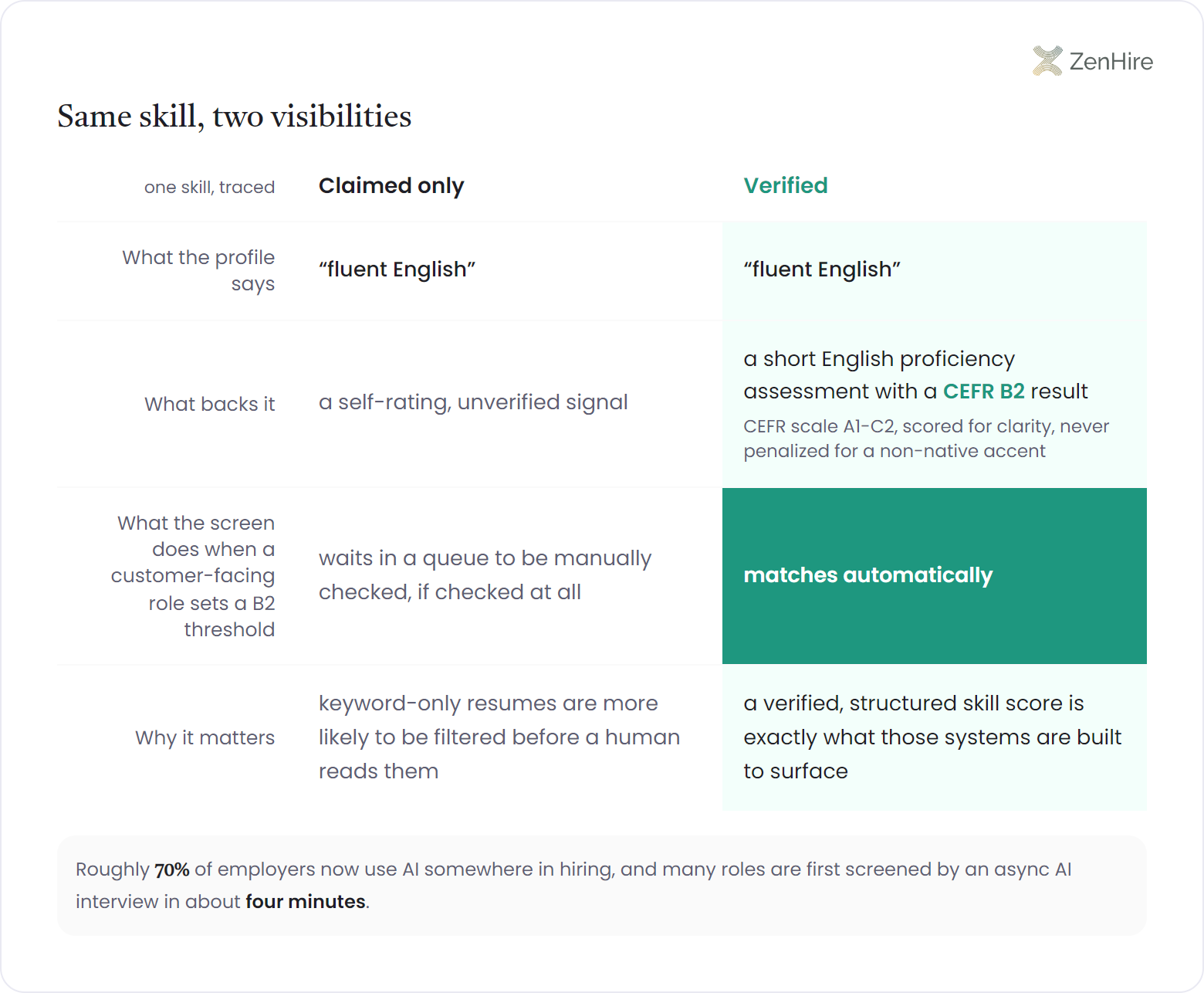
Build your profile for the reader it will actually meet first. Around 70% of employers now use AI somewhere in hiring, and for many roles the opening read is a four-minute async interview, not a human. A keyword-only profile is the kind that machine quietly drops; a profile carrying a verified, structured skill score is precisely what it was built to promote. Verification is not a bonus you add later. It is what decides whether the first reader passes you upward or sets you aside.
How do you keep your candidate profile current?
You keep your candidate profile current by refreshing skills and proof on a regular cadence, not only when you are job-hunting, because skills decay, new ones land, and a stale profile quietly stops matching the roles you would now be perfect for. The mechanism is matching freshness: an engine pairs you against live openings using the skills on your profile *right now*, so an unrefreshed profile is invisible to opportunities that arrived after you last touched it.
Build a light maintenance habit. Every few months, add a skill you have grown, retire one you no longer use, and attach fresh proof to anything important: a new project outcome, an updated assessment, or a course you finished. Free, short courses are an easy way to add a provable, current skill; see free courses to get a job and the soft-skills track in improve soft skills. Each refresh re-enters you into matching with stronger, more recent signal.
Concrete example: a candidate who finishes a data-analysis course adds the skill, completes a short assessment to verify it, and notes a specific output ("built a weekly sales dashboard in a spreadsheet tool"). Within their next matching cycle they start surfacing for analyst-adjacent roles that their six-month-old profile would never have reached. The update did the work; the candidate did not apply to a single one of them.
Edge case: do not pad a current profile with skills you cannot back up. A skills-first system reads for evidence, and an inflated profile that fails verification at the interview stage costs you more trust than an honest, leaner one ever would. Currency means recent and true, not long. Keep it tight, keep it provable, and keep it fresh: that combination is what keeps you continuously matchable rather than periodically scrambling.
| Refresh action | Why it keeps you matchable |
|---|---|
| Add a newly grown skill | Surfaces you for roles that arrived after your last update |
| Verify a key skill | Turns a claim into a rankable signal a screen can weight |
| Attach fresh proof | Keeps each skill evidence-backed, not just asserted |
| Retire stale skills | Stops mismatches and keeps your profile honest and precise |
I built ZenHire because I watched capable people get filtered out before anyone looked at what they could do: wrong school, wrong keyword, wrong gap in the timeline. So here is my honest advice to you: do not try to out-pedigree the resume screen, because you cannot, and you should not have to. Put the skills you can prove front and center and let a structured, bias-excluded screen read them. We keep your name, your background, and where you come from out of the scoring on purpose, because your verified ability is the thing we want to surface. A skills-first profile is not a trick to game the system; it is the system finally measuring the right thing, and that is the fairest, fastest shot a good candidate has ever had.
Frequently asked questions
How do I build a candidate profile that gets noticed?+
You build a candidate profile that gets noticed by leading with provable, role-relevant skills instead of titles. Name the concrete abilities a job needs, attach real proof to each one, and verify the most important skills so a screen can rank you, a method that predicts performance far better than the resume keyword scan that quietly filters strong candidates out.
What makes a candidate profile a standout profile?+
A standout candidate profile is specific, honest, and evidence-backed. Vague claims read as noise to a skills-based matcher, while a precise skill tied to an outcome or a verified result is exactly the signal it rewards. Standout does not mean longer; it means every skill you list is one you can actually demonstrate.
Do verified skills really improve my profile's visibility?+
Yes, verified skills are what surface you when a keyword filter would otherwise drop you. A self-rated claim is unverified signal; a structured assessment or short scored interview turns it into a result a system can weight. A verified skill is read at the 0.45-0.60+ level structured assessments reach, where a resume line only carries the ~0.14 predictive weight of a plain CV, so verifying a claim is how you move it onto the scale that actually gets you ranked.
Will a skills assessment expose my weaknesses and hurt me?+
Verification most helps the candidate a resume undersells, not the one it flatters. Scoring is bias-excluded and glass-box, so sensitive attributes stay out and your ability is read on its own. If your pedigree is unremarkable but your skills are real, a verified result is your strongest asset; the bigger risk is being filtered out before anyone sees you at all.
How often should I update my candidate profile?+
Refresh your profile every few months, not only when you are job-hunting. Add skills you have grown, verify the key ones, attach fresh proof, and retire what is stale. Matching engines pair you against live openings using the skills on your profile right now, so a current profile keeps surfacing for roles a stale one would miss.
Free for building a candidate profile
Build a profile that gets matched
A short, candidate-side worksheet for building a high-match profile: which skills to front-load, how to phrase proof, and which abilities to verify first so the right employers find you.