
What Is a Skills Badge and How Do You Earn One?


· 9 min read
A skills badge is verified proof of a specific ability, earned by demonstrating it in a short [structured assessment](/interview/structured-interview) that records your core skill, your soft skills, and where you land on the CEFR language ladder from A1 up to C2, all on a single rubric. The whole reason a badge exists is that a resume is a weak witness: on its own, a screened CV lines up with actual job performance at a correlation of roughly 0.14, whereas an ability that has been measured and scored sits far higher, in the 0.45 to 0.6-plus range. That gap is the badge's job to close. It hands an employer a number built on the trustworthy signal, so you are read on what you demonstrated rather than on the keywords a filter happened to catch.
What is a verifiable skills badge?
A verifiable skills badge is a portable, verified proof that you can do something specific. It is the outcome of a structured assessment that watched you demonstrate a skill, rather than a self-reported line on your resume. Where a resume says you have a skill, a verified skill badge shows that an objective evaluation measured it and recorded the result an employer can trust.
The mechanism is simple: instead of trusting that a keyword on your CV reflects real ability, a skills badge is generated from a consistent, scored exercise (answering role-relevant questions, completing a short task, or speaking on a structured prompt), and the same scoring rubric is applied to every candidate. That consistency is the whole point. Your badge means the same thing whether you applied first or last, from a famous school or none at all. ZenHire builds this from your candidate skill score, so the badge attached to your profile reflects measured ability, not pedigree.
For example, suppose you taught yourself customer support through two years of part-time work and a few free courses. Your resume looks thin next to a polished degree-holder, so a keyword filter rejects you. A verifiable skills badge instead captures that you can de-escalate a frustrated caller, communicate clearly under pressure, and follow a process (the actual job), and surfaces that to the employer as evidence. The edge case worth knowing: a badge is a snapshot of one assessment, not a lifetime grade. If you were nervous or had a bad audio connection, the result reflects that moment, which is exactly why most fair systems let you improve and re-earn it.
Why a badge beats a resume line: read on its own, a screened CV correlates with real job performance at about 0.14, hardly above a coin flip, while a skill that has been demonstrated and scored lands in the 0.45 to 0.6-plus band. A verified skill badge is deliberately built on that stronger signal, which is how capable people a keyword filter would reject finally get a way to prove it.
- Verified, not claimed: scored from a real exercise, not copied from a job posting
- Comparable: the same rubric is applied to every candidate, so your score means the same thing as anyone else's
- Portable: it travels with your profile across roles and employers that recognize it
- Explainable: built on glass-box scoring, so the result can be broken down rather than hidden in a black box
How do employers read your skills badge score?
Employers read your skills badge score as a fair, comparable measure of fit for a specific role, not as a pass-or-fail verdict on you as a person. The score breaks down into dimensions an employer cares about: the core skill itself, your soft skills and communication, and, for many roles, your language proficiency, each measured against what the job actually needs.
Mechanically, the employer sets a threshold for the role and compares your scored dimensions against it. Language, for instance, is reported on the CEFR scale from A1 to C2, and a customer-facing role might ask for B2 while a managerial role asks for C1. Your accent is rated only for how clearly you can be understood and is never penalized for being non-native. Crucially, the scoring is bias-excluded: sensitive attributes like age, gender, and ethnicity are kept out of the model entirely, so the employer is reading ability, not background. You can dig into how the components combine on the candidate skill score page.
For example, imagine two candidates apply for an inbound support role. One has a stronger resume; you have a stronger badge: a clear B2 on language, high marks on de-escalation, and a strong reliability signal. Because the employer reads the badge against the role's threshold rather than the resume's prestige, your verified profile rises to the top of the shortlist and you get matched. The edge case: a single low dimension does not always sink you. A glass-box score lets an employer see that, say, your skill and reliability are excellent and only your written formatting is weak, which is coachable, so a thoughtful employer reads the shape of your badge, not just the headline number.
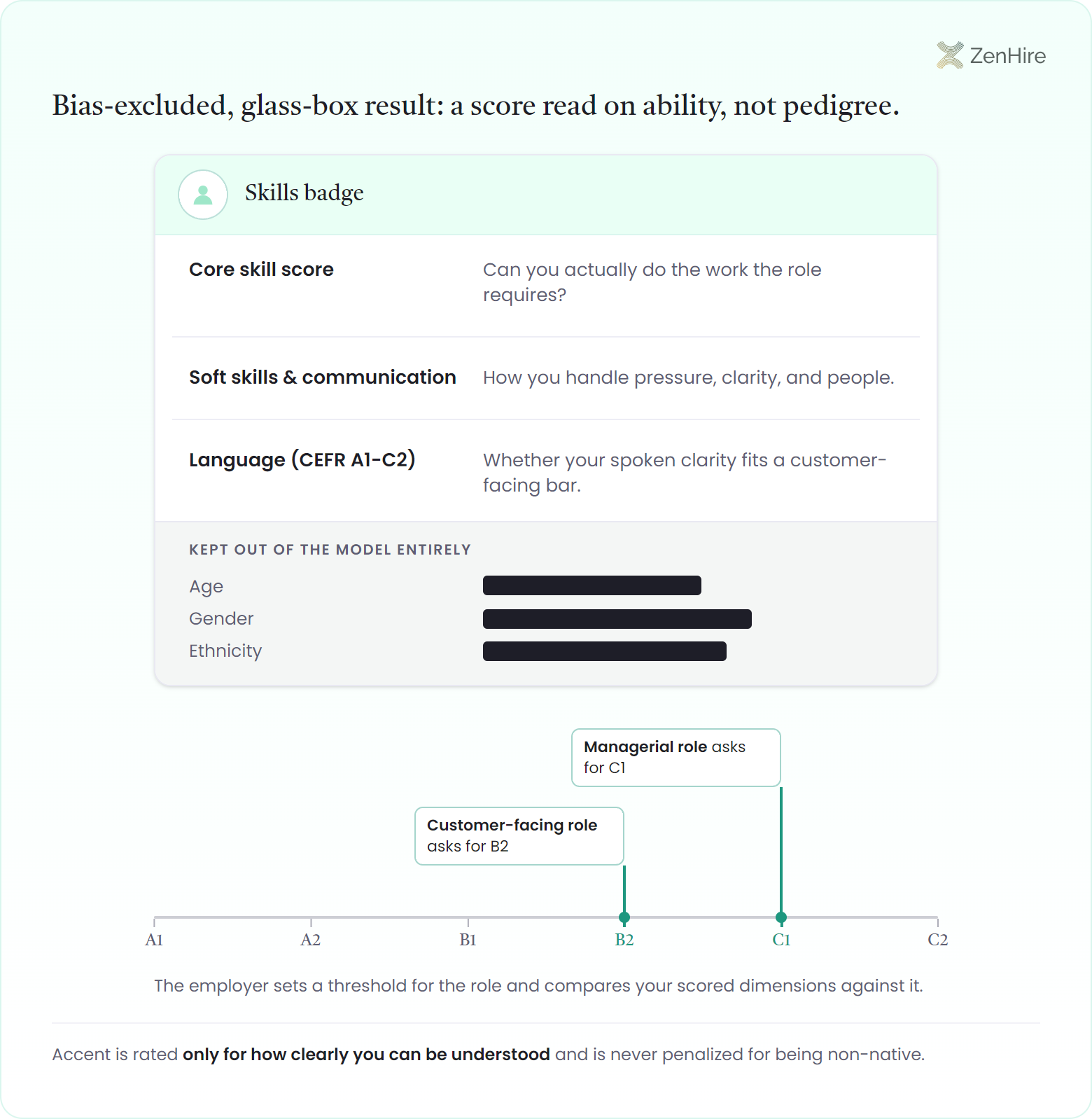
| What your badge reports | What the employer learns |
|---|---|
| Core skill score | Can you actually do the work the role requires? |
| Soft skills & communication | How you handle pressure, clarity, and people |
| Language, placed on the CEFR ladder | Whether your spoken clarity clears a customer-facing bar |
| Bias-excluded, glass-box result | A score read on ability, not pedigree, and one that can be explained |
How do you raise your skills badge for a role?
You raise your skills badge for a role by genuinely improving the underlying ability, then re-earning the badge: practicing the core skill, sharpening your communication and soft skills, and retaking the assessment once you have actually leveled up. There is no trick to it: because the scoring is structured and consistent, the reliable way to a higher score is to get better at the thing being measured.
Start by reading what each dimension of your badge is telling you. If language is your gap, deliberate spoken practice moves your CEFR level over weeks; if it is the core skill, a focused project or one of the free courses to get a job builds the ability the assessment looks for. If communication and composure are dragging you down, the work on your soft skills, namely clear structure, calm pacing, and listening before answering, is often the fastest win because so many roles weight it heavily. Then refresh your candidate profile and retake the evaluation so your badge reflects the new you.
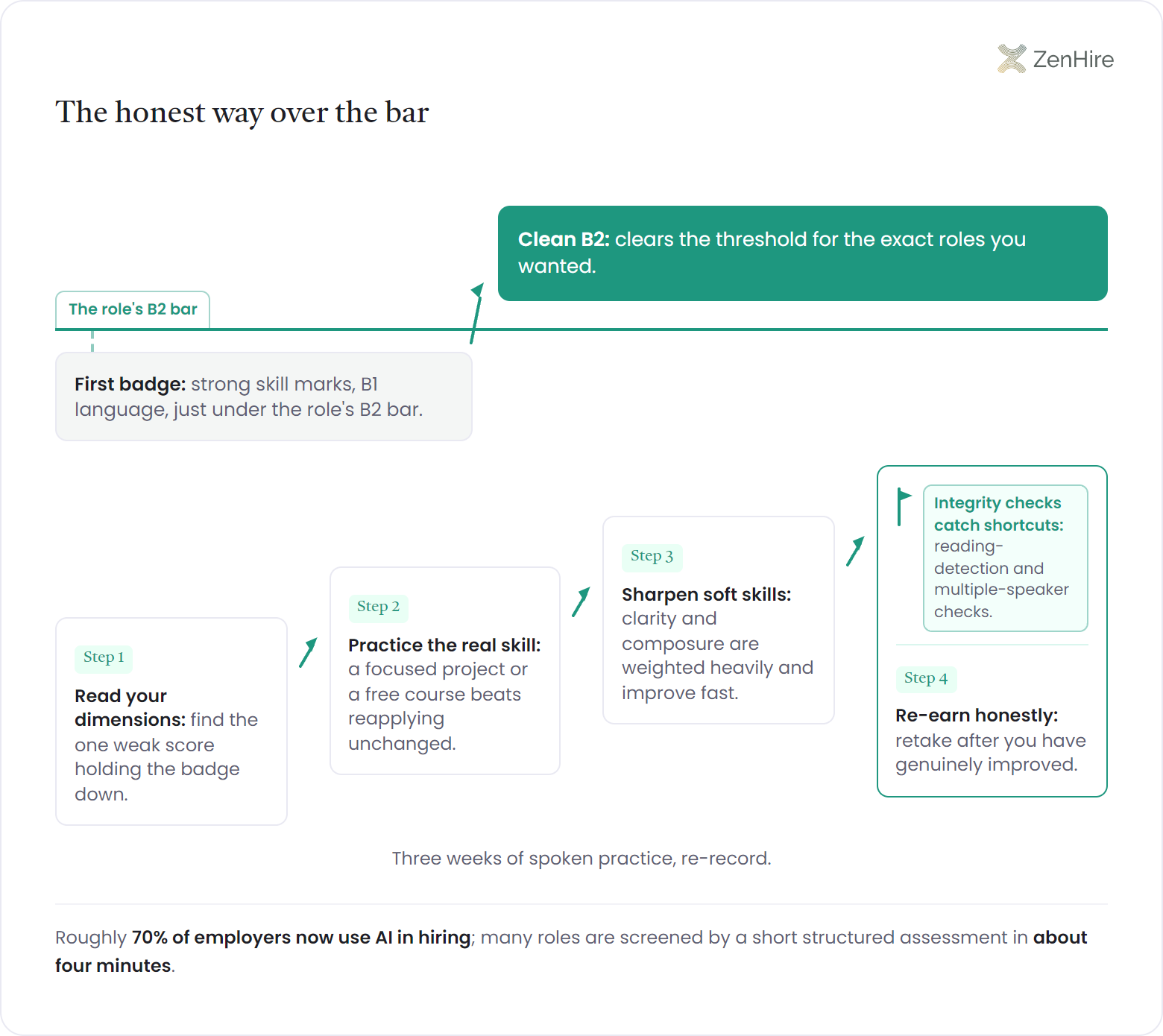
For example, say your first badge came back with strong skill marks but a B1 language score that fell just under a role's B2 bar. Rather than reapplying unchanged, you spend three weeks on spoken practice, re-record, and earn a clean B2, and now you clear the threshold for the exact roles you wanted. The edge case to respect: improvement has to be real. Memorizing a script or having someone else speak for you is detected by integrity checks like reading-detection and multiple-speaker checks, and it produces a brittle badge that collapses on the job. The honest path, real practice followed by a real retake, is also the only durable one.
A practical reason the effort pays off: about 70% of employers now put AI somewhere in their hiring, and a structured async screen often reaches a verdict in roughly four minutes. In that window there is no time to explain yourself; a strong, honestly earned badge does the proving on your behalf, and it is the quickest way through the first gate.
- Read your dimensions: find the one weak score that is holding the badge down
- Practice the real skill: a focused project or a free course beats reapplying unchanged
- Sharpen soft skills: clarity and composure are weighted heavily and improve fast
- Re-earn honestly: retake after you have genuinely improved; integrity checks catch shortcuts
I have watched brilliant people get filtered out before anyone heard a word they said, because a resume is a terrible measure of what someone can actually do; screened on its own, it lines up with real performance at a correlation of only about 0.14. That is not your failure, it is the tool's. So we built scoring that keeps your name, age, and background out of the model and measures the work instead: the skill, how you communicate, how clearly you can be understood. A skills badge is your evidence. If you can do the job, I want the system to see it in the four minutes an async screen takes, not lose you on a busy day because a keyword did not match.
Frequently asked questions
What is a skills badge for jobs?+
A skills badge for jobs is verified proof of what you can do, earned from a structured assessment that scores your real ability rather than a self-reported resume line. Because the same rubric is applied to every candidate, a verified skill badge carries more weight with employers than a keyword they cannot check.
How is a skills badge different from a certificate or a degree?+
A skills badge measures demonstrated ability, while a degree or certificate mostly signals that you completed a program. Both can help, but a badge is the closer match to job-ready certification because it scores the specific skill, soft skills, and language a role needs, which is why it predicts performance far better than a resume credential alone.
Will my accent or background affect my skills badge?+
Your accent is rated only for how clearly you can be understood and is never penalized for being non-native, and sensitive attributes like age, gender, and ethnicity are kept out of the scoring model entirely. The badge is built on bias-excluded, glass-box scoring, so you are measured on ability, not pedigree.
How do I raise my skills badge score?+
You raise your skills badge by genuinely improving the underlying ability and then re-earning it. Read which dimension is weakest, practice the real skill or sharpen your soft skills and language, refresh your profile, and retake the assessment; honest improvement is the only durable path, since integrity checks catch scripted or proxy answers.
Do employers actually trust skills badges?+
Employers increasingly trust verified skills badges because a resume is a weak predictor of performance: on its own, a screened CV correlates with job success at roughly 0.14, against the 0.45 to 0.6-plus a demonstrated, scored skill reaches. With about 70% of employers now leaning on AI to sort applicants, a strong verified badge is often the fastest way through that first screen.
Free for earning a verified skills badge
Earn a verified skills badge
Create a free candidate profile, take a short fair assessment, and turn your real ability into a verified badge employers trust, then get matched to roles where your skills clear the bar.