
What Free Courses Help You Get a Job?


· 8 min read
Free courses help you get a job when they build a verifiable, role-targeted skill: data and spreadsheets, customer support writing, entry coding, digital marketing, or CEFR-graded spoken English. Here is the leverage a free learner rarely hears: the certificate you finish with barely moves a hiring decision, because resume-level screening tracks performance at about 0.14 while a validated skills check climbs to 0.45-0.6 and beyond. So the skill you can demonstrate is worth far more than the badge on top of it. Pick courses by tallying the skills five to ten real job postings repeat, close your two or three biggest gaps, then prove each with a project, portfolio, or a roughly four-minute async skills check.
Which free courses actually help you get a job?
The free courses that actually help you get a job are the ones that build a job-ready, demonstrable skill, something you can show working, not just list. The value is in the capability you walk away with, because skills-based hiring rewards what you can do. A free spreadsheet-automation course you can prove beats a paid certificate in a subject the role never tests.
The mechanism is simple: most hiring now tries to measure ability, and a course only helps if it leaves you with ability you can put on display. Free courses in high-demand, testable areas (data and spreadsheets, customer support and communication, basic coding, digital marketing, project coordination, or spoken English) translate directly into screening signals. Pair the skill with a way to evidence it and you can get hired faster than a candidate who only collected logos.
Concrete example: two candidates apply for a customer-support role. One finished a paid generic certificate; the other did a free support-fundamentals course and a free communication module, then handled three mock tickets. In a skills-based screen, the second candidate scores higher because the evaluation measures clear writing and problem-solving, exactly what the free courses built.
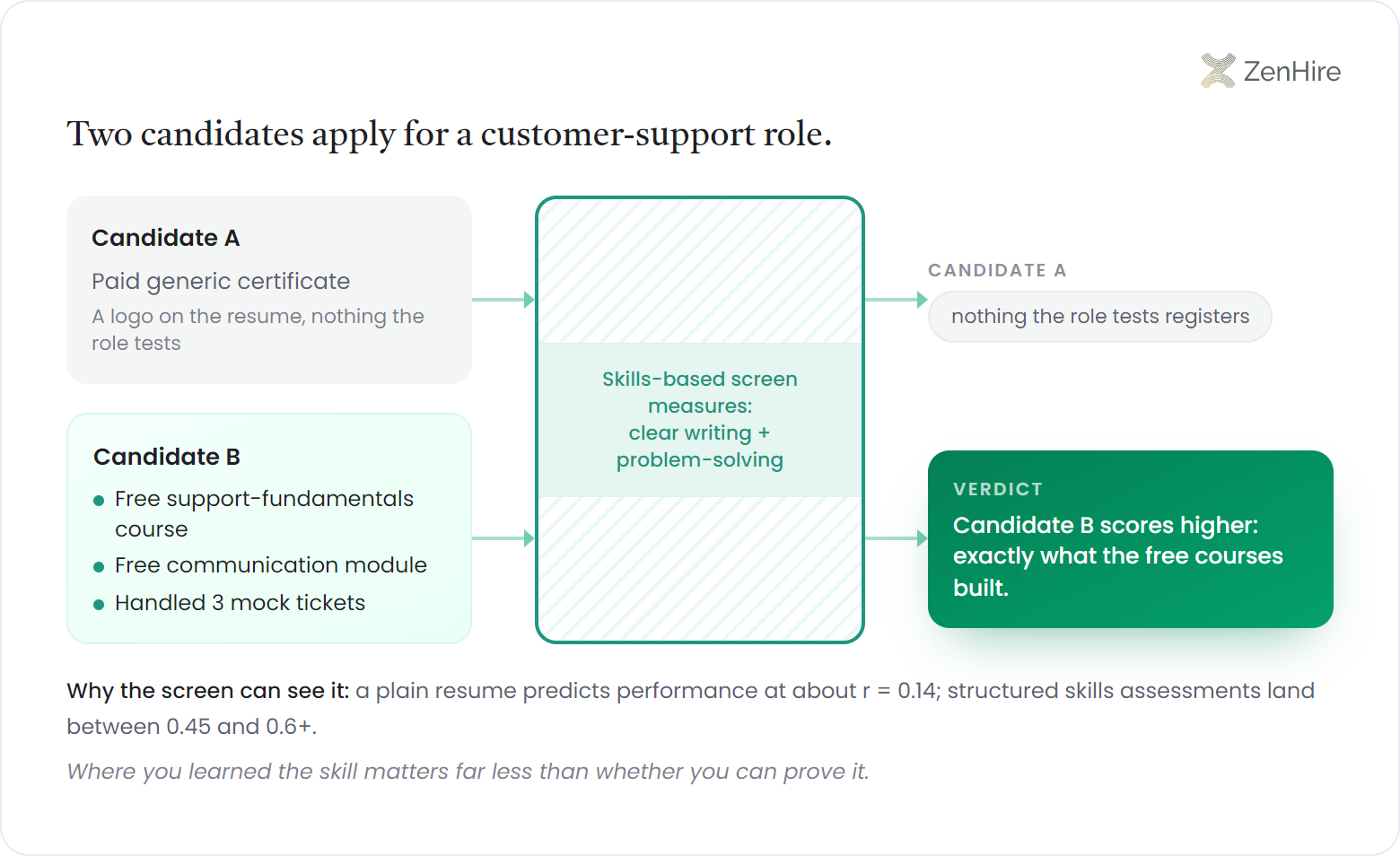
Why this matters for a free learner: the piece of the resume a paid course adds, the credential line, is exactly the piece that predicts job performance worst, at about 0.14. Screens that actually score what you can do reach 0.45 to 0.6+. So the free ability you can demonstrate outweighs the paid badge you cannot, and where you learned the skill matters far less than whether the screen can watch you use it.
- Data and spreadsheets: formulas, cleaning, basic analysis (directly testable in assessments)
- Communication and writing: clear, structured responses that screens reward
- Customer support fundamentals: ticket handling, tone, problem-solving
- Spoken English: CEFR-relevant fluency for global and customer-facing roles
- Entry coding or no-code: small projects you can show working
How do you pick free courses for your target role?
You pick free courses for your target role by working backward from real job postings, not forward from a course catalog: find the role you want, list the skills it repeatedly asks for, and close your biggest gaps first. The mechanism is reverse-engineering demand: the market tells you what to learn, and free courses become the cheapest way to get there. If you are unsure which roles fit, start with what jobs fit my skills and let your current strengths point you toward the smallest learning gap.
Read five to ten postings for the same role and tally the skills that show up again and again. Those repeated requirements are your shortlist. Then prioritize the two or three you are weakest on, because closing a real gap moves you across a screening threshold, while a fourth course in a skill you already have moves nothing. Free upskilling is most efficient when it is targeted, not broad.
Concrete example: you want a junior data role. Across ten postings, spreadsheets and basic SQL appear every time and a dashboard tool appears often. You already know spreadsheets, so you spend your free hours on a SQL course and a free dashboard tutorial, the exact two gaps between you and the shortlist, and nothing wasted on skills the role never asks for.
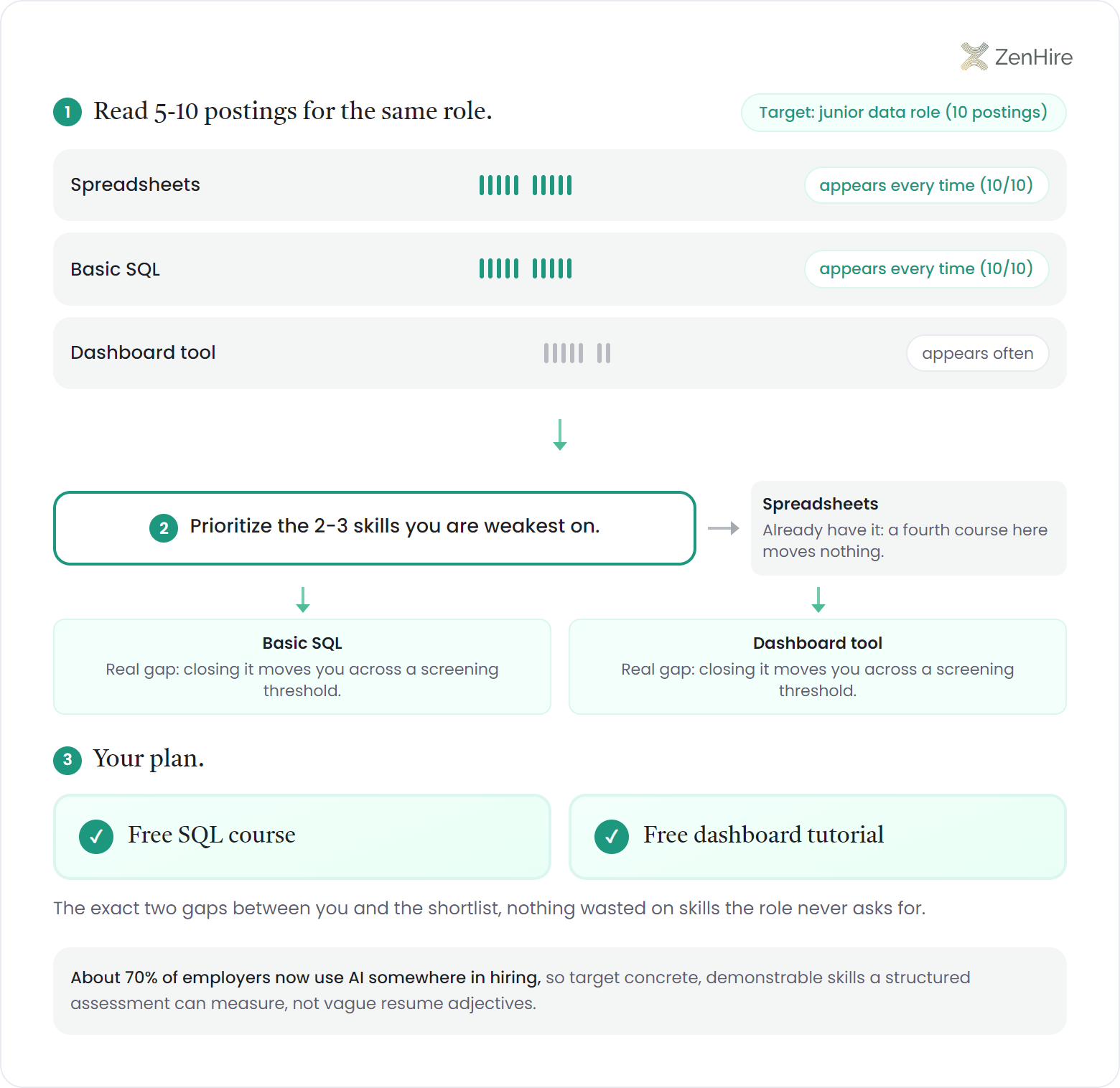
Edge case worth knowing: about 70% of employers now [use AI somewhere in hiring](/talent-acquisition/ai-for-talent-acquisition), and many first-round screens read your skills before a human ever does. That means the skills you target should be the ones a structured assessment can measure, meaning concrete, demonstrable abilities, not vague resume adjectives that an automated screen cannot score.
How do you prove what you learned from free courses?
You prove what you learned from free courses by turning the learning into evidence an employer can verify: a project, a portfolio, a verified skills score, or a strong showing in an assessment, not just a completion badge. The mechanism is substitution: when you can demonstrate the skill, the credential stops mattering, because the proof itself is what the employer was trying to infer from the credential in the first place.
Build a small artifact for every course that counts: a cleaned dataset, a short written sample, a working mini-project, a recorded mock interview. Then put yourself in front of a measurement that scores ability directly. A verified skills badge or a candidate skill score gives an employer a number they trust, and a fair screen that excludes pedigree means your self-taught skill is read on the same scale as a degree-holder's. You can also fold the proof into your candidate profile so it travels with every application.
Concrete example: after a free English course, you record a four-minute spoken answer in an AI interview. A CEFR-aligned assessment scores you at B2 for a customer-facing role, and because accent is rated for clarity only and never penalized for being non-native, a non-native speaker who learned for free gets a fair, defensible result instead of a recruiter's gut call.
| Way to prove it | What an employer can verify |
|---|---|
| Finished project or portfolio | You can actually do the work, not just describe it |
| Verified skills score / badge | An objective, comparable number across candidates |
| Short async skills check | Your free-course skill performed live in about 4 minutes, scored the same for every applicant |
| CEFR language result | Where your self-taught English lands on the A1-C2 scale, with accent judged only for clarity |
I have watched brilliant people get filtered out before a human ever read their name, because a resume scan could not see what they could do. If you taught yourself with free courses, that is not a weakness to hide; it is exactly the kind of capability a fair, skills-based screen is built to surface. We keep sensitive attributes and pedigree out of the scoring on purpose, so the question becomes can you do the work, not where did you learn it. Bring the proof. The screen is on your side.
Frequently asked questions
Do free courses actually help you get a job?+
Free courses help you get a job when they build a skill an employer can verify, not just a logo on your resume. The resume line a paid credential buys you predicts performance at only about 0.14, while a screen that scores actual ability reaches 0.45-0.6+, so a free skill you can demonstrate can outweigh a pricier badge you cannot.
Are free courses with certificates worth it?+
Free courses with certificates are worth it mainly for the skill, not the certificate. The badge is a weak signal on its own; pair it with a project, portfolio, or verified skills score and the proof does the persuading. A certificate plus demonstrable ability beats a certificate alone.
How do I pick the right free course for my target role?+
Pick free courses by reverse-engineering real job postings for your target role. Read five to ten listings, tally the skills they repeat, and close your two or three biggest gaps first. Targeted upskilling moves you across a screening threshold; a fourth course in a skill you already have does not.
Will I be at a disadvantage as a self-taught candidate?+
A fair, skills-based screen reduces the self-taught disadvantage. When evaluation excludes sensitive attributes and pedigree and scores ability directly, your free-course skills are read on the same scale as a degree-holder's. The deciding question becomes whether you can do the work.
How do I prove a skill I learned for free?+
Prove a free-learned skill by turning it into verifiable evidence: a finished project, a portfolio, a verified skills badge, or a strong showing in a live check. A common first round is an async skills check of about four minutes, and four minutes of proven performance says more than a long list of course titles you merely finished.
Free for free courses to get a job
The free-course-to-hired roadmap
A one-page plan for turning free courses into offers: how to reverse-engineer the skills a role wants, the two or three gaps to close first, and how to prove each one with verifiable evidence.