
How Do You Improve Diversity in Hiring?


· 8 min read
You improve diversity in hiring by widening the top of the funnel and evaluating every candidate against one structured, consistent standard, so a broader pipeline actually changes who gets hired. The catch is that the loosest screens leak the most diversity: an unstructured interview tracks real performance at just r = 0.18, a structured one at 0.28, and validated methods combined clear 0.6, so tightening the screen makes it both fairer and sharper at once. ZenHire's audio-only read scores on demographically neutral features with accent and gender-correlated signals removed, and it agrees with a panel of PhD linguists 90-96% of the time against 68-75% for untrained recruiters.
What are effective diversity hiring strategies?
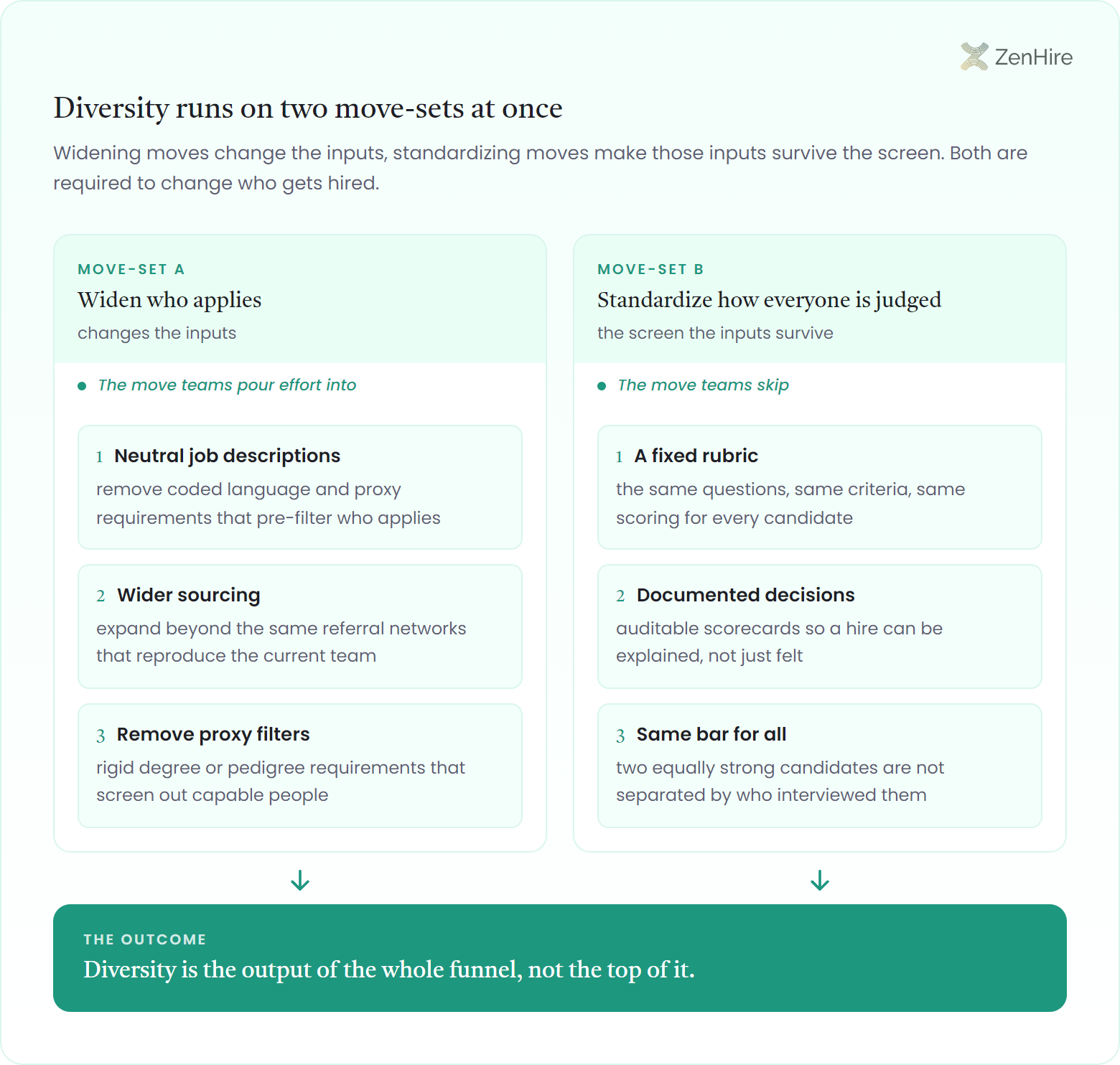
Effective diversity hiring strategies widen who applies and then standardize how everyone is judged. The first half changes the inputs, the second half makes sure those inputs survive the screen. Sourcing alone is the common mistake: teams pour effort into a broader pipeline, then funnel it through an inconsistent, gut-feel evaluation that filters the new candidates right back out. Diversity is the output of the whole funnel, not the top of it.
The widening moves are well understood: scrub job descriptions of coded or exclusionary language, expand sourcing channels beyond the same few referral networks, and remove proxy filters (rigid degree or pedigree requirements) that screen out capable people for reasons unrelated to the work. The standardizing moves are the ones teams skip: a fixed rubric, the same questions for every candidate, and a documented score, so two equally strong candidates are not separated by who interviewed them on which day. In-house teams running talent acquisition at scale feel this most, where a hundred reqs invite a hundred slightly different bars.
An edge case worth naming: representation at the top of the funnel without consistency below it can look like progress while changing nothing. If a broader slate consistently stalls at the same screening stage, the problem is the screen, not the sourcing, and you would not see it without funnel data broken down by group. Fixing the rubric there does more for diversity than another sourcing campaign.
The method, not the sourcing budget, decides who survives the screen: a resume scan tracks on-the-job performance at roughly r = 0.14 and an unstructured interview at ~0.18, so most of the call is left to a subjective read that quietly favors the familiar. A structured interview climbs to ~0.28, and layering validated methods together carries the signal past 0.6 — a screen that is harder to bias precisely because it is more accurate.
- Neutral job descriptions: remove coded language and proxy requirements that pre-filter who applies
- Wider sourcing: expand beyond the same referral networks that reproduce the current team
- A fixed rubric: the same questions, same criteria, same scoring for every candidate
- Documented decisions: auditable scorecards so a hire can be explained, not just felt
How does structured, AI-assisted screening support diversity hiring?
A [structured interview](/interview/structured-interview) applied consistently by AI-assisted screening supports diversity hiring by holding every candidate to one evidence-based standard and excluding the signals that carry bias: the same questions, the same scoring, the same evidence, whether a person applied first or last in a stack of thousands. Consistency is the mechanism: when every candidate clears an identical bar, a strong communicator is not lost because a tired reviewer reached them at the end of a long day, and a non-traditional background is judged on demonstrated ability rather than on how unfamiliar it reads.
The design choices matter as much as the consistency. ZenHire's evaluation is audio-only and uses engineered, demographically neutral features (filler-word rate, grammatical patterns, words-per-minute, vocabulary range, non-fluent moments) while deliberately excluding facial cues, gender-correlated pitch, and accent patterns that penalize regional English. Placing communication on a CEFR A1-C2 scale is what lets the read grade how clearly someone speaks without leaking who they are. The same evidence is captured at any volume, so a fair process does not break the moment hiring scales. You can see how the bias-reduction approach is built in rather than retrofitted, and how the AI interview produces an explainable scorecard per role.
A concrete example: a candidate with a heavy regional accent and an unconventional resume often loses points in a human phone screen for reasons that have nothing to do with the job. An audio-only model that grades spoken English on the CEFR scale evaluates whether the person communicates clearly, not whether they sound like the last good hire. The edge case to manage is automation bias: treating the score as the verdict. The honest model is AI measures, a human decides, and every score stays auditable so the human can interrogate it. A glass-box system makes that possible; a black-box one does not.
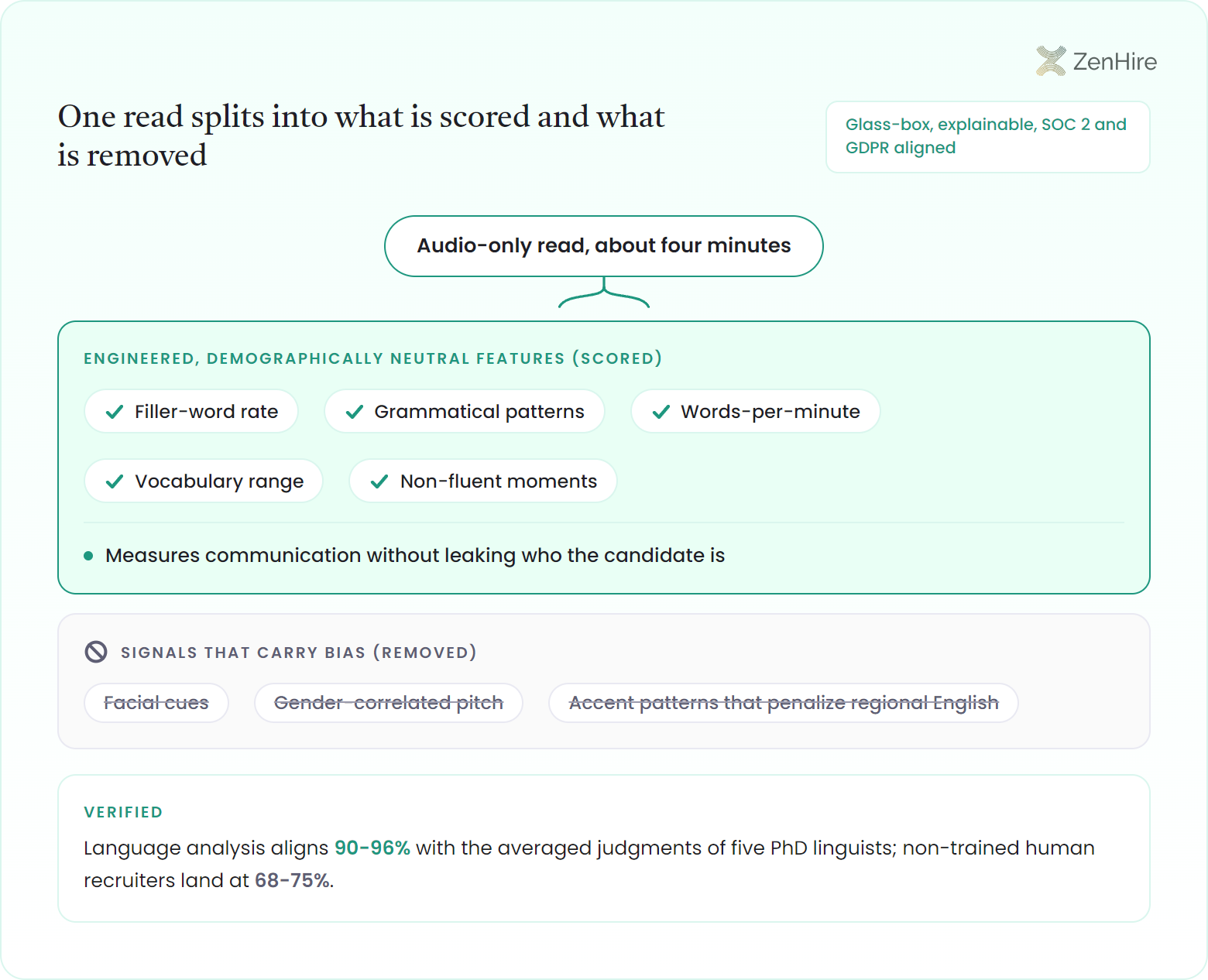
You can check the consistency for yourself: ZenHire's language read matches the averaged verdict of five PhD linguists 90-96% of the time, where untrained human recruiters only agree 68-75% of the time. The whole assessment is audio-only and takes about four minutes, scored on neutral features with accent and gender-correlated signals removed. It is glass-box and explainable, SOC 2 and GDPR aligned, so any scored decision can be pulled up and reviewed.
How do you measure diversity hiring progress?
You measure diversity hiring progress with stage-by-stage pass-through rates, segmented by source and group, not with a single headline number: one aggregate figure hides the exact step where the funnel narrows. Representation at the offer stage is the lagging outcome; the leading signal is where candidates drop out. If a group enters the pipeline in proportion but stalls at one screening step, that step is your problem, and only segmented funnel data will show it.
Track conversion at each stage as part of your talent acquisition metrics and watch for the gap between groups, not just the totals. Pair the diversity view with quality-of-hire so a broader slate is read against performance, proving fairness and accuracy moved together rather than trading off. An edge case to avoid: optimizing the top of the funnel while a mid-funnel screen keeps narrowing it: the application mix improves, the hire mix does not, and the headline number stays flat while the real bottleneck goes untouched.
| Metric | What it tells you |
|---|---|
| Application-stage representation | Whether sourcing is widening the top of the funnel |
| Stage-by-stage pass-through | Where the funnel narrows: the exact step that filters the slate |
| Screen-to-interview rate by group | Whether the rubric, not the resume, is deciding |
| Offer mix vs. applicant mix | If a wider pipeline is changing who gets hired |
| Quality of hire across the slate | That fairness and performance moved together, not apart |
When people hear AI plus hiring, they brace for more bias, not less. I understand the fear, but it inverts where the bias actually lives. The least transparent part of most hiring is the human screen no one writes down: the gut call on a phone interview, the resume that just felt off. You cannot audit a feeling. What we built measures communication on neutral, engineered features, audio-only, with accent and gender-correlated signals stripped out, and it writes down why it scored what it scored. For an in-house TA team, that is the point: not to take the decision away from your people, but to give them a consistent, explainable baseline so the wider pipeline they worked to build actually changes who gets the offer. AI measures, your team decides, and every score can be challenged.
Frequently asked questions
How do you improve diversity in hiring?+
You improve diversity in hiring by widening the top of the funnel and then evaluating everyone in it consistently. Neutral job descriptions and broader sourcing get more candidates in; a fixed rubric and documented scoring make sure those candidates are judged on ability rather than filtered out by gut feel. A diverse pipeline only changes the hire if the screen below it is consistent.
Does AI in hiring increase or reduce bias?+
Structured, explainable AI can reduce bias compared with informal human screening, because the real risk is opacity, not automation. An undocumented phone screen hides more bias than a transparent, audited system. ZenHire excludes facial cues, gender-correlated pitch, and accent patterns, scores on neutral features, and keeps every decision auditable, the opposite of a black-box tool.
What is the most common diversity hiring mistake?+
The most common mistake is fixing sourcing while leaving the screen inconsistent. Teams widen the pipeline, then funnel it through gut-feel evaluation that filters the new candidates right back out. The application mix improves and the hire mix does not. Segmented funnel data reveals the stage where the slate actually narrows.
How is diversity hiring different from quotas?+
Diversity hiring removes noise so ability decides; it does not lower the bar. A quota changes the target, whereas structure changes the instrument: combined validated methods exceed 0.6 against ~0.18 for an unstructured interview, so the fairer screen and the more accurate one turn out to be the same screen. The aim is a wider, more consistent evaluation, checked against quality of hire.
How do you measure diversity hiring progress?+
You measure progress with stage-by-stage pass-through rates segmented by source and group, not one headline number. Representation at the offer stage is the lagging outcome; the leading signal is where candidates drop out. Pair it with quality of hire so a broader slate is read against performance and you can prove fairness and accuracy moved together.
Free for improving diversity in hiring
The diversity hiring funnel audit
A one-page worksheet for finding where your funnel narrows: the stage-by-stage pass-through rates to segment, the rubric checks that catch inconsistent screening, and the signals to exclude so fit decides instead of familiarity.