
How Do You Get Hired Faster?


· 9 min read
You get hired faster by proving your skills early: clear the AI screen that gates most roles with sharp, example-led answers, then reuse one verified skill profile across every application instead of restarting each time. The speed comes from evidence employers can trust on sight: a resume tells a hiring team almost nothing about your work, tracking job performance at just r = 0.14, whereas a structured skills assessment lands in the 0.45-0.6+ range, so a verified score gets acted on in days rather than sitting in a queue. With roughly 70% of employers now leaning on AI somewhere in hiring, plenty of roles open with a short async interview, about four minutes long, that grades how you communicate, how you reason, and, on the CEFR A1-C2 scale, how clearly you speak.
What slows you down from getting hired faster?
What slows you down from getting hired faster is rarely your ability; it is the resume keyword filter and the queue in front of a fair look. Most applications are screened by software before a human ever sees them, and that software scores you on whether your wording matches a job description, not on whether you can do the work. If your phrasing is off, you stall, even when you are qualified.
The math is unkind to good candidates here. Weigh what a resume actually tells an employer about your future work: almost nothing, with predictive validity of about r = 0.14, a hair above a coin toss, so a screen built on resume keywords throws out capable people and keeps confident writers. If you changed careers, skipped a brand-name school, or describe your work in plain language instead of buzzwords, a keyword filter reads that as a gap. The fix is not gaming keywords forever; it is getting to a stage where you can show the skill itself. To speed up your job search, aim your effort at proof, not at more copies of the same resume.
There is an edge case worth naming: applying to everything actually slows you down. Fifty rushed applications to roles that do not fit produce fifty filter rejections and zero signal about where you truly match. A smaller set of well-fit roles, where you can show evidence, moves faster. See what jobs fit my skills for how to narrow the target before you apply.
Line up what a resume can tell a hiring team against reality and the gap is stark: it tracks on-the-job performance at only about r = 0.14, near a coin flip. That is why a strong, capable candidate can be rejected by a keyword filter that never measured their actual ability: the screen was reading words, not skill.
- Keyword filters: software rejects you on phrasing, not on whether you can do the job
- Spray-and-pray applications: fifty rushed applies create fifty rejections and no signal
- Non-traditional background: a career switch or a no-name school reads as a gap to a resume scan
- The human queue: even strong resumes wait in a pile a recruiter may never reach
How do you stand out in AI screening to get hired faster?
You stand out in AI screening to get hired faster by treating it as your fastest fair shot, not a hurdle, and by answering the way it actually scores. AI now sits somewhere in the hiring flow at roughly 70% of employers, and for many roles the first gate is a short async interview you can finish in about four minutes. Speed is the point: there is no calendar to coordinate, no recruiter to catch on a good day, and the same rubric applies to everyone whether you are candidate three or candidate forty.
Here is the mechanism. A fair AI interview grades concrete things: how clearly you get a point across, how you reason through a problem, and, for many roles, how well you handle the working language, placed on the CEFR scale that runs from A1 up to C2. On a well-built system, your accent counts only toward how clearly you come through and is never marked down for being non-native, and sensitive attributes stay out of the score entirely. So you stand out by being clear and specific: structure your answer, give a real example, and speak at a steady pace rather than rushing. A short, concrete story about something you actually did beats a polished but vague claim every time. Strengthening your soft skills directly raises the signals these interviews measure.
A concrete example: two candidates apply for a support role. One says, "I am a great communicator and a fast learner." The other says, "When a customer was angry about a double charge, I confirmed the error, refunded it in one call, and followed up by email so they had it in writing." The second answer scores higher on communication and problem-solving because it shows the skill instead of asserting it, and it does so in the same four minutes. The edge case: if your connection or device is weak, look for the AI interview audio-only option, which many platforms offer specifically so a slow connection never decides your score.
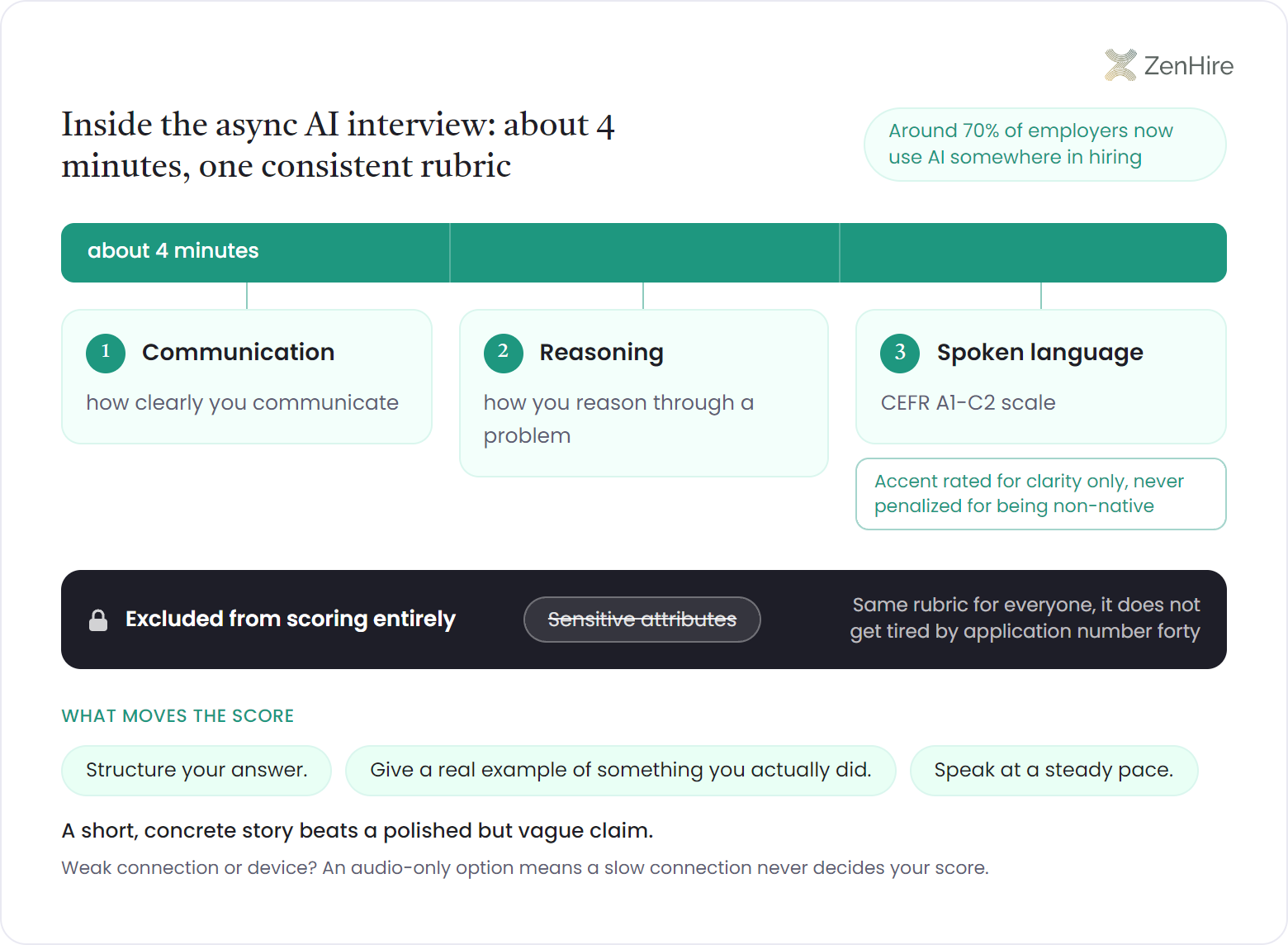
The first gate for many roles is an async interview you wrap up in roughly 4 minutes, and a fair one places your spoken command of the working language somewhere between A1 and C2 on the CEFR scale, counting your accent only toward clarity and never against you for being non-native. What moves the score is a specific, example-led answer, not a polished claim.
How does a verified skill profile help you get hired faster?
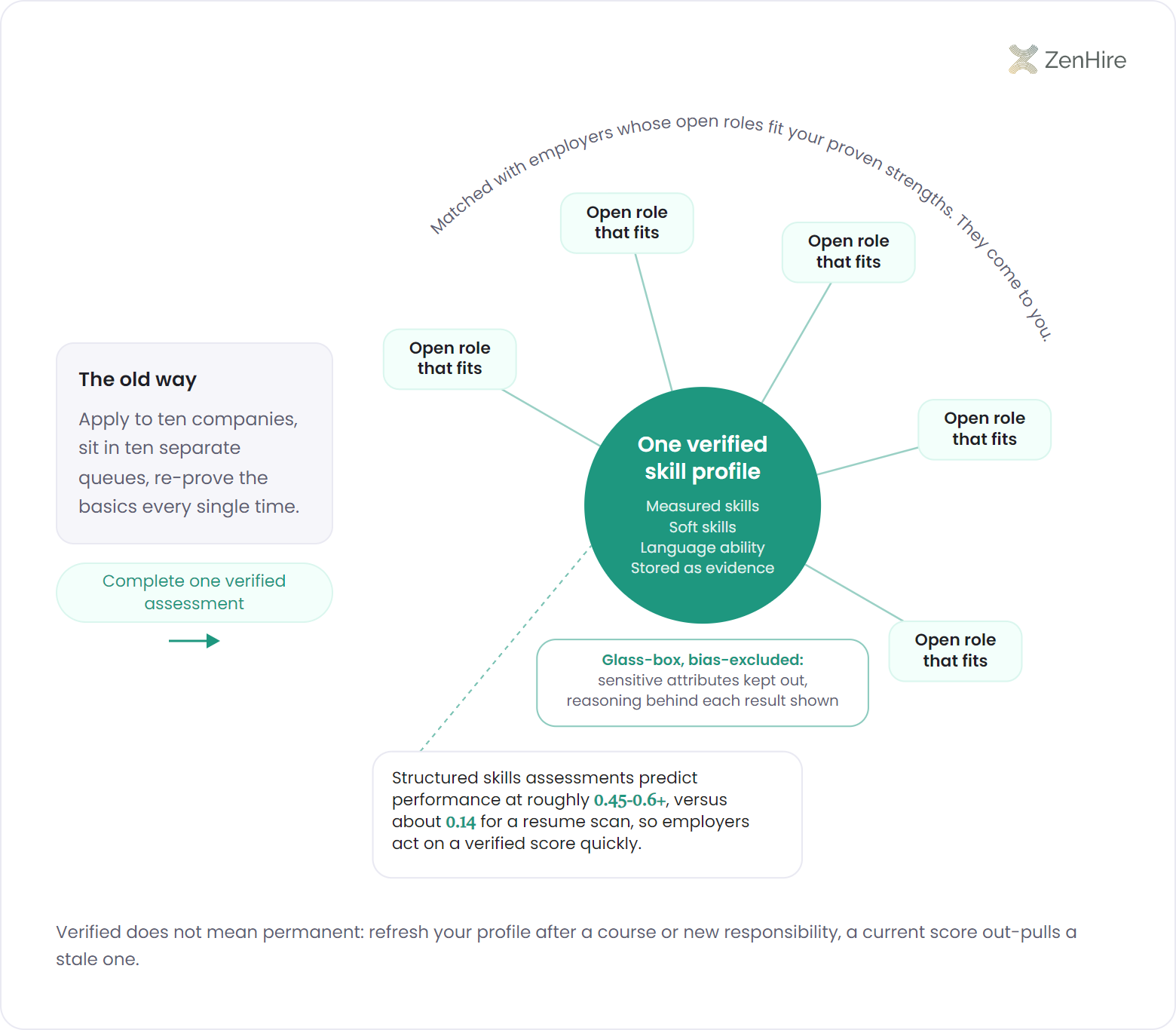
A verified skill profile helps you get hired faster by letting you prove yourself once and get reused for many roles, instead of restarting from zero with every application. When your skills, soft skills, and language ability are measured and stored as evidence, employers can match you to openings without making you re-pass the same screen. The slow part of job hunting, re-proving the basics every single time, gets collapsed into a single verified record.
The mechanism is the difference between asserting and verifying. A structured, skills-based assessment carries real signal about future performance, landing around 0.45-0.6+ where a resume scan tops out near 0.14, a gap of several multiples, which is exactly why a hiring team trusts a verified score enough to move on it in days. A glass-box, bias-excluded evaluation keeps sensitive attributes out and shows the reasoning behind each result, so the score is something a hiring team can defend and move on from, fast. Build your candidate profile around verified evidence and pair it with a skills badge so the proof travels with you.
A concrete example: instead of applying to ten companies and sitting in ten separate queues, you complete one verified assessment and get matched with employers whose open roles fit your proven strengths, and they come to you. The edge case worth knowing: verified does not mean permanent. Skills grow, so refresh your profile after you finish a course or take on new responsibility; a current score reflecting today's ability will always out-pull a stale one.
| What you lead with | How much it actually says about your work |
|---|---|
| A resume read for keyword match | ~0.14 signal, a shade above guessing |
| A structured skills assessment | 0.45-0.6+, multiples stronger and worth acting on |
| One verified profile, reused across roles | Prove it once, get surfaced for many openings |
| Bias-excluded, glass-box scoring | Sensitive attributes kept out; the reasoning is explainable |
I have sat on the hiring side and watched genuinely strong people get filtered out before anyone heard a word from them: wrong keywords, no-name school, a career switch a resume scan read as a gap. That always felt backwards to me. So we built ZenHire to judge what you can actually do: your skills, how you communicate, your real ability, with the things that should never matter, like where you are from or how your name sounds, kept out of the score entirely. If you are good at the work, you deserve a fast, fair shot at proving it. That is the whole point.
Frequently asked questions
What is the single fastest way to get hired faster?+
The single fastest way to get hired faster is to prove a skill early instead of leaning on resume keywords. A resume says almost nothing about your future work, tracking it at only about r = 0.14, so capable people get filtered out by software scanning for phrasing. Show real ability through a skills assessment or a clear, example-led interview answer and you move forward at exactly the point a keyword scan would have stalled you.
Does applying to more jobs help me get hired quickly?+
Applying to more jobs rarely helps you get hired quickly; it usually slows you down. Fifty rushed applications to roles that do not fit produce fifty filter rejections and no real signal. A smaller set of well-matched roles where you can show evidence moves faster, which is why narrowing to jobs that fit your skills beats spraying applications.
How do I stand out in an AI interview?+
You stand out in an AI interview by being clear, specific, and example-led. The whole thing often runs about four minutes and grades communication and problem-solving through interview analysis on one consistent rubric, so a concrete story about something you actually did beats a vague claim. Keep an even pace; a fair system reads your spoken clarity onto the CEFR scale and never penalizes a non-native accent.
Will AI screening be unfair to me because of my background?+
A well-built AI screen is designed to be fairer to your background, not harsher. Glass-box, bias-excluded scoring keeps sensitive attributes out of the result and judges what you can do, which gives a non-traditional candidate a fairer shot than a resume scan that reads a career switch or a no-name school as a gap.
What is a verified skill profile and why does it speed things up?+
A verified skill profile is a trusted record of your measured skills that you prove once and reuse across many roles. Because a structured assessment carries real signal (0.45-0.6+, against 0.14 for a resume), a hiring team acts on your verified score fast, and you skip re-proving the basics at the front of every separate application queue.
Free for getting hired faster
Get a fair, fast shot: build your candidate profile
Create a verified profile that scores you on real skills and soft skills, not pedigree, then gets you surfaced to employers with roles that fit. Prove it once, get matched many times.