
How Do You Improve Your Soft Skills as a Candidate?


· 8 min read
You improve your soft skills by rehearsing short, structured spoken answers out loud, recording yourself, and tightening each one with the STAR method (Situation, Task, Action, Result). Soft skills are the part of you a resume cannot carry, and it shows in the numbers: a CV on its own tracks real performance at only about r = 0.14, whereas a structured, skills-based screen reaches the 0.45-0.6+ band because it actually watches you communicate. With roughly 70% of employers now using AI somewhere in hiring, that screen is often a four-minute async interview where your spoken clarity is graded on the CEFR A1-C2 scale for how easily you are understood, accent and all left out of the verdict.
Which soft skills do employers test in interviews?
The soft skills employers test in interviews are communication, problem-solving, reliability, teamwork, and adaptability, the human abilities a resume cannot prove and a degree does not guarantee. When you understand which ones get measured, you can practice the right things instead of guessing.
Communication sits at the top of almost every scorecard because nearly every role depends on it: explaining a decision, calming a frustrated customer, or asking a clear question when you are stuck. The good news is that these are the most coachable soft skills for jobs. With roughly 70% of employers now using AI somewhere in hiring, your spoken answers are increasingly evaluated for structure and clarity, so a candidate who has practiced explaining their thinking has a real, measurable edge. If you are still mapping where your strengths fit, see what jobs fit my skills before you over-prepare for the wrong role.
Why this matters for you: a resume can list "great communicator," but it predicts real performance at only about r = 0.14 - it never hears you say a word. Screens that actually watch those soft skills in action climb to the 0.45-0.6+ range, and that gap is your opening: demonstrate communication and problem-solving live, and the strong candidate a keyword filter would have skipped finally gets a fair look.
- Communication: speaking and writing clearly, listening, and adjusting your message to the listener
- Problem-solving: breaking a messy situation into steps and explaining your reasoning out loud
- Reliability: following through, owning mistakes, and being consistent under pressure
- Teamwork: handling disagreement, sharing credit, and supporting a shared goal
- Adaptability: staying useful when the plan changes or the question is unexpected
How do you practice soft skills for an AI interview?
You practice soft skills for an AI interview by rehearsing short, structured spoken answers out loud, on camera or audio, until clear delivery becomes a habit, because the format rewards a calm, organized response more than a perfect script. The mechanism is simple: you are training the same muscle the assessment measures, so practice in the format you will be scored in.
The most reliable method is the STAR pattern (Situation, Task, Action, Result): name the situation, the task you owned, the action you took, and the result you got. Record yourself answering a few common prompts, then play it back and listen for filler words, rushing, or burying the point. As a concrete example, instead of saying "I'm a hard worker," you say "When two agents called in sick, I covered both queues and kept our response time under our target for the shift," a specific result an evaluator can actually score. To rehearse the real thing, run through a practice AI interview and treat it as a dress rehearsal, not a test.
Edge case worth planning for: some screens are audio-only or low-bandwidth, which is great if your camera or connection is unreliable, but it means your voice carries the entire impression. If you know the format is audio-only, practice slowing down and enunciating, because clarity is doing all the work. And if you freeze on a question, say so briefly and think out loud; a structured "let me think through this" reads far better than a long, anxious silence.
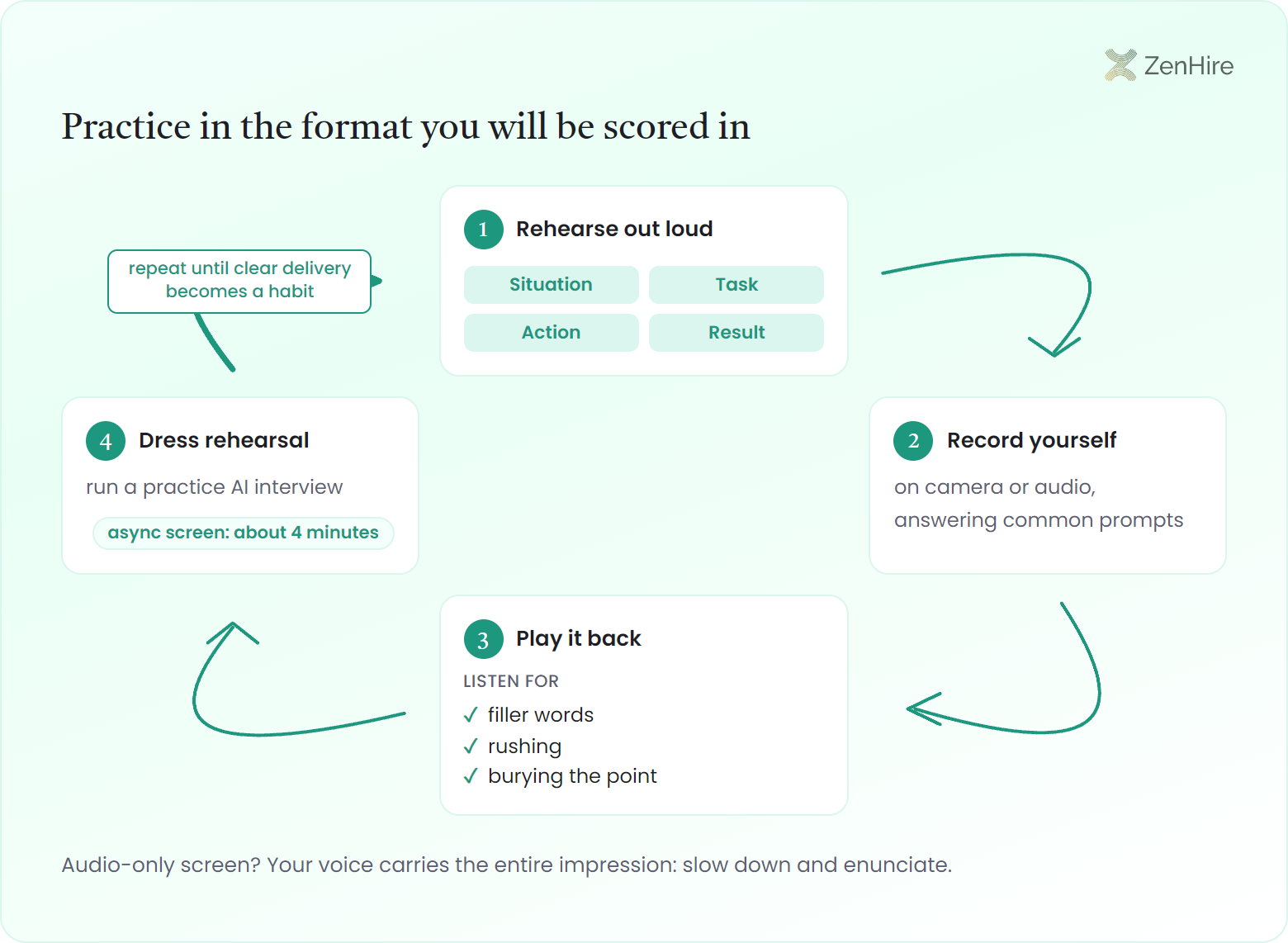
A useful reality check: the async AI interview that showcases these soft skills runs about 4 minutes, which is far too short to hide behind a rambling answer - the structure you bring beats the words you pile on. Build communication skills by rehearsing one clear, specific story per common question; a tight, concrete answer consistently outscores a long, vague one.
How are your soft skills measured in an AI interview?
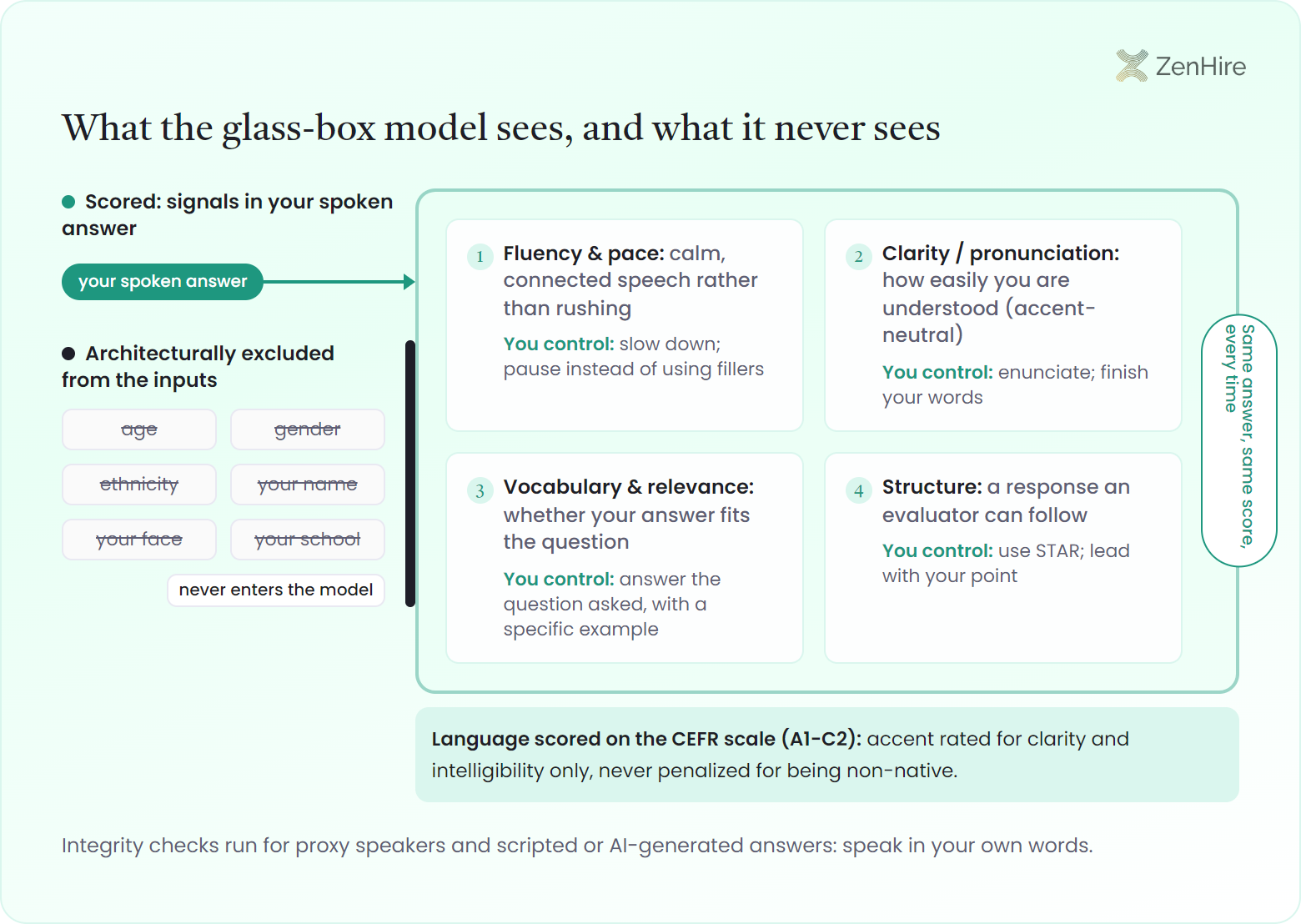
Your soft skills are measured in an AI interview by scoring concrete signals in your spoken answers: fluency, vocabulary, clarity, and how well your response actually addresses the question, not by judging your face, name, or background. The mechanism is a glass-box, feature-engineered model that works only from the content and delivery of what you said, so the same answer earns the same score every time.
Language is scored against the CEFR scale (A1-C2), and one detail matters enormously for fairness: accent is rated for clarity and intelligibility only, never penalized for being non-native. A candidate from any region who speaks clearly is scored on that clarity, full stop. Because sensitive attributes like age, gender, and ethnicity are architecturally excluded from the inputs, the evaluation is built to keep your background out of the result and put your demonstrated soft skills for jobs front and center. You can see how the structure works in a structured interview, where every candidate answers the same questions and is scored the same way.
As a concrete example, if you give a clear, on-topic answer with specific detail, you score well on communication regardless of whether you went to a famous school; the model never sees that. Edge case to know: these systems also run integrity checks (for proxy speakers or scripted/AI-generated answers), so the honest move is also the safe one. Speak in your own words; reading a canned script can flag as scripted and helps no one, least of all you.
| What gets scored | What it actually measures | What you control |
|---|---|---|
| Fluency & pace | Calm, connected speech rather than rushing | Slow down; pause instead of using fillers |
| Clarity / pronunciation | How easily you are understood (accent-neutral) | Enunciate; finish your words |
| Vocabulary & relevance | Whether your answer fits the question | Answer the question asked, with a specific example |
| Structure | A response an evaluator can follow | Use STAR; lead with your point |
I have watched brilliant people get filtered out before anyone heard them speak, because a resume never captured how they actually think or communicate. That is the problem I wanted to fix for you. When we score your interview, the model only sees the words you said and how clearly you said them, not your name, not your school, not your accent. We rate clarity, never penalize a non-native voice, and we keep sensitive attributes out of the math entirely. A resume can claim you have great soft skills, but it only guesses at your performance - about r = 0.14 - because it never hears you; a fair, skills-based screen actually listens. If you are a capable candidate who has been overlooked, this is your fairer, faster shot. Go practice, then go show us what you can do.
Frequently asked questions
Can you really improve soft skills, or are you just born with them?+
You can absolutely improve your soft skills: they are learned, not fixed. Communication, structure, and staying calm under pressure all get better with deliberate practice, especially speaking your answers out loud and reviewing the recording. Treat them like any skill: rehearse, get feedback, repeat.
How do I build communication skills before an interview?+
You build communication skills by practicing short, structured answers out loud using the STAR method (Situation, Task, Action, Result). Record a few common questions, listen back for fillers and rushing, and tighten each answer to one specific story with a concrete result. A practice run in the real interview format helps most.
Will an AI interview judge my accent?+
No. A fair AI interview asks one thing of your speech - can it be followed - and a non-native accent never counts against you. Since communication is a soft skill about being understood, the CEFR (A1-C2) scale grades exactly that: a clear speaker from any region is scored on how well their point lands, not on where they learned to say it.
Do soft skills matter more than my resume?+
For predicting how you will actually perform, the soft skills you can demonstrate matter far more than a resume. A CV alone tracks job performance at only about r = 0.14, while a structured screen that watches you communicate and problem-solve reaches 0.45-0.6+. Show those skills live and they roll up into your candidate skill score, the fair chance a keyword filter would have denied you.
How long does a soft-skills AI interview take?+
Plan for about 4 minutes - that is how long the async AI interview most roles use to surface your soft skills usually runs. In that little time structure is everything: lead with your point, give one specific example, and finish cleanly. Rehearsing a few crisp, concrete answers is the best use of your prep.
Free for improving soft skills as a candidate
Your soft-skills interview prep kit
A free, candidate-friendly kit: the STAR answer template, the soft skills employers score most, and a checklist for sounding clear and confident in a short AI interview.