
How Do You Get Matched With Employers Automatically?


· 10 min read
You get matched with employers automatically by proving your skills once: a verified, bias-excluded score then surfaces you to roles that fit, so employers reach out instead of you applying. What makes the match trustworthy is what it runs on: an employer will act on a stored skills score because that kind of evidence tracks real performance at 0.45-0.6+, where the resume they used to shortlist by lands near r = 0.14, and about 70% of them now run AI wired to weigh exactly those scores. The score itself comes from a roughly four-minute async interview that also reads your spoken English somewhere on the A1 to C2 band, so one sitting can put you in front of many fitting employers.
How does getting matched with employers work?
Getting matched with employers works by comparing what you can actually do against what a role actually needs, not by checking whether your resume wording mirrors the job posting. When your skills, soft skills, and spoken-language ability are measured and stored as evidence, a matching engine can line your verified strengths up against an employer's open requirements and surface you when the fit is real. The comparison runs on proof, so a capable person is not filtered out for phrasing.
Here is the mechanism. A good match starts from a structured profile: each skill is scored, your communication and reasoning are read from a short interview, and, for many roles, your spoken English is graded on the CEFR A1-C2 scale. The employer's role carries its own requirements: a B2 language minimum for customer-facing work, a particular competency weighted heavily for a technical seat. The engine matches the two, and because the score is glass-box and bias-excluded, sensitive attributes like your name, age, or origin never enter the comparison. Want the foundation in place first? Start by building a candidate profile so there is real evidence to match on.
A concrete example: you finish one verified assessment that scores your support skills and rates your spoken English at B2. A week later an employer opens a customer-facing role that needs exactly B2 and strong de-escalation, and the engine surfaces you to that team without you scanning a single job board. The edge case worth knowing: a match is a strong signal, not a guarantee. The employer still decides, and a borderline language or competency score may route you to a human reviewer rather than an instant pass, which protects you from being auto-rejected by a number alone. See how the candidate skill score is built so you know what the match is reading.
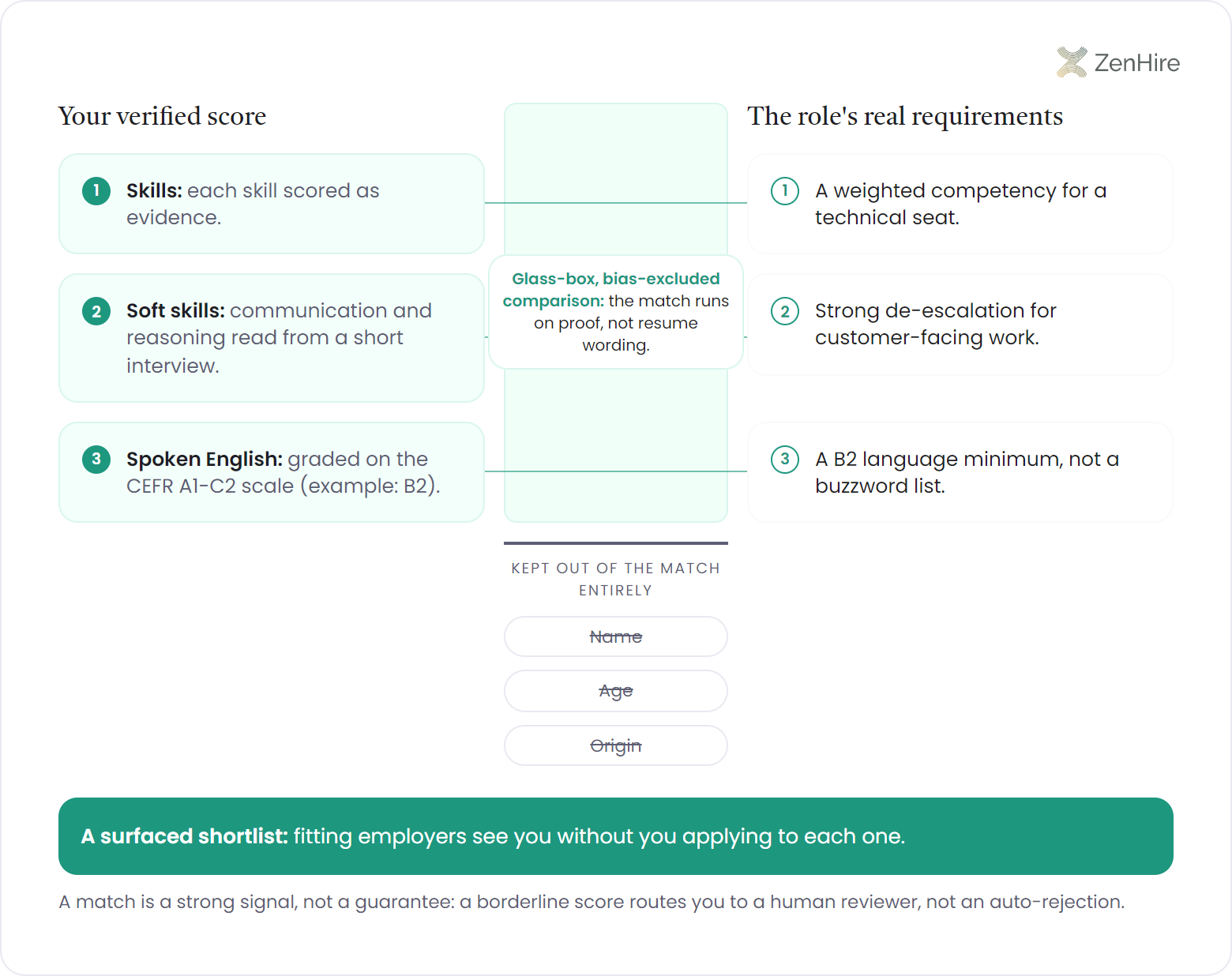
The reason matching beats a keyword filter is what each side can predict. Screen candidates by resume and you are matching on a signal that tracks performance at about r = 0.14; match on the structured skills scores an engine actually compares and you are working from 0.45-0.6+. A fit-based match surfaces the capable people a wording filter would have quietly dropped.
- Your verified score: skills, soft skills, and CEFR language graded as real evidence
- The role's real requirements: a B2 language minimum or a weighted competency, not a buzzword list
- A bias-excluded comparison: name, age, and origin kept out of the match entirely
- A surfaced shortlist: fitting employers see you without you applying to each one
What makes your profile easy to be matched with employers?
What makes your profile easy to be matched with employers is verified, structured evidence of what you can do (measured skills, a clear language level, and concrete soft-skill signals) rather than a wall of self-described qualities. A matching engine can act on a number it trusts; it cannot act on "hardworking team player." The more of your profile that is scored and stored as evidence, the more roles you can be surfaced for and the faster an employer moves on the match.
The mechanism is the difference between asserting and verifying. Since roughly 70% of employers now run AI somewhere in hiring, the reader on the other side of the match is tuned for structured signals: a competency score, a graded language band from A1 to C2, a clear example of how you communicate under pressure. A glass-box assessment shows the reasoning behind each result and keeps sensitive attributes out, which is precisely why an employer trusts it enough to match on it. Strengthening your soft skills raises the exact signals the engine weighs, and a portable skills badge lets that proof travel with you across roles.
A concrete example: two profiles want the same bilingual support role. One lists "excellent English, great communicator." The other carries a CEFR B2 score, a support-skills assessment in the top quartile, and a recorded answer that calmly walks through resolving a double charge. The second is far easier to match because every claim is a number the engine can compare to the role's bar. The edge case: a thin or stale profile matches poorly even when you are qualified, so after you finish a course or take on new responsibility, refresh the score. A current profile out-pulls an old one every time. If you are unsure which roles your evidence fits, check what jobs fit my skills.
| Profile element | Why it makes you easier to match |
|---|---|
| Verified skill scores | Numbers the engine can compare to a role's real bar, not adjectives |
| Graded language level (A1-C2) | Pairs you to a role's stated threshold; accent read for clarity only, never penalized |
| Concrete soft-skill signals | A scored, example-led answer beats "good communicator" every time |
| A fresh, current profile | A score that reflects today's ability out-pulls a stale one |
How do you get matched with employers without applying?
You get matched with employers without applying by proving yourself once into a talent pool and letting fitting roles pull you forward, instead of restarting the screen at every company. When your verified score lives in a pool that employers search by fit, you stop being one resume in one queue and become a standing candidate the engine can surface the moment a matching role opens. The slow part of job hunting, re-proving the basics in every separate application, collapses into a single record that gets reused.
The mechanism is reuse. An employer is willing to pull you from a pool on a score they didn't administer because that score holds several times the predictive weight of the resume they'd otherwise screen by, roughly 0.45-0.6+ against 0.14. The score itself is cheap to earn: a short async AI interview, about four minutes, produces it once, and from then on it works across many openings rather than expiring with a single application. This is the same pipeline as getting recruited without applying: the proof comes to the employer, and the fitting employer comes to you. A fair AI interview keeps sensitive attributes out, so being matched this way is judged on ability, not on who saw your name first.
A concrete example: instead of submitting to ten companies and sitting in ten queues, you complete one verified assessment, join the talent pool, and over the next month three employers with fitting roles reach out, and you applied to none of them. The edge case worth naming: matched without applying is not hired without choosing. You still review each role, and you control your profile; an employer match is an invitation to a fair, fast look, not an automatic offer. Pair the pool with steady skill-building: free courses to get a job raise the score that keeps surfacing you.
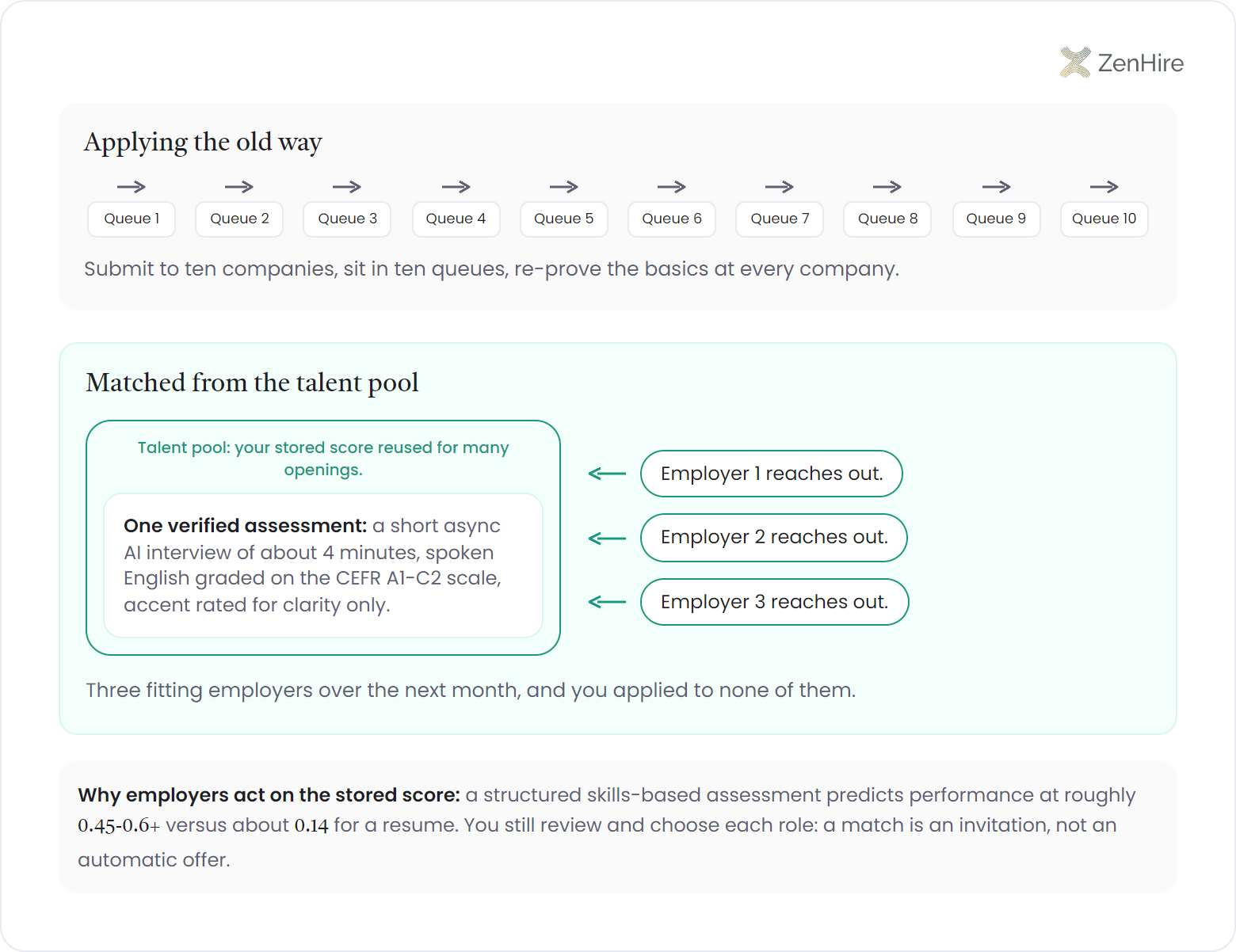
One matchable score, many employers: a single async AI interview of about 4 minutes is enough to produce it, and the same sitting places your spoken English somewhere on the A1 to C2 band, judged on how clearly you come across and never docked for a non-native accent. Earn it once and it keeps surfacing you to fitting roles, no fresh application per employer.
I have watched genuinely capable people sit invisible in application queues while the system rewarded whoever wrote the slickest resume. That always struck me as backwards. The whole reason we built matching the way we did is so you only have to prove yourself once, on your real skills, how you communicate, your actual ability, and then fitting roles find you. We keep the things that should never decide a match, like where you are from or how your name sounds, out of the score entirely. If you are good at the work, you deserve to be discovered for it, not buried under it. That is the point of being matched, not just measured.
Frequently asked questions
How do you get matched with employers in the first place?+
You get matched with employers by proving your skills once into a verified profile that a matching engine compares against open roles. It lines your scored skills, soft skills, and CEFR language level up against what a role actually needs, then surfaces you when the fit is real, running on measured ability rather than whether your resume echoes the posting.
Can you really get matched with employers without applying?+
Yes, you can get matched with employers without applying by joining a talent pool with a verified score. Employers act on a stored assessment because it forecasts performance at 0.45-0.6+ where the resume they'd otherwise screen by sits near 0.14, so they reach out when a fitting role opens instead of waiting for you to find the listing. You still review and choose each role; the match is a fast, fair invitation, not an automatic offer.
What makes my profile easier to auto match to jobs?+
Verified, structured evidence makes your profile easiest to auto match to jobs. A scored skill, a CEFR language level, and a concrete example of how you communicate are numbers a matching engine can compare to a role's real bar, far more matchable than adjectives like "hardworking team player." Keeping the profile current after courses or new responsibilities keeps you surfacing.
Is employer matching for candidates fair if AI runs it?+
A well-built matching system is designed to be fairer to you, not harsher. Glass-box, bias-excluded scoring keeps sensitive attributes like name, age, and origin out of the comparison and judges what you can do, which gives a non-traditional candidate a fairer shot than a resume scan that reads a career switch or a no-name school as a gap.
Does my accent affect whether I get matched with employers?+
Your accent does not lower your match on a fair system; it is rated for clarity only, never penalized for being non-native. The match reads your spoken English as a proficiency band from A1 through C2, keyed to how clearly you can be understood, so an employer's language threshold pairs you to fitting roles rather than filtering you by how native you sound.
Free for getting matched with employers
Get matched with employers: join the talent pool
Create a verified profile scored on real skills, soft skills, and language, then get surfaced to employers with roles that fit. Prove it once, get matched many times, apply to none of them.