
What Skills Does a Talent Acquisition Specialist Need?


· 10 min read
A talent acquisition specialist needs five skills: sourcing craft, structured evaluation, stakeholder management, data literacy, and AI fluency, with structured evaluation carrying the most predictive weight. Rank the specialist's own toolkit by how well each method forecasts on-the-job performance and the order becomes obvious: the resume scan they lean on sits at ~0.14, the improvised phone screen at ~0.18, but a structured interview backed by cognitive and skills testing clears 0.6, better than four times the signal a CV scan gives them. By 2025 roughly 70% of hiring teams are expected to run AI in the funnel, and the ones that do report roughly 62% faster and 59% lower-cost hiring, which is why AI fluency has moved from a resume line to a core competency.
What does a talent acquisition specialist do day to day?
A talent acquisition specialist spends the day running the full hiring funnel for a set of open roles: sourcing candidates, screening applications, structuring and conducting interviews, managing hiring managers, and reporting on the pipeline. The role is wider than recruiting a single req: a specialist owns the system that turns demand into hires, which is why the day swings between deep candidate work and stakeholder coordination. On a typical day they triage new applicants, run two or three screens, debrief a hiring manager, refresh a sourcing search, and update the metrics that tell them whether the funnel is healthy.
Mechanically, the work is a queue-management problem layered on a judgment problem. The specialist decides who advances at each stage, and every decision is either consistent (scored against the same rubric) or improvised (scored against whoever happened to interview that day). The specialists who scale push as much of the routine evaluation as possible into a standard process, especially under high-volume hiring, then spend their freed time on the parts only a human does well: calibrating with hiring managers, closing strong candidates, and protecting the candidate experience. The day-to-day also sits inside the broader talent acquisition function, so a specialist is constantly translating a strategy into individual decisions.
A concrete example: a specialist supporting a contact-center launch opens a single agent req and watches 2,000-plus applications land in a week. They cannot read all of them, so the day becomes a sorting exercise, which is where an inconsistent process quietly fails, because a strong communicator who applied on a busy afternoon gets buried. The edge case is the opposite extreme: a senior, low-volume hire where the specialist runs a long, relationship-heavy search over weeks, and the skill that matters is patience and stakeholder trust, not throughput. The same person needs both modes, and the day rarely warns them which one is coming.
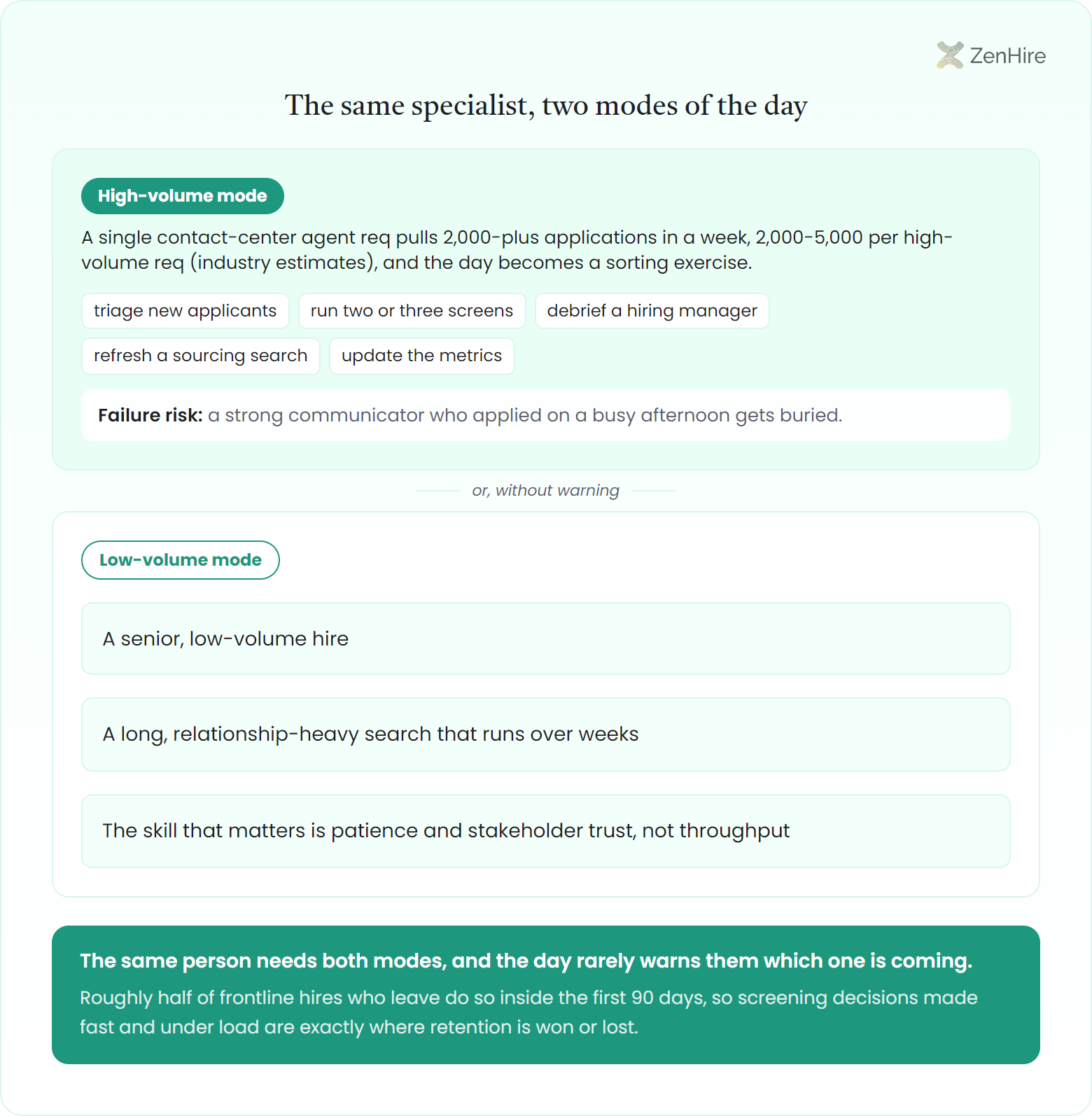
The shape of the day is set by volume. A single high-volume req can pull 2,000-5,000 applications (industry estimates), and roughly half of frontline hires who leave do so inside the first 90 days, so a specialist's screening decisions, made fast and under load, are exactly where retention is won or lost.
- Sourcing: building and refreshing searches, working the talent pipeline, executing a sourcing strategy, and re-engaging past candidates
- Screening: triaging applications and running consistent first-round evaluations against a rubric
- Interviewing: conducting and coordinating structured interviews, then writing scorecards
- Stakeholder management: calibrating with hiring managers and keeping reqs moving
- Reporting: reading talent acquisition metrics and flagging where the funnel is leaking
Which skills make a talent acquisition specialist effective?
The skills that make a talent acquisition specialist effective are structured evaluation, sourcing craft, stakeholder management, data literacy, and clear candidate communication, with structured evaluation carrying the most weight. Most of these are learnable, and the gap between an average specialist and a great one is usually not charisma but discipline: the great ones decide the same way every time and can prove the decision was good months later. Effectiveness is the ability to hold quality steady while volume moves, which is precisely what an improvised process cannot do.
The mechanism is predictive validity: how well a selection method actually forecasts on-the-job performance. A specialist who leans on resume scans and gut-feel phone screens is working with weak instruments, while one who runs structured interviews plus validated assessments is working with strong ones. This is why evaluation skill outranks the rest: it is the single choice that multiplies the value of every candidate the other skills bring in. Pair it with the data literacy to read your own recruitment funnel conversion and the quality-of-hire you produce, and a specialist stops guessing and starts tuning.
A concrete example: a specialist replaces a free-form 'tell me about yourself' screen with three behavioral questions scored on a fixed five-point scale, and within a quarter their hiring managers stop overriding shortlists because the scorecards finally match what they see in the room. The edge case is the senior or highly specialized hire, where rubrics are harder to standardize and the specialist must blend a lighter structured core with deeper subject-matter judgment. The structure still helps, but it shares the wheel with experience. The skill is knowing how much structure each role can carry, and never letting it drop to zero.
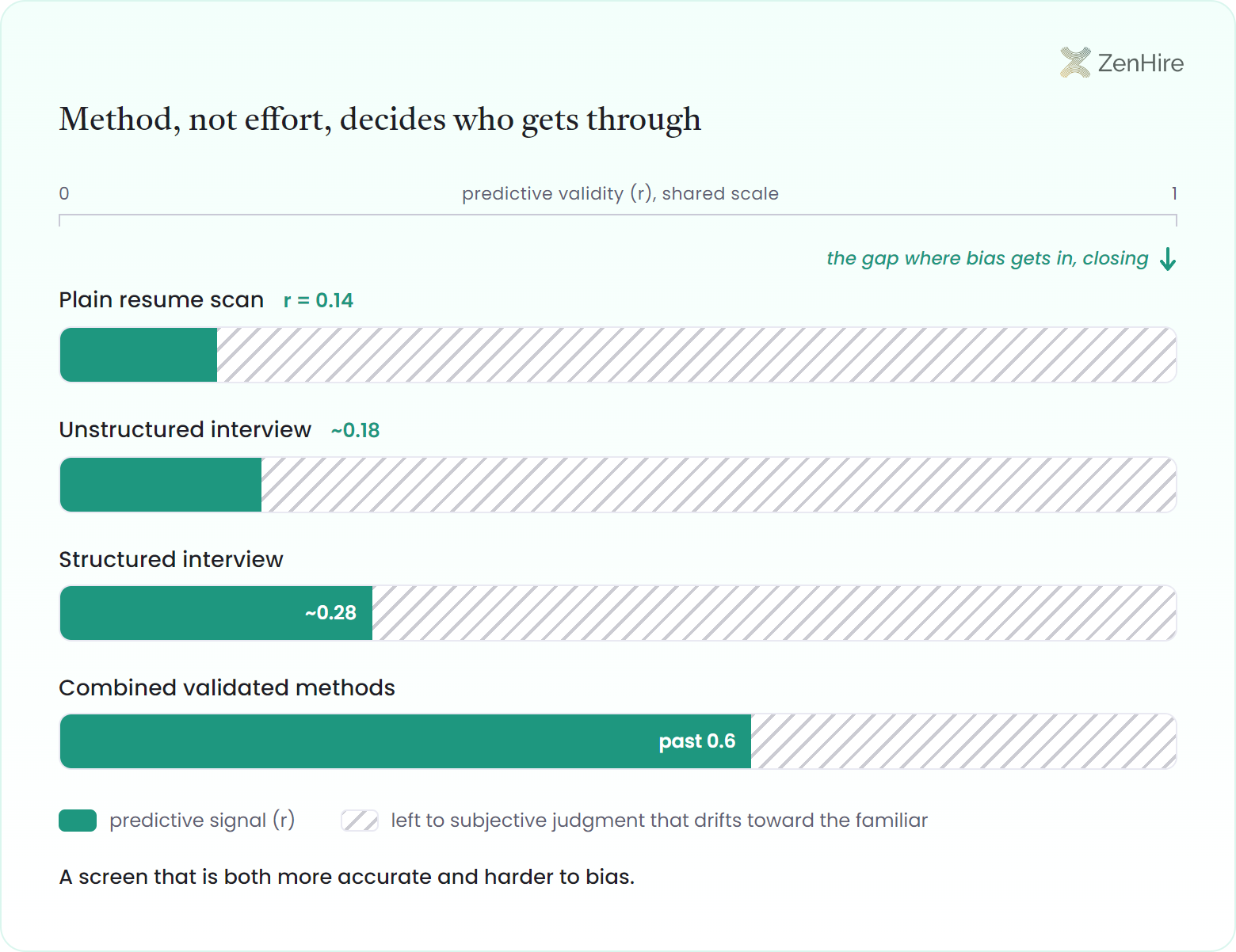
For a specialist, the instrument matters more than the hours put in. Line the methods up by predictive validity and the ranking is unambiguous: a plain CV review lands near r = 0.14 and a free-form interview near ~0.18, a structured interview reaches 0.28, a skills test 0.45+, and stacking a structured interview with cognitive and skills assessments carries the signal past 0.6, more than four times what a resume scan tells you about the same candidate.
| Specialist skill | Why it moves outcomes |
|---|---|
| Structured evaluation | Highest predictive lever: same rubric every time, so good hires are repeatable |
| Sourcing craft | Fills the funnel with people who can actually do the job, not just apply |
| Stakeholder management | Hiring managers trust the shortlist and stop re-screening it |
| Data literacy | Reads time-to-hire, conversion, and quality-of-hire by role and source |
| Candidate communication | Protects offer acceptance and employer brand through honest, timely feedback |
How does a talent acquisition specialist use AI well?
A talent acquisition specialist uses AI well by letting it measure the repeatable signal at scale while keeping the judgment, the relationships, and the final hiring decision firmly human. Used well, AI is a consistency engine: it reads every CV against the same criteria, scores communication and soft skills the same way for every candidate, and never gets tired on application number 3,000. Used badly, it becomes either a black box the specialist rubber-stamps or a threat they refuse to touch, both of which waste the actual benefit. The skill is directing the tool, not deferring to it.
The mechanism is division of labor. AI handles the high-volume, low-judgment work (CV extraction, semantic matching that distinguishes a skill someone used from one they merely listed, structured first-round interviews scored consistently) and surfaces a ranked, explainable shortlist. The specialist then spends their attention where it compounds: edge cases, motivation, culture fit, and closing. ZenHire's AI interview software captures communication and reliability signals from a roughly four-minute async interview, and because that evidence is identical whether the specialist works a shortlist of ten or a flood of ten thousand, the in-house vs agency math tilts toward keeping volume hiring on the specialist's own desk. To go deeper on the full stack, see AI for talent acquisition.
A concrete example: a specialist facing a 2,000-application req lets AI place every candidate on the CEFR A1-C2 spoken-English scale and run a structured screen, then personally reviews only the top band and a sample of the borderline cases, turning an impossible read into a focused half-day. The edge case is the candidate the model is unsure about, or one who flags for potential fraud; here the specialist must read the explainable scorecard, not the headline number, and make the call themselves. That is why glass-box, auditable scoring matters more than raw accuracy: a specialist can only stand behind a decision they can explain, and explainability is what keeps the human accountable for the AI's mistakes.
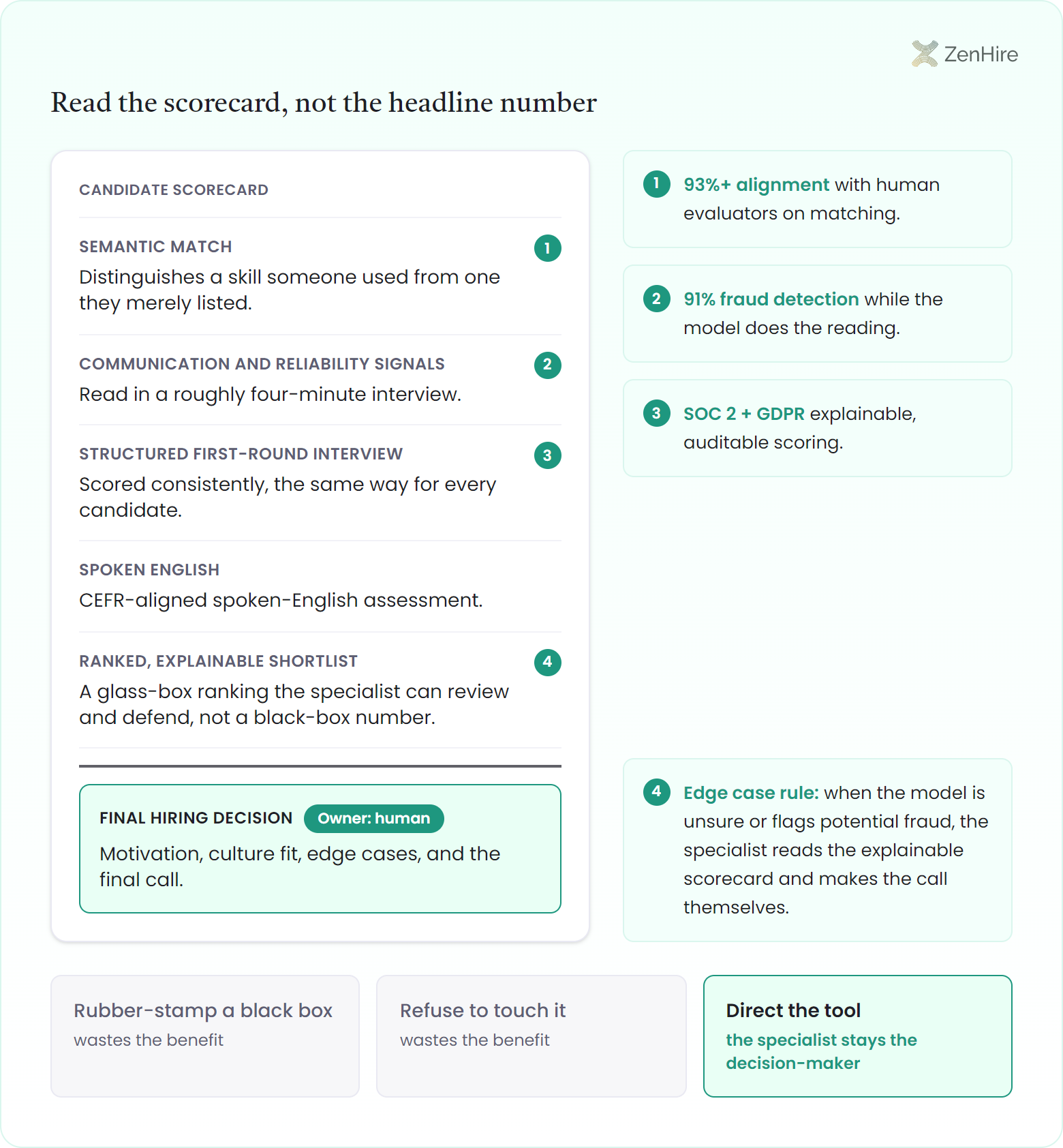
AI fluency now belongs on the specialist's core skill list, not their wish list: roughly 70% of hiring teams are expected to use AI by 2025, and adopters report about 62% faster and 59% lower-cost hiring. What separates the good operators is direction, not access: ZenHire holds 93%+ alignment with human evaluators on matching and 91% fraud detection under explainable, SOC 2 + GDPR scoring, so the specialist keeps the final say while the model absorbs the reading.
- Let AI do the reading: CV extraction, semantic matching, and consistent first-round scoring at volume
- Keep the judgment human: motivation, culture fit, edge cases, and the final hiring call
- Insist on explainability: review glass-box scorecards, not black-box rankings, so you can defend every decision
- Audit for fairness: use demographic-neutral, auditable scoring to reduce bias, not import it
I am building an AI recruiter, and the thing I want every in-house TA specialist to hear is this: the goal is not to automate you away, it is to delete the part of your job that was never really judgment. Reading the two-thousandth CV of the week is not a skill; it is endurance, and endurance makes people inconsistent, which is where good candidates slip through. The specialists who will matter most over the next decade are the ones who treat AI the way a surgeon treats imaging: it shows you the signal you could never see by hand, but you are still the one who decides and who is accountable. Get fluent at directing the measurement, and spend the hours it gives you back on the things a model genuinely cannot do: calibrating with a hiring manager, reading why a hesitant candidate is actually the right hire, and closing the person everyone else would have buried.
Frequently asked questions
What is the most important skill for a talent acquisition specialist?+
The most important talent acquisition specialist skill is structured evaluation: judging every candidate the same way against a fixed rubric. It ranks first because it delivers the highest predictive validity of any method a specialist controls: an improvised interview forecasts performance at only ~0.18, whereas combined structured methods clear 0.6, more than four times the signal.
How do you become a better talent acquisition specialist?+
You become a better talent acquisition specialist by replacing gut-feel screening with structured, measurable evaluation and learning to read your own funnel data. Standardize your scorecards, track quality-of-hire and conversion by role and source, and get fluent at directing AI to handle the high-volume reading so your judgment goes where it compounds.
What are the core responsibilities of a TA specialist?+
The core TA specialist responsibilities are sourcing, screening, structured interviewing, stakeholder management, and reporting: owning the full hiring funnel for a set of roles rather than a single stage. The role translates a talent acquisition strategy into consistent, defensible decisions on individual candidates.
Do talent acquisition specialists need technical or data skills?+
Yes, data literacy is now a core talent acquisition specialist skill. A specialist who can read time-to-hire, funnel conversion, and quality-of-hire by role and source turns hiring into a defensible, improvable function instead of a series of one-off guesses. You do not need to be an analyst, but you must be able to spot where the funnel leaks.
Will AI replace talent acquisition specialists?+
AI will not replace talent acquisition specialists, but specialists who use AI well will replace those who do not. AI measures the repeatable signal at scale; the specialist owns judgment, relationships, and accountability for the final call. The skill that matters is directing an explainable tool, not deferring to a black box.
Free for talent acquisition specialist skills
The TA specialist skills scorecard
A one-page self-assessment across the five skills that decide a specialist's results (sourcing, structured evaluation, stakeholder management, data literacy, and AI fluency), with the predictive-validity benchmarks to calibrate against.