
What Are the 4 R's of Recruitment?


· 10 min read
The 4 R's of recruitment are Recruitment, Retention, Recognition, and Reduction: attract and select the right people, keep them, value them, and cut mis-hires and slow time-to-productivity, not headcount. Roughly half of frontline leavers quit inside their first 90 days, most tracing back to a screening mismatch, and replacing one frontline worker costs $5,000-$20,000 (industry estimates). Every R inherits the accuracy of the first one: a gut-feel interview forecasts who will actually perform at just ~0.18, whereas a stack of validated methods clears 0.6, so a weak Recruitment R quietly caps the other three.
What are the 4 R's of recruitment?
The 4 R's of recruitment are Recruitment, Retention, Recognition, and Reduction: a framework that frames talent as one continuous system rather than four separate departments. Recruitment is attracting and selecting the right people; Retention is keeping them past the point where they pay back the cost to hire; Recognition is valuing their contribution so they want to stay; and Reduction is trimming the waste in the system, meaning fewer mis-hires and faster time-to-productivity, not headcount cuts. The point of the framework is that these four reinforce each other: get the first R right and the other three get easier.
Mechanically, the 4 R's work because each R is a different failure mode of the same pipeline. A great employer brand (Recruitment) that funnels into inconsistent screening still produces wrong-fit hires; strong Recognition cannot save a person who was never able to do the job; and Reduction without better selection just means you fire faster, not hire better. The model forces you to ask which R is actually broken, instead of treating every staffing problem as a 'we need more applicants' problem. Often the leak is upstream of where the pain shows up, which is why reducing employee turnover usually starts at the screen, not at the exit interview.
A concrete example: a contact-center operator complains it cannot retain agents, so it raises pay and adds perks (Recognition and Retention), but attrition barely moves, because the real failure was Recruitment, where rushed phone screens kept passing candidates who could not handle the pace. Fix the selection R and the retention R improves on its own. The edge case is a genuinely strong hire who leaves anyway: here the broken R really is Recognition or Retention (no growth path, weak management), and pouring more selection rigor onto the problem does nothing. Diagnosing the right R is the whole value of the framework.
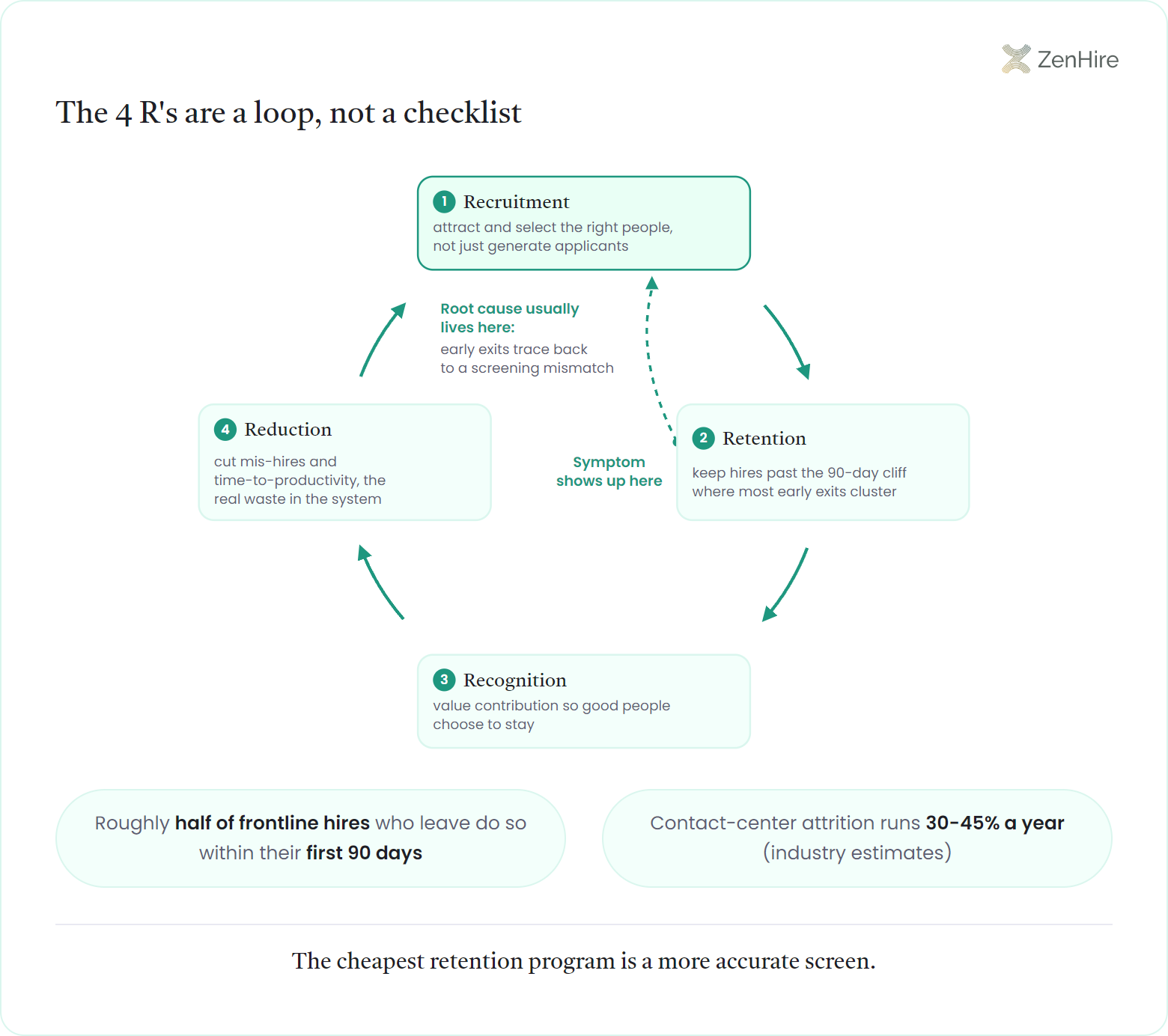
Why the first R carries the others: roughly half of frontline hires who leave do so within their first 90 days, before training pays back, and contact-center attrition alone runs 30-45% a year (industry estimates). When early turnover is that high, no amount of Recognition fixes a Recruitment problem; the cheapest retention program is a more accurate screen.
- Recruitment: attract and *select* the right people, not just generate applicants
- Retention: keep hires past the 90-day cliff where most early exits cluster
- Recognition: value contribution so good people choose to stay
- Reduction: cut mis-hires and time-to-productivity, the real waste in the system
How do the 4 R's map to your hiring funnel?
The 4 R's map to your hiring funnel as four sequential stages, each with its own owner and metric. Recruitment owns the top of the funnel (sourcing and selection), Retention and Recognition own the post-hire stretch (onboarding through the first year), and Reduction is the efficiency metric that runs across all of them. Mapping the framework this way turns a memorable acronym into an operating model: every R becomes a stage you can instrument, so you can see exactly where the loop is leaking instead of guessing.
The mechanism is that each R attaches to a measurable point in the funnel. Recruitment is measured at the screen, by selection quality and time-to-hire; Reduction is measured by cost-per-hire and time-to-productivity; Retention is measured by 90-day and annual turnover; and Recognition shows up as a leading indicator inside engagement and regrettable-attrition data. Because the funnel is sequential, a number that looks like a Retention problem (people leaving) is frequently a Recruitment metric in disguise (you selected people who could not do the job). Mapping the R's lets you trace the symptom back to its stage.
A concrete example: a retailer staffing 1,200 seasonal hires assigns Recruitment to a structured screen that scores reliability and communication, Reduction to a cost-per-hire target, Retention to a 90-day attrition dashboard, and Recognition to a first-week manager check-in. When 90-day attrition spikes in two regions, the map shows the screen in those regions drifted, a first-R fix, not a perks problem. The edge case is a mature, low-volume team where the funnel is so short that the R's blur together; there the framework is still useful as a checklist, but the per-stage metrics matter less than for high-volume hiring.
| The R | Funnel stage | Primary metric |
|---|---|---|
| Recruitment | Source and screen | Selection quality, time-to-hire |
| Reduction | Hire and ramp | Cost-per-hire, time-to-productivity |
| Retention | Onboard to year one | 90-day and annual turnover |
| Recognition | Ongoing | Engagement, regrettable attrition |
How do you improve each of the 4 R's?
You improve each of the 4 R's by fixing the upstream R first, because selection quality is the lever that moves all four. Better Recruitment (consistent, validated screening) reduces mis-hires (Reduction), keeps people who can actually do the job (Retention), and gives managers stronger hires worth investing in (Recognition). Trying to improve the later R's while the first one leaks is like bailing a boat without patching the hole; the most leveraged work is almost always at the screen.
The mechanism is predictive validity, and it is where the first R either earns or squanders the other three. The way you screen sets a ceiling on how many hires can succeed at all, and that ceiling swings hard by method: a skim of the resume forecasts on-the-job performance at roughly r = 0.14, an unstructured interview at ~0.18, a structured interview at ~0.28, and stacking a structured interview with cognitive and skills assessments carries the combined signal past 0.6. So strengthening the Recruitment R is not a matter of effort; it is a matter of choosing methods with more than triple the predictive power and running them the same way on every candidate. ZenHire's evaluation layer scores communication, soft skills, and reliability inside a roughly four-minute interview and hands back an identical glass-box scorecard for each applicant, so the Recruitment R keeps its bar at ten hires or ten thousand. That same discipline is what feeds the Reduction R, since a screen that catches wrong-fit hires early is precisely what lowers recruitment costs by removing the rework of replacing them.
A concrete example: a BPO improves all four R's with one change: it replaces a 30-minute human phone screen with a CEFR-aligned AI assessment, so Recruitment gets a consistent reliability and language score, Reduction gets recruiters off the phones, Retention improves as fewer mis-fits get through, and Recognition improves because new hires get personalized feedback even when rejected, lifting the candidate experience. The edge case is a team where selection is already strong but people still leave: there the leverage flips to Recognition and Retention (career paths, management quality, and pay) and adding more screening rigor yields nothing, which is why diagnosing the broken R before acting is the discipline the framework enforces.
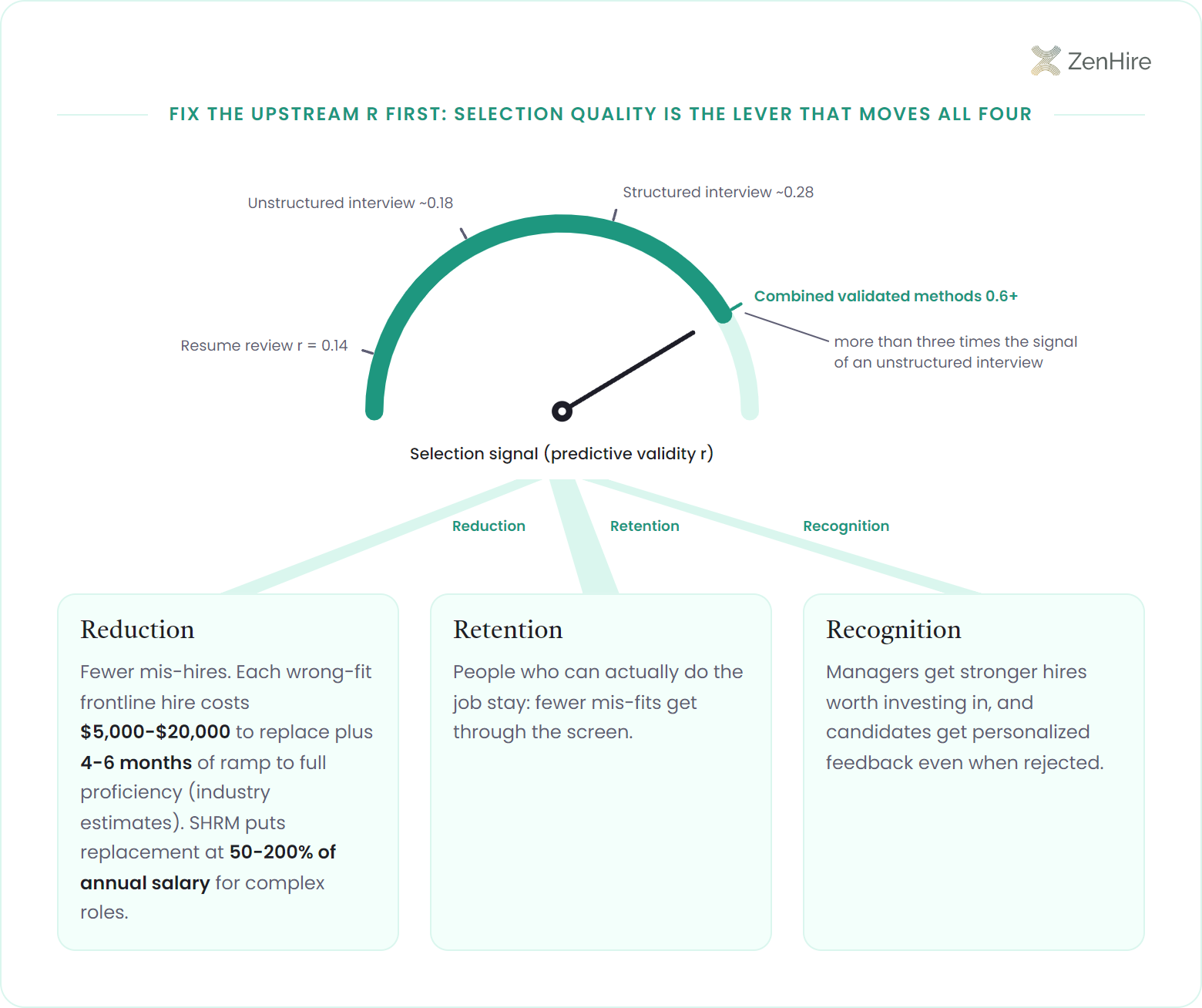
Reduction, done right, compounds: it takes 4-6 months for a frontline hire to reach full proficiency (industry estimates), so every wrong-fit hire you screen out earlier saves not just the $5,000-$20,000 replacement cost but months of half-productive ramp. SHRM puts replacement at 50-200% of annual salary for more complex roles, which is why improving the Recruitment R is the cheapest way to improve the Reduction R.
- Recruitment: standardize the screen with validated, structured methods scored the same way every time
- Reduction: measure cost-per-hire and time-to-productivity, and cut mis-hires upstream
- Retention: track 90-day attrition by source so you can see which screening change moved it
- Recognition: give every candidate and new hire honest feedback and a visible path
I like the 4 R's because the acronym is honest about something most hiring teams resist: these are not four problems, they are one. When a company tells me it has a retention crisis, my first question is never about perks or pay; it is what their screen actually measured. Nine times out of ten the retention leak is a recruitment leak wearing a disguise. You hired someone you hoped would work out, and on day one they could not, and no amount of recognition rescues that. So if I had to compress the whole framework into one sentence: spend your energy on the first R, because it is the only one that makes the other three cheaper. Measure with the machine, decide with the human, and stop treating the exit interview as the place to learn what the screen should have told you months earlier.
Frequently asked questions
What are the 4 R's of recruitment?+
The 4 R's of recruitment are Recruitment, Retention, Recognition, and Reduction. Recruitment is attracting and selecting the right people, Retention is keeping them past the point where they pay back the cost to hire, Recognition is valuing their contribution so they want to stay, and Reduction is cutting waste in the system: mis-hires and slow time-to-productivity, not headcount.
Is Reduction about cutting jobs?+
No. Reduction in the 4 R's is about cutting waste, not jobs. It means reducing mis-hires, rework, and time-to-productivity, since replacing one frontline worker runs roughly $5,000-$20,000 (industry estimates) and a new hire takes 4-6 months to reach full proficiency. The fastest way to improve Reduction is a more accurate screen, not layoffs.
Which of the 4 R's matters most?+
Recruitment matters most because it is the lever that moves the other three. How well you screen sets whether your hires can succeed at all, so a soft first R resurfaces later as a Retention or Reduction failure. A hunch-based interview forecasts performance at only ~0.18 against a combined validated screen above 0.6, which is why sharpening selection is what makes Retention, Recognition, and Reduction cheaper.
How do the 4 R's differ from the 5 C's of recruitment?+
The 4 R's describe the lifecycle stages of talent, while the [5 C's of recruitment](/recruitment/5-cs) describe what you evaluate in a candidate. The 4 R's (Recruitment, Retention, Recognition, Reduction) frame hiring as a connected system over time; the 5 C's frame the qualities you screen for. They complement each other, and the C's sharpen the first R.
Do the 4 R's apply to high-volume hiring?+
Yes, the 4 R's are most useful in high-volume hiring, where each R can be instrumented with its own metric across thousands of hires. Mapping Recruitment to selection quality, Reduction to cost-per-hire, Retention to 90-day attrition, and Recognition to engagement lets you trace exactly where the loop is leaking instead of guessing.
Free for the 4 R's of recruitment
The 4 R's diagnostic worksheet
A one-page worksheet for finding which of the 4 R's is actually broken: the metric to check at each funnel stage, and how to tell a Retention problem apart from a Recruitment problem in disguise.