
What Are the 5 C's of Recruitment?


· 9 min read
The 5 C's of recruitment are competency, character, communication, culture fit, and consistency: five dimensions scored on one rubric to evaluate the whole candidate, not the resume alone. A resume only ever speaks to one of the five C's, and it predicts job performance at roughly r = 0.14 even there; score all five with structured interviews and validated assessments and the combined signal climbs past 0.6. The reason to bother is the four C's a resume stays silent on: roughly half of frontline leavers quit within 90 days, and contact-center attrition runs 30-45% a year, mostly from character, communication, and fit gaps no keyword scan ever tested.
What are the 5 C's of recruitment?
The 5 C's of recruitment are competency, character, communication, culture fit, and consistency, a checklist that names the five things a good hiring decision actually weighs. Competency is whether the person can do the work; character is reliability, integrity, and motivation; communication is how clearly they express and listen; culture fit is alignment with how the team operates; and consistency is evaluating every candidate against the same bar so the first four C's mean something.
The framework earns its place because resumes only cover one C well, competency, and even that imperfectly. The other four are exactly the signals that decide whether a hire stays past their first 90 days. People rarely leave because they lacked a skill on day one; they leave because of a reliability gap, a communication mismatch, or a fit problem that screening never tested for. The 5 C's force you to look at all five before you make an offer instead of discovering four of them after, which is the difference between a hire who sticks and one who joins the early turnover count.
A concrete example: two candidates apply for a customer-service role with identical resumes. One reads as competent and warm but vague under pressure; the other is competent, calm, and explains tradeoffs clearly. The resume cannot separate them. Scoring against communication and character does, and that difference is what shows up months later in quality of hire. The edge case worth naming: the C's are not equally weighted for every role. A night-shift warehouse hire leans on character and consistency; a client-facing role leans on communication and culture fit. The framework is a lens, not a fixed formula. You set the weights, then apply them uniformly.
Why five dimensions and not one: leaning on the competency C alone, read from a resume, predicts on-the-job performance at only about r = 0.14, and adding a gut-feel interview barely moves it, to ~0.18. Score character, communication, and fit alongside competency with structured interviews and validated assessments and the combined signal climbs past 0.6, more than four times the predictive power of the resume-only C (industry research).
- Competency: the skills, knowledge, and ability to actually do the role
- Character: reliability, integrity, motivation, and how someone behaves under pressure
- Communication: clarity in speaking, writing, and listening, especially in customer-facing work
- Culture fit: alignment with how the team works, not sameness of background
- Consistency: the same questions, rubric, and bar applied to every candidate
How do the 5 C's shape your hiring process?
The 5 C's shape your hiring process by turning each stage into a deliberate test of one or two of the dimensions, instead of letting every interviewer chase whatever they happen to notice. The resume screen covers competency; a structured interview tests communication and character; an assessment or work sample confirms competency and surfaces consistency of behavior; and a final conversation checks culture fit. Mapped this way, the process has no blind spots, because every C has a stage that owns it.
The discipline matters most in high-volume hiring, where the pressure to fill seats invites rushed, inconsistent screening, the exact opposite of the fifth C. When a team is hiring hundreds of people, the temptation is to drop the soft-skill checks and screen on resume keywords alone, which is how the 90-day cliff forms. Embedding the C's into a structured interview keeps every candidate measured on the same five things even at scale, which is precisely what manual screening loses first when volume spikes.
A concrete example of the framework shaping a process: a contact-center team rebuilds its recruitment funnel so that competency is screened from the resume, communication and character are scored in a short structured interview, and culture fit is confirmed by the hiring manager, with one shared rubric across all of them. Suddenly two interviewers stop arguing about a candidate, because they are scoring the same dimensions, not trading impressions. The edge case: the C's can conflict. A brilliant communicator who fails on reliability, or a strong fit who lacks a core competency, is not an automatic yes. The framework does not resolve the tradeoff for you; it makes the tradeoff visible so a human can decide it on purpose rather than by accident.
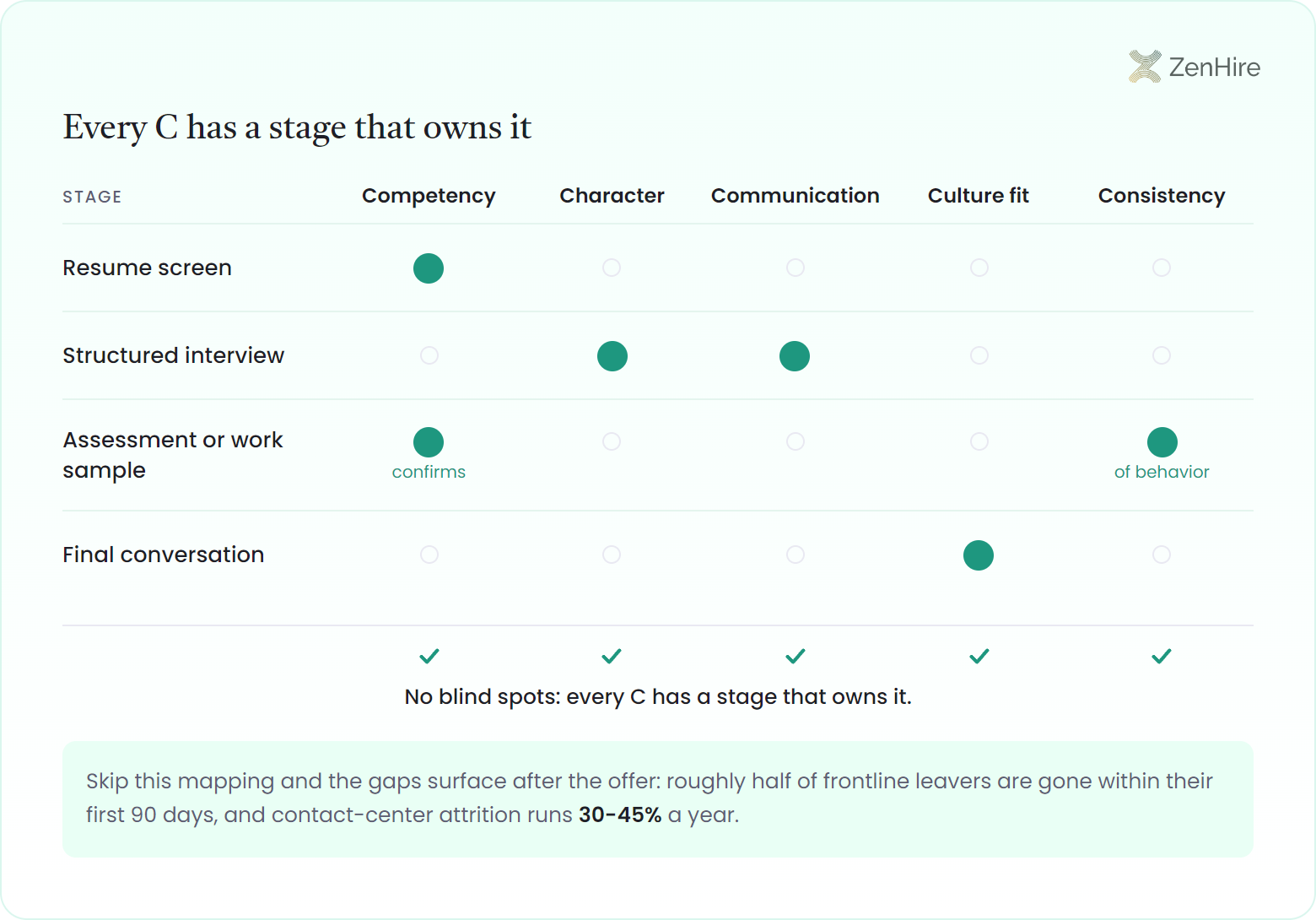
The C the framework exists to protect is the early hire. Industry studies put roughly half of frontline leavers gone within their first 90 days, before training pays back, and contact-center attrition alone runs 30-45% a year. Most of those exits are character, communication, or fit failures a resume could never have caught, which is exactly what the other four C's are designed to test before the offer.
How do you score candidates against the 5 C's?
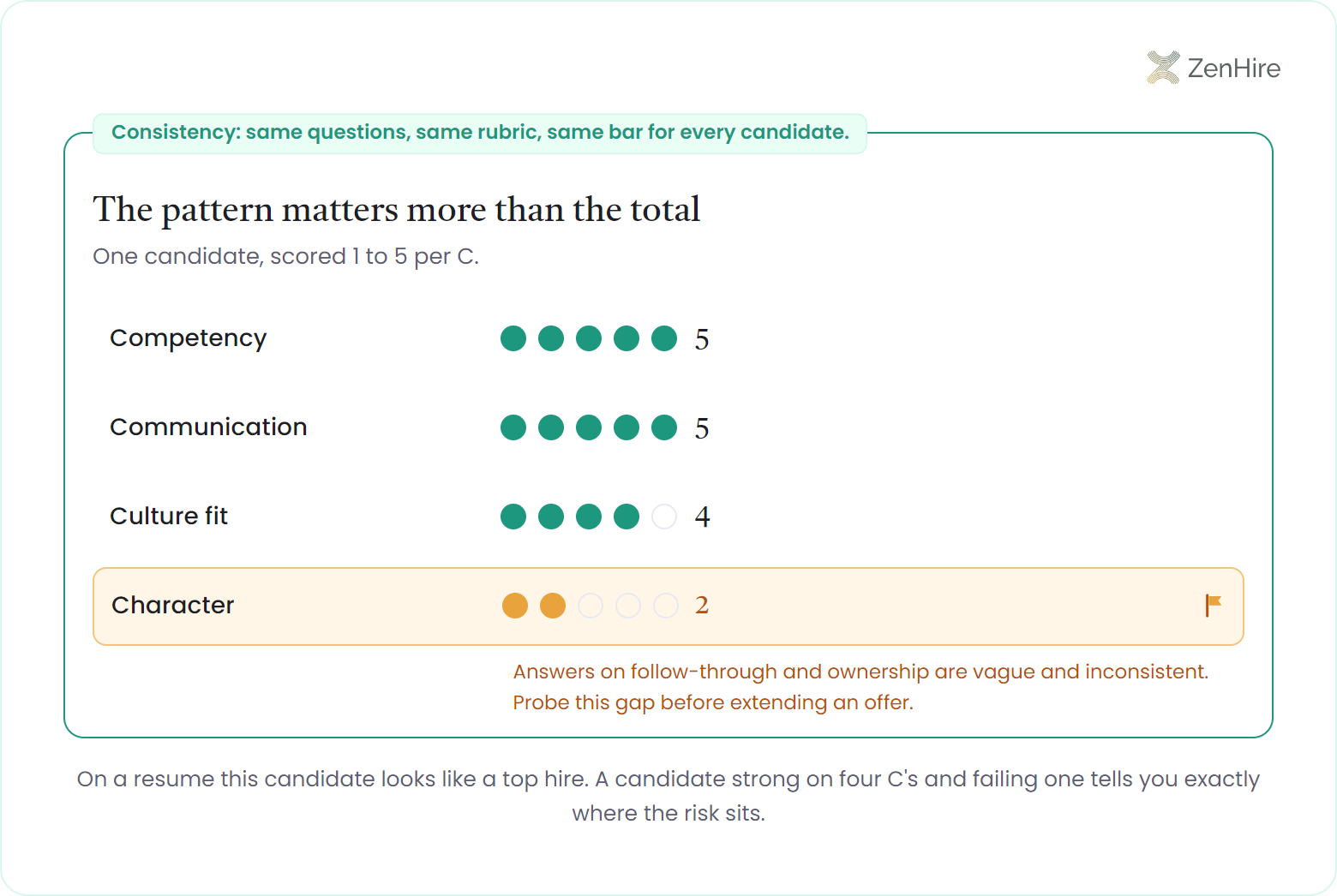
You score candidates against the 5 C's by giving each C a defined rubric and rating every candidate on the same scale, so a strong communicator is not lost because they applied on a busy day and a weak one is not waved through on charm. A simple 1-to-5 scale per C, with written anchors for what a 3 versus a 5 looks like, converts five fuzzy ideas into a comparable scorecard. The total is less important than the pattern: a candidate strong on four C's and failing one tells you exactly where the risk sits.
This is where the fifth C, consistency, does the heavy lifting, and where AI-assisted screening adds what a busy hiring manager cannot: the same evaluation applied at scale. ZenHire's AI interview software reads communication, soft-skill, and reliability signals in a few minutes and produces a per-role scorecard, so the competency, character, and communication C's are scored the same way for candidate one and candidate ten thousand. The evidence is auditable, which also means a hiring decision can be explained later rather than defended as a hunch, and that scoring stays consistent whether you are screening English proficiency for an offshore role or reliability for a local one.
A concrete example: a candidate scores 5 on competency, 5 on communication, 4 on culture fit, but a 2 on character because their answers on follow-through and ownership are vague and inconsistent. On a resume they look like a top hire. The scorecard tells you to probe the character gap before extending an offer, and probably to keep looking. The edge case to guard against: scoring against fit can quietly become scoring against difference, which is how bias enters. Define culture fit as alignment with how the team works, never as similarity of background, and keep the rubric demographic-blind so the framework reduces bias instead of laundering it, the same principle behind reducing hiring bias by design.
| The C | What you are scoring | How to measure it |
|---|---|---|
| Competency | Can they do the actual work? | Resume screen, skills test (0.45+ validity), work sample |
| Character | Reliability, integrity, motivation | Behavioral questions, structured interview, references |
| Communication | Clarity speaking, writing, listening | Structured interview, CEFR-aligned language assessment |
| Culture fit | Alignment with how the team works | Hiring-manager conversation against a shared rubric |
| Consistency | Same bar for every candidate | One rubric, same questions, auditable scorecards |
People love frameworks like the 5 C's because they sound complete, then quietly ignore the fifth one. Competency, character, communication, culture fit: teams will happily debate those for an hour per candidate. Consistency is the boring C, and it is the only one that makes the other four trustworthy. If two interviewers score the same person differently, you do not have a framework, you have four opinions wearing a checklist. The whole point of building the C's into a structured, scored screen is that the framework finally does what people assume it already does.
Frequently asked questions
What are the 5 C's of recruitment?+
The 5 C's of recruitment are competency, character, communication, culture fit, and consistency. Competency is the ability to do the work, character is reliability and integrity, communication is clarity in speaking and listening, culture fit is alignment with how the team operates, and consistency is scoring every candidate the same way so the other four mean something.
Why is consistency one of the 5 C's?+
Consistency is one of the 5 C's because it is what makes the other four reliable. If different interviewers score competency or culture fit on different scales, you have opinions, not evidence. Applying one rubric and the same questions to every candidate turns the framework into a comparable scorecard; scored loosely, the other four C's predict performance at only ~0.18, but scored consistently across combined methods they clear 0.6+.
How is culture fit different from hiring people who are similar?+
Culture fit means alignment with how a team works, not similarity of background. Defined well, it is about shared standards for reliability, collaboration, and pace. Defined badly, it becomes a proxy for sameness and a source of bias. Keep the rubric behavioral and demographic-blind so the C reduces bias rather than laundering it.
Are the 5 C's weighted equally for every role?+
No, the 5 C's are weighted by role. A night-shift warehouse hire leans on character and consistency; a client-facing role leans on communication and culture fit. The framework is a lens you tune per role, then apply uniformly to every candidate for that role.
How are the 5 C's related to the 4 R's of recruitment?+
The 5 C's describe what to evaluate in a candidate, while the [4 R's of recruitment](/recruitment/4-rs) describe the process around them: recruitment, refinement, retention, and the broader hiring cycle. The C's are the scoring lens; the R's are the operating model the scoring lives inside.
Free for the 5 C's of recruitment
The 5 C's scoring rubric
A ready-to-use scorecard with 1-to-5 rating anchors for each of the five C's, the questions that surface each one, and how to set role-specific weights without inviting bias.