
What Are the Biggest Hospitality Hiring Challenges?


· 9 min read
The biggest hospitality hiring challenges are chronic frontline turnover, seasonal and event demand spikes, and screening guest-ready, multilingual staff at speed, and all three trace back to screening quality at the front door. Roughly half of frontline leavers quit inside their first 90 days, before training pays back, and replacing one worker costs $5,000-$20,000 (industry estimates). The reason a resume cannot stop this is that it barely forecasts who thrives on the floor, tracking real performance at only about r = 0.14, whereas CEFR-aligned spoken assessment (A1-C2) reads guest-facing fluency in about four minutes and lands within 90-96% of PhD-linguist ratings.
Why is hospitality hiring and retention so hard?
Hospitality hiring and retention are hard because the industry combines the highest hiring volume with the shortest patience: you are filling front-desk, housekeeping, server, and line roles constantly, and a large share of those hires walk before they ever pay back. The churn is not random: most early exits are screening failures, where a candidate looked fine on paper but could not actually carry the pace, the guest pressure, or the shift reliability the job demands.
The mechanism is a 90-day cliff. Hospitality leans on hourly, frontline workers, and roughly half of frontline hires who leave do so inside their first 90 days, before training has paid back. Pay and scheduling drive the later exits, but the early ones are about fit, and fit is decided in the screen. When you are hiring at volume under time pressure, that screen is exactly what gets rushed and made inconsistent across managers and properties. The fix is to make evaluation the same for every candidate, which is the core of these hotel staffing problems and what reliable structured interviews are built to solve.
Consider a 200-room hotel onboarding twelve front-of-house hires for a quarter. If five of them quit inside 90 days, the property has paid to recruit, train, and re-recruit for nearly half its intake, and the lost hires were not the ones who were underpaid, they were the ones who never fit the role. The edge case that breaks naive screening is the strong-on-paper applicant who interviews well on a quiet Tuesday but cannot hold composure across a Saturday rush. A resume scan and a single rushed phone screen cannot see that; consistent, structured evaluation can.
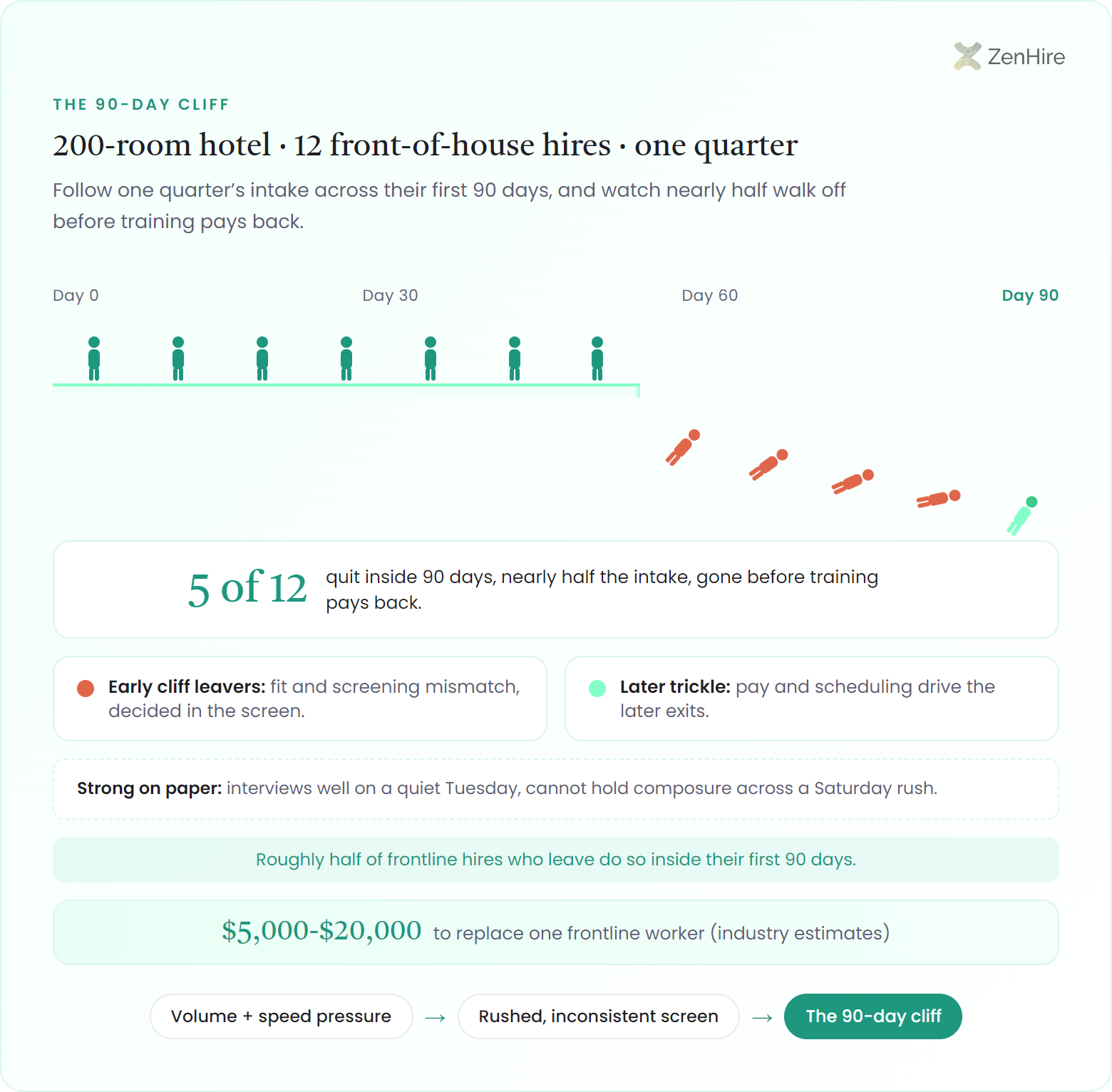
Early turnover is the most expensive kind: roughly half of frontline hires who leave do so inside their first 90 days (before training pays back), and replacing one frontline hospitality worker runs about $5,000-$20,000 (industry estimates), with SHRM putting skilled-role replacement at 50-200% of annual salary. A stack of resumes tells you almost nothing about who survives the Saturday rush, forecasting floor performance at only about r = 0.14; layering structured interviews on validated assessments lifts that predictive signal past 0.6.
- Volume + speed pressure: constant frontline req loads invite rushed, inconsistent screening across managers and properties
- The 90-day cliff: most early leavers are screening mismatches, gone before training pays back
- Reliability is invisible on a resume: attendance and composure under guest pressure decide who stays, and a CV hides both
- Margin sensitivity: every avoidable early quit hits a thin operating margin directly
How do you staff hospitality seasonal and event peaks?
You staff hospitality seasonal and event peaks by making screening fast, consistent, and elastic, so you can scale headcount up and back down without lowering the bar. Peaks are the defining shape of hospitality demand: a resort fills for a season and empties, a hotel doubles banquet staff for a single convention weekend, a venue needs forty servers for one event and none the next week. The hiring problem is not just finding bodies, it is evaluating a surge of candidates quickly enough to staff the peak while still hiring people who can actually deliver.
The mechanism that breaks under peaks is the manual screen. A general manager who can phone-screen fifteen candidates in a normal week simply cannot screen two hundred for a seasonal ramp, so the bar slips and mis-hires spike right when guest volume is highest. Structured, AI-assisted screening removes that ceiling: every candidate clears the same evaluation, scored the same way, whether you are hiring ten people or a thousand. That is the same elasticity that high-volume seasonal hiring depends on, and it is why cutting time-to-hire matters more in hospitality than almost anywhere else: an unfilled seat during a peak is lost revenue, not just an open req.
Picture a ski resort ramping from 40 to 120 staff for a winter season in three weeks. With a four-minute structured assessment, the recruiting team can evaluate the full applicant pool in days and rank candidates on guest-readiness instead of on who applied first. The edge case to plan for is the rehire wave, returning seasonal workers who were strong last year. A consistent, documented evaluation lets you fast-track proven performers while still holding new applicants to the same bar, rather than re-screening everyone from scratch or waving people through on memory alone.
| Staffing challenge at a peak | What consistent, fast screening changes |
|---|---|
| Surge volume | Evaluate hundreds of applicants on the same bar in days, not weeks |
| Time-to-hire pressure | Each applicant clears a ~4-minute structured assessment, so the ramp is ranked before the first guest arrives |
| Quality at speed | Guest-readiness scored consistently, so the bar does not slip under pressure |
| Seasonal rehires | Documented prior scores let you fast-track proven returners |
How do you hire multilingual, guest-ready hospitality staff?
You hire multilingual, guest-ready hospitality staff by measuring the things a resume cannot show, spoken language, composure, and communication, with consistent, structured evaluation instead of a gut-feel read. Hospitality is a guest-facing, often multilingual business: a front-desk agent in a tourist city may need working English plus a second language, and the difference between a five-star review and a complaint is frequently how clearly and warmly someone communicates under pressure. None of that is visible on a CV, and an interviewer's quick impression of a candidate's English is exactly the kind of judgment that varies wildly from one manager to the next.
The mechanism is measurement. CEFR-aligned spoken-language assessment evaluates fluency, vocabulary, and pronunciation in a few minutes and aligns 90-96% with averaged PhD-linguist evaluations, versus only 68-75% for untrained human recruiters, so 'good enough English' stops being a coin flip. Pairing that with structured scoring of communication and reliability signals gives every candidate the same, defensible read on guest-readiness. ZenHire's English proficiency assessment is audio-only and built on neutral, engineered features, and the broader AI interview reads communication and composure, so you can rank a multilingual applicant pool on the signals that actually predict guest satisfaction.
Take a resort hiring guest-relations staff who need to handle check-ins, complaints, and concierge requests in two languages. A structured, CEFR-scored assessment surfaces the candidate who is genuinely fluent and composed over the one who simply listed a language on their resume. The edge case worth guarding is the strong written-but-weak-spoken applicant, someone whose CV reads beautifully but who struggles in live, fast guest conversation. Spoken assessment catches that gap before it reaches a guest, which a resume scan or a written test never would.
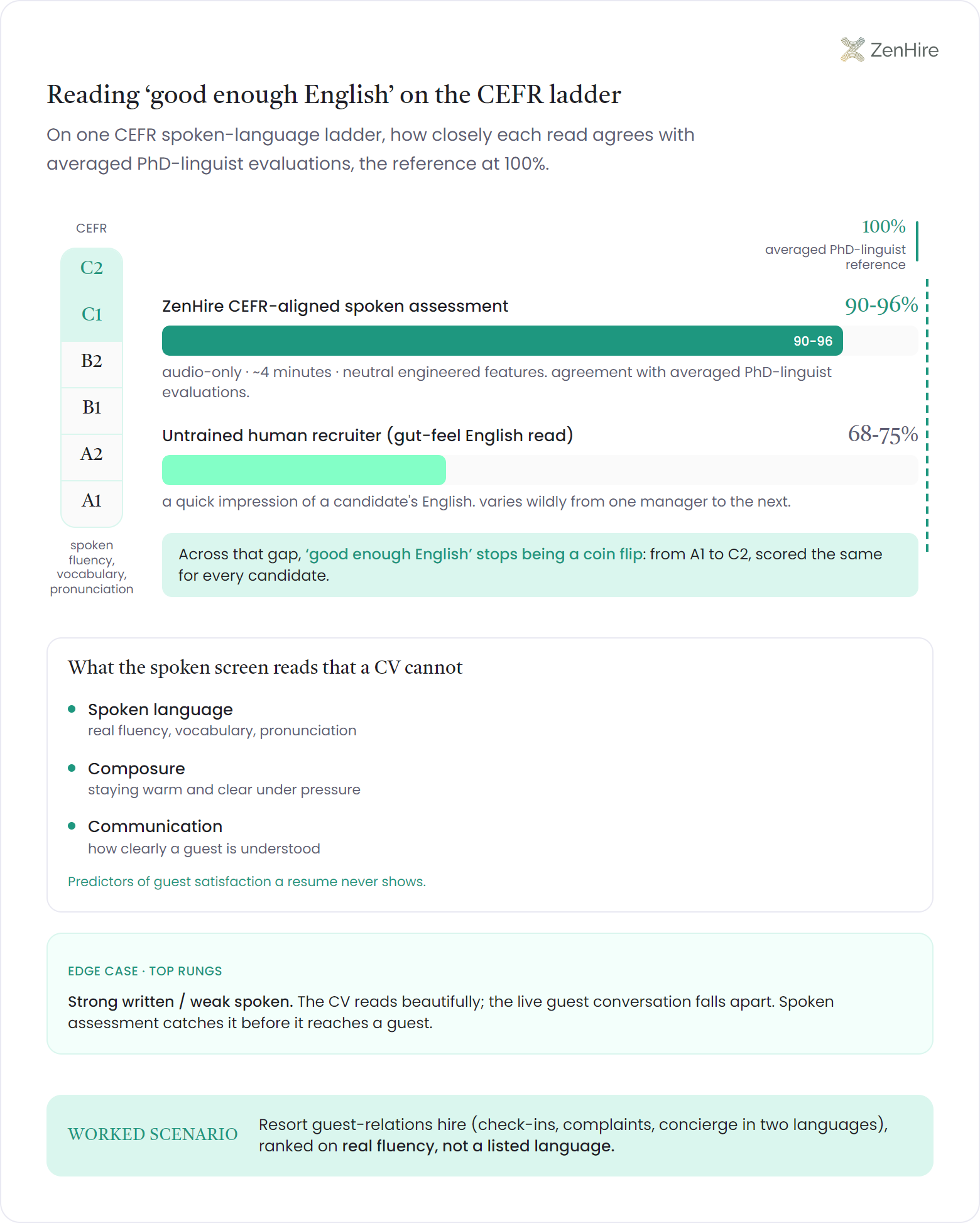
Language can be measured, not guessed: CEFR-aligned spoken assessment (A1-C2) aligns 90-96% with averaged PhD-linguist evaluations, versus 68-75% for untrained recruiters, and completes in about 4 minutes, audio-only, on neutral engineered features. How you screen decides what you learn: a manager's off-the-cuff chat about a candidate's English predicts on-the-job performance at only ~0.18, while stacking structured interviews, cognitive, and skills assessments carries that signal past 0.6.
People assume hospitality turnover is a pay problem, so they chase it with bonuses and lose the war anyway. What I see is a screening problem wearing a pay costume. A guest does not feel your wage band; they feel whether the person at the desk can stay warm and clear when the lobby is on fire. We were never going to read that off a resume, and a manager juggling a seasonal ramp cannot read it the same way twice. So we measure it: composure, communication, real spoken fluency, scored the same for everyone, in minutes. Get that screen right and most of the churn, the bad reviews, and the frantic re-hiring simply stop showing up.
Frequently asked questions
What is the single biggest hospitality hiring challenge?+
The single biggest hospitality hiring challenge is high frontline turnover driven by screening mismatch: hiring at volume under time pressure invites rushed, inconsistent screens, and roughly half of frontline leavers quit inside their first 90 days, before training pays back. Consistent, structured evaluation at the front door is the most direct lever on it.
How do you handle hotel staffing problems during peak season?+
You handle peak-season hotel staffing problems by making screening fast and consistent enough to scale. A four-minute structured assessment lets you evaluate a surge of applicants on the same bar in days, rank them on guest-readiness, and fast-track documented seasonal returners, so the hiring bar does not slip exactly when guest volume is highest.
How do you assess English and other languages for hospitality roles?+
You assess hospitality language skills with CEFR-aligned spoken evaluation rather than a manager's quick impression. Spoken assessment scores real fluency, vocabulary, and pronunciation in minutes and aligns 90-96% with averaged PhD-linguist evaluations, versus 68-75% for untrained recruiters, catching the strong-on-paper, weak-in-conversation gap before it reaches a guest.
How much does hospitality turnover cost?+
Hospitality turnover costs about $5,000-$20,000 to replace one frontline worker (industry estimates), and SHRM puts skilled-role replacement at 50-200% of annual salary once you count recruiting, training, and lost productivity, which is why cost per hire climbs fast in a high-churn operation. On thin hospitality margins, every avoidable early quit is a direct hit.
Can better hiring actually reduce hospitality turnover?+
Better hiring is the most direct lever on hospitality turnover, because most early exits are screening failures, not pay problems. Structured evaluation that predicts fit, composure, and reliability catches the mismatch before the offer. On its own a resume tracks who will actually perform at only about 0.14, whereas combined validated methods clear 0.6.
Free for hospitality hiring
The hospitality peak-staffing playbook
A one-page guide to staffing seasonal and event peaks without lowering the bar: what to screen for guest-readiness, how to score spoken language consistently, and how to fast-track proven seasonal returners.