
What Is Outstaffing (and How Is It Different From Outsourcing)?


· 9 min read
Outstaffing is a hiring model where a third-party provider legally employs dedicated remote staff who report to you, handling payroll, taxes, and local labor compliance while you direct the daily work. It differs from outsourcing in control: you keep the how and the who, with no foreign subsidiary required, while an outsourcing vendor owns the whole outcome. The model rides a recruitment market growing from roughly $450B in 2023 toward $870B by 2032, and because these are people you steer every day rather than a vendor's deliverable, whether they can carry the work is on you: a CV alone tracks future output at just r = 0.14, against 0.6+ once you validate the skills before onboarding. Because these hires are dedicated to your team, the discipline of talent acquisition applies to them exactly as it does to internal roles.
What is outstaffing?
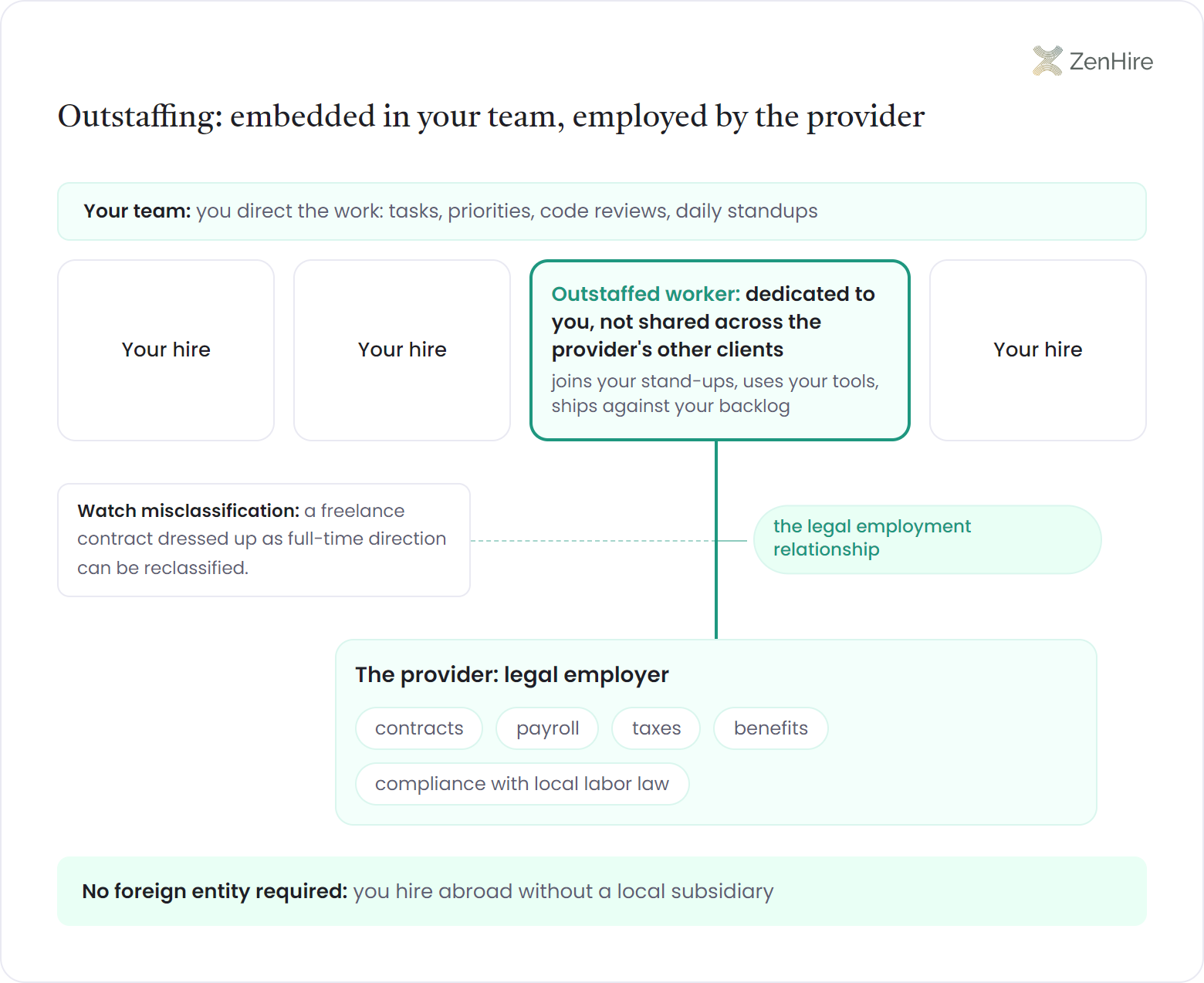
Outstaffing is a staffing model in which a provider legally employs workers on your behalf, but those workers function as a dedicated, integrated part of your own team and take direction from your managers. You decide what they build and how they spend their day; the provider handles the employment relationship underneath: contracts, payroll, taxes, benefits, and compliance with local labor law in the worker's country.
The mechanism is a split of two responsibilities that usually travel together. Direction of work stays with you, so an outstaffed developer joins your stand-ups, uses your tools, and ships against your backlog like any internal hire. The legal employer relationship sits with the provider, so you never register a foreign entity, run foreign payroll, or interpret another country's termination rules yourself. This is closely related to the employer of record arrangement, which formalizes that legal-employer layer.
A concrete example: a UK product company wants two backend engineers in Poland but has no Polish entity. Through outstaffing, the provider hires both engineers in Poland on compliant local contracts, while the company's engineering manager assigns their work, reviews their code, and treats them as part of the squad. The edge case to watch is misclassification. If the relationship is structured loosely (a freelance contract dressed up as full-time direction), some jurisdictions can reclassify the worker as your employee, which is exactly the liability a proper outstaffing or EOR setup is meant to prevent.
The global recruitment industry sits at roughly $450B in 2023 and is projected to reach about $870B by 2032 (around 7.5% CAGR), with an estimated 160,000 recruitment and staffing agencies worldwide. Distributed models like outstaffing are a meaningful slice of that growth as teams hire across borders rather than relocating.
- You manage the work: tasks, priorities, code reviews, daily standups
- The provider is the legal employer: payroll, taxes, benefits, local contracts
- The worker is dedicated to you, not shared across the provider's other clients
- No foreign entity required: you hire abroad without a local subsidiary
How does outstaffing differ from outsourcing?
Outstaffing differs from outsourcing in who controls the work: in outstaffing you keep control of how the work is done and who does it, while in outsourcing you hand a whole function or deliverable to a vendor and let them decide the how. Outstaffing extends your team with people you manage; outsourcing buys you a result and the team behind it stays the vendor's responsibility. It sits alongside models like recruitment process outsourcing on the spectrum of how much of hiring you hand off.
The mechanism is control versus outcome. With outstaffing, you own the roadmap, the process, and the daily direction; the provider only owns employment. With outsourcing, you own the requirement and the acceptance criteria; the vendor owns staffing, management, methodology, and delivery. That difference cascades into everything else: visibility, flexibility, how you measure success, and how tightly the people are woven into your culture.
A concrete example: if you outstaff two QA engineers, they sit in your sprint, you assign their test plans, and you see their daily output. If you outsource QA, you sign a contract for tested releases, the vendor staffs and runs the testing however they see fit, and you judge them on whether the releases pass, not on how any individual tester spent Tuesday. The edge case is the blurry middle: a 'dedicated team' from an agency can drift toward outstaffing in practice if you start directing individuals daily, which can quietly shift legal and management expectations, so the contract should state plainly which model it is. When you keep direct control, you also own selection quality, which is why structured interview screening matters as much for outstaffed hires as for internal ones.
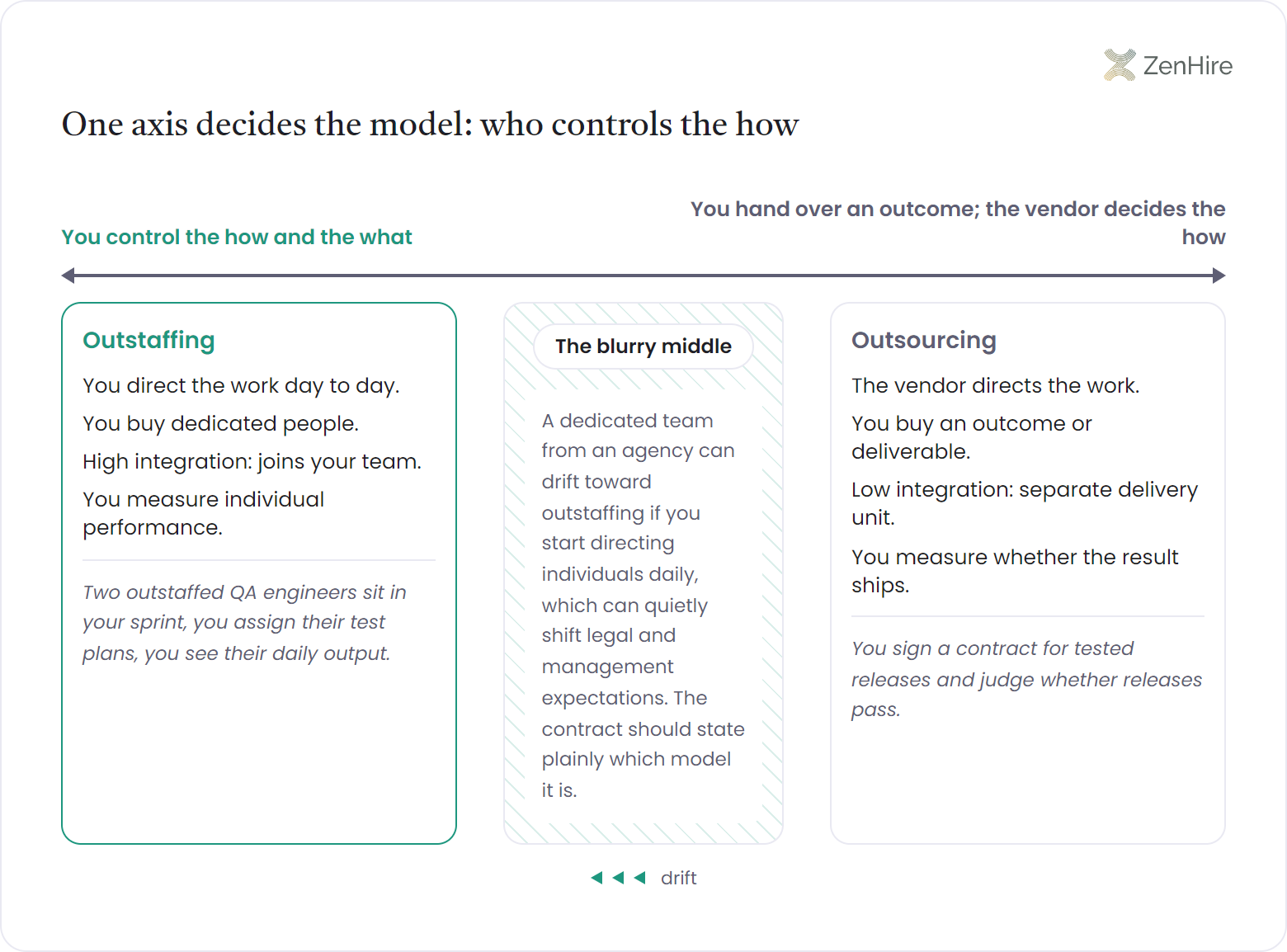
| Dimension | Outstaffing | Outsourcing |
|---|---|---|
| Who directs the work | You do, day to day | The vendor does |
| What you buy | Dedicated people | An outcome or deliverable |
| Legal employer | The provider | The vendor |
| Team integration | High, joins your team | Low, separate delivery unit |
| You measure | Individual performance | Whether the result ships |
When does outstaffing make sense?
Outstaffing makes sense when you need dedicated, ongoing talent you intend to manage directly, but you do not want the cost and delay of opening a legal entity in the worker's country. It is the right call when control and integration matter, the work is continuous rather than a one-off project, and the blocker is employment logistics, not management capacity.
The mechanism that makes it pay off is that it removes a months-long, expensive barrier (standing up a foreign subsidiary and running compliant local payroll) while leaving the part you actually care about (who does the work and how) under your control. It is especially powerful for roles where consistency and tenure matter, because the people are yours to develop, not a rotating bench. That is also where the model is most fragile: since you are managing these hires daily and betting on them staying, a screening miss is costly. Roughly half of frontline leavers go within their first 90 days, and a resume read in isolation forecasts performance at barely r = 0.14 while a validated combination of methods reaches 0.6+, so the leverage is in hiring for quality of hire, not just filling the seat.
A concrete example: a scaling fintech needs five customer-support specialists who speak fluent English, will be coached on the product over months, and must stay long enough to reach proficiency. Outstaffing lets them hire and direct that dedicated team abroad without a local entity, and screening for spoken fluency up front protects the investment, which is why CEFR-aligned English proficiency assessment is a natural fit. The edge case where outstaffing is the wrong tool: a fixed-scope, time-boxed deliverable with no need to manage individuals; there, true outsourcing (buy the outcome) is cleaner than taking on day-to-day direction you do not want.
When you own the day-to-day direction, hire quality compounds instead of hiding behind a vendor. The research is blunt: a resume review lands near r = 0.14 and an off-the-cuff interview near 0.18, whereas structured interviews paired with cognitive and skills assessments lift the combined signal past 0.6, more than four times the predictive power. For staff dedicated to your team, that spread separates a squad that ships from one you are perpetually re-staffing.
People hear 'outstaffing' and picture cheaper labor in another country. That framing misses the point. The value is not the rate. It is keeping control of the work while someone else absorbs the employment machinery. But that only pays off if the people are genuinely good, because you are managing them every single day. I have seen teams treat the screening as an afterthought because a provider is handling payroll, and then wonder why a 'dedicated' hire cannot carry the work. The provider can own the contract. They cannot own whether the person is right. That part is still yours, and it is the part that decides whether outstaffing is a bargain or an expensive mistake.
Frequently asked questions
What is outstaffing in simple terms?+
Outstaffing in simple terms is renting dedicated team members you manage yourself, while a provider handles their employment. You assign the work and direct their day; the provider runs payroll, taxes, benefits, and local compliance so you do not need a legal entity in their country.
What is the difference between outstaffing and outsourcing?+
The difference between outstaffing and outsourcing is control: outstaffing gives you dedicated people you direct daily, while outsourcing hands a whole outcome to a vendor who decides how it gets done. With outstaffing you measure individual performance inside your team; with outsourcing you measure whether the deliverable ships.
Is outstaffing cheaper than hiring in-house?+
Outstaffing can be cheaper because it removes the cost of opening a foreign entity and running local payroll, but the real saving comes from avoiding mis-hires. Since a resume by itself predicts performance at only about r = 0.14, the model only pays off when you vet dedicated staff for real skill before you start directing them day to day.
When should I use outstaffing instead of outsourcing?+
Use outstaffing when you want ongoing, dedicated talent you will manage and develop directly without standing up a foreign subsidiary. Choose outsourcing when the work is a fixed-scope deliverable and you would rather buy the outcome than direct individuals day to day.
Who is the legal employer in an outstaffing arrangement?+
In an outstaffing arrangement the provider is the legal employer, holding the local contract and owning payroll, taxes, benefits, and labor-law compliance. You retain day-to-day direction of the work, which is what keeps the model distinct from a freelance contract that could risk misclassification.
Free for outstaffing and distributed hiring
The distributed-hiring screening checklist
A one-page guide to vetting dedicated remote staff before you direct them: the skills and reliability signals to weight, how to test spoken language, and the contract terms that keep your model clearly outstaffing, not outsourcing.