
Public sector recruitment software has to do more than screen fast: it has to show its work. ZenHire scores candidates with glass-box AI that excludes sensitive attributes, logs every decision, and produces structured scorecards you can hand to an auditor or a procurement panel.
They have to prove a decision was fair, consistent, and reviewable, not just that it was reached quickly. A government employer answers to candidates, oversight bodies, and the public, so any tool in the pipeline must produce evidence that stands up to scrutiny.
ZenHire meets that bar with explainable scoring and a logged trail behind every result, rather than an opaque number. The fairness posture is the same one behind ethical hiring practice: job-relevant signals decide, demographics never enter. One concrete example: a panel hiring for the same role across three departments can apply one weighted scorecard, so a rejected candidate gets the same criteria everyone else did, with a record to show it. The edge case worth flagging is roles governed by statutory rules or collective agreements that mandate a specific human-only step, where the software documents and supports the process rather than automating the final call.
For an oversight body, the numbers are the defence: a rejected candidate can challenge a hunch, but not a validated method. Selection research pegs a bare CV review at roughly r = 0.14 against actual job performance, while a structured interview plus validated assessments lifts the combined signal above 0.6. On a public record, that gap is the difference between a decision you can only assert and one you can substantiate.
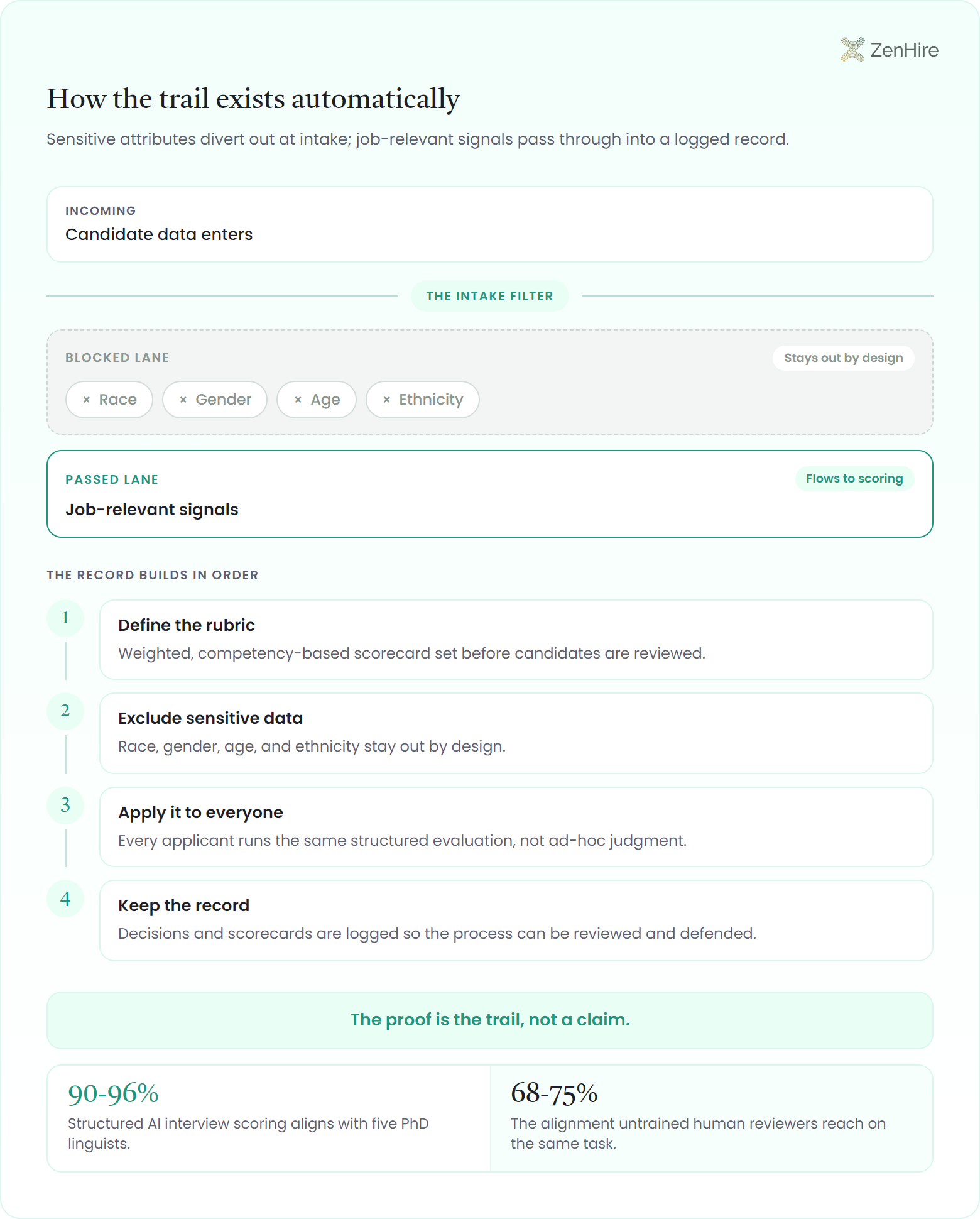
You document the criteria up front, exclude demographics from the scoring, apply the same rubric to everyone, and keep the record. The proof is the trail, not a claim, and ZenHire is built so that trail exists automatically.
Glass-box AI makes this defensible because each score is explainable and stable across runs, instead of an opaque model that nobody can interrogate. Some will argue that any AI in hiring simply imports bias and adds legal exposure. The honest counter is that the larger risk is undocumented human screening, where bias hides and leaves no record; an audited, attribute-excluded, explainable system with logged decisions is easier to review and correct than a panel working from memory. Where spoken-language judgment is involved, the gap is stark: ZenHire's structured AI interview scoring aligns 90-96% with five PhD linguists, versus 68-75% for untrained human reviewers, so consistency improves rather than degrades. One concrete example: a hiring lead can open a candidate's scorecard months later and see exactly which competencies drove the result. The edge case is that the software cannot certify your process as legally compliant in a given jurisdiction; it gives you the documentation, and your legal and HR teams confirm it fits local rules.
1. Define the rubric
Set the weighted, competency-based scorecard before candidates are reviewed, drawing on a validated assessment test library where useful.
2. Exclude sensitive data
Score on job-relevant signals; race, gender, age, and ethnicity stay out by design.
3. Apply it to everyone
Every applicant runs through the same structured evaluation, not ad-hoc judgment.
4. Keep the record
Decisions and scorecards are logged so the process can be reviewed and defended.
Explainability is exactly what procurement panels look for, because it lets them assess how a tool reaches a result rather than trusting a black box. A system whose scores can be traced and whose data handling is documented is far easier to approve.
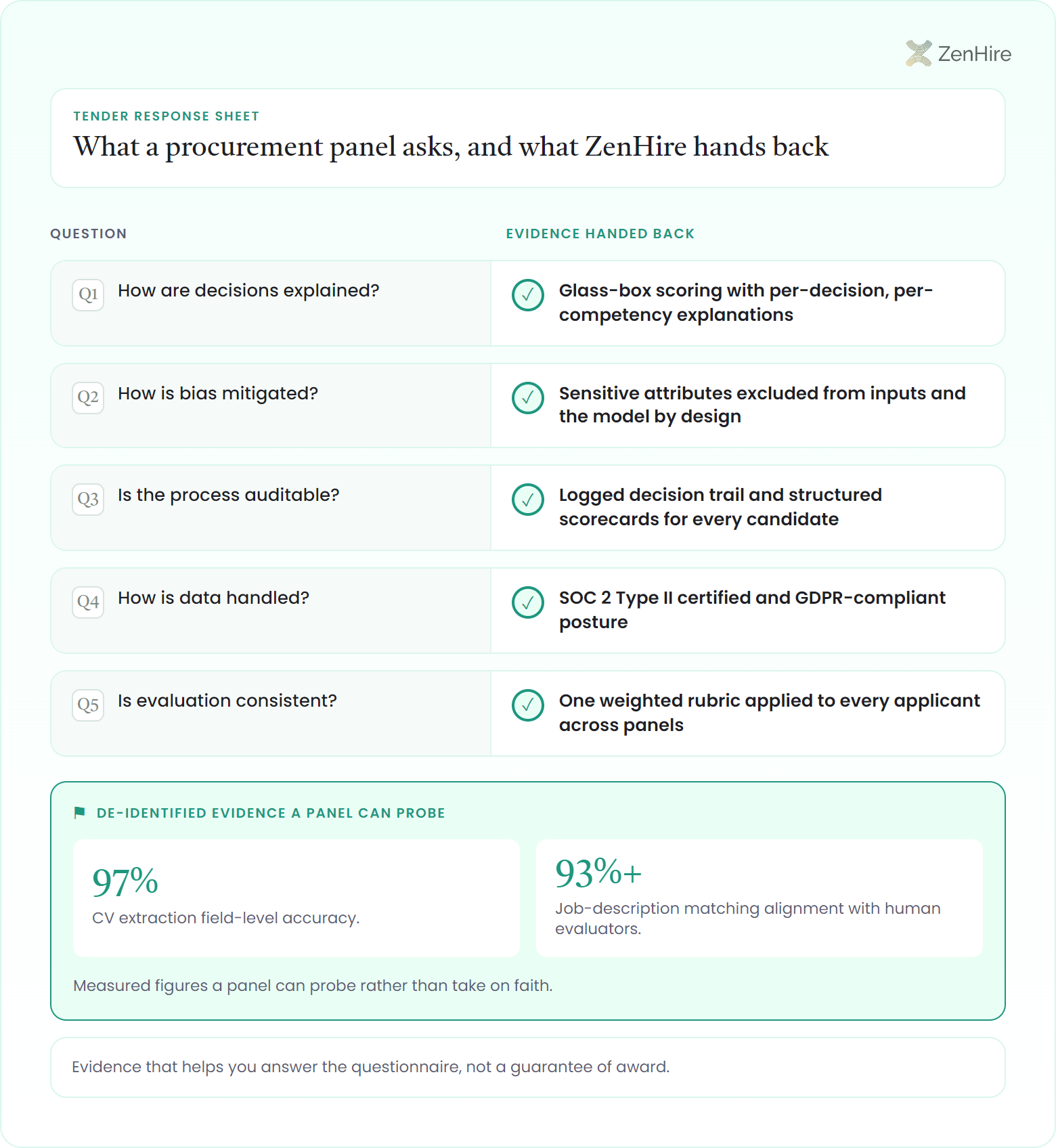
ZenHire is positioned for that review: glass-box, deterministic scoring with per-decision explanations, sensitive attributes excluded by architecture, plus SOC 2 Type II and GDPR posture for the data-protection questions a tender will ask. It also reads cleanly to a panel that has done its homework on what an AI-native recruitment system is and how it differs from a black-box screener. One concrete example: when a procurement questionnaire asks how the system avoids discriminatory outcomes, you can point to attribute exclusion, audit logs, and explainable scorecards rather than a marketing claim. The edge case is that procurement criteria vary by authority and country, so treat ZenHire as evidence that helps you answer the questionnaire, not a guarantee of award.
One de-identified data point worth keeping handy for a tender: ZenHire's CV extraction runs at 97% field-level accuracy and its job-description matching aligns 93%+ with human evaluators: the kind of measured, repeatable figures a procurement panel can probe rather than take on faith.
| Procurement question | What ZenHire provides |
|---|---|
| How are decisions explained? | Glass-box scoring with per-decision, per-competency explanations |
| How is bias mitigated? | Sensitive attributes excluded from inputs and the model by design |
| Is the process auditable? | Logged decision trail and structured scorecards for every candidate |
| How is data handled? | SOC 2 Type II certified and GDPR-compliant posture |
| Is evaluation consistent? | One weighted rubric applied to every applicant across panels |
This public sector recruitment software is built for fairness by design. Sensitive attributes such as race, gender, age, and ethnicity are excluded from the inputs and the model, scoring runs on job-relevant signals, and every decision is logged for review. The same structured approach supports diversity in hiring without setting quotas.
The explainable AI scoring uses a glass-box, deterministic approach rather than an opaque model. Each result comes with per-competency explanations from interview analysis and is stable across runs, so a hiring lead or auditor can trace why a candidate scored as they did.
This government hiring software supports audits and appeals because it keeps a logged decision trail and a structured scorecard for every candidate. You can reopen a result months later and show the exact criteria and weighting that produced it.
It is compliant AI hiring software in posture, with SOC 2 Type II certification and a GDPR-aligned, right-to-explanation design. It gives you the documentation a tender asks for, while your legal and HR teams confirm it meets the rules of your jurisdiction.
Explainable scoring keeps public sector hiring consistent by applying one weighted scorecard to every applicant. Panels and departments evaluate against the same documented rubric instead of relying on individual judgment that varies from reviewer to reviewer.
Free for Public sector AI hiring procurement
A one-page checklist for evaluating AI hiring software against a tender: the fairness, explainability, audit-trail, and data-protection questions every procurement panel should ask, and what a defensible answer looks like.


See how ZenHire scores candidates with explainable AI, excludes sensitive attributes, and logs every decision for review.