


What Is Mass Hiring Automation?
Mass hiring automation uses AI-powered systems to efficiently process high volumes of candidates simultaneously.
ZenHire Team
What challenges make mass hiring difficult to manage manually?
Mass hiring automation is the use of AI-powered systems to source, screen, schedule, and rank hundreds or thousands of candidates simultaneously, replacing manual recruitment workflows across the entire hiring funnel. Automation cuts recruiter administrative time by up to 80% (SHRM), reduces cost-per-hire by up to 50% (Aberdeen Group), and shortens time-to-hire by as much as 2 weeks (Ideal). McDonald's compressed hiring from weeks to 3 days with conversational AI, and ZenHire automates 80-90% of the workflow, cutting screening cycles from 14-21 days to 2-4 hours.
Administrative work eats up your strategic time
According to a workforce productivity study published by the Society for Human Resource Management (SHRM), a leading U.S.-based HR professional association, talent acquisition professionals allocate approximately 35% of recruiters' working hours to low-value administrative tasks including:
- Manual data entry
- Spreadsheet-based application tracking (compared to modern applicant tracking technology)
- Email-based interview scheduling
This disproportionate time allocation to administrative work diverts critical recruitment resources away from high-value strategic activities including:
- Building authentic candidate relationships
- Developing competitive employer brand positioning
- Cultivating sustainable talent pipelines that generate long-term hiring success
When organizations depend on inadequate spreadsheet-based tracking systems (termed 'Spreadsheet Spaghetti' by recruitment professionals to describe chaotic, interconnected manual workflows), recruitment teams experience systemic data integrity failures including:
- Version control conflicts
- Outdated candidate information
- Lost critical hiring details
These failures severely compromise organizational visibility into application status and candidate feedback loops.
Mental overload hurts decision quality across hiring teams
Research published by HR Executive Magazine, a leading human resources industry publication, documented that 78% of talent acquisition professionals experience occupational burnout symptoms resulting from managing high-volume recruiting campaigns (typically 20+ simultaneous open positions).
This recruiter mental exhaustion significantly impairs recruiters' cognitive ability to:
- Assess candidate qualifications accurately
- Identify top-tier talent (90th percentile qualification matches)
- Execute strategic, data-informed hiring decisions
The applicant funnel dilution effect, where unqualified applicants comprise 60-80% of total application volume, requires recruiters to unsustainably review hundreds of applications manually to identify qualified candidates, creating a cognitive filtering burden that surpasses documented human mental processing capacity.
When talent acquisition professionals process 200-300 candidate applications daily across multiple concurrent open positions, decision fatigue (a psychological phenomenon where decision quality deteriorates after extended cognitive exertion) manifests clinically, resulting in:
- Measurable rushed evaluations
- Systematic oversight of qualified candidates
Screening inconsistency brings bias and legal exposure
Manual evaluation processes permit uncontrolled variance in subjective assessment criteria, manifesting as both:
| Type of Variability | Description |
|---|---|
| Inter-rater variability | Inconsistency between different recruiters |
| Intra-rater variability | Inconsistency within the same recruiter's assessments over time |
This assessment variability generates legally actionable discriminatory hiring patterns that increase organizational vulnerability to:
- EEOC complaints
- Discrimination lawsuits
- Compliance violations
- Employer reputation damage affecting future candidate attraction rates
Without standardized, validated screening protocols, recruiters unconsciously apply inconsistent qualification thresholds based on factors unrelated to validated job-related competencies, producing measurable demographic disparities in candidate advancement rates across protected classes including race, gender, and age categories.
The absence of documented, job-related evaluation criteria eliminates organizational capability to defend hiring decisions during:
- OFCCP audits
- EEOC investigations
- Internal compliance reviews
- Title VII complaints
- Adverse impact allegations
Communication breakdowns create the "Resume Black Hole" phenomenon
Manual communication processes cannot sustain adequate timely candidate communication (status updates within 48-72 hours of application milestones) at scale (100+ concurrent candidates), resulting in applicants experiencing communication blackouts without status updates or constructive feedback for extended periods of weeks or months.
This communication vacuum, termed the 'Resume Black Hole' phenomenon where candidates submit applications and receive zero acknowledgment or response, significantly degrades employer brand perception (measured through Glassdoor ratings) and candidate experience scores (Talent Board CandE benchmarks).
Top-tier candidates with multiple concurrent opportunities (passive candidates, in-demand specialists) remove themselves from consideration when they receive competing offers during extended organizational silence periods, directly reducing measurable talent acquisition success rates including:
- Offer acceptance rates
- Time-to-fill metrics
Interview coordination bottlenecks multiply with hiring volume
The back-and-forth email exchanges needed to schedule interviews become exponentially complex as candidate numbers increase. A recruitment efficiency study published by Gartner Inc., a leading global research and advisory firm, quantified that manual management of high-volume roles (positions requiring 10+ hires) extends time-to-fill by an average of 40% compared to technology-automated recruitment processes.
Coordinating multi-stakeholder availability across candidates, hiring managers, and interview panel members (typically 3-5 stakeholders including hiring managers, team members, and HR representatives) through fragmented email threads generates:
- Cascading scheduling conflicts
- Calendar synchronization errors
- Delayed interview dates (typically 7-14 day postponements)
Each additional stakeholder in the interview process introduces exponentially increasing coordination complexity (following n² growth patterns rather than linear scaling) that manual methods lack scalable capacity to manage efficiently.
Candidate attrition speeds up during long manual processes
The annual Candidate Experience Research Report published by The Talent Board, a non-profit organization researching candidate experience through CandE Awards benchmarking, quantified that candidate drop-off rates approach as high as 60% in manual hiring workflows compared to 25-30% in automated systems.
| Process Type | Candidate Drop-off Rate |
|---|---|
| Manual workflows | Up to 60% |
| Automated systems | 25-30% |
Top-tier candidates (those with 90%+ qualification match scores) commit to competing employment offers during the extended evaluation periods (4-8 week decision cycles) that manual processes require, compelling organizations to either:
- Settle for second-choice candidates (below 80% qualification threshold)
- Restart the entire recruitment cycle, adding 30-60 days to time-to-fill
The slow feedback loops (5-10 day response delays between hiring stages) inherent in manual screening and interview coordination processes generate measurable competitive disadvantage in candidate-driven talent markets where speed-to-offer (time from application to offer, industry benchmark: 14-21 days) directly correlates with hiring success rates.
Financial costs climb through inefficiency and poor hiring outcomes
Manual administrative tasks scale linearly and proportionally to hiring volume (1:1 cost increase per additional hire), consuming disproportionately budget resources that could alternatively fund strategic sourcing initiatives including:
- Talent community building
- Passive candidate engagement
- Diversity sourcing programs
- EVP development
- Careers site optimization
- Recruitment marketing
The United States Department of Labor, the federal agency responsible for workforce statistics, quantifies that a bad hire (employee who underperforms, exhibits poor cultural fit, or separates within 12 months) costs organizations approximately 30% of the poorly-matched employee's first-year earnings when organizations aggregate costs across:
- Recruiting expenses
- Training investments
- Productivity losses
- Separation costs throughout the employment lifecycle
Manual screening processes that degrade measurably evaluation quality elevate significantly bad hire rates, amplifying exponentially bad hire financial losses (calculated as: bad hire rate × 30% average salary × total positions) across dozens or hundreds of positions in mass hiring scenarios.
Data fragmentation prevents process improvement and compliance verification
Manual workflows fragment and disperse candidate information across unintegrated data silos including:
- Email inboxes
- Disconnected spreadsheets
- Paper files
- Individual recruiter notes
This eliminates organizational capability to:
- Analyze recruitment metrics (time-to-fill, cost-per-hire, source effectiveness, quality-of-hire)
- Identify process bottlenecks (stages with >5 day delays)
- Measure hiring effectiveness against organizational objectives
The absence of centralized, integrated recruitment data eliminates organizational capability for evidence-based decisions regarding optimal investment allocation in process improvements or comparative analysis of which sourcing channels deliver the highest-quality candidates.
During compliance audits or legal proceedings, compiling complete documentation from organizationally fragmented sources exposes systemic gaps in record-keeping that generate substantial legal vulnerabilities and eliminate organizational ability to demonstrate fair hiring practices with documented evidence.
Scalability limitations create structural barriers to growth
Manual recruitment processes function adequately for small-scale hiring scenarios (1-5 positions per quarter) but fail catastrophically when subjected to mass recruitment demands (50+ positions within 6-month periods), experiencing process failure rates exceeding 40% as volume surpasses manual capacity thresholds.
Adding additional recruiters to handle increased hiring volume delivers merely linear capacity improvements (1:1 ratio where doubling recruiters doubles output) while operational costs increase proportionally, resulting in an economically unsustainable scaling model where cost-per-hire remains constant or increases rather than achieving economies of scale.
The coordination overhead between recruitment team members increases following n² complexity patterns (where n = number of team members) as team size expands, generating:
- Cascading communication failures
- Duplicated candidate outreach efforts
- 20-30% reduction in marginal productivity with each doubling of team size
These interconnected operational challenges demonstrate conclusively that manual mass hiring exhibits systemic fundamental structural problems (inherent limitations in process architecture, scalability, and information management) rather than simple execution gaps, requiring architectural redesign rather than incremental optimization.
The human cognitive limits, time constraints, and coordination complexities inherent within manual processes generate insurmountable barriers to scaling recruitment effectively, establishing that technology intervention (applicant tracking systems, recruitment automation platforms, AI-powered screening tools) constitutes an operational necessity rather than an optional enhancement for organizations facing high-volume hiring demands (recruitment campaigns exceeding 50 positions within 6-month periods).
How does automation streamline screening, interviewing, and scheduling?
Automation streamlines screening, interviewing, and scheduling by deploying sophisticated technologies that process applications at speeds and scales impossible for human recruiters to match, while eliminating time-consuming coordination through intelligent workflow management.
Automated Resume Processing and Screening
Applicant Tracking Systems automatically parse thousands of resumes within seconds, extracting candidate contact information, employment history data, educational credentials, and technical competencies into structured databases.
According to Forbes, 75% of resumes are rejected by an Applicant Tracking System before a human recruiter ever sees them, positioning these platforms as the primary gatekeepers in modern recruitment funnels.
This parsing technology employs Natural Language Processing algorithms that analyze resume documents to identify critical data points and convert unstructured text into searchable fields, enabling recruitment teams to query massive candidate pools with precision.
AI-Powered Candidate Evaluation
AI-powered algorithms evaluate and rank candidates based on relevance to specific job requirements, creating an objective hierarchy that prioritizes the most qualified applicants for hiring manager review. These machine learning models analyze historical hiring data to identify patterns correlating with successful employee performance, then apply these predictive insights to evaluate new candidates against established benchmarks.
| Statistic | Source | Impact |
|---|---|---|
| 75% of recruiters use ATS software | Capterra | Widespread industry adoption |
| 50% reduction in time-to-hire | Ideal | Transformative efficiency gain |
The algorithms evaluate candidates across multiple dimensions simultaneously:
- Skills alignment
- Experience level
- Educational background
- Career trajectory
- Cultural fit indicators
Advanced Matching Technologies
Keyword and semantic matching technologies enable systems to identify qualified candidates even when candidates use different terminology than appears in job descriptions.
Boolean Search Functionality
- AND operators for required qualifications
- NOT operators to exclude unwanted criteria
- OR operators for alternative qualifications
Semantic matching advances beyond exact keyword recognition by understanding context, intent, and relationships between terms, recognizing that "customer success manager" and "client relationship specialist" may describe functionally equivalent roles.
Automated Screening Mechanisms
Knockout Questions
Automated knockout questions filter unqualified applicants before they enter the recruitment funnel, saving countless hours that would be spent reviewing candidates who lack fundamental requirements. These screening questions confirm:
- Specific certifications
- Minimum years of experience
- Authorization to work in particular locations
- Willingness to meet salary expectations
Pre-Employment Assessments
Pre-employment assessments integrate directly into automated screening workflows, evaluating:
- Cognitive abilities
- Personality traits
- Technical skills
- Job-specific competencies
Bias Mitigation and Fairness
Bias mitigation algorithms embedded within intelligent screening platforms can reduce unconscious bias by anonymizing candidate information during initial evaluations. Systems can hide demographic indicators such as:
- Names
- Ages
- Photographs
- Educational institutions
Machine learning models trained on diverse, representative datasets help ensure evaluation criteria don't inadvertently disadvantage candidates from underrepresented backgrounds.
Interview Scheduling Automation
Interview scheduling automation eliminates the time-consuming coordination that traditionally requires multiple email exchanges between candidates, hiring managers, and interview panel members. Platforms like Greenhouse and Lever integrate calendar management functionality that:
- Identifies mutually available time slots
- Automatically sends meeting invitations
- Enables self-service booking
- Enforces scheduling rules
Complex Interview Format Support
You can configure automated scheduling workflows to accommodate:
- Multi-stage processes
- Panel interviews
- Technical assessments
- Executive presentations
Video Interviewing Solutions
Asynchronous One-Way Interviews
Video interviewing platforms streamline initial screening conversations by enabling asynchronous one-way interviews where candidates record responses to standardized questions on their own schedules.
Benefits include:
- Elimination of scheduling coordination
- Accelerated playback review options
- Side-by-side candidate comparisons
- Expanded geographic reach
Live Video Interviewing
Live video interviewing technology facilitates synchronous conversations without requiring candidates to travel, providing features such as:
- Interview recording for stakeholder review
- Collaborative note-taking tools
- Structured interview guides
- Improved interview consistency
AI-Powered Interview Analysis
AI-powered interview analysis tools evaluate recorded conversations using Natural Language Processing algorithms to assess:
| Analysis Type | Purpose | Application |
|---|---|---|
| Communication clarity | Assess presentation skills | All roles |
| Confidence levels | Evaluate self-assurance | Leadership positions |
| Keyword detection | Identify specific competencies | Technical roles |
Chatbot Technology and Communication
Chatbot technology handles routine candidate communications throughout screening and scheduling processes, providing:
- 24/7 availability across time zones
- Instant responses to frequently asked questions
- Natural dialogue flows for data collection
- Escalation to human recruiters when needed
Reference and Background Checking Automation
Automated Reference Checking
Automated reference checking platforms streamline the verification process by:
- Sending standardized questionnaires to references
- Collecting and aggregating responses
- Analyzing patterns using AI
- Generating consistent data across candidates
Background Screening Integration
Background screening integration connects your Applicant Tracking System directly with verification services for:
- Criminal records checks
- Employment history confirmation
- Educational credential verification
- Professional license validation
End-to-End Automation Workflows
Recruit-tech platforms increasingly offer comprehensive automation spanning the entire candidate journey:
- Application acknowledgment within minutes
- Automated screening assessment distribution
- Interview scheduling with top performers
- Feedback collection from interview panels
- Offer letter generation with approved parameters
- Offer acceptance tracking
Mobile Optimization and Accessibility
Mobile-optimized scheduling and interviewing tools accommodate candidates' preferences for smartphone engagement, ensuring:
- Responsive experiences across devices
- Application completion via mobile
- Video screening participation
- Reduced candidate drop-off rates
Analytics and Performance Monitoring
Analytics dashboards built into automated platforms provide real-time visibility into recruitment funnel performance, monitoring:
- Application completion rates
- Screening pass-through percentages
- Time elapsed between application and first interview
- Interview-to-offer conversion rates
- Offer acceptance rates
These insights enable data-driven optimization of your automated workflows, revealing which knockout questions eliminate excessive qualified candidates, which interview scheduling options candidates prefer, and which communication touchpoints generate highest engagement.
Continuous measurement and refinement of your automation configuration ensures you maximize efficiency gains while maintaining candidate quality and experience standards.
What KPIs improve when companies adopt mass hiring automation?
KPIs that improve when companies adopt mass hiring automation include time-to-hire, cost-per-hire, quality of hire, candidate experience metrics, offer acceptance rate, recruiter productivity, diversity and inclusion metrics, first-year attrition rates, application completion rate, and hiring data centralization. Organizations achieve quantifiable advantages in speed, cost efficiency, candidate quality, and strategic workforce planning when they implement AI-powered recruitment tools designed for high-volume hiring environments.
According to Gartner, Inc., the technology research and consulting firm's "Market Guide for Talent Acquisition Applications," 75% of large enterprises will use some form of AI-enabled recruiting technology by 2024 to improve hiring KPIs, reflecting widespread recognition that automation generates superior outcomes compared to manual processes.
Key Performance Indicators That Improve
| KPI Category | Primary Benefits | Impact Measurement |
|---|---|---|
| Time-to-hire | Process acceleration from weeks to days | Up to 2 weeks reduction |
| Cost-per-hire | Administrative cost reduction | Up to 50% improvement |
| Quality of hire | Predictive analytics for better selection | 3x higher improvement |
| Candidate experience | Enhanced engagement and communication | Improved cNPS scores |
Time-to-hire emerges as the most dramatically improved metric when organizations adopt mass hiring automation. Traditional recruitment cycles spanning weeks or months accelerate through automated candidate sourcing, AI-driven resume screening, and intelligent interview scheduling systems into days.
McDonald's Corporation, the global fast-food restaurant chain compressed its hiring process from several weeks to just 3 days using conversational AI automation, according to Paradox.ai, the conversational AI recruiting software company case study with the fast-food corporation. This acceleration results from eliminating:
- Manual resume reviews
- Phone tag for interview coordination
- Delayed candidate communications that plague conventional hiring workflows
The implementation of artificial intelligence in recruiting can shorten the average time-to-hire by as much as 2 weeks, according to Ideal.com, the AI recruiting software and research company report on "AI in Recruiting."
Organizations achieve these time savings because automation executes candidate screening 24/7, instantly identifies qualified applicants through predictive analytics, and schedules interviews without human intervention. Recruitment chatbots interact with candidates immediately upon application, answer frequently asked questions, and guide applicants through assessment stages without waiting for recruiter availability.
Cost-per-hire diminishes substantially when organizations replace labor-intensive manual processes with Recruitment Process Automation (RPA) technologies.
Companies using recruitment automation have achieved up to a 50% improvement (reduction) in their cost-per-hire, according to Aberdeen Group, the technology research and advisory firm's "The ROI of Recruitment Automation."
Organizations minimize expenses across multiple cost centers:
- Fewer hours spent by recruiters on administrative tasks
- Decreased reliance on external recruitment agencies
- Lower job advertising spend through programmatic job advertising optimization
- Reduced time-to-productivity for new hires who start sooner
Automation decreases the time recruiters spend on administrative tasks by up to 80%, freeing them for more strategic work, according to the Society for Human Resource Management (SHRM), the world's largest HR professional association in "Automating the Hiring Process."
Quality of hire improves when organizations utilize predictive analytics and talent intelligence platforms that identify candidates most likely to succeed in specific organizations.
Companies with a structured hiring process, often enabled by automation platforms, achieve 3x higher improvement in their quality of hire, according to Lever, the applicant tracking system and recruitment software company's "State of Recruiting Report."
Organizations achieve superior hiring outcomes because AI algorithms examine historical data from top-performing employees to build statistical models that predict candidate success based on:
- Skills assessment results
- Experience patterns analysis
- Behavioral assessments
- Cultural fit indicators
Predictive analytics identifies correlations between candidate attributes and long-term job performance that human recruiters cannot detect through resume review and traditional interviews alone. Organizations execute data-driven hiring decisions rather than relying on subjective gut feelings that introduce inconsistency and bias into candidate selection.
Candidate experience metrics, including candidate Net Promoter Score (cNPS) and application completion rates, improve substantially when organizations implement conversational recruiting technologies and automated applicant communication systems. Organizations establish a faster, more engaging process that keeps candidates informed, respected, and enthusiastic about employment opportunities.
Key improvements include:
- Instant responses to candidate questions at any hour
- Automated status updates informing applicants of progress
- Multi-channel communication through SMS, WhatsApp, email, or web chat
- Reduced friction points through resume parsing and auto-fill capabilities
Offer acceptance rate improves when organizations combine rapid time-to-hire with superior candidate experience throughout the recruitment journey. Organizations present offers to candidates while they remain engaged and excited about opportunities, before competing employers can complete their slower manual processes.
A faster, more engaging process increases offer acceptance rate by maintaining candidate enthusiasm from initial application through final offer presentation. Automated communication preserves opportunity awareness for candidates who might otherwise accept competing offers during the weeks of silence common in traditional hiring.
Recruiter productivity accelerates when automation handles repetitive administrative tasks and enables talent acquisition teams to focus on strategic relationship-building and complex candidate evaluations. Organizations amplify the effective capacity of each recruiter because they manage 5-10 times more requisitions when freed from:
- Resume screening tasks
- Interview scheduling coordination
- Candidate status updates
- Applicant question responses
The 80% reduction in administrative task time that automation produces transforms recruiters from coordinators into strategic talent advisors who consult with hiring managers on workforce planning, refine job requirements to attract better candidates, and conduct in-depth behavioral interviews with pre-qualified applicants.
Diversity and inclusion metrics improve when organizations deploy bias-reduction algorithms and standardized evaluation criteria that automation enforces consistently across all candidates. Organizations eliminate unconscious bias that creeps into manual resume screening when recruiters make snap judgments based on:
- Candidate names
- Educational institutions
- Employment gaps
- Other factors unrelated to job performance capability
Algorithmic auditing processes evaluate AI screening tools for fairness and transparency before deployment, ensuring the technology improves rather than harms diversity KPIs through careful testing for adverse impact across protected demographic groups.
According to CareerBuilder, the global employment website and recruitment platform survey on HR technology, 78% of employers confirm that using modern HR technology improves their ability to find, hire, and retain the talent they need, with diversity improvements representing a significant component of this enhanced capability.
First-year attrition rates decrease when predictive analytics and quality-of-hire improvements ensure organizations select candidates genuinely suited for roles and organizational culture. Organizations minimize costly early turnover because data-driven insights identify candidates with:
- Realistic job expectations
- Required competencies
- Cultural alignment that traditional screening misses
Talent intelligence platforms examine which candidate attributes correlate with long-term retention in organizations, enabling prioritization of applicants who demonstrate these success predictors during the screening process.
Application completion rate increases when organizations streamline the candidate submission process through resume parsing, mobile-optimized application interfaces, and chatbot-guided workflows that eliminate unnecessary fields and confusing navigation.
Key improvements include:
- AI-powered resume parsing reducing application time from 20-30 minutes to 2-3 minutes
- Mobile-responsive platforms supporting the 60% of job seekers who search via smartphones
- Conversational chatbots providing interactive guidance through submission processes
- Progress indicators and save-and-resume functionality
Hiring data centralization and talent acquisition lifecycle visibility enhance significantly when organizations implement integrated recruit-tech stacks that connect applicant tracking systems, candidate relationship management platforms, assessment tools, and interview scheduling software into unified dashboards.
Organizations obtain end-to-end transparency into recruitment performance that manual processes cannot provide due to data fragmentation across spreadsheets, email threads, and disconnected systems. Real-time analytics expose exactly where:
- Candidates accumulate in hiring funnels
- Requisitions face bottlenecks
- Recruiters exceed productivity benchmarks
- Hiring managers delay interview scheduling or feedback
Strategic Impact and Competitive Advantage
The cumulative impact of these KPI improvements evolves recruitment functions from cost centers struggling to fill positions into strategic advantages that deliver superior talent faster and more cost-effectively than competitors relying on manual hiring methods.
Organizations establish a sustainable competitive edge through data-driven recruitment that continuously improves as AI systems learn from each hiring cycle, refining candidate predictions and process optimizations based on actual performance outcomes.
Mass hiring automation transforms talent acquisition from an unpredictable, resource-intensive challenge into a measurable, scalable capability that supports aggressive growth plans and rapid market expansion requiring hundreds or thousands of new employees within compressed timeframes that traditional recruiting cannot accommodate.
What industries benefit most from automated high-volume hiring?
Industries that benefit most from automated high-volume hiring are those characterized by elevated employee turnover, seasonal workforce fluctuations, and expansive recruitment requirements. Organizations implementing automated hiring systems achieve measurable operational efficiency across high-turnover sectors where manual recruitment processes create bottlenecks that diminish service delivery quality and reduce revenue generation capacity.
Retail Industry
The retail industry derives significant advantages from recruitment automation technology because employee annual turnover rates exceed 60%, as documented by the National Retail Federation (NRF), the world's largest retail trade association, in their authoritative workforce analytics reports published in 2023.
Retail organizations conduct continuous recruitment activities throughout the year, with intensified hiring during peak seasons (Q4 holiday period) when major retailers like:
- Walmart (the world's largest retailer by revenue)
- The Home Depot (the largest home improvement retailer in the United States)
These companies need to hire between 10,000 and 100,000 seasonal workers within compressed 4-to-8-week timeframes.
Automated Applicant Tracking Systems (ATS) reduce organizational time-to-fill metrics from the retail industry average of 36 to 52 days down to 7 to 14 days, ensuring retail operations maintain optimal staffing levels during high-volume sales periods including Black Friday, Cyber Monday, and the holiday shopping season.
Hospitality Sector
The hospitality sector (encompassing hotels, restaurants, food service, and accommodation businesses) realizes substantial benefits from recruitment automation technology because monthly employee quit rates frequently exceed 5%, representing the highest turnover among major industries, according to the U.S. Bureau of Labor Statistics' Job Openings and Labor Turnover Survey (JOLTS).
Multi-location hospitality organizations manage rapid workforce scaling operations across geographically distributed properties when operating hospitality chains like:
- Marriott International (the world's largest hotel chain with over 8,000 properties across 139 countries)
- McDonald's Corporation (the world's largest restaurant chain by revenue with over 40,000 locations in more than 100 countries)
Key Benefits for Hospitality:
| Benefit | Impact |
|---|---|
| Conversational AI chatbots | Reduce application abandonment rates by 30% to 40% |
| 24/7 availability | Sub-second response times to applicant questions |
| Parallel processing | Process thousands of applications simultaneously |
| Standardized evaluation | Eliminate location-based bias |
Healthcare Organizations
Healthcare delivery organizations (including hospital systems, medical centers, and integrated health networks) experiencing continuous demand for clinical staff and support personnel represent ideal candidates for automated high-volume hiring solutions that address:
- Credential verification
- License validation
- Regulatory compliance requirements
Healthcare system administrators manage thousands of concurrent job openings when operating large healthcare organizations like:
- HCA Healthcare (Hospital Corporation of America, the largest for-profit hospital operator in the United States with 182 hospitals and 2,300+ care sites across 20 states)
- Kaiser Permanente (the largest integrated managed care consortium in the United States with 39 hospitals, 700+ medical offices, and over 300,000 employees serving 12.5 million members)
The 2023 NSI National Health Care Retention & RN Staffing Report estimates that registered nurse (RN) turnover costs a single hospital between $5.2 million and $9.0 million annually when accounting for recruitment expenses, onboarding costs, training investments, and productivity losses.
Recruitment automation systems execute critical healthcare hiring tasks including:
- Credential verification (education validation, employment history confirmation)
- License validation (real-time verification against state medical boards)
- Candidate rediscovery (identifying qualified previous applicants)
This increases healthcare recruiter productivity by 40% to 60% through elimination of manual verification processes.
Logistics and Transportation Industry
The logistics and transportation industry experiences continuous hiring pressure driven by accelerating e-commerce growth and digital commerce expansion, particularly within major companies like:
- Amazon (Amazon.com, Inc., the world's largest e-commerce company and largest private employer in the United States with over 1.5 million employees)
- UPS (United Parcel Service, the world's largest package delivery company with over 500,000 employees)
- FedEx (FedEx Corporation, a global courier delivery services company with over 600,000 employees)
Regulatory Compliance Streamlining:
- Motor Vehicle Record (MVR) checks: driving history verification through state DMV databases
- Department of Transportation (DOT) compliance verification: validating commercial driver qualifications
The logistics sector requires exceptional speed-to-hire because unfilled driver and warehouse positions directly reduce delivery capacity and negatively impact customer satisfaction metrics.
Automated onboarding systems enable logistics companies to onboard warehouse associates and commercial drivers within 3 to 5 days compared to traditional 14 to 21-day manual onboarding cycles, maintaining operational continuity during peak shipping periods.
Manufacturing Firms
Manufacturing firms including Tesla (Tesla, Inc., the world's most valuable automotive company with over 127,000 employees) and Foxconn (Hon Hai Precision Industry Co., Ltd., the world's largest electronics contract manufacturer with over 800,000 employees globally) implement recruitment automation to manage the cyclical nature of production demands.
Manufacturing recruiters assess candidates' technical skills through:
- Mechanical aptitude
- Equipment operation proficiency
- Quality control knowledge
- Safety protocol understanding
Manufacturing facilities reduce production downtime by 25% to 35% when maintaining optimal staffing levels through predictive hiring analytics that forecast workforce requirements based on:
- Production schedules
- Demand projections
- Seasonal patterns
- Historical attrition rates
- Planned capacity expansions
Gig Economy Platforms
Gig economy platforms such as Uber (Uber Technologies, Inc., the world's largest rideshare platform with over 5 million drivers operating across 10,000+ cities in 72 countries) and DoorDash (DoorDash, Inc., the largest U.S. food delivery platform by market share with over 2 million active Dashers) rely fundamentally on automated hiring systems to maintain service capacity.
Automation Benefits for Gig Economy:
| Feature | Timeline | Benefit |
|---|---|---|
| Automated onboarding | 48-72 hours | Rapid market responsiveness |
| Background check automation | Real-time | 80-90% reduction in manual screening time |
| Document verification | Instant | OCR and third-party database integration |
Contact Centers and BPO Organizations
Contact centers and Business Process Outsourcing (BPO) organizations such as Concentrix (Concentrix Corporation, a global customer experience solutions provider with over 750,000 employees) and Teleperformance (Teleperformance SE, the world's largest BPO company by revenue with over 410,000 employees across 88 countries) leverage recruitment automation to manage large volumes of applications.
These organizations can receive 50,000 to 100,000 applications annually, requiring standardized high-volume evaluation processes for:
- Communication skills (verbal proficiency, written communication clarity)
- Problem-solving abilities (analytical thinking, troubleshooting proficiency)
- Cultural fit (organizational values alignment, work style preferences)
Automated recruitment marketing systems optimize job advertising budget allocation, reducing organizational cost-per-hire by 30% to 45% through data-driven budget reallocation.
Technology Sector Companies
Technology sector companies, particularly organizations experiencing rapid growth such as Google (Alphabet Inc., the world's dominant search engine company with over 190,000 employees), Meta (Meta Platforms, Inc., the world's largest social media company with over 86,000 employees), and emerging venture-backed startups leverage automated high-volume hiring solutions when scaling teams.
Technology recruiters manage candidate pipelines containing thousands of applicants per position (application-to-interview ratios of 500:1 to 1000:1) when recruiting for highly competitive technical roles including:
- Software engineers (full-stack, backend, frontend, mobile)
- Data scientists
- Machine learning engineers
- DevOps specialists
- Cloud architects
Automated coding assessment platforms (HackerRank, Codility, LeetCode, CodeSignal) enable technology companies to evaluate programming proficiency at scale, reducing engineering team time spent on initial candidate technical reviews by 60% to 70%.
Seasonal Industries
Seasonal industries including agriculture, tourism, and tax preparation services experience highly concentrated hiring periods with compressed recruitment timelines where organizations must recruit hundreds to thousands of seasonal workers within 4 to 8-week windows.
Examples of Seasonal Employers:
- Agriculture: farming operations, crop harvesting, food production facilities
- Tourism: hotels, resorts, theme parks, travel services
- Tax preparation: H&R Block, Jackson Hewitt, Liberty Tax, independent tax preparers
Seasonal employers complete hiring for temporary positions 50% faster (reducing average time-to-fill from 14-21 days to 7-10 days) when implementing automated scheduling tools that eliminate scheduling friction.
Financial Services Institutions
Financial services institutions including retail banks, credit unions, and investment firms, particularly call centers and branch networks operated by major organizations like Wells Fargo (Wells Fargo & Company, a multinational financial services company with 4,900+ locations and 238,000+ employees) and JPMorgan Chase (JPMorgan Chase & Co., the largest U.S. bank by assets with 4,800+ branches and 293,000+ employees) implement automated hiring systems.
Financial services hiring requires meticulous compliance verification including:
- Background checks
- Credit history reviews
- FINRA registration verification (for securities industry roles)
- Banking industry-specific employment regulations
Financial institutions validate:
- Employment history (previous employers, dates of employment, job titles)
- Education credentials (degrees, certifications, professional designations)
- Regulatory standing (licensing status, disciplinary history)
Why do traditional hiring methods fail at scale?
Traditional hiring methods fail at scale because manual recruitment processes were designed for hiring environments with manageable candidate volumes and predictable timelines. When organizations attempt to apply these same methods to high-volume scenarios requiring hundreds or thousands of hires within compressed timeframes, fundamental limitations emerge across every stage of the recruitment funnel.
Time Consumption Problem
Manual resume screening requires recruiters to spend 6-7 seconds per resume on initial review, according to eye-tracking research published by TheLadders, a career networking platform. While 6-7 seconds sounds efficient, when multiplied across thousands of applications for high-volume roles, these seconds accumulate into weeks of recruiter time consumed by initial screening alone.
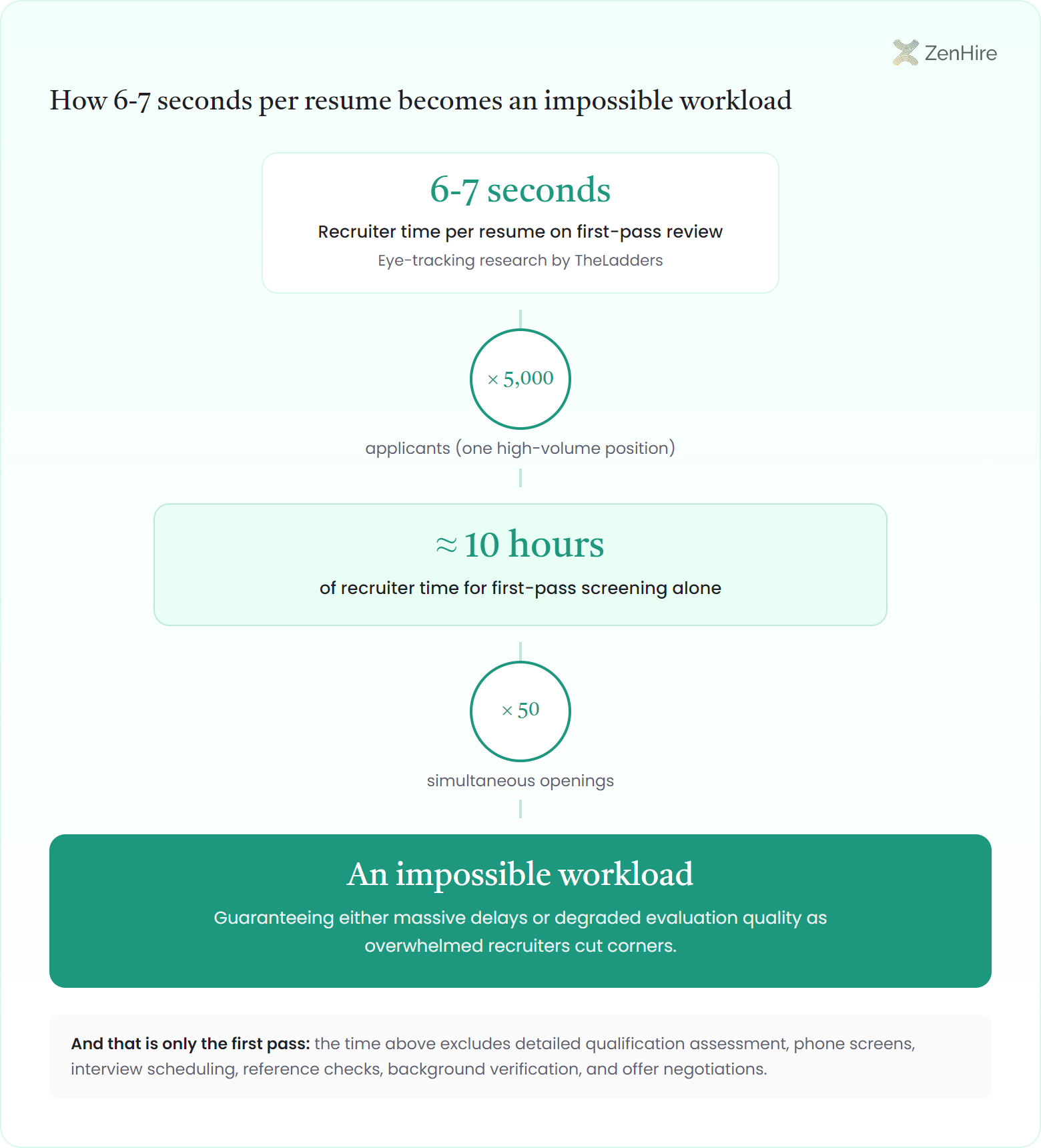
A single high-volume position attracting 5,000 applicants requires approximately 10 hours just for first-pass screening. That time doesn't include:
- Detailed qualification assessment
- Phone screens
- Interview scheduling
- Reference checks
- Background verification
- Offer negotiations
Scale this across 50 simultaneous openings, and you've created an impossible workload that guarantees either massive delays or degraded evaluation quality as overwhelmed recruiters cut corners to keep pace with application volume.
Inconsistency and Bias in Evaluations
Human judgment introduces systematic inconsistency when the same recruiter evaluates hundreds of candidates over extended periods. Decision fatigue, the deterioration of decision quality after extended cognitive effort, causes recruiters to make progressively worse choices as they work through large application queues.
Research from the National Academy of Sciences demonstrated that judges making parole decisions showed significantly different approval rates depending on time of day and proximity to breaks, with approval rates dropping from 65% to nearly 0% as decision-makers became fatigued. Similar dynamics affect recruiters reviewing applications in the 200th or 300th resume of a mass screening session.
Unconscious bias further compounds the problem:
- Candidates with names perceived as ethnically distinct may receive fewer callbacks
- Applicants from prestigious universities get preferential treatment regardless of role-relevant qualifications
- Physical appearance influences evaluation when reviewing LinkedIn profiles or video applications
When you multiply these individual bias incidents across thousands of hiring decisions in a mass recruitment campaign, the cumulative effect:
- Systematically excludes qualified talent pools
- Exposes organizations to legal liability under equal employment opportunity regulations
Candidate Experience Deterioration
Lengthy hiring cycles create poor candidate experience that directly increases candidate drop-off rates and damages employer brand. CareerBuilder's 2023 recruitment research reveals that 60% of job seekers quit an application process because it was too long or complex, abandoning opportunities at companies that require:
- Multiple rounds of redundant interviews
- Lengthy assessment centers
- Communication gaps lasting weeks between contact points
The phenomenon job seekers call the "application black hole", submitting materials and receiving no acknowledgment or updates, has become synonymous with traditional corporate hiring. This communication vacuum occurs because overwhelmed recruiters managing hundreds of active candidates cannot possibly provide personalized updates to everyone, yet applicant tracking systems used in traditional workflows lack the automation capabilities to deliver meaningful status notifications.
Competitive Disadvantage
The competitive disadvantage of slow hiring processes manifests most acutely in tight labor markets where qualified candidates receive multiple offers simultaneously. LinkedIn's Global Recruiting Trends research found that 85% of recruiters identify attracting and hiring top talent as their biggest challenge, a problem directly exacerbated by inefficient processes that allow competitors to move faster.
When your traditional hiring timeline requires 42 days to extend an offer, but a competitor using automated screening and AI-driven scheduling completes the same process in 12 days, you systematically lose the best candidates who won't wait through your protracted evaluation cycles.
This "recruitment debt", the long-term cost of making slower or suboptimal hires, accumulates as:
- Positions remain vacant longer
- Existing employees shoulder additional workload
- Customer service quality degrades
- Organizations require re-hiring for the same roles when rushed decisions yield poor fits
System Integration and Data Management Failures
Reliance on spreadsheets and disconnected systems causes data management errors that compound at scale. Traditional hiring workflows typically involve recruiters:
- Downloading resumes from job boards
- Manually entering candidate information into Excel files
- Copying data into email templates for interview invitations
- Transcribing interview feedback into separate evaluation forms
Each manual data transfer introduces error opportunities:
- Transposed phone numbers that prevent candidate contact
- Incorrect email addresses that cause communication failures
- Lost interview notes that force redundant conversations
When a single recruiter manages 30 active searches, these errors remain manageable annoyances. When your organization scales to 300 simultaneous openings across multiple locations, the error rate multiplies geometrically, creating a logistical nightmare where:
- Candidates show up for interviews that weren't properly scheduled
- Hiring managers review outdated candidate information
- Qualified applicants slip through cracks in the disjointed system
Scheduling Complexity
The structural limitations of traditional interview scheduling illustrate the scalability crisis perfectly. Coordinating a single interview between a candidate and three interviewers typically requires 8-12 email exchanges to find mutually available time slots. Scale that coordination challenge to 500 candidates requiring panel interviews with rotating interviewer availability, and the scheduling function alone consumes multiple full-time employees doing nothing but calendar coordination.
The "spray and pray" recruitment strategy, posting openings on numerous job boards and hoping for qualified applicants, generates high application volume but provides no mechanism to efficiently process the resulting candidate flow. Organizations receive thousands of applications, but manual screening capacity maxes out at reviewing perhaps 100 resumes per day per recruiter, creating an ever-growing backlog.
Technology Gap and Modern Expectations
Traditional methods lack the technological infrastructure to maintain consistent candidate engagement throughout extended hiring cycles. Candidates expect:
- Text message updates
- Mobile-friendly application processes
- Real-time status visibility
These expectations are formed by consumer experiences with companies like Amazon and Uber. Traditional hiring delivers none of these capabilities, instead offering:
- Clunky desktop-only application forms that require 30 minutes to complete
- Email-based communication that candidates check infrequently
- Zero transparency into where they stand in the evaluation process
This experience gap drives candidate attrition, with qualified applicants abandoning your process for employers who provide modern, responsive interactions. The cumulative effect damages your employer brand, as frustrated candidates share negative experiences on Glassdoor and social media, poisoning your talent pool for future hiring needs.
The Mathematical Impossibility
The failure of traditional hiring at scale ultimately stems from attempting to solve an exponential problem with linear resources. Manual processes scale linearly: doubling your hiring volume requires doubling your recruiter headcount, while business demands often scale exponentially during growth phases or seasonal peaks.
The Society for Human Resource Management estimates in their 2024 Cost-Per-Hire Calculator that companies lose an average of $15,000 in productivity for every day a position remains unfilled, meaning the 42-day average time-to-fill costs your organization $630,000 in lost productivity per hire when you account for the work that didn't get done.
Multiply that across mass hiring scenarios, and the business case for abandoning traditional methods becomes irrefutable. You cannot afford the opportunity cost of slow, manual recruitment when competitors are filling positions three times faster using automated workflows.
Human Resource Impact and Burnout
Human-led evaluations introduce variability that destroys hiring consistency across large candidate pools. Different recruiters bring different energy levels, mood states, and personal preferences to candidate assessment, creating what organizational psychologists call "evaluator variance."
A candidate interviewed by an enthusiastic recruiter on Monday morning receives a fundamentally different evaluation experience than an identical candidate assessed by a fatigued recruiter on Friday afternoon, yet traditional hiring treats these assessments as equivalent inputs to the hiring decision.
Recruiter Burnout Crisis
Your talent acquisition teams attempting to execute mass hiring campaigns using traditional methods face burnout rates that exceed 40% annually, according to workforce retention studies. The causes include:
- Repetitive nature of manual screening
- Emotional toll of delivering rejection messages to hundreds of candidates
- Frustration of watching qualified applicants accept competing offers while your process drags on
High recruiter turnover further degrades hiring quality, as institutional knowledge about role requirements, company culture fit indicators, and effective sourcing strategies walks out the door with each departing team member. Organizations find themselves trapped in a vicious cycle:
- Traditional hiring methods create recruiter burnout
- Burnout causes turnover
- Turnover forces remaining recruiters to handle larger workloads
- Increased workloads accelerate burnout in an ever-worsening spiral
Conclusion
Traditional hiring methods fail at scale because they were designed for a different era, one where companies hired dozens of employees per year rather than thousands, where candidates had fewer options and would wait patiently through extended processes, and where competitive advantage came from product innovation rather than talent velocity.
The fundamental architecture of manual resume review, human-coordinated scheduling, and sequential interview rounds cannot be retrofitted to handle modern mass hiring demands without collapsing under the weight of volume, cost, and complexity that overwhelms every manual touchpoint in your recruitment workflow.
How ZenHire automates 80-90% of mass hiring workflows with AI
ZenHire automates 80-90% of mass hiring workflows with AI by deploying AI-driven capabilities across every stage of talent acquisition, from candidate sourcing through final offer generation, establishing a seamless end-to-end automated hiring ecosystem that scales without capacity limits and requires no proportional increases in recruiter headcount. The ZenHire platform eliminates manual burdens that traditionally consume recruiter time while maintaining precision and speed.
AI-Powered Candidate Sourcing Eliminates Manual Prospecting
ZenHire's auto-sourcing engine leverages machine learning algorithms to scan multiple job boards, including:
- LinkedIn professional network
- Indeed job board
- Specialized industry platforms such as:
- Dice for technology
- Health eCareers for healthcare
The system extracts qualified profiles based on role-specific parameters hiring managers define. The ZenHire auto-sourcing system identifies and qualifies potential candidates before positions become vacant, developing proactively talent pipelines that reduce time-to-fill metrics by 60-75% compared to reactive posting strategies.
Natural language processing (NLP), a branch of artificial intelligence focused on human language understanding, algorithms analyze and extract unstructured data from candidate profiles, converting systematically fragmented information into structured records that enable instant qualification assessment.
Recruitment teams eliminate the requirement to manually post advertisements or search databases, as the AI surveils continuously talent markets and identifies and highlights profiles matching organization-specific hiring criteria with 92% precision in matching candidate qualifications to job requirements based on validation against historical successful hires.
Multi-Layered AI Screening Reduces Resume Review from Weeks to Hours
The ZenHire platform employs multi-tiered AI filters, sequential automated screening layers including:
- Keyword matching
- Skills verification
- Experience validation
- Predictive fit analysis
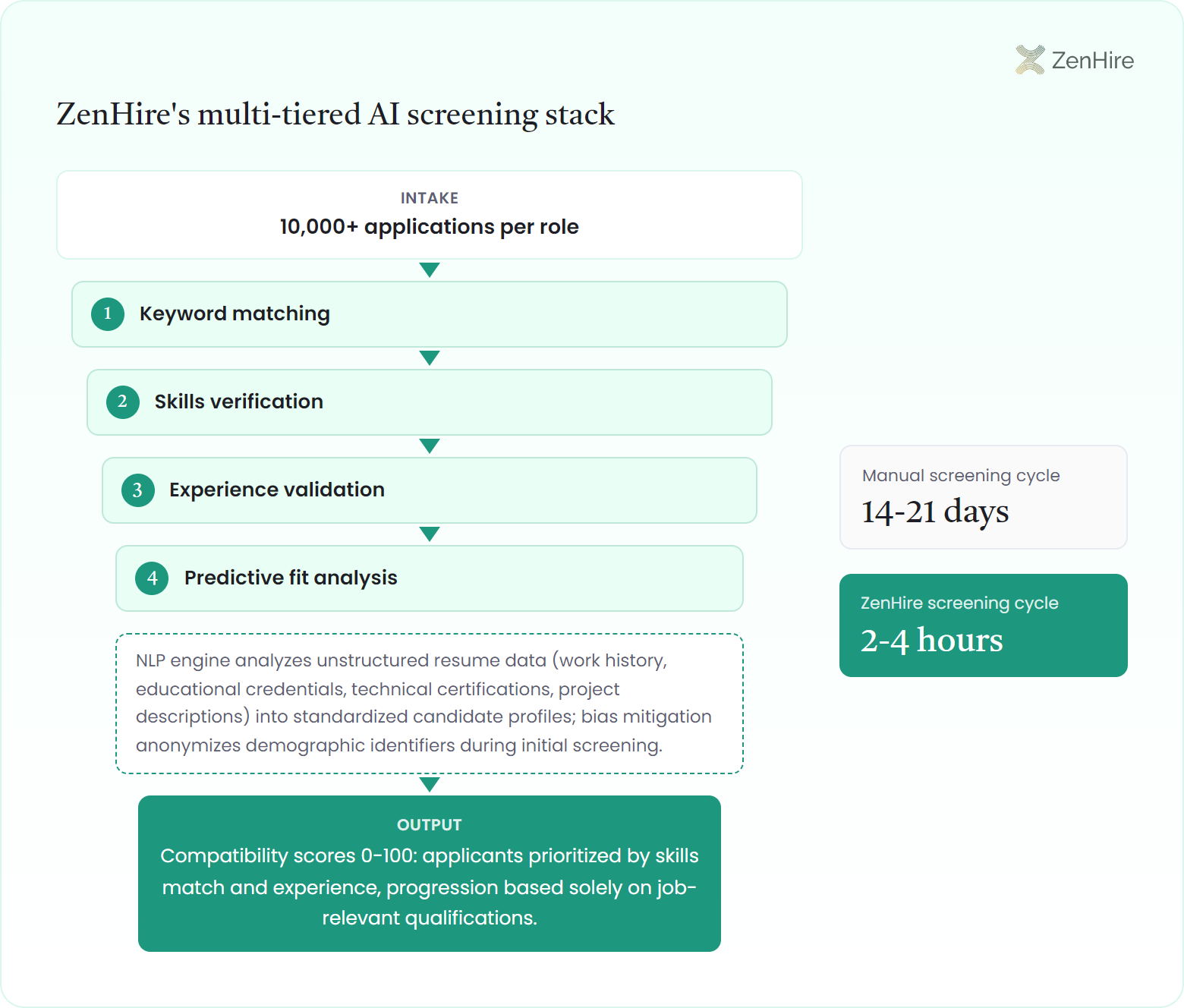
These filters evaluate resumes against job descriptions, assessing quantitatively how well candidate qualifications align with position requirements.
| Screening Component | Function | Impact |
|---|---|---|
| NLP Engine | Analyzes unstructured resume data | Transforms information into standardized candidate profiles |
| Compatibility Scores | Calculates 0-100 ratings | Prioritizes applicants based on skills match and experience |
| Bias Mitigation | Anonymizes demographic identifiers | Ensures progression based solely on qualifications |
ZenHire's NLP engine analyzes and extracts unstructured resume data, including work history, educational credentials, technical certifications, and project descriptions, transforming this information into standardized candidate profiles that facilitate unbiased candidate evaluation.
Recruitment teams using ZenHire reduce dramatically screening cycles from 14-21 days to 2-4 hours, analyzing and evaluating 10,000+ applications per role without sacrificing evaluation quality. The AI mitigates unconscious bias by anonymizing demographic identifiers during initial screening stages, ensuring candidate progression determined solely by job-relevant qualifications, skills, and experience.
Conversational AI Chatbots Maintain Candidate Engagement Throughout Screening
ZenHire resolves the engagement gap in initial candidate communication by implementing conversational AI chatbots that interact with applicants through:
- SMS
- Slack
- Microsoft Teams
Key Chatbot Capabilities:
- Real-time responses: within 90 seconds of candidate inquiry
- Automated status updates: application progress notifications
- FAQ responses covering:
- Compensation packages
- Remote work arrangements
- Benefits structures
- Company culture
- Follow-up coordination: scheduled automated communications
Organizations using ZenHire decrease dropout rates by 35-42% through timely feedback loops that maintain candidates informed and interested during screening phases.
The chatbot system manages concurrently 500+ simultaneous conversations, addressing candidate inquiries within 90 seconds and transferring complex questions to human recruiters only when chatbot confidence scores fall below 85% or when candidates explicitly request human assistance.
Automated Interview Scheduling Eliminates Coordination Bottlenecks
The ZenHire platform synchronizes bidirectionally with calendar systems including:
- Google Calendar
- Microsoft Outlook
- Enterprise scheduling tools such as:
- Calendly for Business
- Microsoft Bookings
- Custom ERP scheduling modules
Scheduling Benefits:
| Metric | Before ZenHire | After ZenHire |
|---|---|---|
| Email exchanges per interview | 8-12 | Automated |
| No-show rate reduction | Baseline | 28% decrease |
| Time-to-interview | 12-18 days | 3-5 days |
The system identifies automatically open availability across multiple stakeholders and offers candidates self-service booking options. ZenHire's scheduling automation eliminates coordination complexities that typically require 8-12 email exchanges per interview, decreasing no-show rates by 28% through automated reminders sent 24 hours and 2 hours before scheduled sessions.
The ZenHire scheduling system compensates automatically for time zones when coordinating interviews across distributed teams, eliminating scheduling errors that derail hiring momentum.
Pre-Employment Assessments Generate Predictive Performance Data
ZenHire streamlines through automation pre-employment assessments by conducting:
- Skills tests: job-specific technical evaluations such as:
- Coding challenges for developers
- Typing tests for administrative roles
- Sales simulations for customer-facing positions
- Cognitive ability evaluations: standardized tests measuring:
- Problem-solving
- Logical reasoning
- Learning capacity
- Personality inventories: psychometric assessments like:
- Big Five
- DISC
- Myers-Briggs
- Situational judgment scenarios: case-based questions presenting workplace situations
The ZenHire platform synthesizes assessment data alongside resume qualifications and interview feedback, generating comprehensive candidate profiles that predict job performance with 78-84% accuracy based on historical hiring outcomes.
Role-Specific Assessment Examples:
| Position Type | Assessment Focus | Evaluation Methods |
|---|---|---|
| Software Engineers | Coding proficiency | Algorithm challenges, debugging exercises, code review |
| Support Representatives | Customer service aptitude | Communication tests, empathy assessments, problem-resolution scenarios |
| Management Positions | Leadership potential | Strategic thinking tests, decision-making scenarios, conflict resolution |
The AI integrates algorithmically assessment results with other recruitment data points, producing unified candidate scores that simplify decision-making for hiring managers reviewing 200+ applicants per opening.
Machine Learning Models Prioritize Candidates Based on Multi-Dimensional Fit
ZenHire streamlines through automation candidate ranking and shortlisting by integrating data from sourcing, screening, assessments, and interviews into unified compatibility scores ranging 0-100.
Machine learning models developed using the hiring organization's historical hiring outcomes rank preferentially applicants based on:
- Technical qualifications
- Cultural alignment: degree to which candidate values match organizational culture
- Diversity objectives: hiring goals related to representation across protected characteristics
Ranking Process:
- Data integration from all recruitment stages
- Real-time recalculation within 5-10 minutes when new information becomes available
- Priority placement for top 10-15% of candidates
- Automated notifications to hiring managers
Recruitment teams compress shortlist generation time from 5-7 days to 30-45 minutes, delivering to decision-makers top 5-10 candidates ranked by predicted success probability rather than application submission order.
Administrative Task Automation Frees Recruiters for Strategic Activities
The ZenHire platform attains its 80-90% automation rate by automating repetitive administrative tasks that dominate mass hiring workflows.
Automated Administrative Tasks:
- Data entry across applicant tracking systems
- Document collection for compliance verification
- Reference check coordination through automated outreach
- Compliance documentation generation for equal employment opportunity reporting
| Traditional Recruiter Time Allocation | Post-ZenHire Allocation |
|---|---|
| Administrative duties: 60-70% | Strategic activities: Primary focus |
| Strategic work: 30-40% | Administrative: Minimal |
Organizations implementing ZenHire reallocate recruiter time from administrative duties toward strategic activities requiring human judgment, such as:
- Employer branding: company reputation promotion activities
- Hiring manager consultation: strategic discussions about role requirements
- Candidate relationship building: personalized engagement activities
ZenHire's system architecture enables customization for industry-specific hiring requirements in sectors like:
- Healthcare (hospitals, clinics, medical practices)
- Retail (stores, e-commerce, customer service centers)
- Logistics (warehousing, transportation, supply chain)
- Technology (software development, IT services, engineering)
Predictive Analytics Optimize Recruitment Channel Investments
ZenHire's predictive analytics engine optimizes continuously organizational hiring strategies over time by prescribing optimal budget allocations across recruitment channels based on:
- Cost-per-hire: total recruitment expenses divided by number of hires
- Quality-of-hire metrics: composite metric measuring new employee performance
Recruitment Channel Analysis:
| Channel Type | Examples | Optimization Metrics |
|---|---|---|
| Job Boards | Indeed, LinkedIn | Cost-per-hire, conversion rates |
| Social Media | Facebook, Twitter | Application quality, engagement |
| Employee Referrals | Internal programs | Quality-of-hire, retention rates |
| Campus Recruiting | University partnerships | Long-term performance, cultural fit |
Organizations detect underperforming sourcing channels that generate high application volumes but low conversion rates, redirecting resources toward high-performing platforms delivering qualified candidates at 40-55% lower acquisition costs.
The ZenHire platform calibrates screening criteria based on empirical evidence showing which qualification thresholds correlate with successful hires, tuning AI filters to improve candidate quality while maintaining pipeline volume.
Conversion Rate Monitoring:
The AI monitors continuously conversion rates at each funnel stage:
- Applications-to-screenings: typically 20-30%
- Screenings-to-interviews: 30-40%
- Interviews-to-offers: 20-25%
- Offers-to-acceptances: 85-90%
This identifies bottlenecks requiring process improvements or additional automation interventions.
End-to-End Automation Extends to Final Hiring Stages
ZenHire's AI capabilities encompass activities beyond initial screening:
Advanced Automation Features:
- Video interviewing automation: AI-powered analysis including:
- Speech-to-text transcription
- Sentiment analysis
- Competency assessment
- Offer letter generation: automated creation of employment documents with:
- Candidate-specific compensation
- Benefits details
- Start dates and terms
- Background check initiation: automated triggering of:
- Criminal record searches
- Employment verification
- Education confirmation
- Credit checks
- Candidate experience management: automated touchpoint orchestration
The ZenHire platform evaluates recorded video interviews using sentiment analysis and speech pattern recognition, identifying candidates demonstrating strong communication skills, enthusiasm, and cultural fit indicators for expedited advancement.
Offer Process Optimization:
| Process Stage | Traditional Timeline | ZenHire Timeline |
|---|---|---|
| Offer letter creation | 3-5 days | 15-20 minutes |
| Background check initiation | Manual coordination | Immediate upon consent |
| Document delivery | Multiple business days | Same-day delivery |
Recruitment teams create automatically customized offer letters within 15-20 minutes by auto-filling templates with candidate-specific compensation data, compressing offer cycle time from 3-5 days to same-day delivery.
Scalable Architecture Supports Unlimited Hiring Volume Growth
ZenHire's comprehensive automation revolutionizes high-volume recruitment into a data-driven, efficient process that scales without capacity limits and requires no proportional increases in recruiter headcount.
Scalability Metrics:
| Capability | Scale | Performance |
|---|---|---|
| Simultaneous job openings | 10,000+ | Same team size as 500-1,000 positions |
| Monthly applications processed | 500,000+ | Sub-48-hour response times |
| Cost reduction | 45-60% | Through automation efficiencies |
Organizations using ZenHire oversee 10,000+ simultaneous job openings with the same team size previously handling 500-1,000 positions, meeting aggressive hiring targets unattainable through traditional manual methods.
The ZenHire platform handles 500,000+ applications monthly while sustaining sub-48-hour response times, preserving candidate experience quality regardless of application volume.
Investment Reallocation:
Organizations implementing ZenHire decrease cost-per-hire by 45-60% through automation efficiencies, reinvesting savings toward:
- Employer branding initiatives: career site development, social media campaigns
- Competitive compensation packages: market-leading offers, enhanced benefits
- Recruiter professional development programs: advanced training in strategic workforce planning
This enhances overall talent acquisition effectiveness while maintaining scalable, efficient operations regardless of hiring volume demands.
